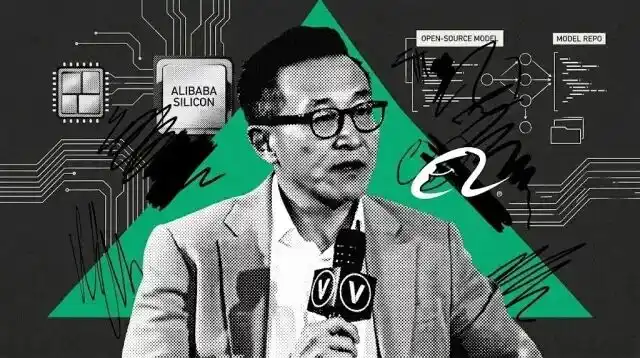
Alibaba Group Chairman Joe Tsai. Image processed via AI.
At this year's VivaTech conference, Alibaba Chairman Joe Tsai systematically outlined the company's long-term AI vision during a "fireside chat." This marks his second public reassessment of Alibaba following a summit at Yale University in late May.
"From a macro perspective, we are going all-in on AI. The logic is simple."
Tsai stated that global GDP exceeds $100 trillion, with at least half coming from human intelligence and productivity contributions. "This $50 trillion is the total addressable market for AI, far larger than any company's IT budget or the software market."
Everyone is talking about going all-in on AI, and Tsai is no exception. He summarized Alibaba's strategic approach as covering almost all layers except the energy layer, encompassing chips, cloud infrastructure, models, and applications.
"We are primarily investing in four layers, but we are not touching the bottommost energy layer because China's energy efficiency is high and costs are relatively low."
In Tsai's view, this near-full-stack strategy stems from future uncertainty, as no one can accurately predict where the ultimate value will settle—whether in chips, cloud infrastructure, or the model layer. "We choose to participate comprehensively, so no matter where the value ultimately lands, we are present."
Compared to Alibaba, U.S. cloud giants are even more aggressive, investing across the entire infrastructure stack, with a combined capital expenditure of $800 billion by 2027, which short-sellers have criticized as a "bubble." Tsai not only disagrees with the bubble theory but also emphasizes that Chinese companies need to increase their infrastructure investments.
"The investment numbers are indeed staggering," Tsai said. "But we need to go back to that $50 trillion total market. That's the reason for optimism."
Discussing open source, Tsai first mentioned the recent suspension of Anthropic's most advanced model by the Trump administration, bluntly stating this is the consequence of "putting all your eggs in one basket." In his view, models from Google, OpenAI, and Anthropic are now all closed-source, while the open-source path is currently being pursued by Chinese companies.
"You truly cannot base trust on the assumption that a third-party government will never act against your interests."
Below is an edited version of Joe Tsai's interview:
01. The $50 Trillion "Market"
Q: Alibaba has changed significantly over the years, with achievements like its open-source large model. But many still see you primarily as a B2B/B2C platform. Can you talk about the group's evolution?
Joe Tsai: When Alibaba started in 1999, it was indeed a B2B platform. The idea was simple: to bring small Chinese manufacturers and trading companies online, helping them wholesale products globally. Later, we entered the B2C space with Taobao, now China's largest consumer e-commerce platform.
Q: How many consumers does this serve?
Joe Tsai: 820 million Chinese consumers. Moreover, this platform helps European companies and brands sell approximately €30 billion worth of goods to Chinese consumers annually. But the story doesn't end there. We are heavily investing in AI and cloud.
We started investing in cloud technology 17 years ago, but out of necessity. Our e-commerce business was generating massive amounts of data daily. If we kept relying on others' database and storage technologies, eventually all our profits would go to the tech vendors. So we decided to build our own proprietary technology to manage this data, and that's how our cloud business began.
From a macro perspective, we are now going all-in on AI, and the logic is simple.
If you ask me how big the AI market is, I'd say it's far larger than any company's IT budget or the software market. Because AI is essentially about producing human intelligence and productivity. Global GDP today is over $100 trillion, with at least half ($50 trillion) related to human productivity and intelligence. That's the total AI market. So we must go all-in.
Q: Do you really believe AI can boost productivity? Many have invested heavily without seeing results yet.
Joe Tsai: Many CEOs will tell you that engineers are consuming a huge number of tokens, and costs are rising. But I'd say we are on the cusp of a real productivity explosion.
Take our company. Some engineers are super-users of AI. They not only use programming tools for their core work but also explore new uses. Give engineers a toy, and they'll find more ways to play with it, sometimes without realizing the company is paying for these usage costs. That's the current reality.
But I am deeply convinced—it's more like a belief, a conviction that artificially produced intelligence units can add value to human intelligence. It's close to a kind of faith. I don't want to try to convince you this will definitely happen, but we ourselves firmly believe it.
02. The Logic of Going All-In on AI
Q: Returning to Alibaba's layout, which AI layer do you invest the most in? Infrastructure, models, or cloud services?
Joe Tsai: We primarily invest in four layers, but we skip the bottommost energy layer because China's energy efficiency is high and costs are low.
We really started at the chip layer—that's the first layer. The second is the infrastructure layer, corresponding to our cloud business. The third is the model layer, like Qwen, which is now one of the world's hottest open-source models. The fourth is the application layer, where we have a complete digital life ecosystem—e-commerce, food delivery, local services, travel, maps, etc. These are all scenarios where AI capabilities can be directly embedded to serve users.
The advantage of this approach is that we are not betting on a single track.
Today, pure model companies have high valuations, making it seem like all the value is in the model layer. But looking five or ten years ahead, no one can say for sure whether the value will settle in chips, cloud infrastructure, models, or applications. We choose comprehensive participation so that, no matter where the value ultimately lands, we are there.
Q: Speaking of AI infrastructure, when you see such massive investments, do you think there's a bubble? Do we really need this much computing power? Some models are more efficient and don't require as many resources.
Joe Tsai: I don't think it's a bubble. The investment numbers are indeed staggering. Just looking at the U.S. hyperscale cloud providers, the combined capital expenditure of the top four or five companies next year exceeds $800 billion, potentially over a trillion the year after. Investments at this scale naturally raise concerns about overcapacity.
But we must return to that $50 trillion total market. That's the reason for optimism.
Moreover, in China, our investment in AI infrastructure and the supply chain is actually insufficient. Theoretically, all Chinese companies should increase their investments. Of course, we won't reach the investment level of the U.S. hyperscale players, but our investment intensity is already quite substantial.
Q: Why can't you reach U.S. levels?
Joe Tsai: Sometimes there are funding constraints, depending on how much free cash flow you can generate. Fortunately, Alibaba is one of the few companies with a core e-commerce business that generates about $25 billion in annual free cash flow, which can support our AI investments. So we are in a relatively good position.
Q: Currently, does the e-commerce platform business still account for 80% to 85% of Alibaba's total revenue?
Joe Tsai: Yes, e-commerce platform revenue still accounts for over 80%. This generates stable cash flow, allowing us to invest in the future, primarily in AI and cloud.
03. Open Source and the Second Basket
Q: Qwen is an open-source model. Who are your main customers, and how do you help them?
Joe Tsai: In recent weeks in Europe, I've spoken with many company executives, CEOs, and scientists. One word that came up most frequently was "sovereignty."
But what is sovereignty?
Ask ten Europeans, and you might get twelve different answers. For me, the core is two things.
First, technological independence. Everyone is worried about the risk of a "one-click shutdown," the fear of relying too heavily on technology from a single country that could flip a switch at any time. We just saw a vivid example of this in recent days.
Second is data privacy. People want to use AI technology but want their data to belong entirely to them, used within their own environment, with a firewall to protect it.
I believe open source addresses both these issues. It is essentially free software; you can download it to your own data center, even onto a laptop. At that point, it has little to do with the original manufacturer—we can't even figure out how to charge for it. That achieves independence.
More importantly, with an open-source model, you can use your own data for further training, fine-tuning, or post-training. The entire process and all data remain entirely confidential within your firewall. This point is crucial for European companies.
But I want to emphasize that open source is not a panacea or the only path, but it is a practical route to achieving a certain degree of sovereignty.
Interestingly, the open-source movement today is largely being driven by Chinese companies, while the major U.S. players have closed their models. They want you to call them via APIs; you have no idea where the data goes. When you converse with a chatbot, your most private questions and thoughts enter their data pool to further train the model. The data flow is completely opaque to you.
Q: Honestly, European sovereignty is a huge concern right now. We've just realized we were too dependent on U.S. technology. I acknowledge the benefits of open source, but I still worry about the risk of future access being cut off to models. That's a significant risk for Europe.
Joe Tsai: You're right; that concern cannot be completely eliminated. Simply put, you truly cannot base trust on the assumption that a third-party government will never act against your interests. But the problem is, right now, all your eggs are in one basket.
Why not choose a second basket and put some eggs there? Even if Europe might develop its own basket in the long term, at least for now, you have two baskets.
04. AI in the Factory
Q: That's true. How do you cooperate with German companies and what do you help them do?
Joe Tsai: These German manufacturing companies are very interesting. In the Chinese market, they are all Alibaba Cloud customers. We collaborate with them in manufacturing, covering areas like design, testing, and quality control.
I believe this will be a very important field in the future. Because most AI applications today are either consumer products like ChatGPT or tools for programmers and knowledge workers like Copilot. But in the future, these manufacturing companies will be extremely valuable because they accumulate their own unique, high-quality data from the production process, which can be used to train proprietary models to improve manufacturing processes.
We have collaborations with companies like BMW, Siemens, and Bosch. Last week, I attended the Bosch ConnectedWorld conference. They are using AI to develop driver assistance and autonomous driving technologies, requiring massive computing power.
A lot of interesting things are happening in manufacturing.
Q: Can I understand it this way: The U.S. export controls on high-end chips have actually created an opportunity for you?
Joe Tsai: You could put it that way. There are two paths here:
First, they directly adopt our open-source model and deploy it on their own infrastructure, like a data center. But our infrastructure is developed in tight integration with our models, achieving high efficiency and helping customers train models. If they use our open-source model, they can also procure computing power from us. The model and infrastructure have a symbiotic relationship. That's one path.
The other path is the emergence of inference platform companies that can offer users multiple model choices. You don't necessarily have to use Qwen. As long as there is an agreement between the model provider and the platform to open the weights in a private environment, customers can use models on these platforms.
05. AI, Agents, and Humanity
Q: A more philosophical question. What's your view on the balance between AI, large language models, and humanity, even the future of human nature? What state will humanity be in ten years from now?
Joe Tsai: Earlier today, I was chatting with colleagues at our Paris office. We just moved into a new office on the upper floors of a beautiful building. I looked out the window; there was a café outside. The weather was nice, people were sitting outdoors drinking coffee, enjoying life.
I pointed to the scene and told my colleagues, "This is the future of AI."
You might think they're just drinking coffee, having fun, seemingly not working. But in reality, they have already deployed agents to work for them. While you sleep, agents are working for you. Think about that productivity boost—having "someone" working for you 24/7.
Q: This sounds similar to some ideas in Silicon Valley, where many people might not need to work, as agents and robots will do it for them.
Joe Tsai: I believe this will definitely free up human time to enjoy life, spend time with family, and engage in more entertainment. That's also why I place great importance on live entertainment. When people spend less time in the office, where will they go? They won't just stay at home; they'll want to go to concerts, watch football, watch basketball games.
Q: The Chinese are known for their diligence. Chinese engineers, even with agents and AI, still work very long hours.
Joe Tsai: There will always be people who work harder than others. But I believe most people, deep down, wish to enjoy life a bit more and spend more time with their families.
This article is from WeChat public account "Tencent Technology," author: Su Yang.