Author:Lao Bai
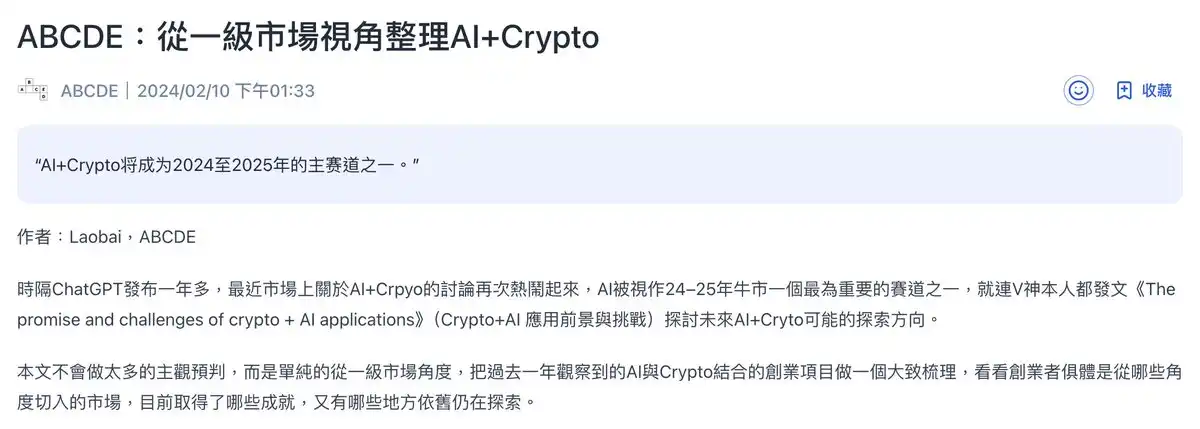
After two years, V God has posted on Twitter again, and I will follow up on the research report from two years ago, even the timing is exactly the same, February 10th. (Related reading: ABCDE: Sorting Out AI+Crypto from a Primary Market Perspective)
Two years ago, V God actually implicitly expressed that he was not very optimistic about the various popular Crypto Helps AI trends at the time. The three popular trends in the circle back then were computing power assetization, data assetization, and model assetization. My research report two years ago mainly discussed the phenomena and doubts observed in the primary market regarding these three trends. From V God's perspective, he was more optimistic about AI Helps Crypto.
The examples he gave at the time were:
- AI as a participant in the game;
- AI as the game interface;
- AI as the game rules;
- AI as the game objective;
Over the past two years, we have made many attempts in Crypto Helps AI, but with little effect. Many sectors and projects ended up - issuing a token and that's it, without real commercial PMF (Product-Market Fit). I call this the "Tokenization Illusion".
1. Computing Power Assetization - Most cannot provide commercial-grade SLA, are unstable, and frequently go offline. They can only handle simple small and medium model inference tasks, mostly serving niche markets. Revenue is not linked to the token......
2. Data Assetization - High friction on the supply side (retail users), low willingness, high uncertainty. The demand side (enterprises) needs structured, context-dependent, professional data suppliers with trust and legal liability. DAO-based Web3 project parties find it difficult to provide this.
3. Model Assetization - Models themselves are non-scarce, replicable, fine-tunable, rapidly depreciating process assets, not final-state assets. Hugging Face itself is a collaboration and dissemination platform, more like GitHub for ML, not an App Store for models. Therefore, so-called "decentralized Hugging Face" projects aiming to tokenize models have mostly ended in failure.
Additionally, over these two years, we have tried various forms of "verifiable inference," which is a typical story of looking for a nail to hit with a hammer. From ZKML to OPML to Gaming Theory, etc., even EigenLayer shifted its Restaking narrative to one based on Verifiable AI.
But it's basically similar to what happened in the Restaking sector - few AVSs (Actively Validated Services) are willing to pay continuously for extra verifiable security.
Similarly, verifiable inference is mostly verifying "things that no one really needs verified." The threat model on the demand side is extremely vague - who exactly are we protecting against?
AI output mistakes (model capability issues) are far more common than AI output being maliciously tampered with (adversarial problems). The various security incidents on OpenClaw and Moltbook some time ago showed that the real problems come from:
- Wrong strategy design
- Excessive permissions granted
- Unclear boundaries
- Unexpected interactions from tool combinations
- ...
Almost none of the imagined nails like "model tampering" or "malicious rewriting of the inference process" exist.
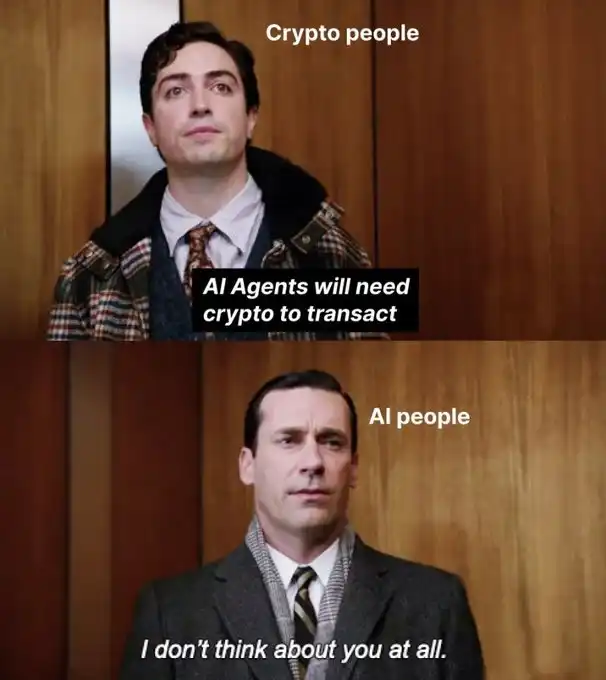
I posted this picture last year, not sure if any old-timers remember.
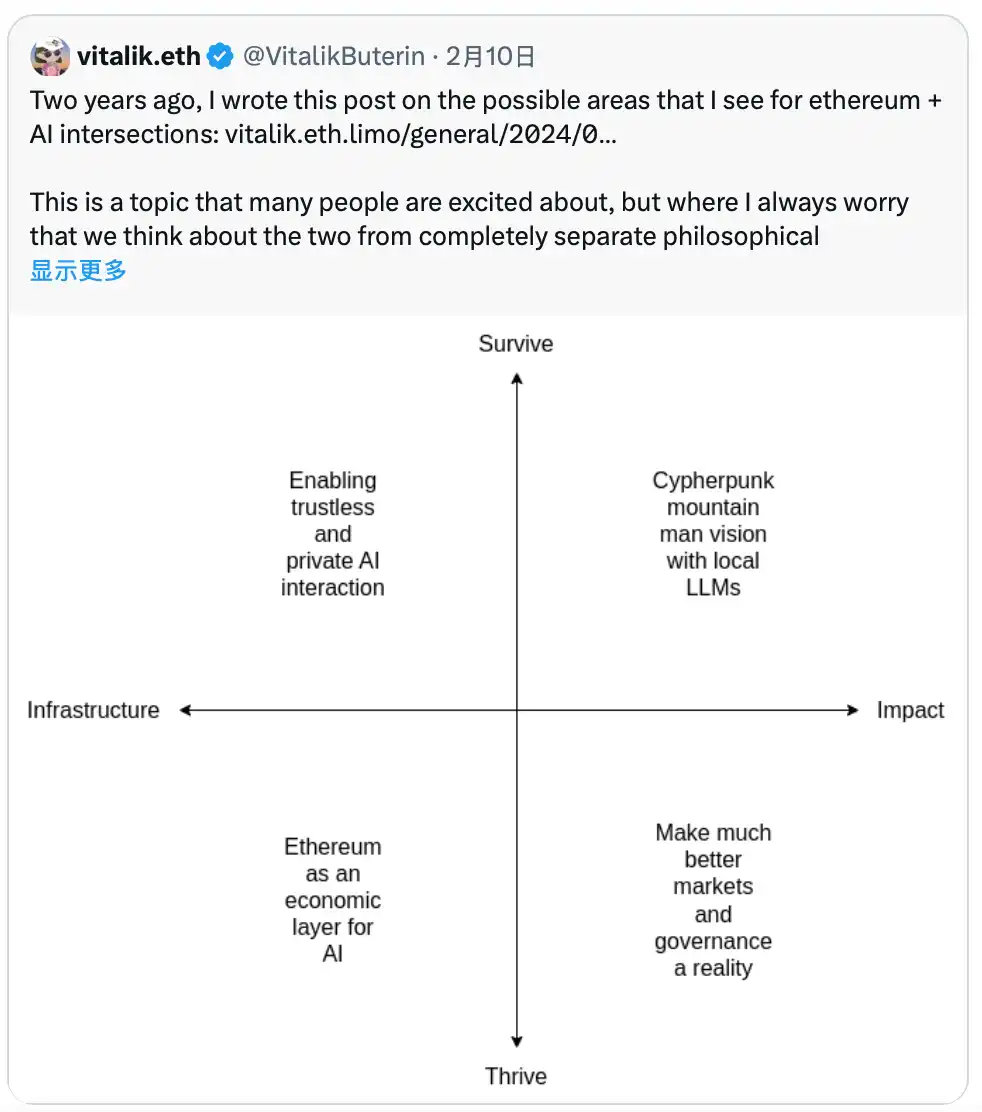
The ideas V God presented this time are明显 more mature than two years ago, also due to the progress we've made in privacy, X402, ERC8004, prediction markets, and other directions.
It can be seen that the four quadrants he divided this time, half belong to AI Helps Crypto, and the other half belong to Crypto Helps AI, no longer明显偏向 the former as it was two years ago.
Top left and bottom left - Utilizing Ethereum's decentralization and transparency to solve AI's trust and economic collaboration problems
1.Enabling trustless and private AI interaction (Infrastructure + Survival): Using technologies like ZK, FHE to ensure the privacy and verifiability of AI interactions (not sure if the verifiable inference I mentioned earlier counts).
2. Ethereum as an economic layer for AI (Infrastructure + Prosperity): Enabling AI agents (Agents) to conduct economic payments, hire other robots, pay deposits, or establish reputation systems through Ethereum, thereby building a decentralized AI architecture rather than being limited to a single giant platform.
Top right and bottom right - Utilizing AI's intelligent capabilities to optimize the user experience, efficiency, and governance of the crypto ecosystem:
3. Cypherpunk mountain man vision with local LLMs (Impact + Survival): AI as the user's "shield" and interface. For example, local LLMs (Large Language Models) can automatically audit smart contracts, verify transactions, reduce reliance on centralized front-end pages, and protect individual digital sovereignty.
4. Make much better markets and governance a reality (Impact + Prosperity): AI deeply participates in Prediction Markets and DAO governance. AI can act as an efficient participant, amplifying human judgment by processing information on a large scale, solving various market and governance problems such as insufficient human attention, high decision-making costs, information overload, and voting apathy.
Previously, we were疯狂 wanting Crypto to Help AI, while V God stood on the other side. Now we finally meet in the middle,只是 it seems to have little to do with various XX tokenizations or so-called AI Layer1s. I hope that when we look back at today's post two years from now, there will be some new directions and surprises.