Open Systems Will Ultimately Prevail: Why Ethereum Is the Next Linux?

Foresight News2026-06-22 tarihinde yayınlandı2026-06-22 tarihinde güncellendi

Özet

The article "Open Systems Will Ultimately Prevail: Why Ethereum Is the Next Linux?" argues that Ethereum, like Linux before it, will triumph over closed, proprietary systems in finance due to its open, permissionless, and credibly neutral nature. It draws a historical parallel: just as the open internet defeated corporate private networks and Linux outcompeted proprietary Unix systems, open financial infrastructure like Ethereum will surpass private blockchains. The core advantage lies in the "bazaar" development model (as described in Eric Raymond's "The Cathedral and the Bazaar"), where decentralized, permissionless innovation by a global community of developers outpaces the controlled "cathedral" approach of centralized entities. This model fosters rapid innovation, as seen with Ethereum standards like ERC-20 and applications like Uniswap, which were built without needing permission. Ethereum's key, irreplicable strength is its credible neutrality: transparent, equally applicable, immutable rules that allow anyone to participate. This ensures sovereign independence, meaning no single entity (company, government) can control or change its core rules—a critical feature for global financial infrastructure. In contrast, private blockchains and consortium chains (like SWIFT or various bank-led projects) suffer from platform risk, central control, and an inability to attract broad developer ecosystems, leading to frequent failures. The article notes that major institutions (e...


Author: Etherealize

Compiled by: Luffy, Foresight News


History Repeats: The Cathedral Eventually Loses to the Open Bazaar


In 1995, the vast majority of tech industry authorities were convinced that the open internet would ultimately lose out to proprietary private enterprise networks. History proved them wrong, and today's skeptics of Ethereum are likely to be mistaken again for the same reasons. The most prominent figure at the time was Bill Gates, who argued in his book "The Road Ahead" that the future of digital commerce lay not with the open internet, but with private, proprietary networks controlled by companies like Microsoft and Oracle. This was the mainstream consensus in the industry. Ben Horowitz, co-founder of a16z, wrote: "Almost no one thought the internet would move beyond academia, let alone compete with the major tech giants, who at the time were all busy building their own private networks to fight against it."


Linux followed an identical path. In the late 1990s, Sun Microsystems dominated the high-end Unix server market. But by the early 2000s, cheap, generic hardware running the open-source Linux system rapidly ate away the vast majority of its business.
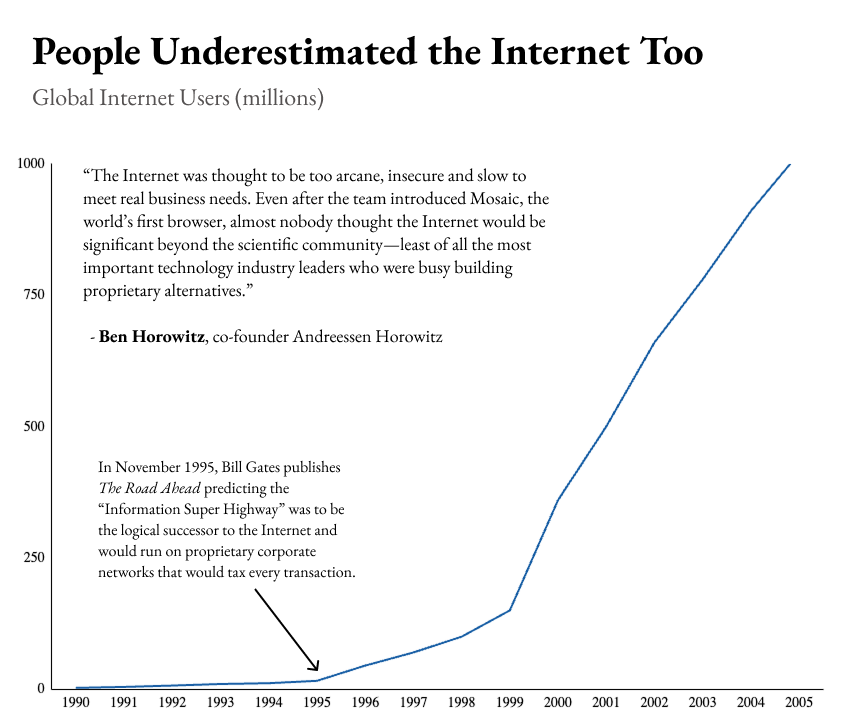


Today, the same historical script is playing out in the realm of financial infrastructure. Sensing both opportunity and threat, major corporations are racing to build private blockchains. In the short term, private chains appear to have the upper hand: faster transaction speeds, better user experience, and large business development teams pushing for adoption. But over time, open, credibly neutral alternatives will slowly erode their market share for two key reasons: 1) No single company can permanently keep up with the pace of innovation in a permissionless system. 2) No legitimate institution wants to build on infrastructure controlled by a competitor.


In 1997, Eric Raymond, a core Linux contributor, explained the underlying logic for the long-term victory of open, permissionless infrastructure in his essay "The Cathedral and the Bazaar." The previously accepted classic theory came from Fred Brooks's "The Mythical Man-Month": software must be developed by a single architect overseeing a small, tightly-knit team, otherwise communication costs would skyrocket exponentially. But Raymond observed that thousands of developers who had never met could simultaneously work on different modules of the Linux kernel, ultimately producing a product that dwarfed those from multi-billion dollar commercial companies. Traditional software was like a finely crafted "cathedral"; the "bazaar" was Fred's term for Linux's distributed development model: public, decentralized, and full of the chaotic, free-flowing energy of iteration. When Linus Torvalds open-sourced the kernel and accepted patches from anyone, he inadvertently pioneered this development paradigm. As Raymond put it: "Release early, release often. Delegate everything you can. Be open to the point of promiscuity." The operating system built using this model powered most internet services by the early 2000s.


Raymond explained that the bazaar model circumvented the problem of exponentially rising communication costs: developers don't need to coordinate directly with each other; everyone simply works synchronously around the code repository, interacting through patches and version updates. The project maintainer integrates all submissions to form a unified standard, which all other developers then use as a baseline. He wrote: "Brooks's law isn't repealed... but given a large enough beta-tester and co-developer base, almost every problem will be characterized quickly and the fix obvious to someone." He added that the negative effects predicted by the law were "overcome by other, nonlinear growth effects."


Raymond also pointed out that the bazaar model breaks down the barrier between users and developers. In the cathedral model, users are merely customers who report bugs to a support ticket system. In the bazaar model, users are co-builders who, upon finding a problem, either submit a fix directly or provide detailed technical descriptions for others to follow up. In the open-source community, "given enough eyeballs, all bugs are shallow." The collective effort of massive participation ultimately leads to overall efficiency surpassing any centralized competitor: "The Linux community... in many ways resembles a free market or an ecology. Many agents pursue their own self-interest, yet the combined result is a self-correcting, resilient system of astonishing complexity and efficiency, far beyond what any centralized planning could achieve."


The Ethereum ecosystem perfectly embodies this pattern. Fabian Vogelsteller, while developing a wallet, found the chaos in various token interface standards and wrote the now-ubiquitous ERC-20 standard. The NFT standard ERC-721 was born from the CryptoKitties development team. Uniswap, now the world's largest decentralized exchange, started as an idea in a Vitalik Buterin blog post, built by Hayden Adams, a mechanical engineer with no financial industry background. These individuals advanced network upgrades without needing anyone's permission. As Sun Microsystems co-founder Bill Joy famously said: "No matter who you are, most of the smartest people work for someone else." A permissionless system allows innovation to spring from anywhere.


The core distinction between the bazaar and the cathedral lies in this: the bazaar's integration layer is lightweight, completely public, and operates on credibility, not top-down authority. Core leaders like Linus Torvalds or Vitalik Buterin gain influence through the voluntary following of developers. Developers follow because core decisions are fully transparent, subject to public critique, and the community can always fork the project if necessary. The internet uses lightweight centralized coordination layers like the IETF and IANA. Wikipedia has a structured editorial review process. All projects that thrive on permissionless innovation manage to be truly open to contributions while having structured integration mechanisms to avoid the feared chaos. And the coordination layer must be maintained by credibility, not coercive control, or the system will quickly collapse.


The bazaar model also requires that the underlying infrastructure cannot be monopolized by a single entity. If Torvalds had tried to privatize the Linux kernel, developers worldwide would have immediately forked the project and continued iterating independently. Raymond refined this theory in "Homesteading the Noosphere." Open-source systems evolved rules similar to Lockean property rights: the developer who writes the initial code first gains founder ownership; continued contribution maintains that ownership; ownership is transferred through formal community succession. Open-source licenses are the formal guarantee of these rules, with community consensus as the soft constraint. If either is missing, developers will migrate to other open-source projects that won't appropriate their labor.


Ethereum's Unreplicable Core Moat


In the Ethereum community, Vitalik has summarized these underlying requirements as "credible neutrality." A coordination mechanism is credibly neutral if it possesses four characteristics simultaneously: the rules are completely transparent, apply equally to all participants, are difficult to arbitrarily change, and anyone can freely participate by following them. These four traits are distilled from mature systems like the internet, Linux, and Wikipedia that attract massive collaboration. Private networks, closed ecosystems, and enterprise blockchains all fail to meet these four points simultaneously.


Over a long enough timeline, credibly neutral systems tend to prevail: the open web replaced corporate private networks, Linux replaced proprietary Unix, Wikipedia replaced Encyclopædia Britannica. In each iteration, the private alternatives held tangible advantages: focused product positioning, strong financial backing, dedicated customer support, professional marketing, and business development teams. But as the open ecosystem matures, these advantages erode, and network effects completely reverse. Once an open system accumulates enough developer tools, applications, and credibility, establishing a perception of stable, unchanging rules, closed systems can no longer compete.


This development pattern is now permeating every layer of financial infrastructure. SWIFT, Visa, Mastercard, and the consortium chains being promoted to institutions today vary in product form and history, but share the same underlying logic: controlled by a centralized entity, harboring platform risk.


For forty years, SWIFT has been owned by member banks and should have remained neutral. But in 2012, under US pressure, it cut off Iranian banks, and in 2022, it was pressured to block several Russian financial institutions. Despite being registered in Belgium and governed by banks, SWIFT ultimately succumbed to US influence, a weakness observed globally. Subsequently, China accelerated its Cross-Border Interbank Payment System (CIPS), Russia built its own System for Transfer of Financial Messages (SPFS), India expanded its Unified Payments Interface (UPI), and Brazil's Pix became a core component of BRICS payment systems. Visa and Mastercard also started as bank cooperatives but have become toll collectors, charging merchants 1.5% to 3.5% fees. Current consortium chains (Canton, Tempo, Arc, etc.) share the same fatal flaw: the interests of the platform operator can always conflict with those of developers building on top.


"The original idea of consortium chains—multiple banks, large companies building their own blockchain together—has largely failed," Vitalik explained. "Such systems combine the worst of both centralized and decentralized worlds." He noted that while the first few participating banks might seem like equal co-builders, the twentieth institution joining is essentially plugging into a system controlled by its competitors. Companies bear all the development costs of a distributed system without gaining the core value blockchains were born to provide: open composability and credible neutrality. Past failures confirm this. From 2017 to 2019, multiple bank consortia tried to rebuild trade finance on blockchain: We.trade, backed by over a dozen institutions including HSBC and Deutsche Bank, went bankrupt in 2022; Marco Polo, with over thirty banks, entered liquidation the next year; Contour followed shortly after, shutting down. The Australian Securities Exchange spent six years and roughly A$250 million building a permissioned ledger with Digital Asset (now developer of Canton), ultimately scrapping the project in 2022. In contrast, Ethereum, owned by no one, has never experienced a full network outage in over a decade, with its ecosystem continually expanding.


This is also the fundamental reason developers choose Ethereum. According to Electric Capital, over 1 million developers have participated in the Ethereum ecosystem since its inception, with 232,000 active developers in the past year alone—no other public chain comes close. Some growth comes from the standard virtuous cycle: Ethereum's concentration of development tools, industry standards, and job opportunities naturally attracts newcomers to learn and build there, which in turn attracts more tools and jobs. But developers and institutions actively choose Ethereum precisely for its extreme decentralization and credible neutrality. For example, last year Robinhood chose to build its Layer 2 on Ethereum rather than develop its own base layer. Johann Kerbrat, head of crypto at the company, stated: "Today, many companies are building their own L1 chains. We also desired the control of our own system, but building a truly secure, decentralized base layer is extremely difficult. Ethereum inherently provides this security base for free. Many new L1s aren't truly decentralized, their security is questionable, and they're essentially just slower, improved databases. We saw no core value."


Erik Voorhees, founder of the privacy-focused AI inference platform Venice AI, expressed a similar view a few days ago. The platform has over 3 million users and generates tens of millions in annual revenue. When asked why they chose to build on Base, Coinbase's Ethereum Layer 2, he said: "We didn't hesitate at all. Among all smart contract platforms, the Ethereum ecosystem is the purest, most resilient, and most mature."


The most fundamental trait of a blockchain is sovereignty. Bitcoin's revolutionary nature lies in being the world's first sovereign computing platform. Before Bitcoin, all computer systems belonged to individuals, companies, or governments and had to obey their owner's will and local laws. A sovereign system follows only its own predetermined rules; no single entity can forcibly change Bitcoin's rules. In the past, sovereignty belonged to monarchs and nations; now, for the first time, a computing platform has achieved sovereignty. This is also why decentralization is so valued in crypto: it's the only path to sovereignty. A chain with only ten validating nodes has its rules dictated by those ten entities. Ethereum, with hundreds of thousands of independent validators spread across global jurisdictions, multiple independent client implementations, and a foundation that explicitly renounces governance power, has long crossed the sovereignty threshold. No single party can claim exclusive ownership of the network. The core value of sovereignty is this: the global financial system can build applications on Ethereum, and all participants need not worry about other institutions, governments, or foundations arbitrarily changing rules to their detriment.


Global Institutions Bet on Ethereum's Open Ecosystem


Ethereum's lead in sovereignty and credible neutrality stems from a historical path dependency that other chains cannot replicate. Ethereum launched in 2015 with Proof of Work, ran for seven years, and only transitioned to Proof of Stake in 2022. Network ownership was sufficiently decentralized through a public crowd sale in 2014 and mining accessible with consumer-grade GPUs, ensuring no single entity holds a large enough token stake to control the network (a key prerequisite for sovereignty in a Proof of Stake system). Most consortium chains today are venture-backed, with tokens concentrated among founding teams, giving a few entities absolute say over consensus. Competitors can copy the technical architecture but not Ethereum's development history.


Since then, Ethereum's lead has compounded: sovereignty and credible neutrality attract developers; an influx of developers brings better libraries, tools, and job markets, further lowering the barrier to entry and attracting more practitioners; applications deposit liquidity and tokenized assets, driving institutional participation. Each layer of the ecosystem reinforces the others. Competitors must build a complete industrial chain simultaneously, while Ethereum's scale advantage continues to grow with compound interest.
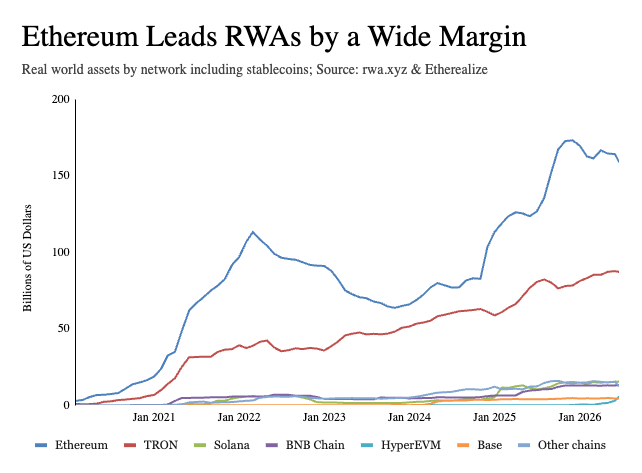


The industry's most sophisticated players are already betting on Ethereum: Coinbase and Robinhood built their Layer 2s on Ethereum; BlackRock and JPMorgan launched tokenized money market funds BUIDL and MONY, both on Ethereum; leading DeFi protocols like Aave, Maker/Sky, Maple, and Uniswap are primarily on Ethereum; the world's top stablecoin issuers settle on Ethereum. Data from Token Terminal's "Q1 2026 Ethereum Industry Report" shows: among the top five public chains, Ethereum hosts 79% of active DeFi lending, 62% of stablecoin issuance, 73% of tokenized funds, and 84% of tokenized commodity assets.


Ethereum's applications are also permissionless, further amplifying its advantages. For example, Uniswap's permissionless listing mechanism gives pricing and liquidity to thousands of long-tail assets, a service centralized exchanges would never provide. Aave's open and highly composable lending markets have spawned an entire ecosystem of specialized pools and risk management tools, far exceeding what the core team alone could develop. Closed systems require platform operators to anticipate all use cases in advance; open systems do not.


The most potent counter-argument to the thesis that "permissionless systems will ultimately win" is not technical but relates to the specific nature of finance: privately controlled networks might be an advantage, not a defect, for the financial industry. When payments fail or funds flow abnormally, regulators need a clear responsible entity; "no one in charge" sounds more like a huge risk than an advantage in a legal context. But this criticism confuses two completely separate layers: accountability mechanisms are built at the application layer; the settlement layer does not need to bear this function. For instance, the ERC-3643 token standard directly embeds KYC verification and cross-border transfer restrictions into smart contracts; issuers can set wallet whitelists, restrict asset transfers, freeze, or recover tokens. Privacy technologies work similarly; zero-knowledge proofs allow institutions to settle on a public chain while hiding transaction details. In contrast, on consortium chains, transaction data is visible only to the company itself and its competitors.


In the early days of the internet, it was widely believed its security was insufficient for commercial transactions. After the HTTPS protocol enhanced security capabilities, most commercial activity migrated to the open web, and such skepticism vanished. The skeptics back then weren't wrong about the internet's early flaws, but they underestimated the self-evolving potential of open networks.


Today, banks and fintech companies building private chains are repeating the mistakes of AOL and Microsoft: trying to replicate an open system but building a walled garden, extracting rent through platform control. This model is doomed to fail. The walls built to exert control also block out external innovation.


Netscape is the model for success. Netscape never tried to monopolize the internet; it built a browser to guide global users onto the open network. Riding the explosive growth of the internet, Netscape became a defining company of its era. Ethereum, with its almost unreplicable credible neutrality, already possesses the potential to become the global settlement layer for finance. The optimal industry strategy is to build applications on top of permissionless infrastructure, not to compete with it head-on.


Trend Kriptolar

İlgili Sorular

QAccording to the article, what is the 'Cathedral vs. Bazaar' analogy, and how does it relate to Ethereum's development?

AThe 'Cathedral vs. Bazaar' analogy, from Eric Raymond's essay, contrasts traditional, centralized 'cathedral' software development with the open, decentralized 'bazaar' model of Linux. The article argues that Ethereum perfectly embodies this 'bazaar' model, where innovation is permissionless and contributions come from a global, decentralized network of developers, leading to superior long-term evolution and resilience compared to closed, corporate-controlled systems.

QWhat are the four key characteristics of 'credible neutrality' as defined by Vitalik Buterin in the context of Ethereum?

AAccording to the article, Vitalik Buterin defines a credibly neutral coordination mechanism as one that possesses four key characteristics: 1) The rules are completely transparent. 2) The rules apply equally to all participants. 3) The rules are difficult to change arbitrarily. 4) Anyone who follows the rules can participate freely. Ethereum is presented as a system that embodies these traits.

QWhy does the author argue that private or consortium blockchains (like Canton, Tempo) are fundamentally flawed for financial infrastructure?

AThe author argues that private or consortium blockchains suffer from a fatal flaw: they reintroduce platform risk controlled by a centralized entity or a consortium of competitors. This structure fails to provide the core value of blockchains—open composability and credible neutrality. Institutions are reluctant to build on infrastructure controlled by rivals, and these systems cannot match the innovation speed of permissionless networks. Historical failures like We.trade and the Australian Stock Exchange's project are cited as evidence.

QWhat historical examples does the article use to support the thesis that open, permissionless systems ultimately triumph over closed ones?

AThe article supports its thesis with several historical examples: the open Internet defeating corporate proprietary networks (like those envisioned by Bill Gates), the Linux operating system displacing proprietary Unix systems (like Sun Microsystems), and Wikipedia replacing the Encyclopaedia Britannica. Each case shows closed systems initially having advantages but ultimately being overtaken by open ecosystems due to network effects and innovation.

QWhat is described as Ethereum's 'unreplicable core moat' or competitive advantage, and how was it established?

AEtheream's 'unreplicable core moat' is its sovereign independence and credible neutrality, achieved through a unique historical path dependence. This was established by launching with Proof-of-Work in 2015, which allowed for highly decentralized ownership via GPU mining, and conducting a public crowd sale with no single entity holding a controlling stake. This history, combined with its subsequent network effects in developers, tools, and applications, creates a competitive advantage that new chains backed by venture capital and centralized token allocations cannot easily replicate.

İlgili Okumalar

Report Interpretation: J.P. Morgan Details Micron's Pre-Earnings Sentiment, Current Hardware Sector Dynamics

Morgan Stanley analyst Joshua Meyers' report (June 21, 2026) highlights key trends in the hardware and semiconductor sector ahead of Micron's earnings. The core takeaways are: 1. **Micron & Memory:** Memory remains a high-conviction long theme, driven by strong AI demand and rising ASPs. However, investor focus is shifting to the sustainability of Micron's >80% gross margins and the specifics of potential new long-term supply agreements (SCAs). 2. **Hardware Supply Chain:** AI-related demand for servers, networking, and storage remains robust, but company performance is diverging. Celestica (CLS) shows improved margin confidence, Western Digital and Seagate benefit from pricing, Fabrinet (FN) sees predictable AI optics growth, and Teradyne (TER) anticipates a new Google customer. 3. **AI Capex & WFE Forecasts:** JPMorgan increased its Wafer Fab Equipment (WFE) market growth forecasts to 28% in 2026 and 29% in 2027. AI infrastructure financing is evolving, with higher project-level debt reducing constraints on capex expansion. The report signals that while the AI-driven hardware cycle is strong, the market is entering a phase focused on execution verification (e.g., Micron's SCA details, Fabrinet's ramp with Amazon) and valuation sustainability. Key near-term signals include Micron's guidance, Arista Networks' outlook, and the pace of demand normalization post potential tariff-related pull-ins.

marsbit28 dk önce

Report Interpretation: J.P. Morgan Details Micron's Pre-Earnings Sentiment, Current Hardware Sector Dynamics

marsbit28 dk önce

Research Report Analysis: The Fed's New Chair's Debut – New Leader, But Same Script?

Report Analysis: Federal Reserve's New Chair Debut – A New Captain, But the Same Script? Morgan Stanley's chief global economist Seth B. Carpenter analyzes the first FOMC meeting under new Fed Chair Kevin Warsh in a June 21 report. Warsh deliberately avoided providing forward guidance on interest rates, aligning with his philosophy. However, market expectations for a rate hike this year were reinforced. Key signals lie elsewhere: inflation may fall more than expected, and quantitative tightening (QT) could be more aggressive than anticipated. The FOMC's "dot plot" suggests only one rate hike in 2026. Carpenter argues that if inflation undershoots forecasts, the logic for even a single hike weakens, especially as projections indicate potential rate cuts in 2027. On QT, Warsh's stance is clear. Carpenter notes that measures like halving the Treasury's account balance could shrink the Fed's balance sheet by around $500 billion with minimal market impact. Combined with adjustments to reserve interest and liquidity rules, the ultimate QT scale may exceed expectations, though its market effect might be less disruptive unless the Fed actively sells Mortgage-Backed Securities (MBS). While Warsh initiated a review of the Fed's policy framework, the 2% inflation target remains intact for now. The report concludes that the market may be overestimating the significance of reduced forward guidance and the near-term rate hike risk, while potentially underestimating the scope and manageable nature of the coming balance sheet reduction. The key debates will hinge on upcoming core PCE data, the specifics of the QT path, and the framework review's findings.

marsbit39 dk önce

Research Report Analysis: The Fed's New Chair's Debut – New Leader, But Same Script?

marsbit39 dk önce

Critical Game Week: BTC Retracement Confirmation vs. HYPE Support Battle | Guest Analysis

This weekly analysis outlines a critical juncture for BTC and HYPE markets, focusing on key price level confirmations. **BTC Analysis:** BTC is at a pivotal point after a five-wave rally from the June 5th low of $59,100. The price has broken below a short-term rising channel's lower boundary, with the current move seen as a pullback to test this breakdown. Failure to reclaim this level could lead to a retest of the $59,000-$60,000 support zone. The core scenario hinges on this channel retest outcome. * **Key Levels:** Resistance at $64,500-$65,000 (channel boundary) and $69,500-$70,500. Support at $59,000-$60,000 and $55,000. * **Strategy:** A core bearish stance is maintained (20% short from last week), with short-term plans for tactical trades. Three detailed contingency plans (A/B/C) are provided for short positions on resistance tests or breakdowns, emphasizing strict stop-loss discipline. **HYPE Analysis:** HYPE shows strong momentum but is currently in a corrective phase after hitting a new high of $76.94. The price is retesting the crucial $64-$66 support area. * **Key Levels:** Resistance near $77 and $80-$82. Support at $64-$66 and $52-$54. * **Strategy:** The short-term approach is "buy on dips, avoid chasing rallies." A long position is considered only if clear stabilization signals appear at the $64-$66 or deeper $52-$54 support zones, with tight risk controls. **General Risk Management:** A standardized trailing stop-loss protocol is emphasized: set initial stop, breakeven at +1% profit, then trail stops upward to lock in gains. *Disclaimer: All analysis is presented as a personal trading framework, not investment advice. Market conditions are complex and require dynamic adjustment.*

marsbit52 dk önce

Critical Game Week: BTC Retracement Confirmation vs. HYPE Support Battle | Guest Analysis

marsbit52 dk önce

Research Report Interpretation: Citi Attends AWS Summit, Bullish on Cloud Business Acceleration but Data Governance Remains Key Variable

Citi analyst Tyler Radke's team attended the AWS New York Summit (June 17-18), engaging with over 10 clients and partners. In a June 19 report, they highlighted the summit's focus on scaling agent AI for enterprise deployment. Citi maintains a "Buy" rating on Amazon, forecasting AWS revenue growth to accelerate to 37% in FY27 from 30% in FY26, noting this estimate may be conservative. Key takeaways: 1. **AWS Strategy Shift:** AWS is moving from proof-of-concepts to scalable deployment. New offerings like AWS Context (building enterprise knowledge graphs), Amazon Quick (cross-application AI assistant), and security tool Continuum address core enterprise pain points for AI adoption. 2. **Data Infrastructure Beneficiaries:** Data infrastructure companies like Snowflake, Elastic, Oracle, and ClickHouse are seen as direct beneficiaries of scaling AI workloads, as evidenced by strong growth and use cases presented. 3. **Critical Role of Data Governance:** As AI agents scale from hundreds to thousands, effective data governance becomes the key variable for deploying AI in core business processes. AWS Context represents AWS's strategic extension from providing compute/models to offering a data governance infrastructure layer. The report emphasizes that without solving data governance, AI will remain confined to pilot projects. The investment thesis focuses on AWS revenue acceleration and data infrastructure vendors' growth, while monitoring signals like AWS's quarterly revenue growth, Bedrock AgentCore task volume, and pricing impacts on companies like Elastic.

marsbit59 dk önce

Research Report Interpretation: Citi Attends AWS Summit, Bullish on Cloud Business Acceleration but Data Governance Remains Key Variable

marsbit59 dk önce

Crucial Week of Contention: BTC Tests Support and HYPE's Key Level Battle | Special Analysis

**Market Enters Critical Week: Bitcoin Pullback Test and HYPE Support Battle** The market enters a crucial phase of contention this week. The marginal shifts in Federal Reserve policy expectations continue to dictate the pricing rhythm for risk assets. Meanwhile, in the crypto market, following a period of sideways consolidation, the divergence between bulls and bears is becoming concentrated at key price levels. **Bitcoin (BTC) Analysis & Strategy** * **Technical View:** The 4-hour chart suggests BTC is in a five-wave structure since the June 5th low near $59,100. Price action shows a short-term rising channel. The recent drop below this channel's lower boundary is now being followed by a pullback attempt (wave 40-41). The outcome of this retest is critical. * **This Week's Outlook:** The core focus is whether BTC can reclaim and hold above the channel's lower boundary. * **Bullish Scenario:** A successful hold could lead to a continued rebound, potentially challenging the $69,500 - $70,500 resistance zone. * **Bearish Scenario:** Failure to hold may trigger a renewed test of the $59,000 - $60,000 core support area, with $55,000 as a deeper support level. * **Operational Strategy:** The author maintains a 20% mid-term short position initiated last week near $64,500, based on a model signaling a shift to a bearish structure. Short-term tactics involve using 30% capital for potential "spread" trades, with three contingency plans (A, B, C) outlined for reacting to resistance tests, breakouts, or support breakdowns. **HYPE Analysis & Strategy** * **Technical View:** On the 4-hour chart, HYPE shows strong momentum, having recently broken to a new high since January. The current pullback presents a clear three-wave correction structure, bringing the price back to the critical $64 - $66 support zone. * **This Week's Outlook:** The focus is on the battle for the $64 - $66 support area. * **Bullish Scenario:** Holding this support could signal a continuation of the uptrend from the June 10th low, leading to new highs. * **Bearish Scenario:** A breakdown could extend the correction, potentially testing the deeper $52 - $54 support band. * **Operational Strategy:** The recommended short-term approach is "buy on dips, avoid chasing rallies." A light long position (under 30% capital) could be considered if HYPE shows stabilization signals at the $64-$66 or $52-$54 support zones, confirmed by model signals. Strict stop-loss discipline is emphasized. **General Risk Management:** A strict trailing stop-loss protocol is advised: set an initial stop; move to breakeven at +1% profit; lock in profits progressively thereafter. *Disclaimer: All analysis is presented as the author's personal technical perspective and trading log, not as investment advice. Markets are complex and dynamic; risk control is paramount.*

Odaily星球日报59 dk önce

Crucial Week of Contention: BTC Tests Support and HYPE's Key Level Battle | Special Analysis

Odaily星球日报59 dk önce

İşlemler

Spot
Futures

Popüler Makaleler

ETH 2.0 Nedir

ETH 2.0: Ethereum için Yeni Bir Dönem Giriş ETH 2.0, Ethereum 2.0 olarak da bilinir, Ethereum blok zincirinde önemli bir yükseltmeyi işaret eder. Bu geçiş yalnızca bir yüz değiştirme değil; ağın ölçeklenebilirliğini, güvenliğini ve sürdürülebilirliğini temelinden geliştirmeyi hedeflemektedir. Enerji yoğun Proof of Work (PoW) konsensüs mekanizmasından daha verimli olan Proof of Stake (PoS) mekanizmasına geçişle birlikte, ETH 2.0 blok zinciri ekosistemine dönüştürücü bir yaklaşım vaat etmektedir. ETH 2.0 Nedir? ETH 2.0, Ethereum'un yeteneklerini ve performansını optimize etmeye odaklanmış özel, birbirine bağlı güncellemelerin bir derlemesidir. Yenileme, mevcut Ethereum mekanizmasının karşılaştığı kritik zorlukları, özellikle işlem hızı ve ağ tıkanıklığı ile ilgili sorunları ele almak üzere tasarlanmıştır. ETH 2.0'ın Amaçları ETH 2.0'ın ana amaçları, üç temel unsuru geliştirmeye odaklanmaktadır: Ölçeklenebilirlik: Ağın saniye başına işleyebileceği işlem sayısını önemli ölçüde artırmayı hedefleyen ETH 2.0, mevcut yaklaşık 15 işlem/saniye sınırlamasını aşmayı ve potansiyel olarak binlerce işleme ulaşmayı planlamaktadır. Güvenlik: Geliştirilmiş güvenlik önlemleri, özellikle siber saldırılara karşı daha iyi direnç sağlama ve Ethereum'un merkeziyetsiz görünümünü koruma açısından ETH 2.0 için hayati öneme sahiptir. Sürdürülebilirlik: Yeni PoS mekanizması, sadece verimliliği artırmakla kalmayıp aynı zamanda enerji tüketimini de önemli ölçüde azaltma hedefiyle tasarlanmış olup, Ethereum'un operasyonel çerçevesini çevresel kaygılarla uyumlu hale getirmektedir. ETH 2.0'ın Yaratıcısı Kimdir? ETH 2.0'ın yaratılması Ethereum Vakfı'na atfedilebilir. Ethereum'un gelişimini destekleme konusunda kritik bir rol oynayan bu kar amacı gütmeyen kuruluş, dikkat çekici kurucu ortağı Vitalik Buterin tarafından yönetilmektedir. Daha ölçeklenebilir ve sürdürülebilir bir Ethereum vizyonu, bu yükseltmenin arkasındaki itici güç olmuştur ve protokolü geliştirmek için kendini adamış küresel bir geliştici ve meraklı topluluğunun katkılarını içermektedir. ETH 2.0'ın Yatırımcıları Kimlerdir? ETH 2.0 yatırımcıları ile ilgili detaylar kamuoyuna açıklanmamış olsa da, Ethereum Vakfı'nın blok zinciri ve teknoloji alanında çeşitli kuruluşlar ve bireyler tarafından desteklendiği bilinmektedir. Bu ortaklar arasında merkeziyetsiz teknolojilerin ve blok zinciri altyapısının geliştirilmesine karşılıklı ilgi duyan girişim sermayesi şirketleri, teknoloji firmaları ve hayır kurumları yer almaktadır. ETH 2.0 Nasıl Çalışır? ETH 2.0, onu öncüsünden ayıran bir dizi önemli özelliği tanıtmasıyla dikkat çekmektedir. Proof of Stake (PoS) PoS konsensüs mekanizmasına geçiş, ETH 2.0'ın en belirgin değişikliklerinden biridir. İşlem doğrulama için enerji yoğun madenciliğe dayanmak yerine, PoS kullanıcıların ağa yatırdıkları ETH miktarına göre işlemleri doğrulayıp yeni bloklar oluşturmalarına olanak tanır. Bu, enerji verimliliğinin artırılmasına yol açarak tüketimi yaklaşık %99,95 oranında azaltmakta ve Ethereum 2.0'ı önemli ölçüde daha çevre dostu bir alternatif haline getirmektedir. Shard Zincirleri Shard zincirleri, ETH 2.0'ın diğer bir kritik yeniliğidir. Bu daha küçük zincirler, ana Ethereum zinciri ile paralel olarak çalışarak birden fazla işlemin aynı anda işlenmesine olanak tanır. Bu yaklaşım, ağın genel kapasitesini artırarak Ethereum'u rahatsız eden ölçeklenebilirlik sorunlarını ele alır. Beacon Zinciri ETH 2.0'ın temelinde, ağı koordine eden ve PoS protokolünü yöneten Beacon Zinciri yer almaktadır. Bu, bir tür organizatör olarak işlev görür: doğrulayıcıları denetler, shard'ların ağa bağlı kalmasını sağlar ve blok zinciri ekosisteminin genel sağlığını izler. ETH 2.0 Zaman Çizelgesi ETH 2.0'ın yolculuğu, bu önemli yükseltmenin evrimini gösteren birkaç önemli dönüm noktası ile tanımlanmıştır: Aralık 2020: Beacon Zinciri'nin başlatılması, PoS'un tanıtımını işaret etmiş ve ETH 2.0’a geçiş için sahneyi hazırlamıştır. Eylül 2022: "The Merge" tamamlanması, Ethereum ağının başarılı bir şekilde PoW'den PoS çerçevesine geçiş yaptığı kritik bir anı temsil etmekte ve Ethereum için yeni bir dönemi müjdelemektedir. 2023: Shard zincirlerinin beklenen dağıtımı, Ethereum ağının ölçeklenebilirliğini daha da artırmayı hedeflemekte ve ETH 2.0'ı merkeziyetsiz uygulamalar ve hizmetler için sağlam bir platform haline getirmeyi pekiştirmektedir. Ana Özellikler ve Faydalar Geliştirilmiş Ölçeklenebilirlik ETH 2.0'ın en önemli avantajlarından biri, geliştirilmiş ölçeklenebilirliğidir. PoS ve shard zincirlerinin kombinasyonu, ağın kapasitesini artırarak, eski sistemle kıyaslandığında çok daha fazla işlem hacmi karşılayabilmesini sağlamaktadır. Enerji Verimliliği PoS'un uygulanması, blok zinciri teknolojisinde enerji verimliliği yönünde büyük bir adım teşkil etmektedir. Enerji tüketimini ciddi şekilde azaltarak, ETH 2.0 yalnızca işletme maliyetlerini düşürmekle kalmaz, aynı zamanda küresel sürdürülebilirlik hedefleriyle daha yakın bir uyum sağlar. Geliştirilmiş Güvenlik ETH 2.0'ın güncellenmiş mekanizmaları, ağ genelinde güvenliğin artırılmasına katkıda bulunmaktadır. PoS'un uygulanması ve shard zincirleri ile Beacon Zinciri aracılığıyla geliştirilen yenilikçi kontrol önlemleri, potansiyel tehditlere karşı daha yüksek bir koruma sağlar. Kullanıcılar için Düşük Maliyetler Ölçeklenebilirlik geliştikçe, işlem maliyetleri üzerindeki etkiler de belirgin hale gelecektir. Artan kapasite ve azalan tıkanıklığın, kullanıcılar için düşük ücretler anlamına gelmesi beklenmekte ve Ethereum'u günlük işlemler için daha erişilebilir hale getirmektedir. Sonuç ETH 2.0, Ethereum blok zinciri ekosisteminde önemli bir evrimi işaret etmektedir. Ölçeklenebilirlik, enerji tüketimi, işlem verimliliği ve genel güvenlik gibi temel sorunları ele alırken, bu güncellemenin önemi abartılamaz. Proof of Stake'e geçiş, shard zincirlerinin tanıtımı ve Beacon Zinciri'nin altyapı çalışmaları, Ethereum'un merkeziyetsiz piyasalarının artan taleplerini karşılayabileceği bir geleceği göstermektedir. Yenilik ve ilerleme ile şekillenen bir sektörde, ETH 2.0, blok zinciri teknolojisinin daha sürdürülebilir ve verimli bir dijital ekonomi için yol açmadaki yeteneklerinin bir kanıtıdır.

184 Toplam GörüntülenmeYayınlanma 2024.04.04Güncellenme 2024.12.03

ETH 2.0 Nedir

ETH 3.0 Nedir

ETH3.0 ve $eth 3.0: Ethereum'un Geleceği Üzerine Derinlemesine Bir İnceleme Giriş Hızla evrilen kripto para ve blok zinciri teknolojisi ortamında, ETH3.0, sıklıkla $eth 3.0 olarak adlandırılmakta, önemli bir ilgi ve spekülasyon konusu haline gelmiştir. Bu terim, netleştirilmesi gereken iki temel kavramı kapsamaktadır: Ethereum 3.0: Bu, mevcut Ethereum blok zincirinin yeteneklerini artırmayı hedefleyen olası bir gelecekteki güncellemeyi temsil eder, özellikle ölçeklenebilirlik ve performansı iyileştirmeye odaklanmaktadır. ETH3.0 Meme Token: Bu ayrı kripto para projesi, Ethereum blok zincirini kullanarak meme merkezli bir ekosistem oluşturmayı amaçlamakta ve kripto para topluluğu içinde etkileşimi artırmaktadır. ETH3.0'ün bu yönlerini anlamak, yalnızca kripto meraklıları için değil, aynı zamanda dijital alandaki daha geniş teknolojik trendleri gözlemleyenler için de hayati öneme sahiptir. ETH3.0 Nedir? Ethereum 3.0 Ethereum 3.0, zaten kurulmuş olan Ethereum ağına önerilen bir güncelleme olarak duyurulmaktadır; bu ağ, kuruluşundan bu yana birçok merkeziyetsiz uygulamanın (dApp'ler) ve akıllı sözleşmelerin belkemiği olmuştur. Tasarlanan iyileştirmeler, esasen ölçeklenebilirlik üzerine yoğunlaşmakta – shardlama ve sıfır bilgi kanıtları (zk-proofs) gibi ileri teknolojileri entegre etmektedir. Bu teknolojik yenilikler, saniyede eşi benzeri görülmemiş sayıda işlem (TPS) gerçekleştirmeyi kolaylaştırmayı amaçlamakta olup, muhtemelen milyonlara ulaşarak mevcut blok zinciri teknolojisinin karşılaştığı en büyük sınırlamalardan birine çözüm getirmektedir. İyileştirme yalnızca teknik değil, aynı zamanda stratejiktir; Ethereum ağını, merkeziyetsiz çözümlere olan artan talep ile belirginleşen bir geleceğe hazırlamak için tasarlanmıştır. ETH3.0 Meme Token Ethereum 3.0'ın aksine, ETH3.0 Meme Token, internet meme kültürünü kripto para dinamikleriyle birleştirerek daha hafif ve eğlenceli bir alanda hareket etmektedir. Bu proje, kullanıcıların Ethereum blok zincirinde meme alım, satım ve ticaret yapmalarına izin vererek, yaratıcılık ve ortak ilgi alanları aracılığıyla topluluk etkileşimini teşvik eden bir platform sunmaktadır. ETH3.0 Meme Token, blok zinciri teknolojisinin dijital kültürle nasıl kesişebileceğini göstererek, hem eğlenceli hem de finansal olarak sürdürülebilir kullanım senaryoları oluşturmayı hedeflemektedir. ETH3.0'un Yaratıcısı Kimdir? Ethereum 3.0 Ethereum 3.0'a yönelik girişim, esas olarak Ethereum topluluğundaki bir geliştirici ve araştırmacı konsorsiyumu tarafından yönlendirilmektedir ve bunlar arasında Justin Drake de bulunmaktadır. Ethereum'un evrimine yönelik içgörüleri ve katkılarıyla tanınan Drake, Ethereum'u “Beam Chain” olarak adlandırılan yeni bir konsensüs katmanına geçirme konusundaki tartışmalarda öne çıkan bir figür olmuştur. Geliştirmeye yönelik bu iş birliği yaklaşımı, Ethereum 3.0'ın tek bir yaratıcının ürünü olmadığını, aksine blok zinciri teknolojisini ilerletmeye odaklanmış kolektif bir dehanın tezahürü olduğunu göstermektedir. ETH3.0 Meme Token ETH3.0 Meme Token'ın yaratıcısına dair detaylar şu anda izlenemez durumdadır. Meme tokenların doğası, genellikle daha merkeziyetsiz ve topluluk odaklı bir yapıya yol açmakta olup, bu da spesifik bir atıf eksikliğini açıklayabilir. Bu durum, yeniliğin genellikle iş birliği yerine bireysel çabalardan ortaya çıktığı kripto topluluğunun genel felsefesiyle uyumludur. ETH3.0 Yatırımcıları Kimlerdir? Ethereum 3.0 Ethereum 3.0'a olan destek, esasen Ethereum Vakfı ve hevesli bir geliştirici ve yatırımcı topluluğu tarafından sağlanmaktadır. Bu temel birliktelik, yıllar süren ağ operasyonlarıyla inşa edilen güven ve itibarından yararlanarak önemli bir meşruiyet sağlamaktadır. Kripto para dünyasının hızla değişen ikliminde, topluluk desteği, gelişim ve benimsemeyi yönlendirmede kritik bir rol oynamakta ve Ethereum 3.0'ı gelecekteki blok zinciri ilerlemeleri için ciddi bir rakip haline getirmektedir. ETH3.0 Meme Token Mevcut kaynaklar, ETH3.0 Meme Token'ı destekleyen yatırım temelleri veya kuruluşları hakkında net bilgiler sağlamasa da, bu durum meme tokenlar için tipik olan finansman modelini göstermektedir; bu model genellikle tabandan destek ve topluluk katılımına dayanır. Bu tür projelerdeki yatırımcılar genellikle toplum odaklı yenilik potansiyeli ve kripto topluluğunda bulunan iş birliği ruhuyla motive olmuş bireylerden oluşmaktadır. ETH3.0 Nasıl Çalışır? Ethereum 3.0 Ethereum 3.0'ın ayırt edici özellikleri, önerilen shardlama ve zk-proof teknolojisinin uygulanmasında yatmaktadır. Shardlama, blok zincirini daha küçük, yönetilebilir parçalara veya “parçalara” ayırma yöntemidir; bu parçalar işlemleri ardışık değil, eşzamanlı olarak işleyebilir. Bu işlem yükünün merkeziyetsizliği, tıkanıklığı önlemeye yardımcı olur ve ağın yoğun yük altında bile yanıt verebilir olmasını sağlar. Sıfır bilgi kanıtı (zk-proof) teknolojisi, işleme katılan temel verileri ifşa etmeden işlem doğrulaması sağlamasıyla başka bir sofistike katman ekler. Bu yön, sadece gizliliği artırmakla kalmaz, aynı zamanda ağın genel verimliliğini de artırır. Bu güncellemeye, ağın yeteneklerini ve faydasını daha da artırarak sıfır bilgi Ethereum Sanal Makinesi (zkEVM) entegrasyonunun da eklenmesi gündeme gelmektedir. ETH3.0 Meme Token ETH3.0 Meme Token, meme kültürünün popülaritesinden yararlanarak kendini farklılaştırmaktadır. Kullanıcıların sadece eğlence için değil, aynı zamanda potansiyel ekonomik kazançlar için meme ticareti yapmalarına olanak tanıyacak bir pazar yeri oluşturur. Stake etme, likidite sağlama ve yönetim mekanizmaları gibi özelliklerin entegrasyonu sayesinde, proje topluluk etkileşimini ve katılımını teşvik eden bir ortam oluşturur. Eğlence ve ekonomik fırsatların eşsiz bir karışımını sunarak, ETH3.0 Meme Token, kripto tutkunlarından gündelik meme meraklılarına kadar çeşitli bir kitleyi çekmeyi hedeflemektedir. ETH3.0 Zaman Çizelgesi Ethereum 3.0 11 Kasım 2024: Justin Drake, ölçeklenebilirlik iyileştirmeleri etrafında şekillenen yaklaşan ETH 3.0 güncellemesine işaret ediyor. Bu duyuru, Ethereum'un gelecekteki mimarisi hakkında resmi tartışmaların başlangıcını simgeliyor. 12 Kasım 2024: Ethereum 3.0'a yönelik beklenen önerinin, Bangkok'taki Devcon'da açıklanması planlanıyor ve bu, daha geniş topluluk geri bildirimi ve gelişim için olası sonraki adımların zeminini hazırlıyor. ETH3.0 Meme Token 21 Mart 2024: ETH3.0 Meme Token, CoinMarketCap'ta resmi olarak listeleniyor, bu da kamusal kripto alanına adım atarak meme merkezli ekosisteminin görünürlüğünü artırıyor. Ana Noktalar Sonuç olarak, Ethereum 3.0, gelişmiş teknolojiler aracılığıyla ölçeklenebilirlik ve performansla ilgili sınırlamaların üstesinden gelmeye odaklanan Ethereum ağındaki önemli bir evrimi temsil etmektedir. Önerilen güncellemeleri, gelecekteki talepler ve kullanılabilirlik için proaktif bir yaklaşımı yansıtmaktadır. Öte yandan, ETH3.0 Meme Token, kripto para alanındaki topluluk odaklı kültürün özünü kapsamakta, meme kültürünü kullanarak kullanıcı yaratıcılığını ve katılımını teşvik eden etkileşimli platformlar oluşturmayı hedeflemektedir. ETH3.0 ve $eth 3.0'un farklı amaçlarının ve işlevlerinin anlaşılması, kripto alanındaki gelişmeleri takip eden herkes için hayati öneme sahiptir. Her iki girişim de benzersiz yollar çizerek, blok zinciri yeniliğinin dinamik ve çok yönlü doğasını birlikte vurgulamaktadır.

178 Toplam GörüntülenmeYayınlanma 2024.04.04Güncellenme 2024.12.03

ETH 3.0 Nedir

ETH Nasıl Satın Alınır

HTX.com’a hoş geldiniz! Ethereum (ETH) satın alma işlemlerini basit ve kullanışlı bir hâle getirdik. Adım adım açıkladığımız rehberimizi takip ederek kripto yolculuğunuza başlayın. 1. Adım: HTX Hesabınızı OluşturunHTX'te ücretsiz bir hesap açmak için e-posta adresinizi veya telefon numaranızı kullanın. Sorunsuzca kaydolun ve tüm özelliklerin kilidini açın. Hesabımı Aç2. Adım: Kripto Satın Al Bölümüne Gidin ve Ödeme Yönteminizi SeçinKredi/Banka Kartı: Visa veya Mastercard'ınızı kullanarak anında Ethereum (ETH) satın alın.Bakiye: Sorunsuz bir şekilde işlem yapmak için HTX hesap bakiyenizdeki fonları kullanın.Üçüncü Taraflar: Kullanımı kolaylaştırmak için Google Pay ve Apple Pay gibi popüler ödeme yöntemlerini ekledik.P2P: HTX'teki diğer kullanıcılarla doğrudan işlem yapın.Borsa Dışı (OTC): Yatırımcılar için kişiye özel hizmetler ve rekabetçi döviz kurları sunuyoruz.3. Adım: Ethereum (ETH) Varlıklarınızı SaklayınEthereum (ETH) satın aldıktan sonra HTX hesabınızda saklayın. Alternatif olarak, blok zinciri transferi yoluyla başka bir yere gönderebilir veya diğer kripto para birimlerini takas etmek için kullanabilirsiniz.4. Adım: Ethereum (ETH) Varlıklarınızla İşlem YapınHTX'in spot piyasasında Ethereum (ETH) ile kolayca işlemler yapın.Hesabınıza erişin, işlem çiftinizi seçin, işlemlerinizi gerçekleştirin ve gerçek zamanlı olarak izleyin. Hem yeni başlayanlar hem de deneyimli yatırımcılar için kullanıcı dostu bir deneyim sunuyoruz.

3.6k Toplam GörüntülenmeYayınlanma 2024.12.10Güncellenme 2026.06.02

ETH Nasıl Satın Alınır

Tartışmalar

HTX Topluluğuna hoş geldiniz. Burada, en son platform gelişmeleri hakkında bilgi sahibi olabilir ve profesyonel piyasa görüşlerine erişebilirsiniz. Kullanıcıların ETH (ETH) fiyatı hakkındaki görüşleri aşağıda sunulmaktadır.

活动图片