When Crypto Meets the World Cup: CoinW and Modrić's Art of "Navigating Cycles"

Foresight News2026-06-17 tarihinde yayınlandı2026-06-17 tarihinde güncellendi

Özet

When Encryption Meets the World Cup: CoinW and Modrić's "Transcending Cycles" Philosophy In the context of the 2026 FIFA World Cup and its massive global audience, the crypto exchange CoinW announced football legend Luka Modrić as its global brand ambassador. This move is framed not merely as a marketing tactic, but as a strategic experiment in user profile migration. It targets mature, financially stable football fans—particularly in Europe, Southeast Asia, and Latin America—who traditionally have low crypto awareness but value trusted, time-tested authority figures like Modrić. The article draws parallels between Modrić's enduring, disciplined career—marked by consistency and success at the highest level over two decades—and CoinW's own development path. Founded in 2017 during a volatile industry period, CoinW focused on building robust infrastructure and risk management. It weathered the 2022 industry crisis without major security incidents, subsequently earning recognition like "Europe's Most Trusted Exchange" and growing to over 20 million registered users. This "long-termism" is translated into user-centric products. CoinW Academy lowers the initial knowledge barrier. Its integrated ecosystem (CoinW, GemW, DeriW, PropW) and the recent launch of a TradFi section—offering perpetual contracts on traditional assets like stocks, gold, and oil—aim to create a unified platform for diverse assets. For the World Cup, CoinW launched the "We Are The Game" campaign, collaboratin...


Author:angelilu,Foresight News


The 2026 FIFA World Cup kicked off in the US, Canada, and Mexico. With global cumulative viewership projected to exceed 50 billion, marketing budgets are flowing towards every billboard, jersey, and pop-up ad slot. The crypto industry is among them, spending increasingly generously.


But beyond the numbers, a question rarely addressed head-on is: who is attracted after the money is spent?


The true value of sports sponsorship for the crypto industry is not just logo exposure. A more accurate description is an experiment in user profile migration. The global football audience, especially the core viewership in Europe, Southeast Asia, and Latin America, possesses stable disposable income and a natural interest in data and probability, but traditionally has very low awareness of crypto assets. This demographic is highly sensitive to "trustworthy authoritative endorsements" – the ambassadors they trust are not names made famous by hype, but those repeatedly validated by time.


On April 9, 2026, CoinW announced Luka Modrić as its global brand ambassador.
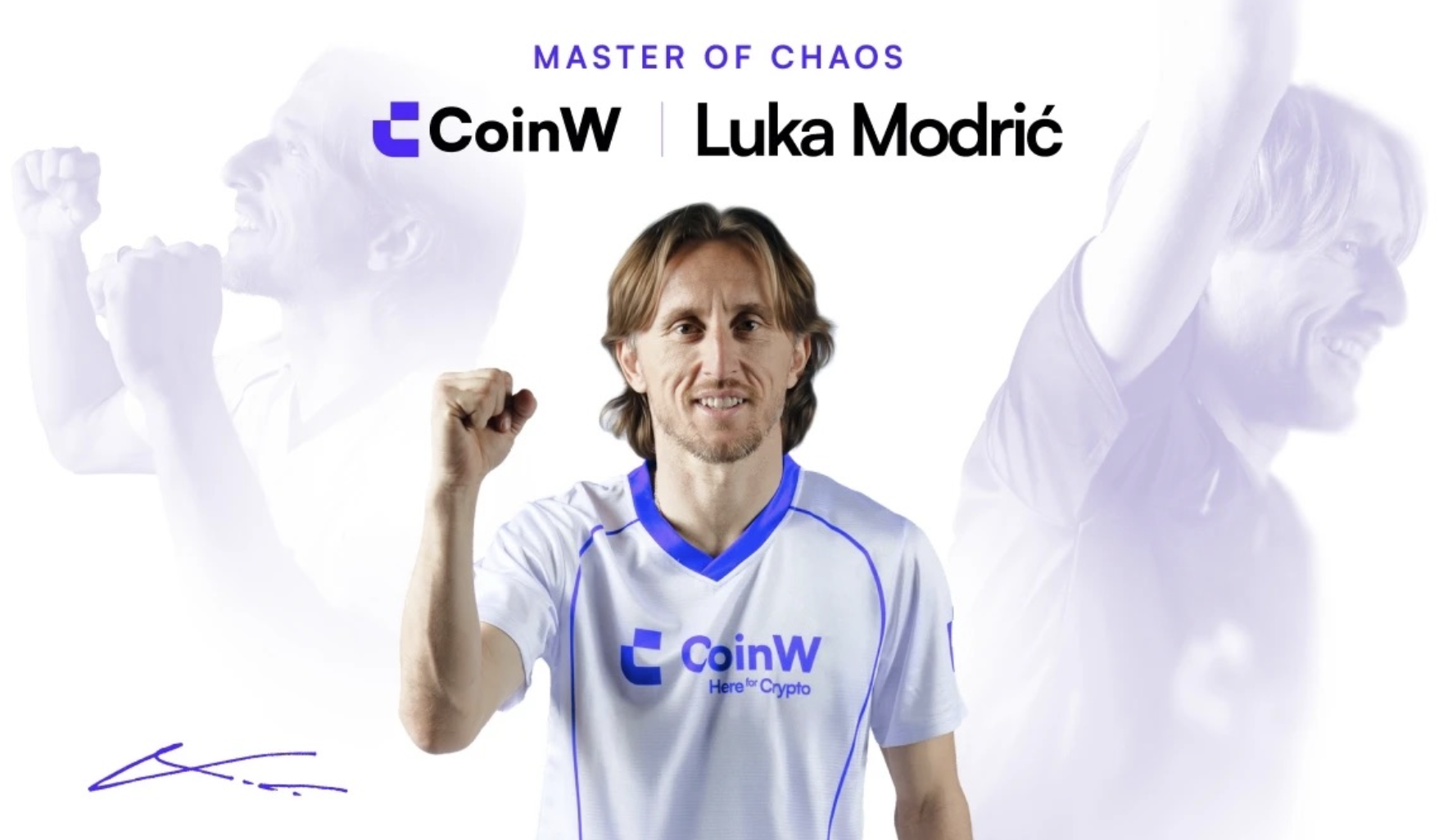


Truly valuable cross-industry collaborations are not just about traffic stacking, but about precise user profile switching – taking people who "know who Modrić is" to the next step of "being willing to understand what CoinW is."


Modrić is almost irreplaceable in this dimension: his fanbase is not young, impulsive star-chasers, but mature fans who have watched his ups and downs over two decades. Once trust is established with such an audience, the conversion path is longer and the retention rate is higher.


The One Who Masters Rhythm Amidst Chaos


CoinW's global brand ambassador, Luka Modrić, will once again take to the World Cup stage as captain of the Croatian national team. At 41, he is still running at the highest level.


Modrić might seem "misaligned" with the crypto industry at first glance. He never creates headlines, nor does he possess explosive flair, but he has slowly accumulated over two decades, waiting for time to prove his worth.


Luka Modrić was not highly regarded when he joined Real Madrid in 2012. But at the 2018 World Cup, he led Croatia to the final, winning the Best Player award. By the end of that same year, he broke Messi and Ronaldo's decade-long monopoly on the Ballon d'Or. During his 13 years at Real Madrid, he won 6 Champions League titles and 28 major trophies.


In the summer of 2024, he parted ways with Real Madrid after 13 years of service. In July 2025, the 40-year-old signed with AC Milan as a free agent, seen as a romantic experiment about the final chapter of a career. The reality was simpler: he played, and he delivered. In the 2025-26 season, Modrić made 34 appearances for Milan, starting 32 times, contributing 2 goals and 3 assists, and creating 51 chances. These numbers do not belong to a veteran burning his last embers, but to a man who still knows exactly what he's doing.


CoinW's trajectory shares a similar quality. Founded in 2017, during the most turbulent early years of the industry when projects came and went like smoke and exchanges opened and closed, CoinW chose to focus its energy on building infrastructure and risk management systems – a multi-layered security architecture, strict internal control mechanisms, and a product logic centered on user asset protection. In an industry that emphasized rapid expansion, this choice seemed exceptionally quiet.


In 2022, the entire crypto industry experienced a systemic crisis. Several leading institutions collapsed one after another, user assets evaporated, and industry trust plummeted to its lowest point. CoinW was not on that list of collapses. The platform maintained uninterrupted service, and according to its disclosed internal records, no major security incidents occurred. This was more important than any growth data.


As the industry's narrative shifted from growth to trust, compliance and transparency gradually became core benchmarks for trading platform competitiveness. CoinW continued to deepen its global expansion, actively participating in industry development in key markets. At the Next Block Expo Europe summit in Warsaw, CoinW was awarded "Europe's Most Trusted Exchange." Currently, the platform has surpassed 20 million global registered users, with a daily trading volume exceeding $5 billion (as of October 2025).


Behind these numbers is not an instant burst from short-term growth, but long-term accumulation formed through maintaining strategic focus and continuous investment in product and infrastructure development across multiple market cycles.


Modrić and CoinW share a common underlying color: not being crushed by cycles, but being tested by time.


Following the official announcement of the ambassadorship, CoinW Chief Strategy Officer Nassar Al Achkar stated: "We chose Modrić not just for his achievements, but for the spiritual power his journey embodies. In an environment full of competition and uncertainty, he has always maintained focus and composure, not swayed by external noise, nor changing direction due to short-term gains or losses. Long-termism, calm restraint, and a born-to-win mentality. These qualities have shaped Modrić's football career and are highly aligned with the developmental logic of CoinW's journey.


Amidst the industry's fluctuations and cycle changes, we have always believed that true competitiveness does not come from chasing short-term trends, but from sustained investment in long-term value. Therefore, we choose to focus our attention on what truly matters: continuously improving product capabilities, enhancing user experience, and earning user trust through long-term building."


How Rhythm Translates into Product


Long-termism is not a slogan; it needs to be translated into tangible things users can perceive.


For an athlete, this manifests as a training system and continuous evolution. The 51 chances Modrić created in the AC Milan season are not flashes of genius, but judgment accumulated year after year.


For a trading platform, this translation takes another form: dismantling barriers to entry, layer by layer.


The first layer is the cognitive barrier. New users facing a world dense with unfamiliar terminology and logic often close the page before they even understand "what is on-chain." CoinW Academy uses tiered, free content covering the complete path from blockchain basics to derivatives trading logic, helping users move from "understanding what this is" to "knowing how to operate." It doesn't appear in any profit data, but it determines how many people can truly enter.


The second layer is the asset boundary. CoinW continuously improves its infrastructure and conducts deep integration at the ecosystem level: the four product ecosystems of CoinW, GemW, DeriW, and PropW are interconnected. Centered around a unified account and strategy engine, they build comprehensive trading capabilities covering multi-category assets, transitioning the user experience from fragmentation to integration.


In June of this year, CoinW officially launched the TradFi Zone. This is a directional product upgrade: integrating traditional assets like gold, crude oil, commodities, and US stocks – including Apple, Google, NVIDIA, as well as recent market attention-grabbers OpenAI and SpaceX – into the platform in the form of perpetual contracts. Currently offering over 60 trading pairs, it provides 7x24 trading, USDT instant settlement, and flexible leverage mechanisms.
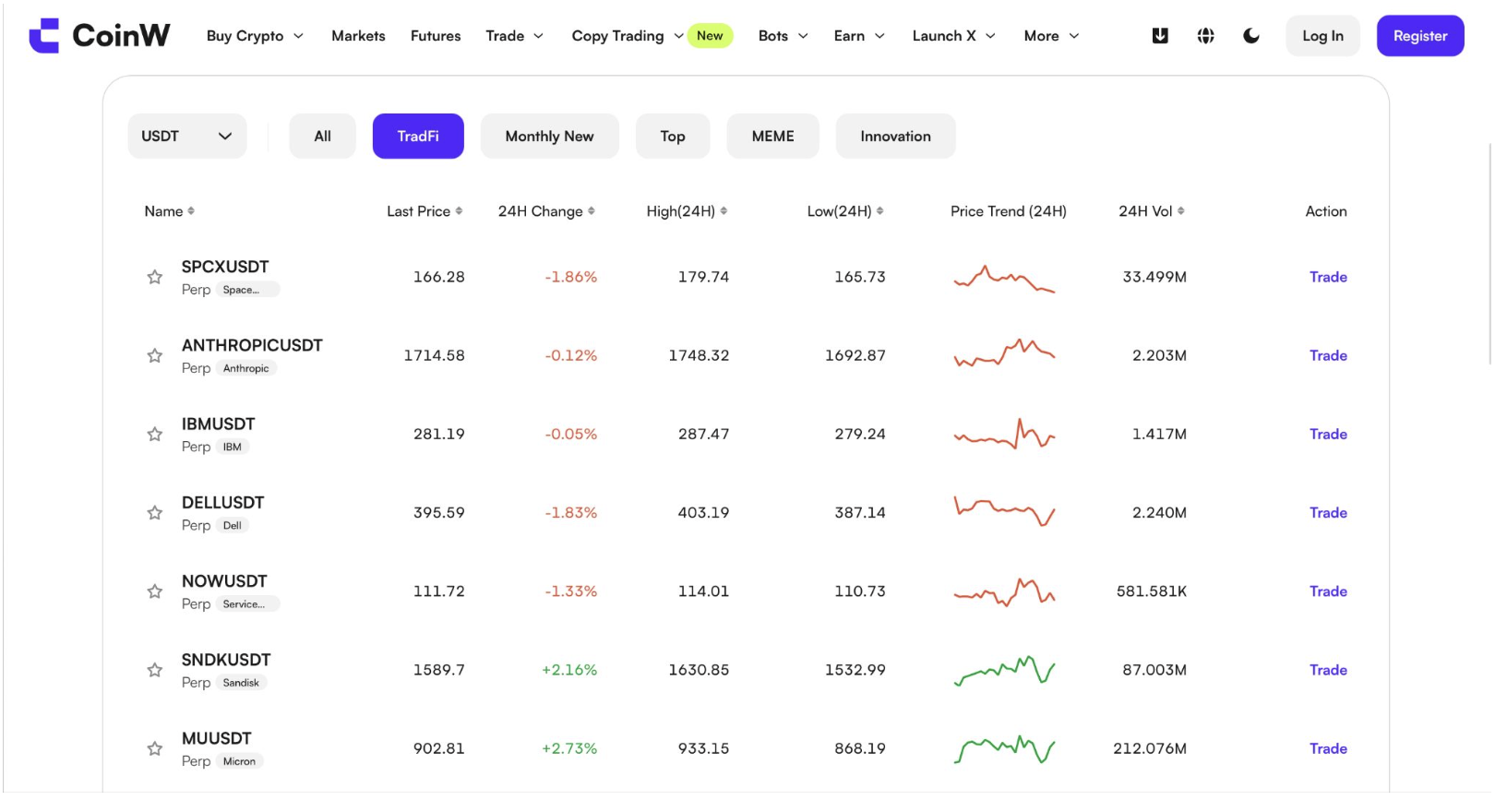


Unlike previously scattered commodity contracts, the TradFi Zone is a unified cross-market entry point. A user holding a Bitcoin position can trade the rise and fall of NVIDIA within the same account. This multi-asset integration is both a product logic and a declaration about "how broad the boundaries of crypto assets should be."


"The launch of CoinW TradFi is a milestone," said Nassar Al Achkar. "Our goal is not just to offer traditional assets, but to build a comprehensive financial platform – integrating high-impact trading varieties, a professional content ecosystem, and AI-driven intelligent tools, allowing users to connect with broader global market opportunities within one trusted platform."


The third layer is the participation barrier, a direction CoinW is focusing on during the World Cup.


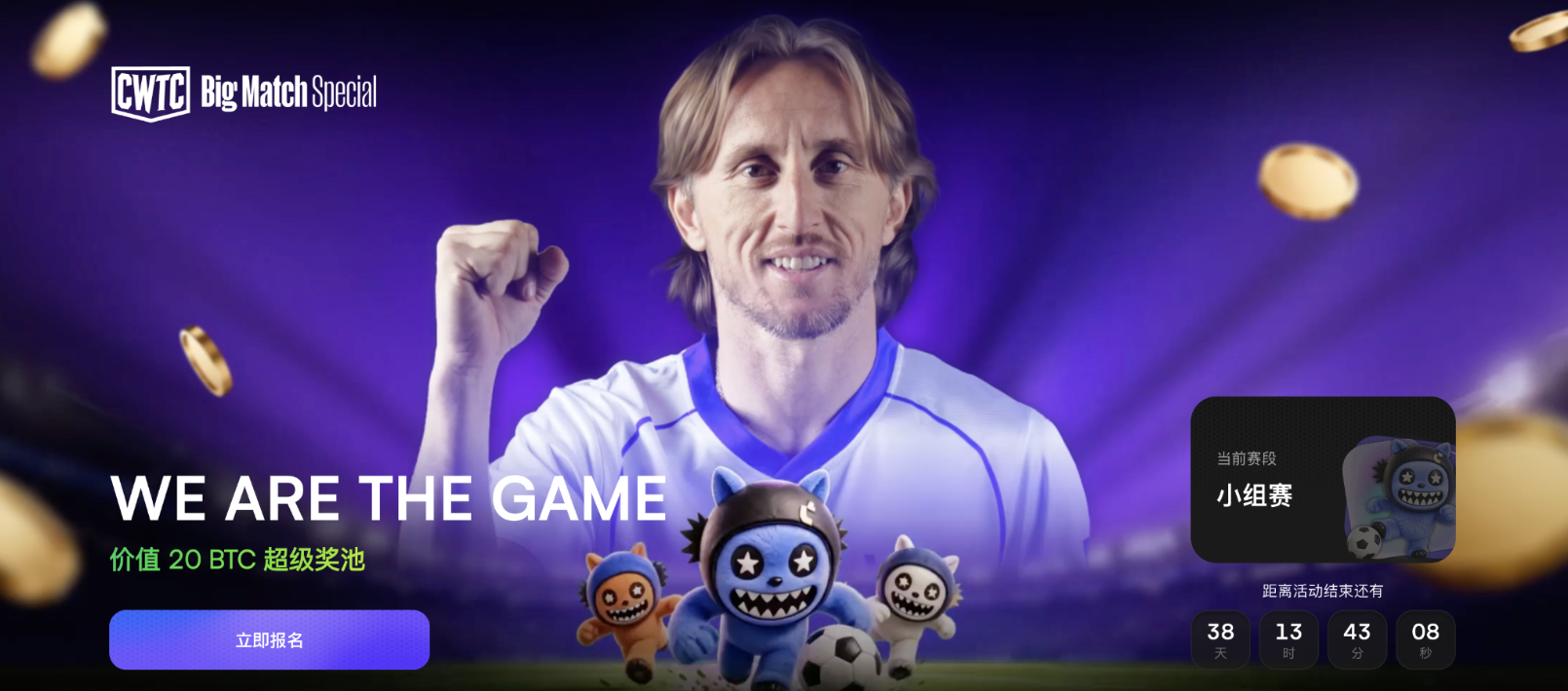
On June 10, 2026, CoinW launched "CWTC Big Match Special: We Are The Game." What's most special about the World Cup isn't just who lifts the trophy, but the fact that billions of people focus on the same match at the same time, sharing the same emotions, regardless of their time zone – this sense of collective presence is the most irreplicable narrative container in human history. "We Are The Game" borrows precisely this logic: transforming spectators in the stands into participants on the field, making trading not a spectator's game but a competitive arena where everyone can participate.


But to truly achieve "everyone's participation," the first step is to remove those invisible barriers. CoinW partnered with payment infrastructure provider Alchemy Pay, starting from the deposit process: a limited-time "0 fee" deposit promotion to alleviate Web2 users' concerns about deposit/withdrawal fees; aligning with the "US-Canada-Mexico" World Cup theme, actively opening local payment channels in Latin America, allowing users to complete deposits using their most familiar local payment methods in a more convenient and lower-fee manner without relying on credit cards.


Whether it's fans in the stands or ordinary users in front of screens, whether newcomers to crypto or seasoned veterans, as more and more people can easily enter, "We Are The Game" can truly become a sport for all.


Time Knows the Answer


The story of the crypto industry has long been a story about those already present: early adopters, institutional investors, quant teams, on-chain veterans. Yet the ordinary people standing at the doorway – those studying Modrić's data analytics, following World Cup odds, with spare funds but zero knowledge of crypto assets – are the silent majority in the industry's narrative. Their concerns are not technical, but a more fundamental issue of trust: Is this place safe? Does anyone really care if I can figure this out?


CoinW's sports initiatives – Official Regional Cryptocurrency Exchange Partner of LALIGA, Web3 Partner of the East Asian Football Federation, Modrić ambassadorship, World Cup campaign activities – are not targeting the same group already present, but that group still standing outside. Lowering cognitive barriers, providing transparent asset protection mechanisms, making traditional financial assets an option in crypto accounts, creating a sense of participation during the world's largest shared cultural moment – these decisions together form a converging path towards a broader user base.


Disclaimer: This article is for brand campaign information sharing only and does not constitute any investment advice or trading invitation. Digital asset trading carries high risks, and users are solely responsible for their own financial decisions. Service content may vary depending on the jurisdiction and is not available in all regions. The US stock-type assets provided by the platform are perpetual contracts tracking the price performance of the underlying assets, not the underlying stocks or securities themselves, and do not represent equity holdings in the related listed companies. The listed companies mentioned in the article are independent third parties and have no affiliation or cooperative relationship with CoinW.


İlgili Sorular

QWho did CoinW announce as their global brand ambassador on April 9, 2026, and why is this partnership considered strategic?

ACoinW announced Luka Modrić as their global brand ambassador. This partnership is strategic because Modrić appeals to a mature, financially stable global football audience with a high level of trust in his authority—a demographic traditionally less familiar with crypto assets. This allows CoinW to migrate the user profile from 'knowing Modrić' to 'being willing to learn about CoinW', targeting users with potentially higher long-term retention and trust.

QWhat key qualities do Luka Modrić and CoinW share, according to the article?

AAccording to the article, Luka Modrić and CoinW share the core qualities of long-termism, resilience through market/sporting cycles, and being validated by time. Both focus on steady, foundational growth (infrastructure, risk management for CoinW; skill, discipline for Modrić) rather than chasing short-term hype or explosive bursts, enabling them to endure crises and build lasting trust.

QWhat are the three main 'thresholds' or barriers to entry that CoinW's products aim to break down for new users?

ACoinW's products aim to break down three main thresholds: 1. **Cognitive Threshold**: Through CoinW Academy's free, tiered educational content. 2. **Asset Boundary Threshold**: Through integrating multiple product ecosystems (CoinW, GemW, DeriW, PropW) and launching the TradFi zone for traditional assets. 3. **Participation Threshold**: Through events like 'We Are The Game' during the World Cup and simplifying on-ramps with partners like Alchemy Pay, including zero-fee deposit periods.

QWhat is the significance of CoinW launching its 'TradFi' zone in June 2026?

AThe launch of CoinW's 'TradFi' zone is a significant product upgrade that integrates traditional financial assets (like gold, oil, stocks of Apple, Google, NVIDIA) as perpetual contracts into the platform. It represents a directional shift towards creating a comprehensive financial platform, allowing users to trade both crypto and traditional assets within a single account. This breaks down the asset boundary and is a declaration about expanding the scope of crypto asset platforms.

QHow does CoinW's World Cup 2026 campaign 'CWTC Big Match Special: We Are The Game' aim to engage users?

ACoinW's 'We Are The Game' campaign aims to leverage the massive collective engagement of the World Cup to transform spectators into participants. It seeks to make trading feel like an accessible,全民运动 (mass-participation sport) rather than a spectator activity. Key tactics include creating a shared event narrative, offering zero-fee crypto deposits via Alchemy Pay, and integrating local payment channels in Latin America to lower the practical barriers to entry for new users during the tournament.

İlgili Okumalar

WeChat AI Card Hands-On Guide: Has the AI Shopping Era Arrived?

**"WeChat AI Card" Practical Test Guide: Has the Era of AI Shopping Arrived?** WeChat has officially launched the "AI Exclusive Card," a feature integrated into its Workbuddy AI assistant. This card is designed to handle payments for AI-initiated purchases. Our hands-on test reveals it's not yet a tool for fully autonomous AI shopping, but rather a controlled payment layer for AI agents. The AI Card functions as an isolated sub-wallet within WeChat Pay. Users must bind the card and transfer funds into it from their main wallet. Crucially, every transaction requires explicit user confirmation via smartphone scan; AI cannot spend autonomously. Currently accessible through the Workbuddy agent, the card targets specific digital consumption scenarios: purchasing paid content (reports, data), calling paid APIs/tools, and subscribing to services. Its design prioritizes security and control by separating funds and mandating approval for each payment. We tested a real-world scenario: ordering bubble tea via Workbuddy using a "Meituan Life Assistant" skill. The process encountered multiple hurdles: high "skill" usage costs (exceeding daily free credits), and most importantly, while a payment was successfully initiated, the AI purchased an incorrect product (a mismatched group-buy coupon instead of the desired drink). This highlights the current limitation: the **AI Card only solves the payment step**. The broader challenge lies in the **AI agent's execution chain**—accurately understanding intent, navigating third-party platforms, selecting the right product, and ensuring proper fulfillment. The payment succeeded, but the purchase failed to meet the user's need. In conclusion, the WeChat AI Exclusive Card is a cautious, early-step experiment in AI commerce. It provides a secure, user-controlled payment method for agent interactions but is not yet capable of reliable, end-to-end complex purchases. For now, it's best used for low-value, low-risk digital services with careful user verification at each step. The vision of AI handling complete shopping tasks remains a work in progress.

marsbit45 dk önce

WeChat AI Card Hands-On Guide: Has the AI Shopping Era Arrived?

marsbit45 dk önce

Deconstructing Notion's Growth: From a Note-taking Tool to 100 Million Users—How Notion Built a Triple Growth Flywheel Through Product, Templates, and Community

Notion's growth from a niche note-taking tool to a platform with 100 million users is powered by three interconnected flywheels: Product-Led Growth (PLG), a Template Economy, and Community-Driven Growth. First, Notion's PLG strategy relies on a highly flexible, "plastic" product that users can adapt to countless personal and team workflows. Its freemium model lowers the barrier to entry, while features like page sharing and collaboration drive organic, usage-based viral growth as users naturally invite others. Second, the Template Economy solves the "blank page" problem. Templates, created by both Notion and its community, transform abstract product capabilities into concrete, copyable solutions for specific scenarios (e.g., project management, content calendars). This dramatically lowers activation costs for new users and fuels SEO-driven discovery. Third, a vibrant Community acts as a distributed growth engine. Users and official Ambassadors create tutorials, share use cases, and host local events. This community not only educates users but also fosters a sense of identity around pursuing "better ways of working," strengthening loyalty and enabling global, low-cost expansion. Together, these flywheels create a self-reinforcing ecosystem: a great product attracts users who create templates and community content, which in turn attracts more users and deepens engagement. This system allowed Notion to scale from individuals to teams and enterprises through a bottom-up adoption path. Looking ahead, AI integration promises to accelerate these flywheels further by making templates smarter and the platform a potential AI-native work operating system. Ultimately, Notion's defensible advantage is not just its features, but this deeply entrenched network of user assets, creators, and community trust.

marsbit46 dk önce

Deconstructing Notion's Growth: From a Note-taking Tool to 100 Million Users—How Notion Built a Triple Growth Flywheel Through Product, Templates, and Community

marsbit46 dk önce

$10 Billion, Qualcomm to Acquire Chip Legend Jim Keller's Company

Global mobile chip giant Qualcomm is in advanced talks to acquire AI chip startup Tenstorrent in a deal valued between $8-10 billion, according to media reports. This potential acquisition would be one of the largest in the AI chip sector in recent years. Tenstorrent, led by legendary chip architect Jim Keller, has gained prominence for its RISC-V architecture and AI accelerator designs. The move highlights Qualcomm's strategic push to diversify beyond its core smartphone chip business. As the smartphone market matures, Qualcomm is aggressively targeting growth in automotive, data center, and cloud AI. Acquiring Tenstorrent would allow Qualcomm to rapidly enter the high-end AI computing market, bypassing lengthy in-house development cycles. Tenstorrent's cost-effective system architecture, which avoids expensive HBM memory and relies on standard Ethernet for clustering, offers a potential alternative to Nvidia's costly solutions. Furthermore, Tenstorrent's high-performance RISC-V CPU technology and its focus on the automotive and edge computing segments align with Qualcomm's strategic goals, including its "Snapdragon Digital Chassis" platform. Despite the strategic rationale, the high valuation has sparked some investor caution. The successful integration of Tenstorrent's open-source culture and independent team into Qualcomm's organization, along with the commercialization of its technology, remains a key challenge.

marsbit1 saat önce

$10 Billion, Qualcomm to Acquire Chip Legend Jim Keller's Company

marsbit1 saat önce

CARDS' Brutal Truth of $535M FDV: Only $43M Net Revenue, Profit Margin Halved

The article deconstructs Collector Crypt (CC), a blockchain-based platform for trading tokenized collectible cards, revealing a significant disparity between its high volume and actual business fundamentals. Key findings include: * CC's cumulative revenue of $635M is misleading; 90.6% is instantly returned to users via card buybacks, leaving only $43M in net revenue (6.7% retention). * Trading activity is minimal, with real secondary market trading below $5M. eBay sales as a percentage of volume have declined for six consecutive quarters. * The platform's user base is highly concentrated, with a few dozen high-frequency wallets driving most of the volume, resembling a "casino" with ~420 daily active players. * As volume shifts to higher-priced card packs, the net profit margin has halved from 11.2% to 5.8%. * Token value capture (via burns and buybacks) totals only $1.4M, just 3.4% of net revenue. Meanwhile, operational wallets have off-ramped $45.7M in USDC. * With a Fully Diluted Valuation (FDV) of ~$535M, the token trades at 7.3x net revenue. The float is only 20.5%, with 72% of the supply allocated to insiders and locked until November 2027. The analysis concludes that while CC has found product-market fit as a high-speed gacha machine, it shows little evidence of evolving into a sustainable collector's marketplace, with minimal value accruing to its CARDS token.

marsbit1 saat önce

CARDS' Brutal Truth of $535M FDV: Only $43M Net Revenue, Profit Margin Halved

marsbit1 saat önce

İşlemler

Spot
Futures
活动图片