Original | Odaily Planet Daily (@OdailyChina)
Author | Asher(@Asher_ 0210)
Last night, the U.S. Department of Defense officially launched the UFO Archive Disclosure website, releasing the first batch of government documents related to UAPs, unidentified flying objects, and suspected extraterrestrial life. According to public reports, this initial release comprises over 160 documents, including videos, photos, mission records, sighting reports, communication logs, and historical archives from multiple U.S. federal agencies such as NASA, the FBI, and the Department of Defense.
These documents are not just abstract government reports; they contain a large amount of specific imagery and historical records. Among them, the Apollo mission spacecraft once captured three anomalous light points hovering above the Moon, and Apollo 17 communication logs also contain discussions among astronauts about mysterious objects approaching the spacecraft. Another batch of materials shows that unexplained objects have appeared in places like the United Arab Emirates, Greece, and Iraq.
Even more viral are those unresolved cases in the files with visual details. A jellyfish-shaped object appeared over the UAE, some materials record unidentified flying objects resembling luminous spheres and objects with an octagonal star-like shape, and the FBI has also captured anomalous targets near U.S. military aircraft. An image released by the U.S. Department of Defense also shows an unidentified object appearing over the western United States in September 2025.
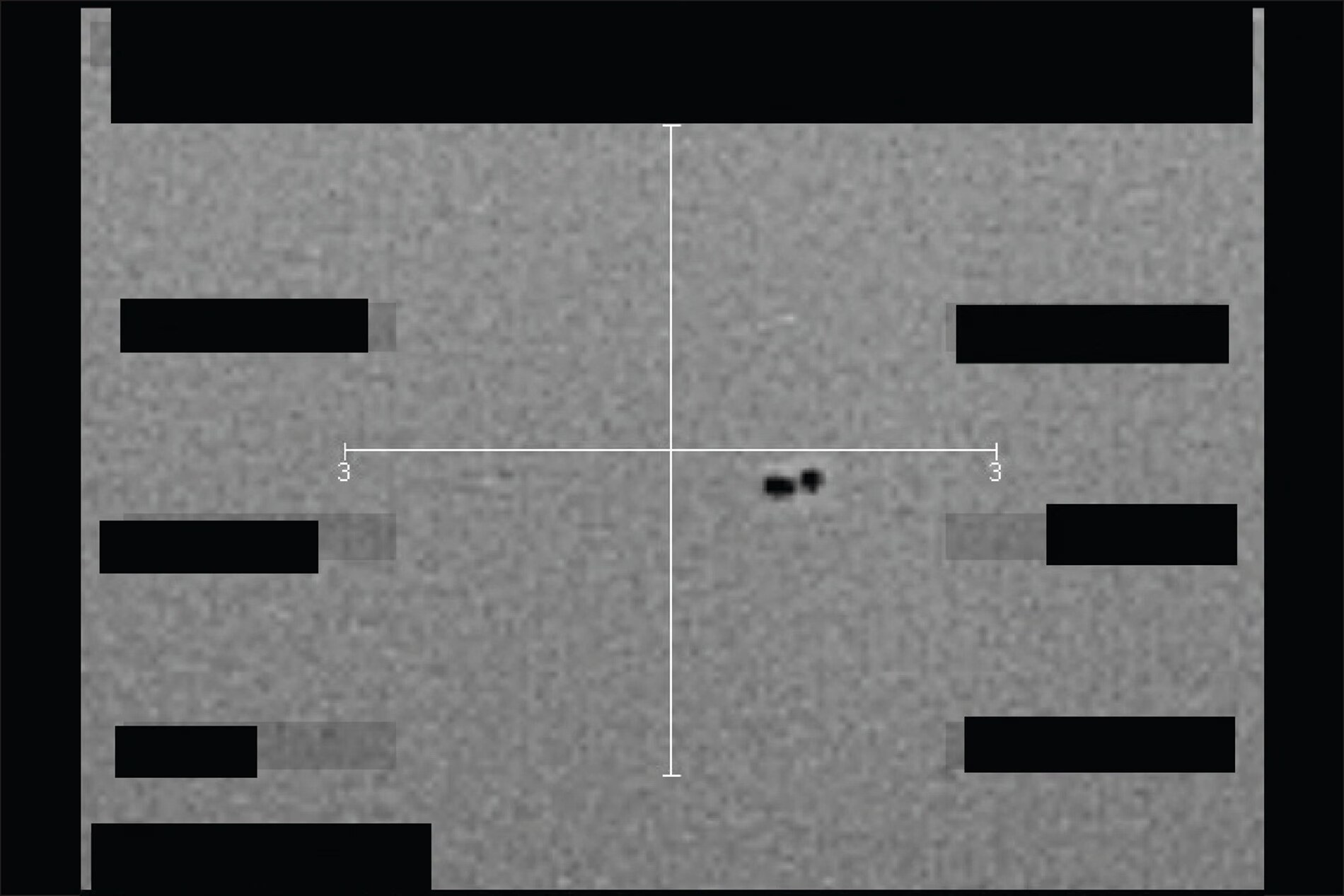
An image released by the U.S. Department of Defense claims to show an unidentified object appearing over the western United States in September 2025 (Source: U.S. Department of Defense)
Compared to mere text reports, this imagery and eyewitness testimony is more likely to cause UFO discussions to spread rapidly, making this disclosure seem more like a concentrated exhibition of "declassified archives."
However, the answer from prediction markets is much more restrained than that of social media. After the first batch of UFO files was made public, the probability for the event "Will the US confirm that aliens exist before 2026-12-31 23:59:59 ET" on the prediction market predict.fun did not surge significantly because of this explosive news. The market did not directly interpret this disclosure as "the U.S. is about to confirm alien existence," and the probability remains at only 20%.
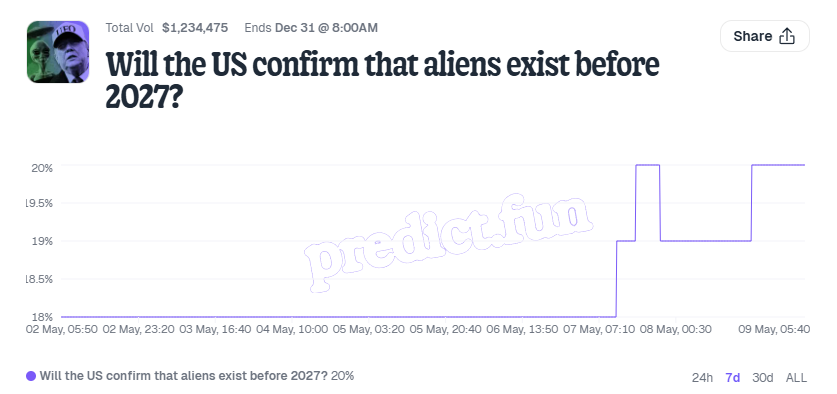
Source: https://predict.fun/market/will-the-us-confirm-that-aliens-exist-before-2027
So, why hasn't this UFO file disclosure significantly changed the judgment of the prediction markets?
Prediction Markets Are Not Betting on Whether Aliens Exist, But on Whether the U.S. Government Will Acknowledge It
Many people, upon seeing a 20% probability, might first think that the prediction market believes the probability of aliens existing is only 20%. But this actually misunderstands the market itself.
Markets like predict.fun are not truly trading on whether extraterrestrial life exists in the universe, but on whether the U.S. government will explicitly confirm the existence of extraterrestrial life or alien technology before 23:59 ET on December 31, 2026. According to the market's settlement rules, only if the U.S. President, a Cabinet member, a member of the Joint Chiefs of Staff, or a U.S. federal agency explicitly makes such a statement will the market settle as Yes; otherwise, it will settle as No. The primary settlement source is official U.S. government information, also referencing consensus formed by credible media reports.
This rule is crucial. It means that a video of an unidentified flying object is not enough, a blurry photo is not enough, an astronaut communication log is not enough, and the military admitting that some phenomena are temporarily unexplainable is also not enough. What can truly trigger a Yes is the U.S. government stating clearly enough, acknowledging that extraterrestrial life or alien technology indeed exists.
Disclosing files is merely placing more material before the public, while official confirmation means the government is backing a conclusion. The former generates discussion; the latter triggers settlement. Between them lies a line that is very difficult to cross.
Archive Disclosure Is Not an Answer Announcement
This UFO file disclosure is indeed not an ordinary information update. The U.S. Department of Defense released related materials in a centralized manner through a dedicated website and stated that more files will be released in batches continuously in the future. For the public, this means that UFO and UAP materials previously scattered across different agencies, eras, and archival systems are being reorganized into an official portal. It makes discussion more focused and makes it easier for the outside world to track what materials the U.S. government actually possesses.
However, judging from the currently disclosed content, this batch of files appears more like presenting historical sightings, anomalous imagery, mission records, and old archives to the public, rather than providing a unified explanation for these materials. The U.S. Department of Defense is not directly telling the world "what this is," but is releasing more unresolved cases, leaving the judgment space to the public.
This also puts this disclosure in a delicate position. It increases transparency but does not change the nature of the events. UFO discussions have thus gained more material, but this material primarily serves to expand the questions themselves rather than advancing unexplained phenomena to extraterrestrial confirmation.
For prediction markets, this file disclosure is more like a new starting point for observation, rather than evidence sufficient to rewrite the odds. It brings the UFO topic back to center stage and gives subsequent file updates transaction value; but the initial batch of materials still consists mainly of historical records, sighting reports, and unresolved imagery. What the market is truly waiting for is a higher-level, harder-to-ignore, and more official key signal.
Is 20% an Underestimation or an Overestimation?
From an emotional perspective, 20% might seem low. After all, UFO file disclosure has entered an official rhythm, and subsequent materials will continue to be released. If clearer military videos, higher-level internal records, or more direct assessments from federal agencies emerge in the future, the Yes price could still be rapidly revalued.
But from a market pricing perspective, 20% is not low. Because this market is not trading an open-ended question, but a question with a clear deadline. The market needs to judge not just whether the U.S. will confirm the existence of extraterrestrial life or alien technology, but also whether such confirmation will happen before the end of 2026.
Time itself is a barrier. Even if files continue to be released, even if more unresolved cases enter the public view, it does not mean the U.S. government will complete evidence review, internal coordination, political assessment, and provide a sufficiently clear conclusion within a few months. For an official system, continuing to disclose material is one thing; reaching a definitive conclusion in a short time is another.
Therefore, the current 20% probability is more like a tail-end pricing with a time discount. It does not deny that subsequent files may continue to create volatility, but it also shows that the market does not believe the initial disclosure has fundamentally changed the assessment of the event. For traders, the disclosure of files itself is not scarce; what is truly scarce is the key signal that could drive official confirmation before the end of this year. Before such a signal appears, the Yes price will find it difficult to be pushed higher solely by archival updates.
When UFOs Enter Prediction Markets, Truth Begins to Have a Price
The most noteworthy aspect of this event is no longer just a certain photo, a certain video, or a jellyfish-shaped object. UFO discussions have long remained in the realm of emotion, belief, and conspiracy narratives. Believers see more clues in every file disclosure, while skeptics continue to emphasize insufficient evidence, misidentification, and technical noise. Both sides have debated for years but find it hard to truly convince each other because they are often not discussing the same question.
Prediction markets pull this question one step closer to reality. They do not attempt to answer whether other life exists in the universe, but narrow the question down to a more specific level—will the U.S. government explicitly acknowledge the existence of extraterrestrial life or alien technology before the end of this year. They turn a previously hard-to-grasp imagination into an event that can be traded, settled, and constantly adjusted as information changes.
Therefore, this roughly 20% probability is not a final judgment on whether alien life exists, but the market's judgment on whether the U.S. government will concede by the end of this year. It truly reflects traders' comprehensive judgment of the evidence chain, official statements, and the time window.
When humanity's oldest puzzle enters prediction markets, truth is no longer just something to be awaited and discussed; it also begins to be priced. UFOs may still hang in the sky, but when they will be officially confirmed, when they will transition from unexplained phenomena to factual conclusions, has already landed in the market.