a16z Crypto Partner: Cash Flow is the Moat

链捕手2026-06-12 tarihinde yayınlandı2026-06-12 tarihinde güncellendi

Özet

Title: a16z Crypto Partner: Cash Flow Is the Moat Summary: Historically, many of the best businesses were built by positioning themselves within the "flow of funds"—facilitating the creation and transfer of value within a network and taking a cut. The more value flows through, the larger the business grows. Cryptocurrency is the first modern technology natively built for this purpose. If a startup hasn't architected its product and business to benefit from these principles, it's missing a major opportunity. Thanks to stablecoins, capital and value now move at internet speed—globally settled, 24/7, with end-to-end programmability. Blockchains are inherently network businesses. Each transaction settles on a shared ledger, and every new participant strengthens the same underlying network. Network tokens amplify this effect. A well-designed token aligns all participants—users, developers, suppliers, validators, the protocol—around a single goal: growing the network. Participants are paid proportionally to their contributions, creating a transparent feedback loop between value flowing in the system and value accumulating to those building it. This model isn't new; crypto simply makes it more accessible and scalable for startups. The pattern is consistent: find where value flows and position yourself in the middle. Examples range from railroads (earning from freight) and Standard Oil to Google, Meta, and AWS (earning from attention, commerce, and compute flows, respectively). Fi...

Author: Jason Rosenthal, a16z Operating Partner

Compiled by: Hu Tao, ChainCatcher Highlights

Many of history's greatest businesses were built by positioning themselves in the "flow of funds" – facilitating the creation and transfer of value within a network and taking a cut. The more value that flows through the network, the larger the business typically grows.

Cryptocurrency is the first modern technology natively built for this purpose. If your startup hasn't yet architected its product and business to benefit from these principles, you're missing an opportunity. Thanks to stablecoins, funds and value now flow at internet speed – 24/7, with global settlement, and end-to-end programmability. Payment rails are frictionless, unit economics are transparent, and every dollar flowing globally is addressable.

The Specific Model

Blockchains are network businesses by design. Every transaction settles on a shared ledger. Every new participant strengthens the same underlying network that the next builder can use. As more people use and build on it, the network becomes more valuable for all users.

Most companies spend years manufacturing network effects on top of traditional infrastructure. Crypto founders inherit them as starting conditions.

Network tokens amplify this. A well-designed token aligns users, developers, suppliers, validators, and the protocol around a single outcome—growing the network—and pays each proportionally to their contribution. But the protocol's revenue belongs to the people who use it. No partner rebates, no side deals. Just a feedback loop between value flowing in the system and value accumulating in the hands of the people building and growing it.

This isn't a new model. Cryptocurrency just makes it accessible and scalable for startups for the first time.

Railroads didn't make money on locomotives. They made money on every ton of grain, coal, and steel that crossed their tracks. Standard Oil, U.S. Steel, and AT&T were companies in the flow of funds. Google and Meta replaced print and TV not because their ads were better, but because they sat at the choke point where attention turned into commerce, enabling them to take a cut of trillions in commercial intent. AWS is in the flow of compute.

The pattern is consistent: find where value moves and put yourself in the middle.
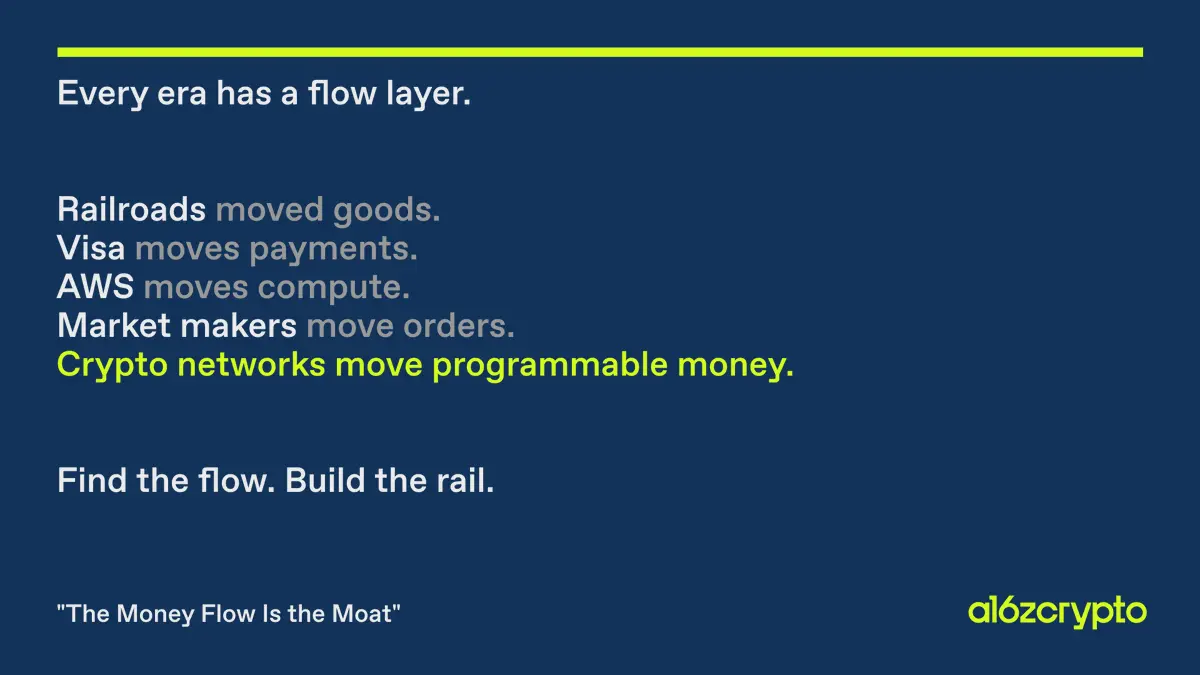
Financial markets make this model even clearer. Visa processed $15.7 trillion in payment volume in FY 2024 and reported $35.9 billion in net income. Jane Street posted $20.5 billion in net trading income last year – more than Citigroup or Bank of America. The top five US market makers handled 87% of order flow payment: they don't predict markets; they sit in the flow of every order and earn more as volume grows.

These businesses share another trait: network effects. Visa is more useful to more merchants because there are more cards; more useful to more cardholders because more merchants accept it. Same with order flow – each additional broker tightens spreads, attracting more brokers, which attracts more flow.

Flow of funds plus network effects is one of the most durable business structures ever.

Your Margin Is My Opportunity

Bezos called it “your margin is my opportunity.” He was talking about retail, but it applies even more to traditional financial services – the world's largest pool of profit extraction. Payments, custody, lending, FX, securitization, settlement, market making, without exception. Visa and Mastercard charge 2–3% transaction fees on networks designed in the 1960s. Remittance corridors take 6–9%. Prime brokers and custodians take a piece of every securities trade. Even after the US moved to T+1 settlement in 2024, funds still sit idle overnight as a structural tax on everyone involved.

Each of these margins is a target. Compress the cost, increase the speed, and potentially expand the whole market. Stripe and Square proved this was possible in payments.

Crypto founders have the opportunity to build the next version – programmable, instant, global, and natively in the flow of funds.

And the frontier extends far beyond financial services. Compute and GPU markets. Memory chips. AI training data. Energy. Robotics. Space. Rare earth metals. Each is a category where global value can begin to move at volumes the existing rails were never designed to carry.

Each is greenfield for building a flow-of-funds business on programmable infrastructure from the ground up. These markets have no existing rails, no entrenched intermediaries, and nothing to defend.

As a founder, ask yourself:

1. Are you in the flow of funds today?

2. When the value of activity on your product grows 10x, does your revenue grow with it?

3. If you're building a new product, where in your target market is the profit extraction highest relative to the value being created?
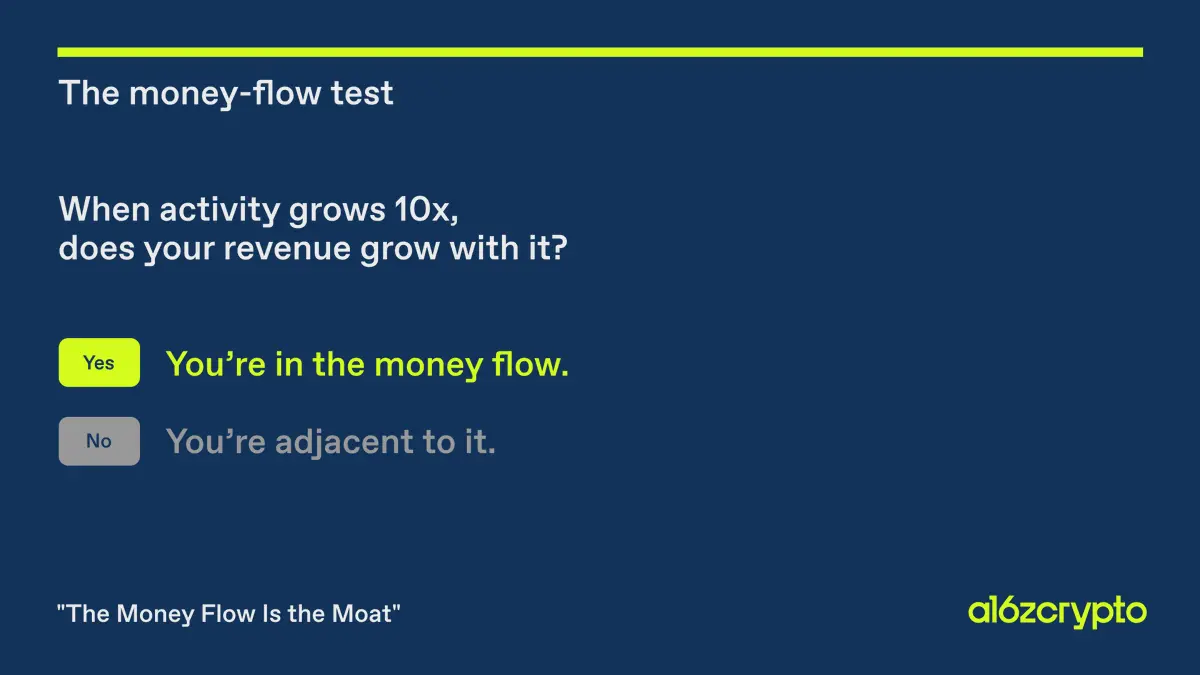
The opportunity is there. Take it, get into the new flow, and let the network compound from there.

İlgili Sorular

QAccording to the article, what is the core principle shared by historically great businesses like railroads, Google, Meta, and AWS?

AThe core principle is that historically great businesses position themselves within the 'flow of funds.' They facilitate the creation and transfer of value within a network and capture a portion of it. The more value that flows through the network, the larger the business typically becomes.

QHow does the article describe the unique advantage that cryptocurrency provides for startups regarding business models?

ACryptocurrency is the first modern technology natively built for the 'flow of funds' model. It enables value to move at internet speed—24/7, settled globally, with end-to-end programmability. This gives startups the advantage of inheriting network effects from the start and building on programmable infrastructure where payment rails are frictionless.

QWhat two powerful business concepts, when combined, does the article claim create one of the most durable business structures ever?

AThe combination of being in the 'flow of funds' and having 'network effects' creates one of the most durable business structures ever. The flow of funds generates revenue, while network effects make the service more valuable as more participants join, creating a powerful, self-reinforcing cycle.

QWhat does the article suggest is the primary target for crypto founders looking to disrupt traditional industries?

AThe primary target is the high-profit margins extracted by entrenched intermediaries in traditional industries, especially in financial services (payments, custody, lending, FX, etc.). The article quotes Jeff Bezos: 'Your margin is my opportunity.' Crypto founders can build cheaper, faster, and more programmable alternatives.

QWhat are the three key questions the article advises founders to ask themselves about their business?

A1. Are you in the flow of funds today? 2. When the value of activity on your product grows 10x, does your revenue scale with it? 3. If you're building a new product, where in your target market is profit extraction highest relative to the value being created?

İlgili Okumalar

Retail Ecology Dwindles, ZKsync Bets on Bank Pilots for a Breakthrough

Amidst declining retail activity, ZKsync is pivoting to target institutional banking as its primary growth strategy. The article explores this shift, contrasting it with the competitive "survival of the fittest" narrative by highlighting a cooperative model inspired by naturalist Peter Kropotkin. ZKsync is developing infrastructure like its private, permissioned Prividium suite for banks (e.g., Deutsche Bank's use case via Memento), enabling private transactions with public verifiability via zero-knowledge proofs. This appeals to institutions needing privacy, compliance, and Ethereum-based settlement security, unlike fully private chains (e.g., JPMorgan's Kinaxis) or consortium models (e.g., R3 Corda). However, this strategic focus has coincided with a steep decline in its public DeFi ecosystem, evidenced by plunging TVL and the departure of major protocols like Aave due to low fees. The network's future now hinges on banking adoption, with upcoming pilots like the Cari Network involving regional banks holding over $600 billion in deposits. A significant challenge is balancing this institutional focus with ZKsync's decentralized governance. Banks must operate on a network where rules and fees (denominated in the volatile ZK token) can be changed via community vote, and where a Security Council holds emergency control—a stark contrast to the predictable, contract-bound environments of traditional finance. The coming 18 months will test whether ZKsync can successfully onboard traditional banks onto a dynamically governed public chain or if institutions will ultimately revert to proprietary solutions.

Foresight News30 dk önce

Retail Ecology Dwindles, ZKsync Bets on Bank Pilots for a Breakthrough

Foresight News30 dk önce

The Recursive AI Anthropic Warned About: Tian Yuandong's New Company Has Just Taken the "First Step"

Anthropic recently highlighted the rapid progress toward "recursive self-improvement," where AI systems autonomously design and train their successors. In response, Recursive Superintelligence, a new company co-founded by former Meta researcher Tian Yuan Dong, has publicly demonstrated its first step toward automating AI research. The company released a system designed to autonomously execute the full AI research cycle: generating ideas, implementing code, running experiments, and learning from results. It validated this approach by achieving state-of-the-art results on three diverse benchmarks: 1. **NanoChat Autoresearch:** Optimizing a small language model's validation loss under a fixed 5-minute GPU budget, improving upon the community's best result. 2. **NanoGPT Speedrun:** Reducing the time to train a GPT model to a specific loss on 8 H100 GPUs from 79.7 seconds to 77.5 seconds, beating a highly optimized, human-driven community effort. 3. **SOL-ExecBench:** Improving the overall score on NVIDIA's suite of 235 GPU kernel optimization tasks by 18%, closing the gap to the hardware limit. The system discovered novel optimizations in this highly specialized domain without direct human expertise. Recursive's system operates as a general framework, capable of parallel exploration and cross-task knowledge transfer while incorporating safeguards against reward hacking. The company, backed by $650M in funding and a star-studded team including Richard Socher and Alexey Dosovitskiy, aims to create AI that recursively enhances its own research capabilities. This development represents an early but concrete move toward a new paradigm where AI accelerates its own advancement. It occurs alongside Anthropic's warnings about the need for industry coordination and potential pauses when recursive self-improvement thresholds are reached, highlighting the dual trajectory of rapid technical progress and growing calls for careful stewardship.

marsbit37 dk önce

The Recursive AI Anthropic Warned About: Tian Yuandong's New Company Has Just Taken the "First Step"

marsbit37 dk önce

The Gold Buy-on-the-Dip Guide: Watch Interest Rates, Not Just War

"Gold Buying Guide: Focus on Interest Rates, Not Just War" Four months ago, gold buyers likely didn't anticipate buying at a peak that even a war couldn't sustain. After hitting a record high of $5,596 on January 29, gold entered a bear market just 91 days later, its fastest decline since 2008. A key trigger was the Fed's hawkish shift, highlighting that monetary policy, not geopolitics, is the primary driver. The article argues that the traditional "buy gold in turmoil" script has changed. While the US-Iran conflict initially boosted prices, the sustained rally in oil prices heightened inflation fears, forcing central banks to maintain or consider tighter policy. Since gold yields no interest, higher rates increase its opportunity cost, eroding its appeal. This dynamic was evident when gold fell sharply on May 18 despite positive peace talks, as lower oil prices eased inflation and thus rate hike pressures. The recent sell-off is also part of a broader market deleveraging. Correlations between gold, Nasdaq, and Bitcoin spiked as leveraged investors sold liquid assets to cover losses, creating a synchronized downturn. Historically, gold bottoms align with policy shifts, not conflict resolutions. The 2008 and 2022 bear markets ended with shifts to extreme easing and peak inflation expectations, respectively. For potential buyers, the author suggests monitoring three signals: 1) Peak interest rate hike expectations, 2) Reopening of the Strait of Hormuz (to ease oil/inflation pressure), and 3) A return to net inflows for Gold ETFs, indicating the end of forced selling. While predicting the exact bottom is impossible, the author's personal strategy involves scaling into a position across price levels like $4000, $3700, and $3500, committing no more than 30% of the intended total allocation initially, and adding the remainder only if key signals emerge. The core conclusion: In turbulent times, watching interest rates is more crucial than watching wars.

marsbit44 dk önce

The Gold Buy-on-the-Dip Guide: Watch Interest Rates, Not Just War

marsbit44 dk önce

Recent On-Chain Review: No Clear Narrative Under U.S. Stock Market Pressure, Just Hype

This article analyzes the current state of the Solana meme coin and community token ecosystem, highlighting a market caught between two dominant forces: attention-based PvP and a gradual return to community-centric projects. The first part explores the "Attention PvP" dynamic, where success is driven by celebrity endorsements, viral events, and speed. Examples include $JOTCHUA, which surged after its meme creator's social media activity, and $WORLDCUP, which outperformed a similar Base chain project ($PITCH) largely due to influencer support. The recent "pump.fun GO" feature, allowing bounty tasks for token promotion, is critiqued for fostering sensationalist and often negative stunts—like people getting token tickers tattooed on their bodies for rewards—reminiscent of old internet shock content. In contrast, the article points to a resurgence of organic, community-driven tokens that survive market volatility through strong holder bases and shared ideology, not just hype. Influencer Ansem is cited, arguing that durable meme coins rely on communities willing to endure losses and promote their core message daily. Examples given are older tokens like $neet (anti-work ethos), $troll, $buttcoin, and $triplet, which have maintained relative price stability. A prime example of this community-build model is the new project $KINS, the token for the browser-based MMORPG Kintara. Its success stems not from advanced graphics but from consistently delivering updates, fostering player trust, and creating genuine engagement (e.g., in-game economies, events, property auctions). It has attracted a growing player base and even notable KOLs as participants, demonstrating that sustainable growth can come from building trust rather than orchestrating pumps. The article concludes by questioning whether the market is ultimately a game of mutual trust or mutual deception, expressing hope that such reflection might lead to a healthier ecosystem.

marsbit44 dk önce

Recent On-Chain Review: No Clear Narrative Under U.S. Stock Market Pressure, Just Hype

marsbit44 dk önce

İşlemler

Spot
Futures

Popüler Makaleler

FLOW Nasıl Satın Alınır

HTX.com’a hoş geldiniz! Flow (FLOW) satın alma işlemlerini basit ve kullanışlı bir hâle getirdik. Adım adım açıkladığımız rehberimizi takip ederek kripto yolculuğunuza başlayın. 1. Adım: HTX Hesabınızı OluşturunHTX'te ücretsiz bir hesap açmak için e-posta adresinizi veya telefon numaranızı kullanın. Sorunsuzca kaydolun ve tüm özelliklerin kilidini açın. Hesabımı Aç2. Adım: Kripto Satın Al Bölümüne Gidin ve Ödeme Yönteminizi SeçinKredi/Banka Kartı: Visa veya Mastercard'ınızı kullanarak anında Flow (FLOW) satın alın.Bakiye: Sorunsuz bir şekilde işlem yapmak için HTX hesap bakiyenizdeki fonları kullanın.Üçüncü Taraflar: Kullanımı kolaylaştırmak için Google Pay ve Apple Pay gibi popüler ödeme yöntemlerini ekledik.P2P: HTX'teki diğer kullanıcılarla doğrudan işlem yapın.Borsa Dışı (OTC): Yatırımcılar için kişiye özel hizmetler ve rekabetçi döviz kurları sunuyoruz.3. Adım: Flow (FLOW) Varlıklarınızı SaklayınFlow (FLOW) satın aldıktan sonra HTX hesabınızda saklayın. Alternatif olarak, blok zinciri transferi yoluyla başka bir yere gönderebilir veya diğer kripto para birimlerini takas etmek için kullanabilirsiniz.4. Adım: Flow (FLOW) Varlıklarınızla İşlem YapınHTX'in spot piyasasında Flow (FLOW) ile kolayca işlemler yapın.Hesabınıza erişin, işlem çiftinizi seçin, işlemlerinizi gerçekleştirin ve gerçek zamanlı olarak izleyin. Hem yeni başlayanlar hem de deneyimli yatırımcılar için kullanıcı dostu bir deneyim sunuyoruz.

269 Toplam GörüntülenmeYayınlanma 2024.12.10Güncellenme 2026.06.02

FLOW Nasıl Satın Alınır

Tartışmalar

HTX Topluluğuna hoş geldiniz. Burada, en son platform gelişmeleri hakkında bilgi sahibi olabilir ve profesyonel piyasa görüşlerine erişebilirsiniz. Kullanıcıların FLOW (FLOW) fiyatı hakkındaki görüşleri aşağıda sunulmaktadır.

活动图片