S&P 500 Falls for Third Consecutive Day, Dollar Breaks Through 13-Month High, Gold Dips Below 4000, Oil Below 70, Bitcoin Below 60000 Mark, Micron and Qualcomm Spark Major Chip Stock Rebound

华尔街日报2026-06-25 tarihinde yayınlandı2026-06-25 tarihinde güncellendi

Özet

U.S. stocks were mixed, with the S&P 500 falling for a third consecutive session as tech weakness offset gains in other sectors. The Nasdaq underperformed, with the AI semiconductor sector plunging nearly 10%. Micron and Qualcomm, however, sparked a major after-hours rally in chip stocks, with Micron surging over 16% on a strong earnings report and outlook driven by AI-related memory demand. The dollar rose to a 13-month high, pressuring dollar-denominated assets. Gold tumbled below $4,000 per ounce, and oil prices crashed, with WTI crude falling below $70 a barrel to its lowest level since before the Iran conflict, as geopolitical risk premiums faded with improved Middle East supply flows. Bitcoin briefly fell below the $60,000 mark. Treasury yields dropped sharply, with the 10-year yield falling 9 basis points, supported by the drop in oil prices easing inflation concerns. Market focus now turns to upcoming PCE inflation data for further direction on Fed policy.

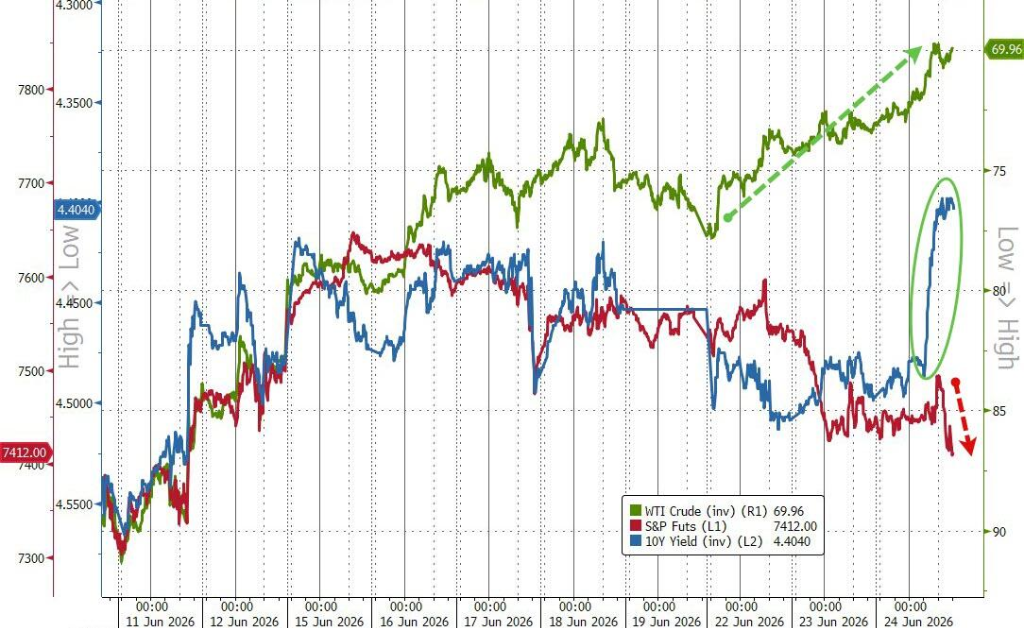
The weakness in the tech sector led to mixed intraday performance for major U.S. stock indices. Oil prices fell to their lowest level since the outbreak of the Iran war, and the fading inflation risk premium pushed the 10-year U.S. Treasury yield down by 9 basis points in a single day.

The dollar broke through a 13-month high, weighing heavily on the commodity markets. Gold prices briefly fell below $4000, oil dropped below $70, and Bitcoin once dipped below $60,000.

Micron Technology's stock jumped over 16% after-hours as the company reported earnings that beat analyst expectations. An AI-driven shortage of memory chips is driving product prices significantly higher. The Nasdaq 100 ETF rose 1% after-hours.
Following an overnight V-shaped recovery in South Korean stocks, the three major U.S. indices initially rose after Wednesday's opening. However, selling pressure began as European markets closed and persisted with each rebound attempt. The Nasdaq experienced the largest decline, while the Dow Jones and the small-cap index barely managed to hold onto gains.
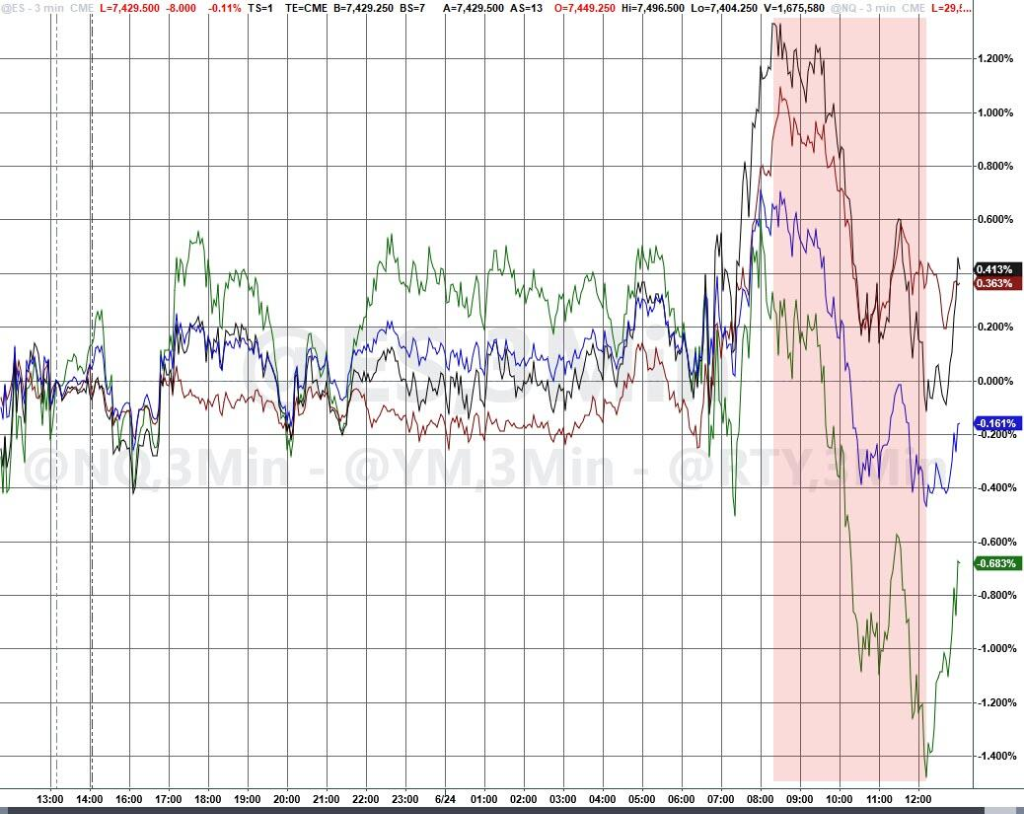
Notably, despite overall index pressure, more than 310 stocks in the S&P 500 closed higher on the day. The 'Magnificent Seven' tech giants underperformed the remaining 493 S&P components, showing a clear "rotation" pattern in the market.
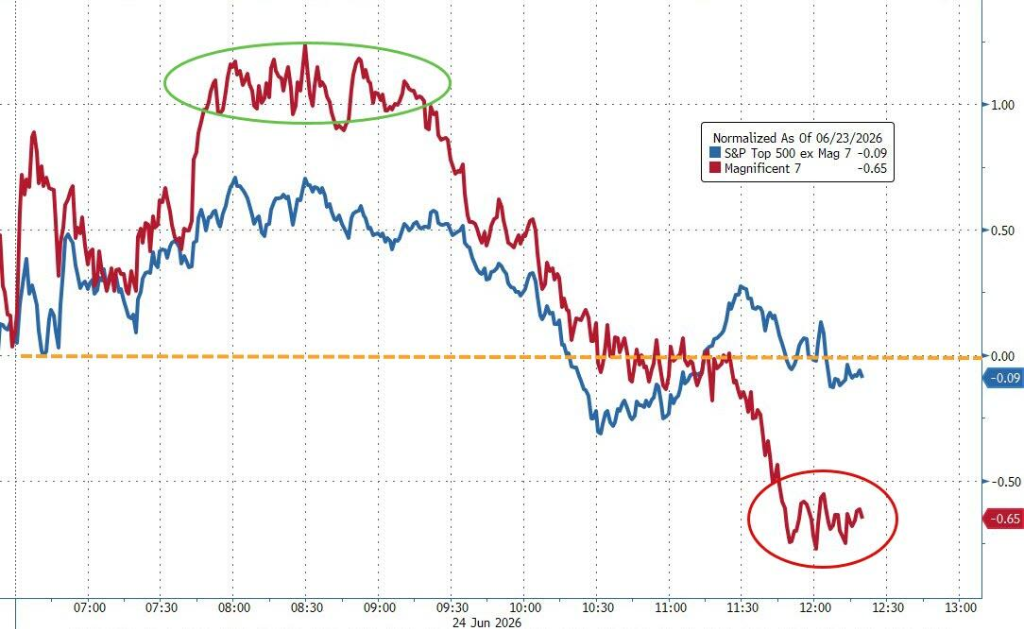
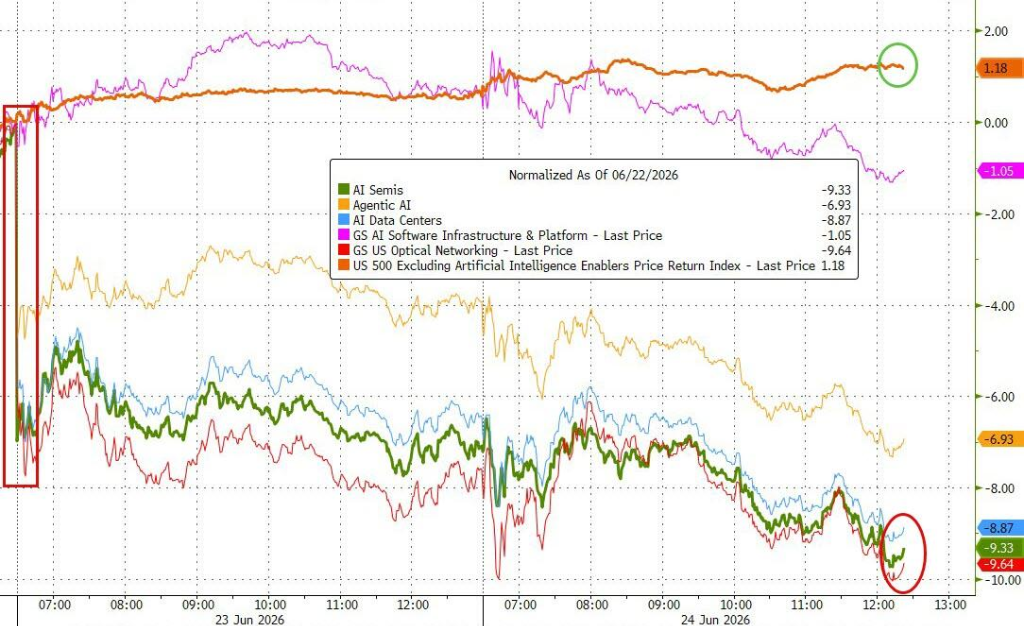
Technology and energy stocks were the biggest drags of the day, while consumer discretionary and industrial sectors relatively outperformed. Over the past two days, the AI "leader" sector has shown notable weakness. The S&P 500 index (excluding the AI sector) actually rose over 1%, while the AI semiconductor sector plummeted nearly 10%.
The Philadelphia Semiconductor Index fell 0.82% for the day. Qualcomm dropped over 4%, Arm and Marvell Technology fell over 3%, ON Semiconductor declined over 2%, and Micron Technology also fell 0.81%.

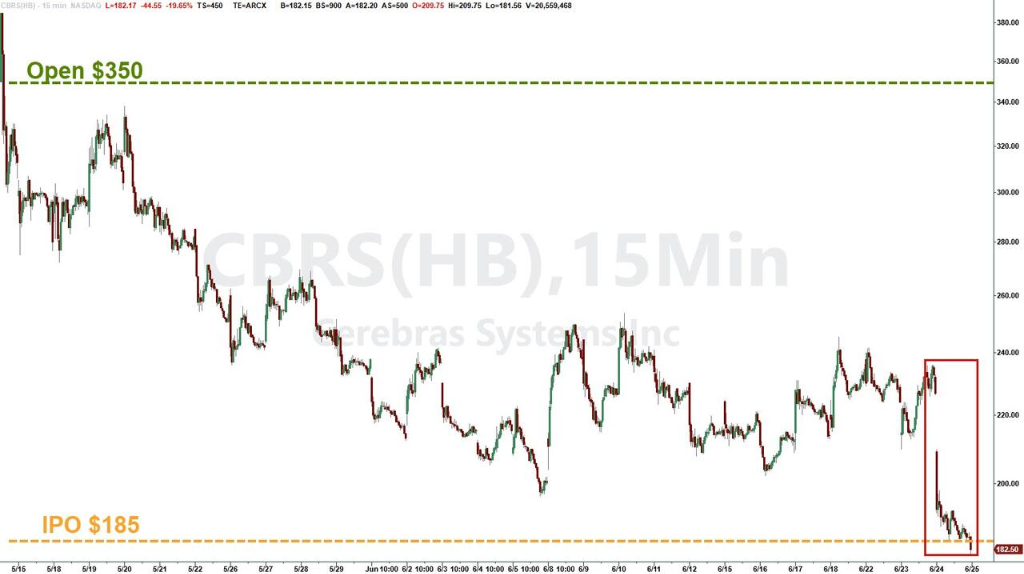
Cerebras Systems plunged about 19%, falling below its IPO issue price after the company forecast its full-year profit margin would be lower than Q1 levels in its first post-IPO quarterly report.
OpenAI announced the launch of its first self-developed AI chip, codenamed "Jalapeño," jointly developed with Broadcom on the same day, further increasing competitive pressure on external chip suppliers.

Mark Hackett of Nationwide believes the recent tech weakness is more of a position adjustment and rotation rather than a fundamental warning signal. Rick Gardner of RGA stated:

Stocks rose too fast and too much; a pullback was almost inevitable. For investors underweight this sector, this correction actually provides a buying opportunity, as the fundamentals of this sector remain strong.

Micron Technology's after-hours report of its fiscal 2026 Q3 (ended May 31) results and guidance became a key variable for whether the market could stabilize.

As mentioned by Wall Street News, Micron's Q3 revenue grew approximately 346% year-over-year to $41.46 billion, about 16% above analyst expectations. Non-GAAP adjusted EPS grew over 12-fold to $25.11, more than 20% above estimates.

Analysts generally believe the guidance is even more important than the quarterly data itself. Micron expects Q4 adjusted revenue between $49 billion and $51 billion, implying record revenue this quarter. The midpoint guidance of $50 billion is 15.6% above analyst expectations.

Nomura pointed out that the implied volatility premium for Micron's earnings in the options market exceeded the market impact of recent Federal Reserve meetings. The options market implied a breakeven volatility range of about ±7% to 8%. If the actual price movement reaches 10% and breaks this range, the market may interpret it as a signal verification of demand in the semiconductor and AI industry chain, potentially triggering broader directional volatility in tech stocks.

In the end, Micron's after-hours sales forecast was comprehensively ahead of market expectations, causing its stock price to jump over 16%, drawing a provisional pause to the tech sell-off of the previous days.
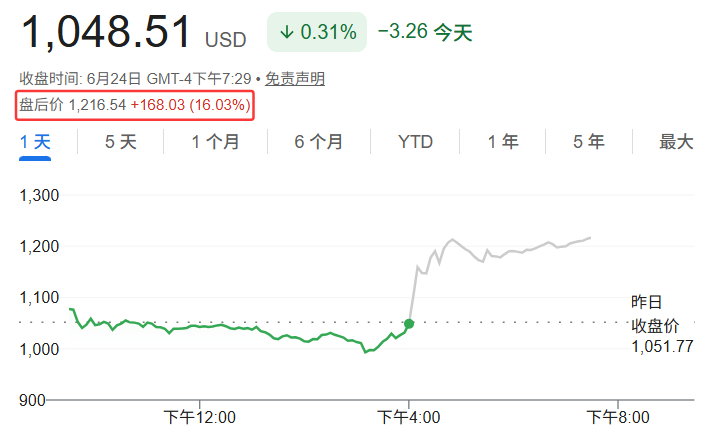
Memory stocks hit highs again after Micron's report, and the rally wasn't limited to Micron or just 16%. Influenced by Micron's results, Qualcomm's stock price also rose over 10%.

At an investor day event on Wednesday, Qualcomm made a series of positive comments on the growth prospects in the AI field. The company stated that its expansion into data center chips would generate "billions of dollars" in revenue in the fiscal year starting in October.

Other U.S. chip stocks also surged after-hours. Memory stocks Western Digital, SanDisk, and Seagate Technology all jumped over 10%.

Arm and Applied Materials rose over 6%, ASML and Intel gained over 4%, AMD climbed over 3%. In early Thursday Asia-Pacific trading, Nasdaq 100 index futures once surged over 2%.

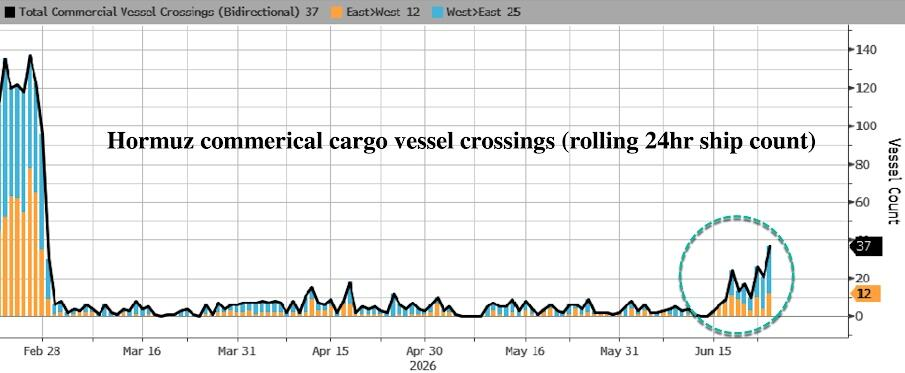
According to International Energy Agency estimates, UAE oil exports have recovered to nearly 85% of pre-war levels, reflecting a significant increase in oil shipments via the Strait of Hormuz in recent weeks.

Just the UAE alone sold about 60 million barrels of crude from within the Persian Gulf in recent weeks. Data shows vessel traffic through the Strait of Hormuz has reached new highs since the signing of the Memorandum of Understanding and continues to rise.
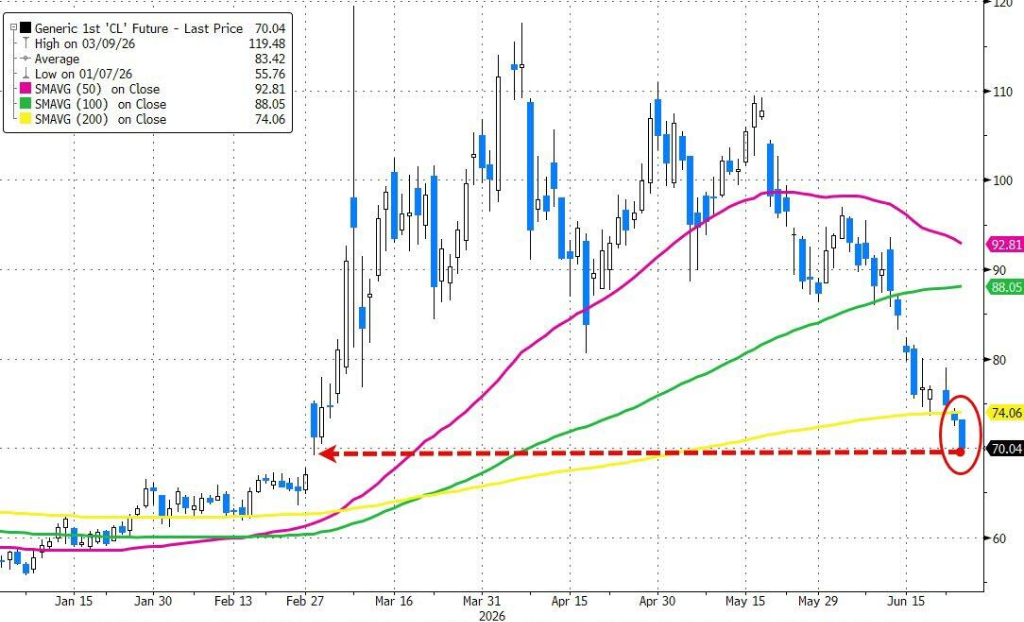
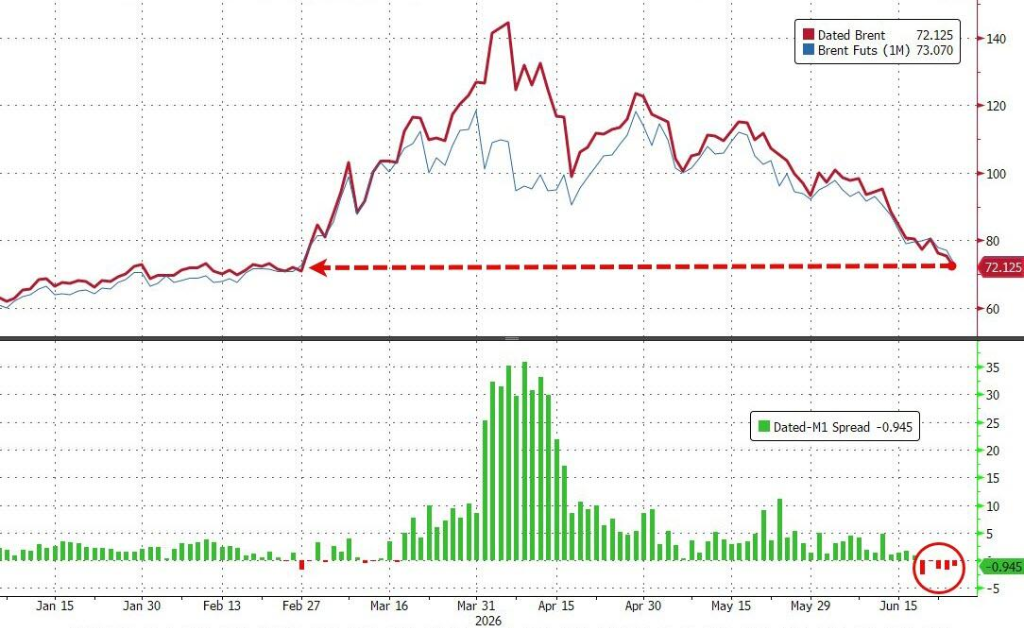
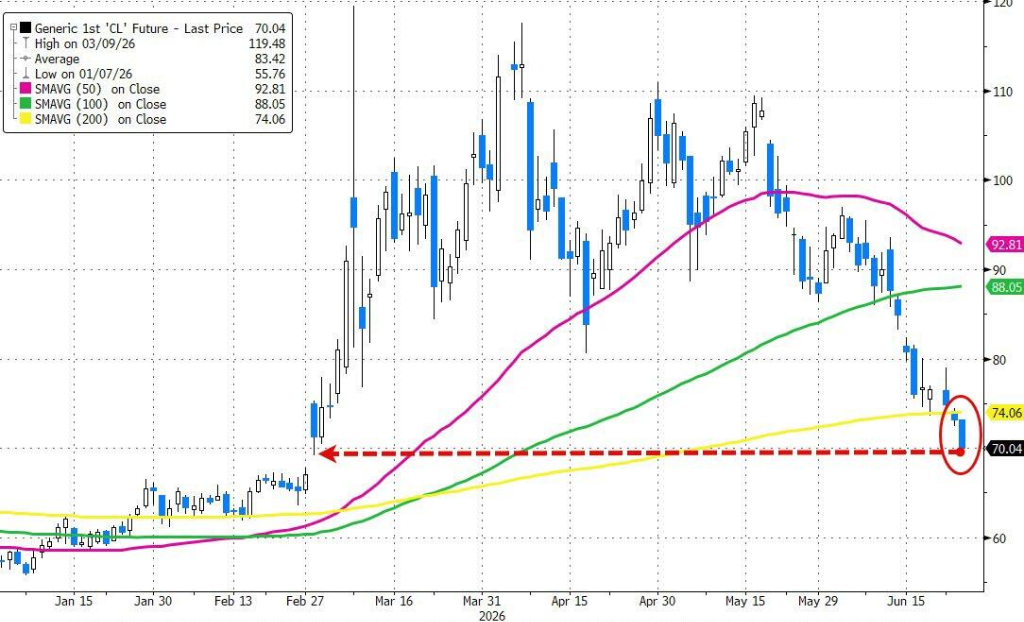
The spot crude market also softened, with premiums for regional crudes relative to benchmarks from the North Sea to West Africa rapidly declining. WTI crude futures broke below $70, touching near pre-war lows, with a daily drop of 4.5%.
Brent crude has largely erased all the geopolitical risk premium accumulated since the outbreak of the Iran war.
On the news front, Trump posted on social media on the 24th, stating Iran had informed the U.S. it would not impose any transit fees, insurance fees, or other charges on vessels passing through the Strait of Hormuz. However, he also threatened that negotiations would terminate immediately if this information was false.

He also revealed the U.S. would unfreeze some Iranian funds for purchasing U.S. agricultural products, but no funds have been unfrozen yet. He told reporters after meeting with Senate Republicans:

I see oil just fell below $70, who would have thought this would happen? And this is during wartime. Iran is behaving very well.

Stephen Innes, Managing Partner at SPI Asset Management, pointed out, "The oil price decline is not because the market believes geopolitical risks have disappeared, but because the improvement in physical flows has been faster than expected."

Options market data shows investors are positioning for further downside in oil, with put option volume exceeding call options. The most actively traded contracts are August and September expiry puts with strike prices between $60 and $68.

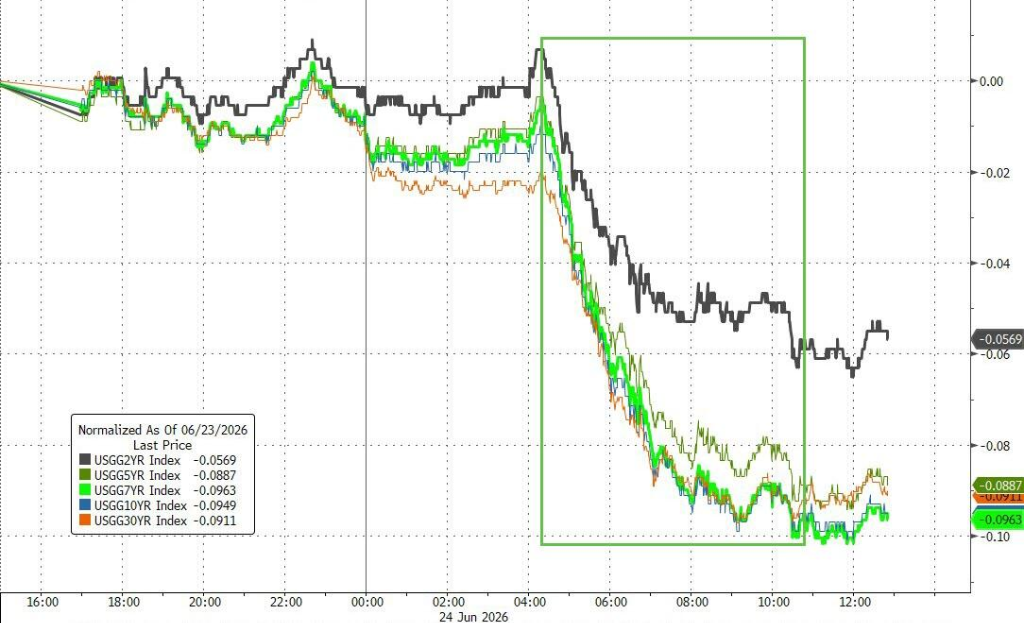
The oil price decline provided a clear boost to the bond market. The 10-year U.S. Treasury yield fell 9 basis points to 4.40%, and the 30-year yield touched 4.85%, its lowest level since April 8th.
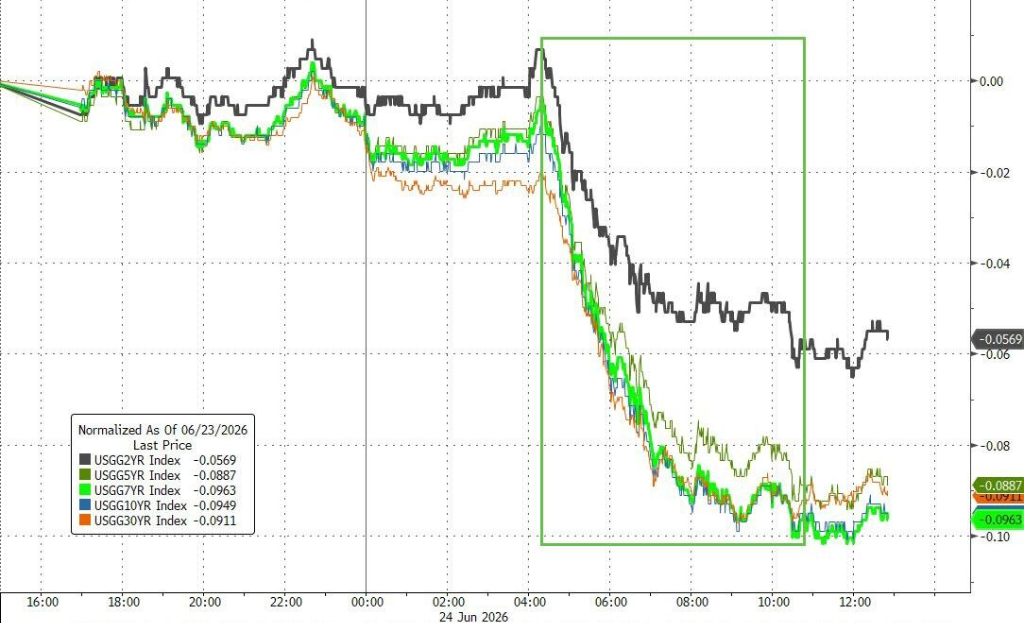
The PCE price index release on Thursday will be the next key node. Forecasters expect the May data to show acceleration on both a monthly and yearly basis, providing a new reference for the Federal Reserve's policy direction.

Goldman Sachs Chief Economist Jan Hatzius reiterated that his baseline forecast remains for no rate hike, citing that a lasting peace in the Middle East would create a more moderate inflation environment than the Fed currently expects.
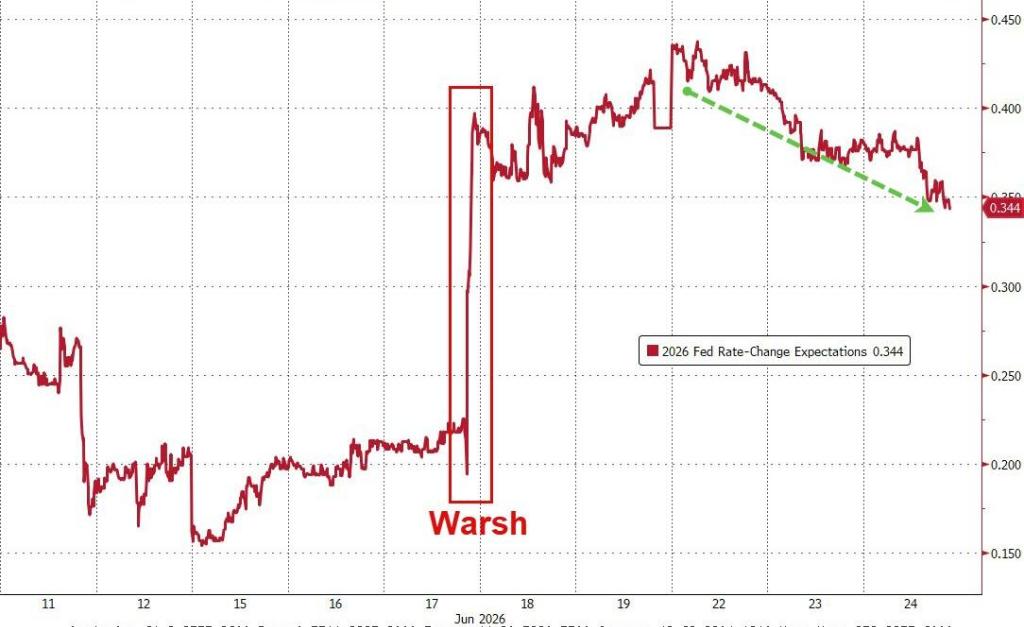
The logic chain for gold's pressure is clear: cooling geopolitical tensions reduce safe-haven demand, rising Fed rate hike expectations support a stronger dollar, and a stronger dollar directly depresses dollar-denominated precious metal assets.

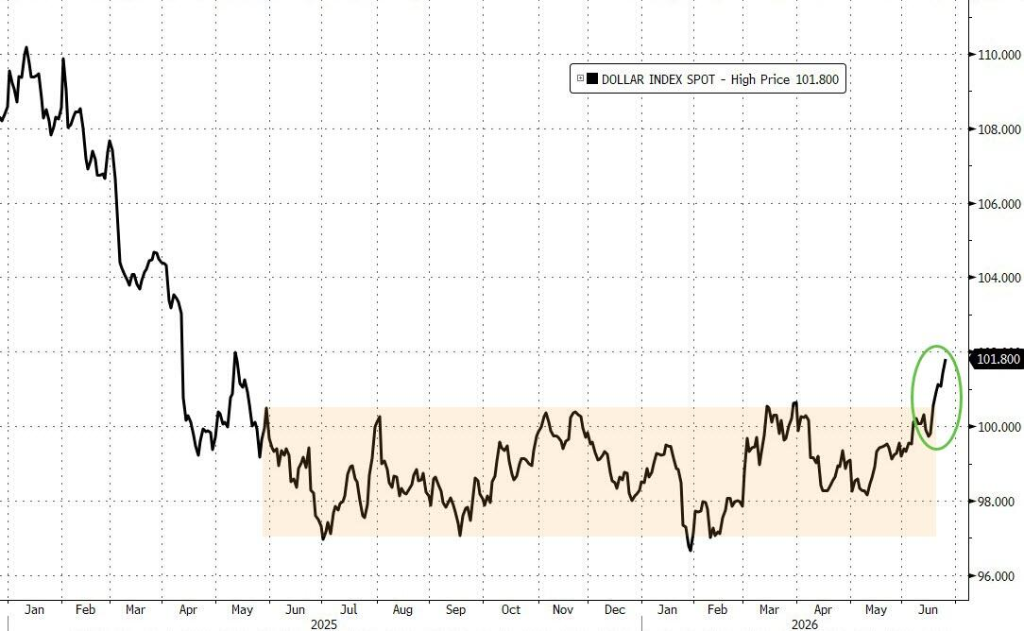
The U.S. Dollar Index (DXY) continued to hit new 13-month highs.
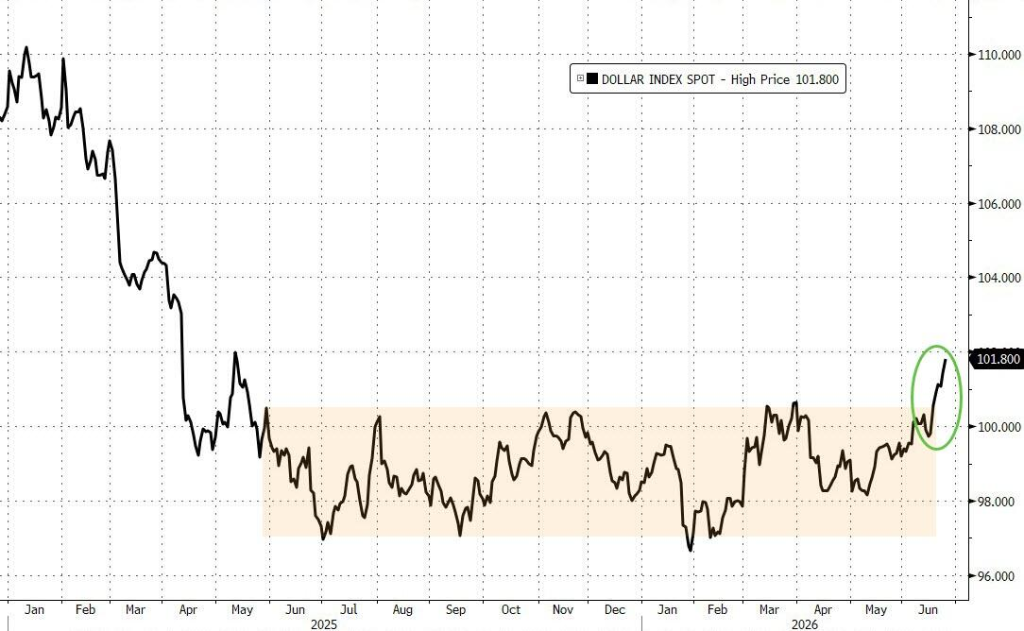
On the policy front, U.S. Treasury Secretary Besant stated on CNBC that negotiations with Iran involved having Iran price its oil and gas exports in dollars, Venezuela is returning to the dollar system, and Russia is expected to return to dollar settlements after the Russia-Ukraine conflict ends. He characterized these developments as part of a broader reshaping of the dollar's global dominance.

Besant also predicted U.S. GDP growth could return to 3% within the year. The strong dollar narrative thus gained policy endorsement, further suppressing gold's attractiveness.

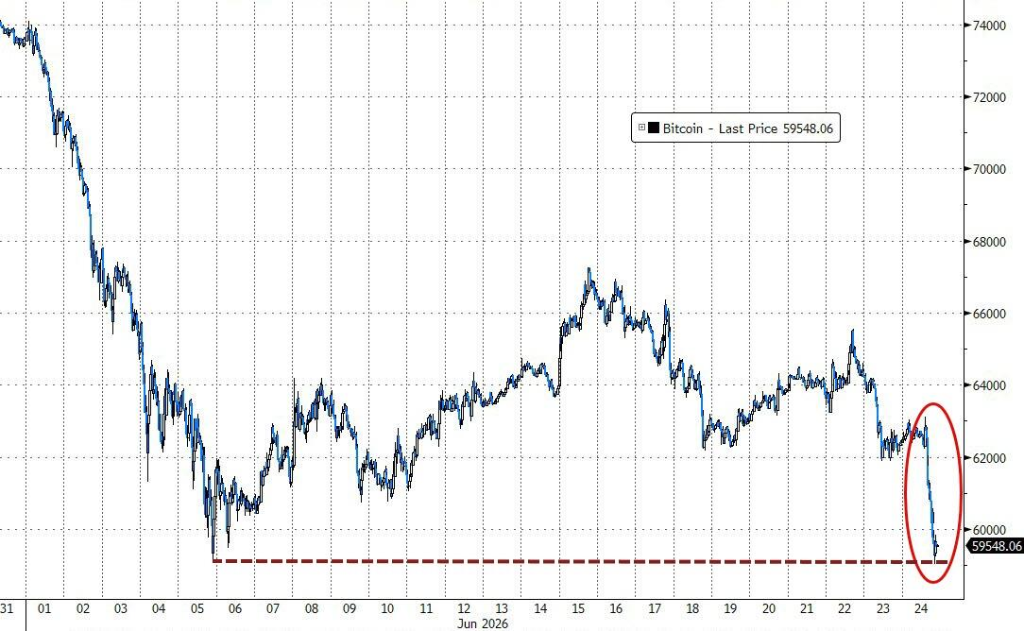
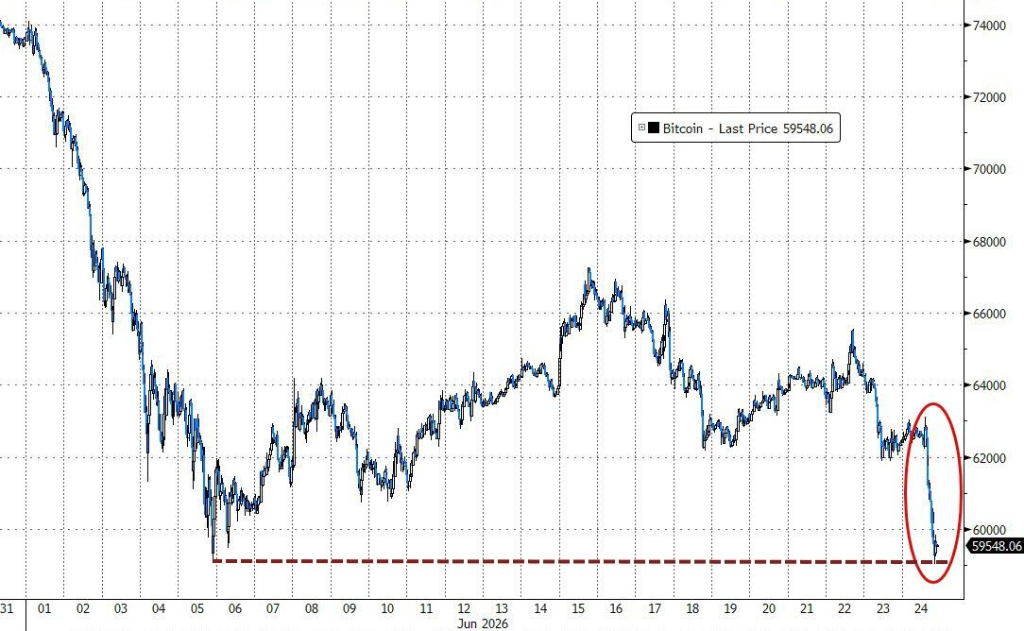
Amid the strong dollar, Bitcoin plunged over 5.3%, once breaking below the $60,000 mark during the session.
Persistent weakness in tech stocks on Wednesday left the S&P 500 essentially flat, with the Nasdaq Composite falling 0.41%, but the Dow Jones Industrial Average rising 0.36%. The Nasdaq Biotech Index and the Regional Bank Index hit record closing highs. Cerebras Systems plunged 19% during the session.

Major U.S. Stock Indices:

  • The S&P 500 Index closed down 7.24 points, or 0.10%, at 7358.22.

  • The Dow Jones Industrial Average closed up 182.06 points, or 0.35%, at 51848.90.

  • The Nasdaq closed down 110.403 points, or 0.43%, at 25476.636. The Nasdaq 100 Index closed down 127.216 points, or 0.43%, at 29220.056.

  • The Russell 2000 Index closed up 0.37% at 2986.629.

  • The VIX Volatility Index closed down 4.31% at 18.65, showing an M-shaped pattern since 00:00 Beijing Time.

U.S. Sector ETFs:

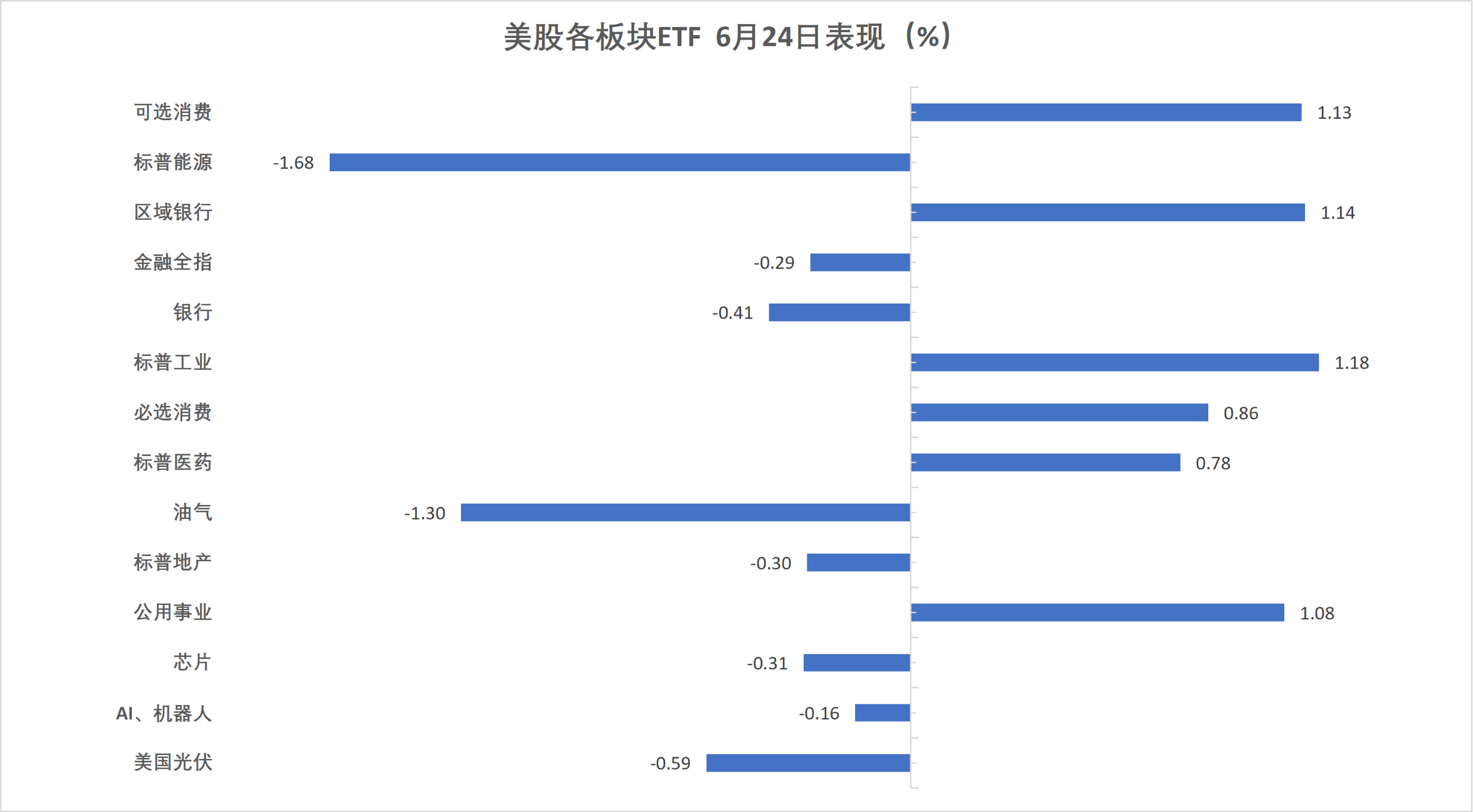
  • Most U.S. sector ETFs closed higher. The Global Airlines ETF rose 4.17%, the Biotech Index ETF, Regional Bank ETF, Consumer Discretionary ETF, and Utilities ETF rose up to 1.93%.

(U.S. Sector ETFs on June 24)

Magnificent Seven Tech Giants:

  • The Wind Magnificent 7 Index fell 0.70%.

  • Amazon rose 0.11%, Google (Class A) fell 0.25%, Apple fell 0.38%, Nvidia fell 0.56%, Meta fell 0.78%, Tesla fell 1.61%, Microsoft fell 2.27%.

Chip Stocks:

  • The Philadelphia Semiconductor Index closed down 0.18% at 13458.195.

  • TSMC ADR rose 1.01%, AMD fell 0.15%.

Chinese Stocks:

  • The Nasdaq Golden Dragon China Index closed down 1.77% at 5847.87, approaching its September 20, 2024 close of 5838.26 and its August 28, 2024 close of 5399.48.

  • Among popular Chinese stocks, Nio, Meituan, and Alibaba fell at least about 3%, Baidu fell 2.3%, PDD fell 1%, Tencent rose 2.4%, ASE Technology rose 3.5%.

Other Notable Stocks:

  • Circle fell 6.20%.

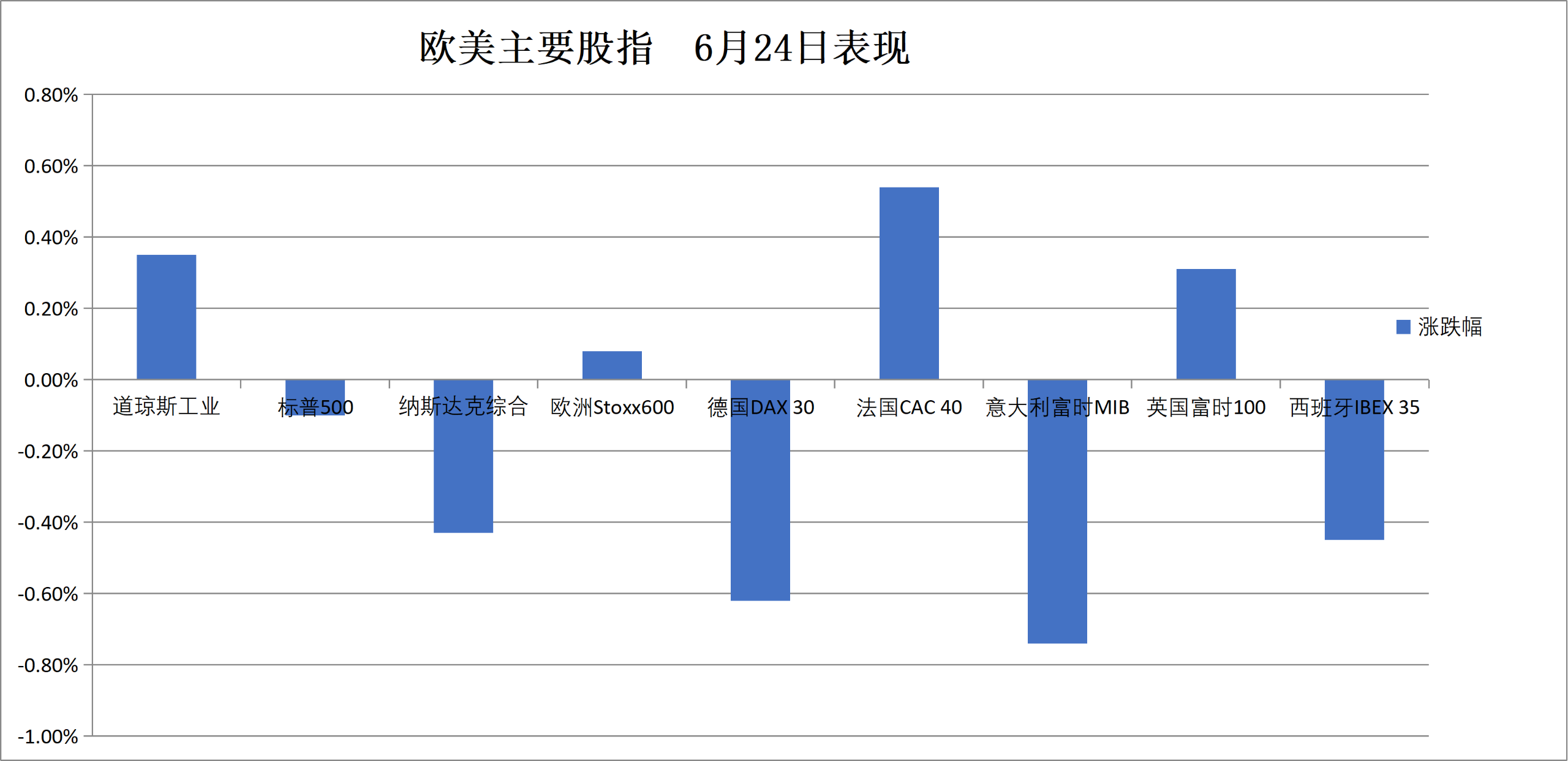
Eurozone blue-chip stocks closed down over 0.2%, with defense stock Rheinmetall (RHM) falling over 18.6%, leading declines among constituents. German stocks closed down over 0.6%, Defense ETF fell over 2.6%, UK's FTSE 250 rose over 0.7%.

Pan-European Indices:

  • The STOXX Europe 600 Index closed up 0.08% at 635.16.

  • The EURO STOXX 50 Index closed down 0.25% at 6214.70.

National Indices:

  • Germany's DAX 30 Index closed down 0.62% at 24740.36.

  • France's CAC 40 Index closed up 0.54% at 8385.49.

  • The UK's FTSE 100 Index closed up 0.31% at 10461.63.

    (Performance of Major European and U.S. Indices on June 24)

Sectors and Stocks:

  • Among Eurozone blue-chips, Germany's Rheinmetall (RHM) closed down 18.65%, Argenx fell 7.92%, Eni fell 3.28%, Deutsche Bank fell 2.58%, Volkswagen fell 2.44%.

  • Among all constituents of the STOXX Europe 600, Soitec closed down 10.888%, Hochschild Mining fell 9.03%, KGHM Polska Miedź S.A. fell 7.29%, joining RHM and Argenx as leading decliners.
Medium and long-term U.S. Treasury yields fell over 10 basis points. Eurozone sovereign bond prices rose broadly, with the 10-year Greek bond yield down about 6 bps. The UK 30-year gilt yield fell about 8 bps.

U.S. Treasuries:

  • At the New York close, the yield on the 10-year U.S. Treasury note fell 10.47 basis points to 4.3922%.

  • The 2-year yield fell 5.28 bps to 4.1456%; the 30-year yield fell 10.57 bps to 4.8396%.

    (Yields on Key U.S. Treasuries)

European Bonds:

  • At the European close, the yield on the 10-year German Bund fell 5.5 bps to 2.865%, in decline throughout the day.

  • The UK 10-year Gilt yield fell 7.0 bps to 4.684%. The 2-year yield fell 3.7 bps to 4.129%.

  • The French 10-year OAT yield fell 5.2 bps to 3.629%.
Dollar recovery, emerging market currencies fell for the fifth consecutive session.

U.S. Dollar:

  • At the New York close, the ICE U.S. Dollar Index rose 0.18% to 101.592, trading between 101.356 and 101.800 during the session.

  • The Bloomberg Dollar Index rose 0.27% to 1226.97, trading between 1223.32 and 1228.36, approaching its November 21, 2025 high of 1228.98 around 21:12.

    (Bloomberg Dollar Index)

Offshore Renminbi (CNH):

  • At the New York close, USD/CNH stood at 6.8132, up 184 pips from Tuesday's New York close, trading between 6.7910 and 6.8195 during the session.

Cryptocurrencies:

  • At the New York close, Bitcoin plunged over 5.3%, once breaking below $60,000 during the session. Ethereum fell 3.10%.

(Bitcoin Price)
International oil prices hit new closing lows since late February.

Crude Oil:

  • WTI July crude oil futures closed down $2.87, or 3.92%, at $70.34 per barrel.

(WTI Crude Oil Futures)

  • Brent July crude oil futures closed down $3.34, or 4.33%, at $73.74 per barrel.

  • Middle East Abu Dhabi Murban crude futures fell 3.43% to $67.24 per barrel.

Natural Gas:

  • NYMEX July natural gas futures settled at $3.2210 per million British thermal units.
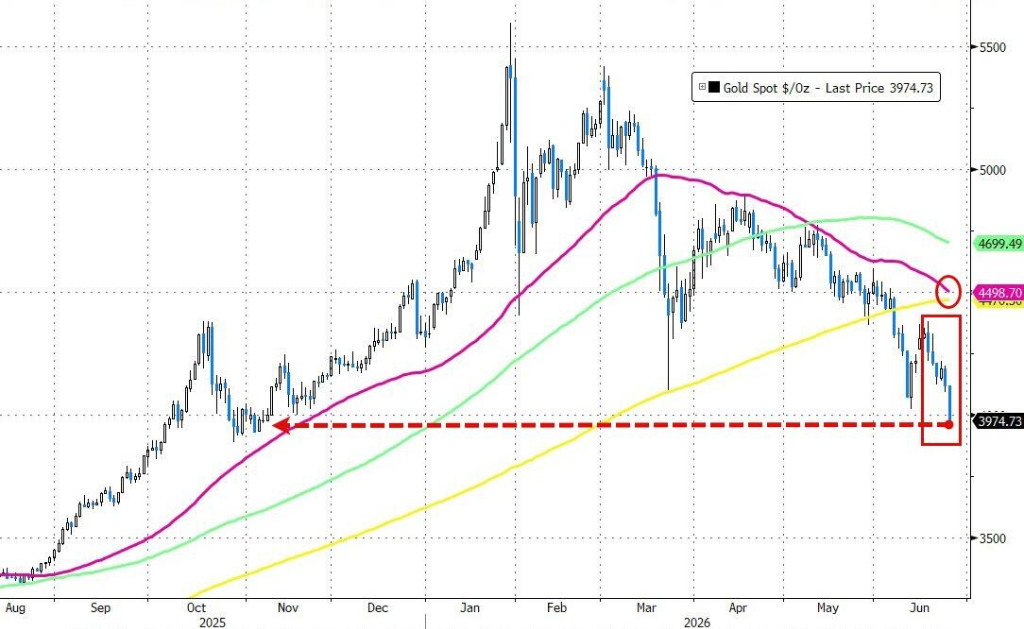
New York gold futures fell 3.2% Wednesday, spot gold lost the $4000 psychological level, silver fell over 6%. Aluminum prices returned to pre-Iran war levels on a stronger dollar and hopes for restored Gulf supply.

Gold:

  • At the New York close, spot gold fell 2.86% to $3999.08 per ounce, in decline throughout the day.

(Spot Gold Price)

  • COMEX gold futures fell 3.21% to $4016.40 per ounce, hitting a low of $3975.70 around midday in New York.

Silver:

  • At the New York close, spot silver fell 6.72% to $57.4512 per ounce, trading between $62.3762 and $55.6125, approaching its November 28, 2025 low of $53.3447 around 02:04.

  • COMEX silver futures fell 6.64% to $57.940 per ounce.

Other Metals:

  • At the New York close, COMEX copper futures fell 2.57% to $6.0525 per pound.

  • Spot platinum fell 4.25%, spot palladium fell 5.01%.

  • LME copper futures closed down $284 at $13,086 per metric ton. LME tin closed down $1,473 at $49,681 per ton. LME nickel closed down $354 at $16,818 per ton. LME aluminum closed down $110 at $3,122 per ton.
Trend Kriptolar

İlgili Sorular

QWhat were the key factors behind the significant drop in oil and gold prices according to the article?

AThe drop in oil prices was primarily driven by an unexpectedly fast improvement in physical oil flows from the Middle East, particularly increased exports from the UAE through the Strait of Hormuz, which erased the geopolitical risk premium from the Iran war. The decline in gold was attributed to a stronger US dollar reaching a 13-month high, cooling geopolitical tensions reducing safe-haven demand, and supportive policy statements from US officials reinforcing the dollar's strength.

QWhat was the market impact of Micron Technology's earnings report, and why was it significant?

AMicron Technology's earnings report, which exceeded analyst expectations and provided strong forward guidance, triggered a major after-hours rally in chip stocks. Micron's stock jumped over 16%, and other semiconductor companies like Qualcomm and Western Digital saw gains exceeding 10%. It was significant because it acted as a key signal for demand in the AI and semiconductor supply chain, potentially halting a recent sell-off in tech stocks and leading to a broader market rebound.

QHow did the performance of the so-called 'Magnificent 7' tech stocks compare to the broader S&P 500 index on the day described?

AThe 'Magnificent 7' tech stocks underperformed the broader S&P 500 index. The article notes that the S&P 500 (excluding the AI sector) actually rose over 1%, while the Magnificent 7 index fell 0.70%. This indicated a market rotation, where money moved away from the dominant tech leaders into other sectors like consumer discretionary and industrials, with over 310 S&P 500 components closing higher for the day.

QWhat geopolitical and policy developments contributed to the strength of the US dollar as mentioned in the article?

ASeveral factors contributed to US dollar strength: 1) Progress in US-Iran negotiations, including Iran reportedly agreeing not to charge fees for Strait of Hormuz passage and discussions on allowing Iran to price oil exports in dollars. 2) Potential reintegration of Venezuela and post-conflict Russia into the US dollar system. 3) Supportive comments from US Treasury Secretary Bessent, who framed these developments as part of a broader reshaping of the dollar's global dominance and predicted a return to 3% US GDP growth.

QWhat was the divergent performance between major US stock indices (Dow, S&P 500, Nasdaq) on June 24, and what sector was the biggest drag?

AOn June 24, the major US indices showed divergent performance: The Dow Jones Industrial Average rose 0.35% (gaining 182 points), the S&P 500 was nearly flat with a slight 0.10% decline, and the Nasdaq Composite fell 0.43%. The biggest drag on the market was the technology sector, along with the energy sector. Specifically, the AI semiconductor sector was highlighted as plummeting nearly 10%, contributing heavily to the Nasdaq's underperformance.

İlgili Okumalar

Super Spiral Mega-Boom, Micron's Earnings Report Rekindles the Semiconductor Bull Run

On June 25, 2026, Micron Technology released its blockbuster Q3 FY2026 results, significantly exceeding market expectations and reigniting confidence in the semiconductor bull market. Revenue soared to $41.456 billion (vs. ~$35.4B expected), up 346% year-over-year, while GAAP net profit surged nearly 15 times to $28.243 billion. Guidance for Q4 was even more striking, with projected revenue of approximately $50 billion, far surpassing prior estimates. The report highlighted that the AI boom is now fueling growth across Micron's entire product stack, not just HBM. Cloud memory, core data center, SSD, mobile, and automotive businesses all saw revenue growth exceeding 250-600%, with margins hovering around 80%. While HBM4 is already in volume shipment and 2026 capacity is sold out, AI-driven demand is also tightening supply for traditional DRAM and NAND, sustaining a strong pricing cycle. A pivotal development is Micron's shift toward a "demand-first" model. The company disclosed 16 long-term strategic customer agreements (SCAs), most spanning 5 years to 2030, covering about 20% of DRAM and one-third of NAND shipments. These are take-or-pay contracts, with 14 agreements already securing roughly $100 billion in guaranteed future revenue and $22 billion in customer performance assurances. To fulfill this locked-in demand, Micron plans substantial capacity expansion, with Q4 capital expenditure projected at ~$10 billion. This investment, backed by concrete long-term orders rather than cyclical speculation, marks a historic change for the memory industry. Following the earnings release, Micron's stock surged 16% after-hours, lifting the broader semiconductor sector globally. The report served as a powerful signal that AI infrastructure build-out is accelerating, with memory positioned as a central protagonist in the ongoing narrative.

Odaily星球日报19 dk önce

Super Spiral Mega-Boom, Micron's Earnings Report Rekindles the Semiconductor Bull Run

Odaily星球日报19 dk önce

Deciphering the Ethereum Foundation's New Structure: Reaffirming Self-Sovereignty Amid Institutionalization Trends

Summary: The Ethereum Foundation (EF) has announced a major restructuring, laying off 20% of its staff and introducing a new five-layer operational framework. This move aims to clarify the EF's mission and reaffirm Ethereum's core principle of self-sovereignty amidst growing institutionalization in the crypto space. The five layers are: 1. **Protocol Layer**: Focuses on maintaining Ethereum's foundational "CROPS" values—Censorship-resistant, Robust, Open, Private, and Secure. This involves core technical work like secure hard forks and mitigating toxic MEV. 2. **Access Layer**: Ensures users can practically exercise self-sovereignty through actions like reading the chain and making transactions. A key principle is the "zero option," meaning a trusted, non-intermediated path must always exist as an alternative to any centralized service. 3. **User Layer**: Bridges the protocol and access layers by grounding EF's work in the real needs of users and organizations. This is seen as crucial for moving beyond a purely research-driven approach and ensuring development effectively serves the ecosystem. 4. **Community Layer**: Responsible for building and maintaining consensus around Ethereum's core values both internally and externally. This involves guarding against centralization, upholding technological neutrality, and preventing short-term commercial interests from undermining CROPS principles. 5. **Institutional Layer**: Manages EF's engagement with institutions, but with the precondition of self-sovereignty. The goal is not to make it easier for institutions to control users, but to demonstrate how Ethereum's technology can enable better integrations. The article argues that while institutional adoption brings legitimacy, it also risks diluting crypto's foundational ethos of decentralization. The new structure represents EF's effort to navigate this tension, upholding its core mission while actively engaging with a broader, more complex ecosystem.

marsbit38 dk önce

Deciphering the Ethereum Foundation's New Structure: Reaffirming Self-Sovereignty Amid Institutionalization Trends

marsbit38 dk önce

OpenRouter: How Did This 'AI Model Relay Station' Achieve a $10 Billion Valuation?

OpenRouter: The Model Router Building a $10B+ Company This article explores OpenRouter, a platform that aggregates access to over 400 AI models from 70+ providers (like OpenAI, Claude, Gemini) through a single API. It has grown into a unicorn with a $1.3B valuation by 2026, processing massive scale—reaching 100 trillion tokens monthly. Its core value isn't just being a "model supermarket." For developers building real-world AI applications, managing multiple models for different tasks (e.g., cheap models for titles, powerful ones for long articles) is complex. OpenRouter acts as a critical "model scheduling layer," handling routing, failover between providers, cost optimization, and enterprise features like zero-data-retention policies and budget controls. OpenRouter's business model is a "toll fee": it charges a small platform fee (5.5%) on purchased credits while passing model costs directly to users. Its revenue scales with the tokens flowing through its system, which saw explosive growth as AI apps evolved. Key growth drivers include: 1) The explosion of specialized models, increasing choice complexity; 2) AI apps shifting focus from performance to cost optimization; 3) The rise of AI agents that require more reliable, multi-step model calls. However, risks remain. Large enterprises or cloud providers (AWS, Google Cloud) could build similar internal gateways. Its position between model suppliers and developers could also create future tension over pricing and data control. To stay ahead, OpenRouter must deepen its enterprise features and prove it's more than just a request forwarder.

marsbit57 dk önce

OpenRouter: How Did This 'AI Model Relay Station' Achieve a $10 Billion Valuation?

marsbit57 dk önce

Bitcoin Falls Below $60,000 Again; After 20 Months, We've Reached a New Low

Bitcoin Drops Below $60,000, Hitting a 20-Month Low Bitcoin fell below the key $60,000 psychological level again, reaching a low of $59,023—its lowest point in approximately 20 months, dating back to October 2024. While it later recovered slightly to around $60,600, this marks its third significant breach of $60,000 this year. The downturn is attributed to two primary factors. First, U.S. spot Bitcoin ETFs are experiencing their longest streak of net outflows since launch, with nearly $5.94 billion withdrawn over 30 days. This creates sustained selling pressure as Authorized Participants sell Bitcoin to meet redemptions. Second, shifting macroeconomic expectations are adding pressure. Strong U.S. job data and hawkish remarks from Fed officials have increased market pricing for potential rate hikes, reversing the earlier liquidity-driven bullish sentiment and prompting a shift away from risk assets like Bitcoin. Analyst views are mixed. 21Shares maintains a bullish long-term outlook, expecting prices to recover towards $100,000, citing historical post-halving cycles and substantial ETF holdings as a base. In contrast, Arthur Hayes predicts a potential bottom around $40,000 within six months due to persistent Fed hawkishness. CryptoQuant suggests, based on on-chain data, that the market may not find a bottom until prices fall below the average investor cost basis around $53,000, potentially extending the bearish phase into late 2026 or early 2027. The immediate focus is on upcoming U.S. inflation data and Fed signals. Lower-than-expected CPI could offer relief, but confirmation of sticky inflation or continued ETF outflows may lead to further downside pressure. Bitcoin's ability to hold above $60,000 remains a critical test for the near-term market direction.

Odaily星球日报1 saat önce

Bitcoin Falls Below $60,000 Again; After 20 Months, We've Reached a New Low

Odaily星球日报1 saat önce

İşlemler

Spot
Futures

Popüler Makaleler

$S$ Nedir

SPERO'yu Anlamak: Kapsamlı Bir Genel Bakış SPERO'ya Giriş İnovasyonun manzarası gelişmeye devam ederken, web3 teknolojilerinin ve kripto para projelerinin ortaya çıkışı dijital geleceği şekillendirmede önemli bir rol oynamaktadır. Bu dinamik alanda dikkat çeken projelerden biri SPERO, $$s$$ olarak adlandırılmaktadır. Bu makale, SPERO hakkında ayrıntılı bilgi toplamak ve sunmak amacıyla, meraklılar ve yatırımcıların web3 ve kripto alanlarındaki temellerini, hedeflerini ve yeniliklerini anlamalarına yardımcı olmayı amaçlamaktadır. SPERO,$$s$$ Nedir? SPERO,$$s$$, kripto alanında merkeziyetsizlik ve blok zinciri teknolojisi ilkelerini kullanarak etkileşimi, faydayı ve finansal kapsayıcılığı teşvik eden bir ekosistem yaratmayı amaçlayan benzersiz bir projedir. Proje, kullanıcıların yenilikçi finansal çözümler ve hizmetler sunarak eşler arası etkileşimleri yeni yollarla kolaylaştırmayı hedeflemektedir. SPERO,$$s$$'nin temel amacı, bireyleri güçlendirmek ve kripto para alanındaki kullanıcı deneyimini artıran araçlar ve platformlar sağlamaktır. Bu, daha esnek işlem yöntemlerini mümkün kılmayı, topluluk odaklı girişimleri teşvik etmeyi ve merkeziyetsiz uygulamalar (dApp'ler) aracılığıyla finansal fırsatlar yaratmayı içermektedir. SPERO,$$s$$'nin temel vizyonu kapsayıcılık etrafında dönmekte olup, geleneksel finansal sistemlerdeki boşlukları kapatmayı ve blok zinciri teknolojisinin faydalarından yararlanmayı hedeflemektedir. SPERO,$$s$$'nin Yaratıcısı Kimdir? SPERO,$$s$$'nin yaratıcısının kimliği bir miktar belirsizdir, çünkü kurucusu(ları) hakkında ayrıntılı arka plan bilgisi sağlayan sınırlı kamuya açık kaynaklar bulunmaktadır. Bu şeffaflık eksikliği, projenin merkeziyetsizlik taahhüdünden kaynaklanabilir—birçok web3 projesinin paylaştığı bir etik anlayışı, bireysel tanınmanın yerine kolektif katkıları önceliklendirmektedir. Topluluk ve onun kolektif hedefleri etrafında tartışmaları merkezileştirerek, SPERO,$$s$$, belirli bireyleri öne çıkarmadan güçlendirme özünü taşımaktadır. Bu nedenle, SPERO'nun etik anlayışını ve misyonunu anlamak, tek bir yaratıcının kimliğini belirlemekten daha önemlidir. SPERO,$$s$$'nin Yatırımcıları Kimlerdir? SPERO,$$s$$, kripto sektöründe yeniliği teşvik etmeye adanmış girişim sermayedarlarından melek yatırımcılara kadar çeşitli yatırımcılar tarafından desteklenmektedir. Bu yatırımcıların odak noktası genellikle SPERO'nun misyonuyla uyumlu olup, toplumsal teknolojik ilerlemeyi, finansal kapsayıcılığı ve merkeziyetsiz yönetimi vaat eden projeleri önceliklendirmektedir. Bu yatırımcı temelleri, yalnızca yenilikçi ürünler sunan projelere değil, aynı zamanda blok zinciri topluluğuna ve ekosistemlerine olumlu katkılarda bulunan projelere de ilgi duymaktadır. Bu yatırımcıların desteği, SPERO,$$s$$'yi hızla gelişen kripto projeleri alanında dikkate değer bir rakip haline getirmektedir. SPERO,$$s$$ Nasıl Çalışır? SPERO,$$s$$, onu geleneksel kripto para projelerinden ayıran çok yönlü bir çerçeve kullanmaktadır. İşte benzersizliğini ve yeniliğini vurgulayan bazı temel özellikler: Merkeziyetsiz Yönetim: SPERO,$$s$$, kullanıcıların projenin geleceğiyle ilgili karar alma süreçlerine aktif olarak katılmalarını sağlayan merkeziyetsiz yönetim modellerini entegre etmektedir. Bu yaklaşım, topluluk üyeleri arasında sahiplik ve hesap verebilirlik duygusunu teşvik etmektedir. Token Kullanımı: SPERO,$$s$$, ekosistem içinde çeşitli işlevler sunmak üzere tasarlanmış kendi kripto para token'ını kullanmaktadır. Bu token'lar, işlemleri, ödülleri ve platformda sunulan hizmetlerin kolaylaştırılmasını sağlayarak genel etkileşimi ve faydayı artırmaktadır. Katmanlı Mimari: SPERO,$$s$$'nin teknik mimarisi, modülerlik ve ölçeklenebilirliği destekleyerek projenin evrimi sırasında ek özelliklerin ve uygulamaların sorunsuz bir şekilde entegrasyonuna olanak tanımaktadır. Bu uyum sağlama yeteneği, sürekli değişen kripto manzarasında geçerliliği sürdürmek için hayati öneme sahiptir. Topluluk Katılımı: Proje, işbirliği ve geri bildirim teşvik eden mekanizmalar kullanarak topluluk odaklı girişimlere vurgu yapmaktadır. Güçlü bir topluluk oluşturarak, SPERO,$$s$$, kullanıcı ihtiyaçlarını daha iyi karşılayabilir ve piyasa trendlerine uyum sağlayabilir. Kapsayıcılığa Odaklanma: Düşük işlem ücretleri ve kullanıcı dostu arayüzler sunarak, SPERO,$$s$$, daha önce kripto alanında yer almamış bireyler de dahil olmak üzere çeşitli bir kullanıcı tabanını çekmeyi hedeflemektedir. Bu kapsayıcılık taahhüdü, erişilebilirlik yoluyla güçlendirme misyonuyla uyumludur. SPERO,$$s$$ Zaman Çizelgesi Bir projenin tarihini anlamak, gelişim yolculuğu ve kilometre taşları hakkında kritik bilgiler sağlar. Aşağıda, SPERO,$$s$$'nin evriminde önemli olayları haritalayan önerilen bir zaman çizelgesi bulunmaktadır: Kavram Geliştirme ve Fikir Aşaması: SPERO,$$s$$'nin temelini oluşturan ilk fikirler, blok zinciri endüstrisindeki merkeziyetsizlik ve topluluk odaklılık ilkeleriyle yakından uyumlu olarak geliştirildi. Proje Beyaz Kağıdının Yayınlanması: Kavramsal aşamayı takiben, SPERO,$$s$$'nin vizyonunu, hedeflerini ve teknolojik altyapısını ayrıntılı bir şekilde açıklayan kapsamlı bir beyaz kağıt yayımlandı ve topluluk ilgisini ve geri bildirimini toplamak amacıyla sunuldu. Topluluk Oluşturma ve Erken Katılımlar: Projenin hedefleri etrafında tartışmalar yürüterek destek toplamak ve erken benimseyenler ile potansiyel yatırımcılar için bir topluluk oluşturmak amacıyla aktif iletişim çabaları gerçekleştirildi. Token Üretim Etkinliği: SPERO,$$s$$, yerel token'larını erken destekçilere dağıtmak ve ekosistem içinde başlangıç likiditesini sağlamak amacıyla bir token üretim etkinliği (TGE) gerçekleştirdi. İlk dApp'in Yayınlanması: SPERO,$$s$$ ile ilişkili ilk merkeziyetsiz uygulama (dApp) faaliyete geçti ve kullanıcıların platformun temel işlevleriyle etkileşimde bulunmalarını sağladı. Sürekli Gelişim ve Ortaklıklar: Projenin tekliflerine sürekli güncellemeler ve iyileştirmeler yapılmakta olup, blok zinciri alanındaki diğer oyuncularla stratejik ortaklıklar, SPERO,$$s$$'yi rekabetçi ve gelişen bir oyuncu haline getirmiştir. Sonuç SPERO,$$s$$, web3 ve kripto paranın finansal sistemleri devrim niteliğinde dönüştürme ve bireyleri güçlendirme potansiyelinin bir kanıtıdır. Merkeziyetsiz yönetime, topluluk katılımına ve yenilikçi tasarlanmış işlevselliğe olan bağlılığıyla, daha kapsayıcı bir finansal manzaraya doğru bir yol açmaktadır. Hızla gelişen kripto alanındaki herhangi bir yatırımda olduğu gibi, potansiyel yatırımcılar ve kullanıcılar, SPERO,$$s$$ içindeki devam eden gelişmelerle ilgili olarak kapsamlı bir araştırma yapmaları ve düşünceli bir şekilde katılmaları teşvik edilmektedir. Proje, kripto endüstrisinin yenilikçi ruhunu sergileyerek, sayısız olasılığını keşfetmeye davet etmektedir. SPERO,$$s$$'nin yolculuğu hala devam ederken, temel ilkeleri, teknoloji, finans ve birbirimizle etkileşim biçimimizi etkileyebilir.

102 Toplam GörüntülenmeYayınlanma 2024.12.17Güncellenme 2024.12.17

$S$ Nedir

AGENT S Nedir

Agent S: Web3'te Otonom Etkileşimin Geleceği Giriş Web3 ve kripto para dünyasında sürekli gelişen manzarada, yenilikler bireylerin dijital platformlarla etkileşim biçimlerini sürekli olarak yeniden tanımlıyor. Bu tür öncü projelerden biri olan Agent S, açık ajans çerçevesi aracılığıyla insan-bilgisayar etkileşimini devrim niteliğinde değiştirmeyi vaat ediyor. Otonom etkileşimlerin yolunu açarak, Agent S karmaşık görevleri basitleştirmeyi ve yapay zeka (AI) alanında dönüştürücü uygulamalar sunmayı hedefliyor. Bu detaylı inceleme, projenin karmaşıklıklarına, benzersiz özelliklerine ve kripto para alanındaki etkilerine dalacaktır. Agent S Nedir? Agent S, bilgisayar görevlerinin otomasyonunda üç temel zorluğu ele almak üzere özel olarak tasarlanmış çığır açıcı bir açık ajans çerçevesidir: Alan Spesifik Bilgi Edinimi: Çerçeve, çeşitli dış bilgi kaynaklarından ve iç deneyimlerden akıllıca öğrenir. Bu çift yönlü yaklaşım, alan spesifik bilgi açısından zengin bir veri havuzu oluşturmasını sağlar ve görev yürütmedeki performansını artırır. Uzun Görev Ufukları Üzerinde Planlama: Agent S, karmaşık görevlerin verimli bir şekilde parçalanmasını ve yürütülmesini kolaylaştıran deneyim artırımlı hiyerarşik planlama kullanır. Bu özellik, çoklu alt görevleri etkili ve verimli bir şekilde yönetme yeteneğini önemli ölçüde artırır. Dinamik, Homojen Olmayan Arayüzlerle Başlama: Proje, ajanlar ve kullanıcılar arasındaki etkileşimi geliştiren yenilikçi bir çözüm olan Ajan-Bilgisayar Arayüzü'ni (ACI) tanıtmaktadır. Çok Modlu Büyük Dil Modellerini (MLLM'ler) kullanarak, Agent S çeşitli grafik kullanıcı arayüzlerini sorunsuz bir şekilde gezinebilir ve manipüle edebilir. Bu öncü özellikler aracılığıyla, Agent S, makinelerle insan etkileşimini otomatikleştirmede karşılaşılan karmaşıklıkları ele alan sağlam bir çerçeve sunarak, AI ve ötesinde birçok uygulama için zemin hazırlıyor. Agent S'nin Yaratıcısı Kimdir? Agent S'nin kavramı temelde yenilikçi olsa da, yaratıcısı hakkında spesifik bilgiler belirsizliğini koruyor. Yaratıcı şu anda bilinmiyor, bu da projenin yeni aşamasını veya kurucu üyeleri gizli tutma stratejik tercihini vurguluyor. Anonimlikten bağımsız olarak, odak çerçevenin yetenekleri ve potansiyeli üzerinde kalıyor. Agent S'nin Yatırımcıları Kimlerdir? Agent S, kriptografik ekosistemde oldukça yeni olduğundan, yatırımcıları ve finansal destekçileri hakkında ayrıntılı bilgiler açıkça belgelenmemiştir. Projeyi destekleyen yatırım temelleri veya organizasyonları hakkında kamuya açık bilgilerdeki eksiklik, finansman yapısı ve gelişim yol haritası hakkında sorular doğuruyor. Destekleyicilerin anlaşılması, projenin sürdürülebilirliğini ve potansiyel pazar etkisini değerlendirmek için kritik öneme sahiptir. Agent S Nasıl Çalışır? Agent S'nin temelinde, çeşitli ortamlarda etkili bir şekilde çalışmasını sağlayan son teknoloji bir sistem yatmaktadır. İşleyiş modeli birkaç ana özellik etrafında inşa edilmiştir: İnsan Benzeri Bilgisayar Etkileşimi: Çerçeve, bilgisayarlarla etkileşimleri daha sezgisel hale getirmeyi amaçlayan gelişmiş AI planlaması sunar. Görev yürütmedeki insan davranışını taklit ederek, kullanıcı deneyimlerini yükseltmeyi vaat eder. Anlatı Belleği: Yüksek düzeyde deneyimlerden yararlanmak için kullanılan Agent S, görev geçmişlerini takip etmek amacıyla anlatı belleğini kullanarak karar verme süreçlerini geliştirir. Episodik Bellek: Bu özellik, kullanıcılara adım adım rehberlik sağlayarak, çerçevenin görevler gelişirken bağlamsal destek sunmasına olanak tanır. OpenACI Desteği: Yerel olarak çalışabilme yeteneği ile Agent S, kullanıcıların etkileşimleri ve iş akışları üzerinde kontrol sağlamasına olanak tanır ve Web3'ün merkeziyetsiz felsefesiyle uyumlu hale gelir. Dış API'lerle Kolay Entegrasyon: Çeşitli AI platformlarıyla uyumluluğu ve çok yönlülüğü, Agent S'nin mevcut teknolojik ekosistemlere sorunsuz bir şekilde entegre olmasını sağlar ve geliştiriciler ile organizasyonlar için cazip bir seçenek haline getirir. Bu işlevsellikler, Agent S'nin kripto alanındaki benzersiz konumuna katkıda bulunarak, karmaşık, çok aşamalı görevleri minimum insan müdahalesi ile otomatikleştirir. Proje geliştikçe, Web3'teki potansiyel uygulamaları dijital etkileşimlerin nasıl gelişeceğini yeniden tanımlayabilir. Agent S'nin Zaman Çizelgesi Agent S'nin gelişimi ve kilometre taşları, önemli olaylarını vurgulayan bir zaman çizelgesinde özetlenebilir: 27 Eylül 2024: Agent S'nin kavramı, “Bilgisayarları İnsan Gibi Kullanan Açık Bir Ajans Çerçevesi” başlıklı kapsamlı bir araştırma makalesi ile tanıtıldı ve projenin temelini sergiledi. 10 Ekim 2024: Araştırma makalesi arXiv'de kamuya açık olarak yayınlandı ve çerçevenin derinlemesine bir incelemesini ve OSWorld benchmark'ına dayalı performans değerlendirmesini sundu. 12 Ekim 2024: Agent S'nin yetenekleri ve özellikleri hakkında görsel bir içgörü sağlayan bir video sunumu yayımlandı ve potansiyel kullanıcılar ve yatırımcılarla daha fazla etkileşim sağlandı. Bu zaman çizelgesindeki işaretler, sadece Agent S'nin ilerlemesini değil, aynı zamanda şeffaflık ve topluluk katılımına olan bağlılığını da göstermektedir. Agent S Hakkında Ana Noktalar Agent S çerçevesi gelişmeye devam ederken, birkaç ana özellik öne çıkmakta ve yenilikçi doğasını ve potansiyelini vurgulamaktadır: Yenilikçi Çerçeve: İnsan etkileşimine benzer bir bilgisayar kullanımı sağlamak üzere tasarlanan Agent S, görev otomasyonuna yeni bir yaklaşım getiriyor. Otonom Etkileşim: GUI aracılığıyla bilgisayarlarla otonom olarak etkileşim kurabilme yeteneği, daha akıllı ve verimli hesaplama çözümlerine doğru bir sıçrama anlamına geliyor. Karmaşık Görev Otomasyonu: Sağlam metodolojisi ile karmaşık, çok aşamalı görevleri otomatikleştirerek süreçleri daha hızlı ve daha az hata payı ile gerçekleştirebilir. Sürekli İyileştirme: Öğrenme mekanizmaları, Agent S'nin geçmiş deneyimlerden öğrenmesini sağlar ve sürekli olarak performansını ve etkinliğini artırır. Çok Yönlülük: OSWorld ve WindowsAgentArena gibi farklı işletim ortamlarında uyumlu olması, geniş bir uygulama yelpazesine hizmet edebilmesini sağlar. Agent S, Web3 ve kripto alanında kendini konumlandırırken, etkileşim yeteneklerini artırma ve süreçleri otomatikleştirme potansiyeli, AI teknolojilerinde önemli bir ilerlemeyi temsil etmektedir. Yenilikçi çerçevesi aracılığıyla, Agent S dijital etkileşimlerin geleceğini örneklemekte ve çeşitli sektörlerde kullanıcılar için daha sorunsuz ve verimli bir deneyim vaat etmektedir. Sonuç Agent S, AI ve Web3'ün birleşiminde cesur bir sıçramayı temsil ediyor ve teknoloji ile etkileşim biçimimizi yeniden tanımlama kapasitesine sahip. Henüz erken aşamalarında olmasına rağmen, uygulama olanakları geniş ve çekici. Kritik zorlukları ele alan kapsamlı çerçevesi ile Agent S, otonom etkileşimleri dijital deneyimin ön plana çıkmasına taşımayı hedefliyor. Kripto para ve merkeziyetsizlik alanlarına daha derinlemesine girdikçe, Agent S gibi projelerin teknoloji ve insan-bilgisayar işbirliğinin geleceğini şekillendirmede önemli bir rol oynayacağı kesin.

596 Toplam GörüntülenmeYayınlanma 2025.01.14Güncellenme 2025.01.14

AGENT S Nedir

S Nasıl Satın Alınır

HTX.com’a hoş geldiniz! Sonic (S) satın alma işlemlerini basit ve kullanışlı bir hâle getirdik. Adım adım açıkladığımız rehberimizi takip ederek kripto yolculuğunuza başlayın. 1. Adım: HTX Hesabınızı OluşturunHTX'te ücretsiz bir hesap açmak için e-posta adresinizi veya telefon numaranızı kullanın. Sorunsuzca kaydolun ve tüm özelliklerin kilidini açın. Hesabımı Aç2. Adım: Kripto Satın Al Bölümüne Gidin ve Ödeme Yönteminizi SeçinKredi/Banka Kartı: Visa veya Mastercard'ınızı kullanarak anında Sonic (S) satın alın.Bakiye: Sorunsuz bir şekilde işlem yapmak için HTX hesap bakiyenizdeki fonları kullanın.Üçüncü Taraflar: Kullanımı kolaylaştırmak için Google Pay ve Apple Pay gibi popüler ödeme yöntemlerini ekledik.P2P: HTX'teki diğer kullanıcılarla doğrudan işlem yapın.Borsa Dışı (OTC): Yatırımcılar için kişiye özel hizmetler ve rekabetçi döviz kurları sunuyoruz.3. Adım: Sonic (S) Varlıklarınızı SaklayınSonic (S) satın aldıktan sonra HTX hesabınızda saklayın. Alternatif olarak, blok zinciri transferi yoluyla başka bir yere gönderebilir veya diğer kripto para birimlerini takas etmek için kullanabilirsiniz.4. Adım: Sonic (S) Varlıklarınızla İşlem YapınHTX'in spot piyasasında Sonic (S) ile kolayca işlemler yapın.Hesabınıza erişin, işlem çiftinizi seçin, işlemlerinizi gerçekleştirin ve gerçek zamanlı olarak izleyin. Hem yeni başlayanlar hem de deneyimli yatırımcılar için kullanıcı dostu bir deneyim sunuyoruz.

1.7k Toplam GörüntülenmeYayınlanma 2025.01.15Güncellenme 2026.06.02

S Nasıl Satın Alınır

Tartışmalar

HTX Topluluğuna hoş geldiniz. Burada, en son platform gelişmeleri hakkında bilgi sahibi olabilir ve profesyonel piyasa görüşlerine erişebilirsiniz. Kullanıcıların S (S) fiyatı hakkındaki görüşleri aşağıda sunulmaktadır.

活动图片