How Much Longer Can Ethereum's Last Major Buyer Hold On?

链捕手2026-06-11 tarihinde yayınlandı2026-06-11 tarihinde güncellendi

Özet

"The article analyzes the precarious position of Bitmine, currently the largest and most aggressive marginal buyer of Ethereum (ETH). Despite holding a massive position of approximately 5.66 million ETH (nearing its 5% supply target) and generating staking income, the company faces over $10 billion in unrealized losses due to a high average purchase price. With ETH prices depressed, its equity has plummeted nearly 90%. To sustain its buying spree, Bitmine recently issued $274 million in perpetual preferred shares with a 9.5% annual dividend. The core dilemma is whether staking yields (3-4%) can long-term support these high dividend obligations without significant ETH price appreciation. The article warns that once Bitmine achieves its 5% goal and potentially stops buying, the ETH market risks losing its key support pillar. Other institutional buyers, like ETH ETFs, have shown net outflows, while potential new demand from stablecoin legislation or RWA tokenization remains slow to materialize. The conclusion questions who will provide the next wave of sustained buying pressure to support ETH's price, highlighting a critical uncertainty for the asset's near-term trajectory."

As the crypto market continues to fall, BTC and ETH have once fallen to around $60,000 and $1,500, with both Strategy and Bitmine experiencing floating losses exceeding $10 billion. Just at the end of May, Strategy sold 32 BTC, breaking its long-standing narrative of not selling coins, marking the pressure testing phase for the model of financing purchases with debt.

Against this backdrop, Bitmine grandly announced the issuance of its Series A Perpetual Preferred Shares with a 9.5% annualized yield, raising approximately $274 million net. As of press time, Bitmine increased its holdings by 127,000 ETH last week and accumulated purchases of 125,000 ETH over the past three days. Its total holdings now stand at about 5.66 million ETH, less than 400,000 ETH away from its 5% target.

As the most persistent and aggressive marginal buyer of ETH in the current market, Bitmine continues to increase its holdings despite facing over ten billion dollars in unrealized losses. Now, even it needs to rely on preferred shares to replenish its flywheel. Once the financing market experiences changes and its coin-hoarding machine is forced to slow down, who will be left to support the price of Ethereum?

Reaching 5% Before Year-End, Then What?

Bitmine began accumulating ETH in the second half of last year, planning to complete its "5% Alchemy" plan within 5 years. Data shows that Bitmine raised $19.2 billion through 50 equity offerings between July 2025 and June 2026, with all funds used to purchase ETH.

As of press time, Bitmine's Ethereum holdings have reached approximately 5.66 million ETH, less than 400,000 ETH away from its 5% target, achieving over 90% of the plan's progress within a year.
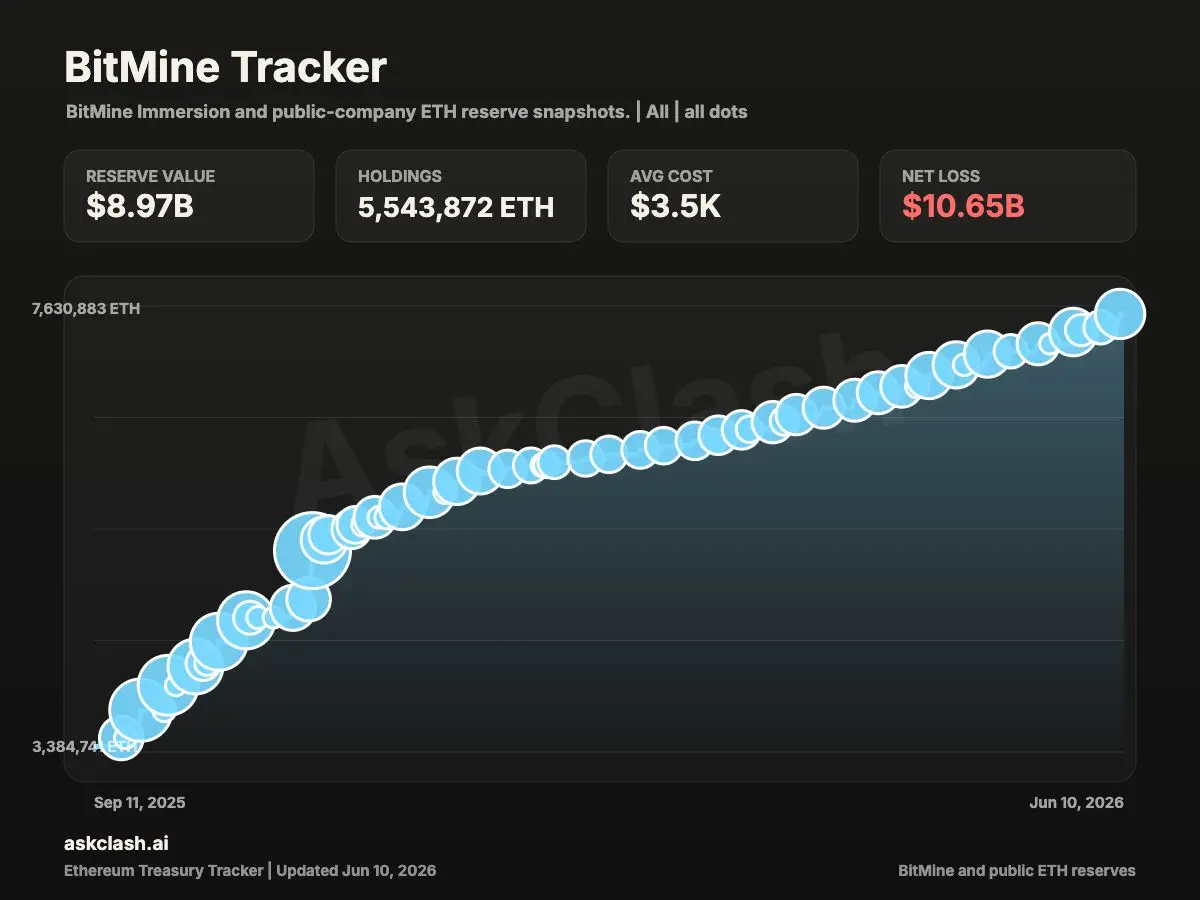
Among these, about 4.719 million ETH have been staked, accounting for over 85% of total holdings, with expected annualized staking returns ranging from $230 million to $296 million. This staking system is supported by the company's self-built MAVAN validator node network, considered the most critical structural design differentiating Bitmine from Strategy.

However, the cost of aggressive accumulation is also evident. With current ETH prices around $1,650, the company's average holding cost is as high as about $3,500. Its ETH treasury is valued at only about $9.3 billion, resulting in an overall company loss of $10.5 billion, a drawdown exceeding 50%. The company's stock price has plummeted nearly 90% from its peak.
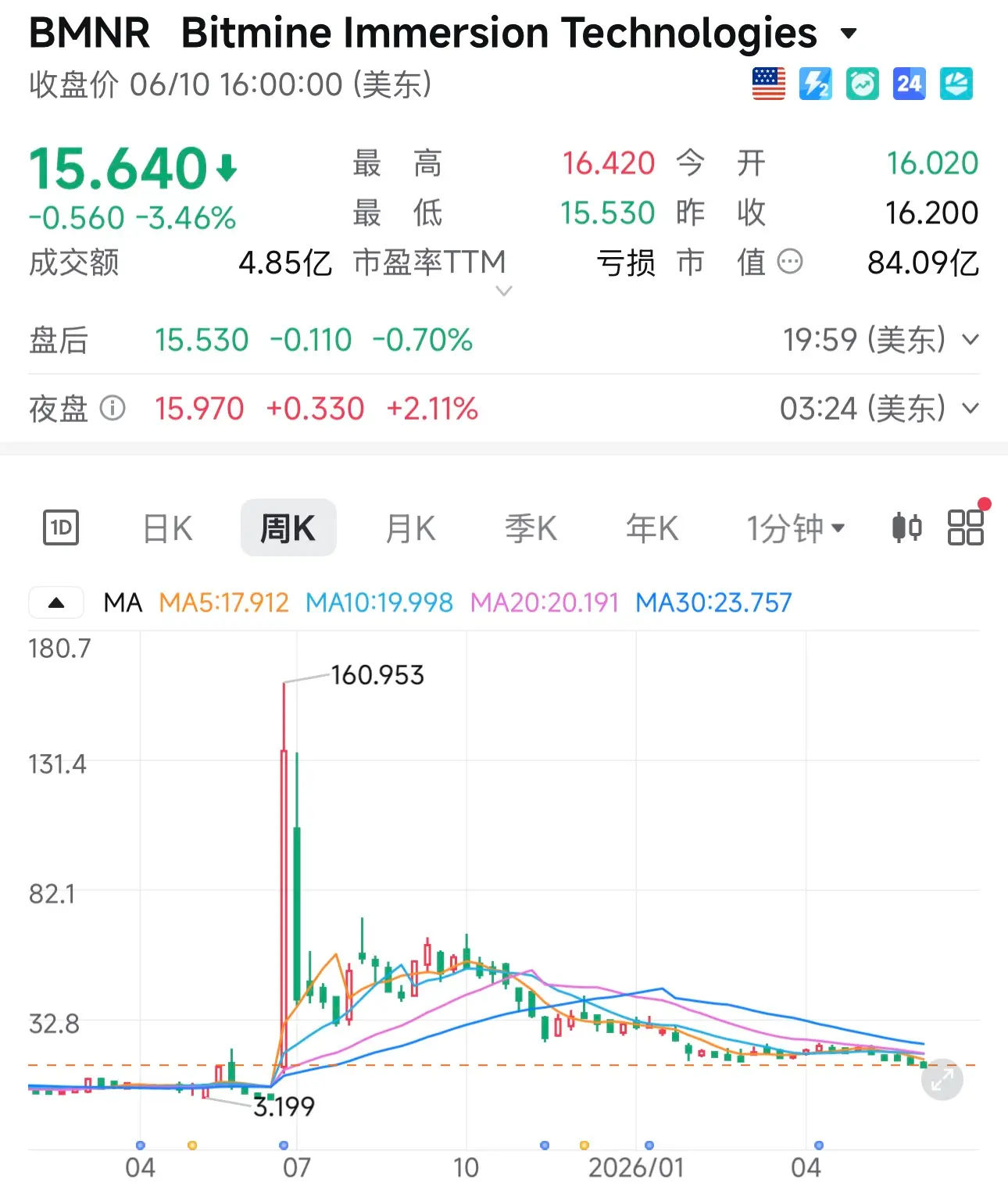
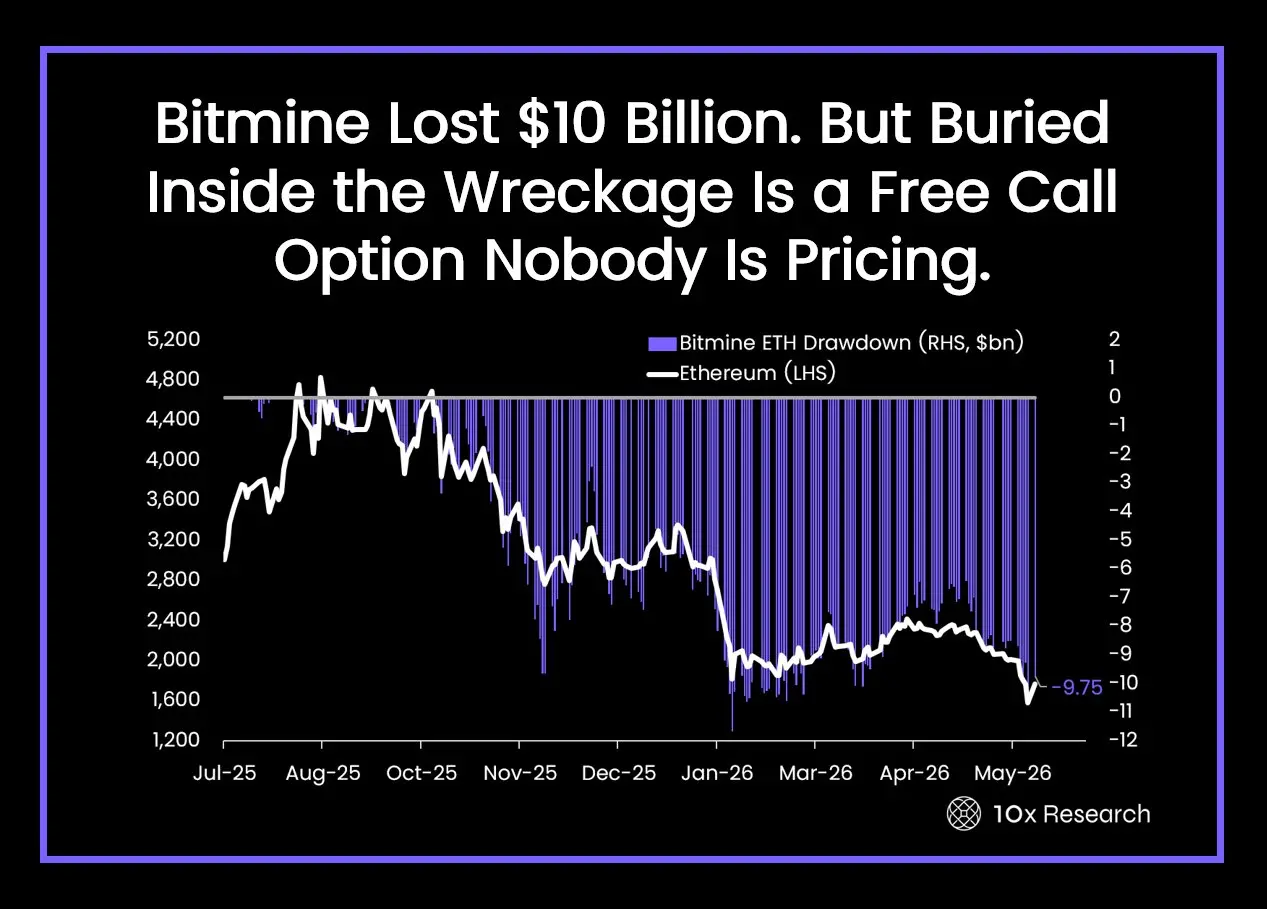
10x Research points out that Bitmine's investors face two layers of losses: the floating loss from ETH's price drop is the first layer. The second layer is the approximately $4.6 billion premium investors paid for BMNR stock relative to the underlying ETH net asset value. Combined, these layers amplify the actual loss magnitude for shareholders.
Facing massive unrealized losses, Tom Lee characterizes this round of decline as superficial. He believes the existing financial system harbors a large amount of fake trading, whereas Ethereum has never had fraudulent transactions, with lower operating costs. On-chain transaction volume and daily active addresses have both hit record highs. The price correction is led by macro factors and leverage unwinding, with fundamentals undamaged. The longer-term bet is that AI agent systems will rely on blockchains to operate, ETH supply is continuously contracting, and Ethereum is the most direct beneficiary.

Tom Lee recently revealed that Bitmine is expected to complete its 5% target before the end of 2026, at which point it may no longer need to continue increasing holdings. He also mentioned the company may be formally included in the Russell 1000 index by the end of June, which, based on market cap calculations at the time, would bring at least $2.15 billion in passive fund buying pressure for BMNR.

How Can 3% Staking Returns Support 9.5% Dividends?

On June 5th, Bitmine completed pricing for its Series A Perpetual Preferred Shares: 3.5 million shares, issued at $80 per share, with a par value of $100, raising approximately $274 million net. The dividend yield is 9.5%, paid weekly in cash, and dividends continue to accrue even if undeclared by the board. Annualized dividend obligation is about $33.25 million based on par value.

Bitmine holds an early redemption right: it can redeem at 110% of par value within 18 months of issuance, at 105% between 18 months and 3 years, and at 100% after 3 years, with accrued but unpaid dividends also paid upon redemption.

At first glance, the math isn't hard. By the end of May, Bitmine had cumulatively staked 4.7 million ETH, with expected annualized staking returns of about $230 million to $296 million, which is 8 to 9 times the annualized dividend obligation.

However, the prediction exceeding $200 million is based on the assumption that the recent 4.7 million ETH are fully staked. According to the prospectus, for the six months ended February 28, 2026, the company's staking income was $11.18 million, annualized to about $22 million.

It's noteworthy that staking rewards are denominated in ETH, not USD. If ETH continues to fall, the company's staking income will shrink accordingly.

Here lies a fundamental difference between Bitmine and Strategy. BTC has no native yield; Strategy's STRC can only pay dividends through BTC price appreciation or selling coins, as detailed by ChainCatcher in the article "Strategy Cashes Out $2.5 Million as Bitcoin Market Cap Evaporates $80 Billion".

ETH's staking mechanism offers Tom Lee a different path: even if the price stays flat, staking rewards still generate income without touching the principal holdings. This is the real pressure-resistant advantage of the Bitmine model in the current bear market.

But this path may not be sustainable. Crypto KOL chenmo points out that in the early stages with low issuance, covering dividends with staking returns is manageable. However, as preferred share issuance scale continues to expand, the 3-4% staking yield is destined to be unable to cover the 9.5% annual interest. At that point, only a rise in ETH can maintain this logic.

Analyst Yuyue also noted that Strategy's model is already under pressure in the current market. Following up with preferred share issuance now, even if it's a short-term positive, may be interpreted by the market as a worse signal.

According to CointelegraphMT research, two details in the prospectus for this issuance are worth noting. The auditor was changed to KPMG on April 27th, with simultaneous disclosure of material weaknesses in internal controls. The audit is not yet complete, and financial data may be subject to restatement.

Additionally, the board has complete discretionary power over dividend payments. The only enforcement mechanism for preferred shareholders is the right to nominate two directors after 18 consecutive months without receiving dividends.

If Bitmine Stops Buying After 5%, Where Will ETH's Price Go?

On-chain analyst Yu Jin stated that at the current buying pace, the target could be reached as early as next month. So, will they continue buying after reaching it? If they stop, and this market's last staunch bull disappears, what will support ETH?

Bitmine has been the most consistent and aggressive marginal buyer in the ETH market over the past year. Other potential buying forces are scattered and weak. ETH spot ETFs saw a net outflow of $173 million overall last week. Although they briefly turned positive on June 8th after 17 consecutive days of outflows, the strength was far less than the previous outflow scale.

Meanwhile, Goldman Sachs reduced its ETH ETF holdings by about 70% in Q1 2026, and Harvard University's endowment fund completely liquidated its approximately $87 million ETHA holdings, selling all after holding for just one quarter. Details on institutional fund movements can be found in "Harvard and Other Institutions Liquidate, Six Core Talents Depart in One Month, What's Wrong with Ethereum?".

Furthermore, stablecoin legislation and institutional incremental demand brought by RWA tokenization are slow variables, difficult to fill a gap of Bitmine's scale in the short term.

Without an overall reversal in the crypto market, it can be foreseen that the treasury flywheel will become difficult to sustain. The transmission would be: ETH price continues to fall, BMNR stock price is under pressure, the premium relative to net assets narrows, the window for additional fundraising shrinks, the buying pace slows, and ETH further loses marginal support. This cycle doesn't even require Bitmine to actively sell a single ETH; the disappearance of buying power alone is sufficient.
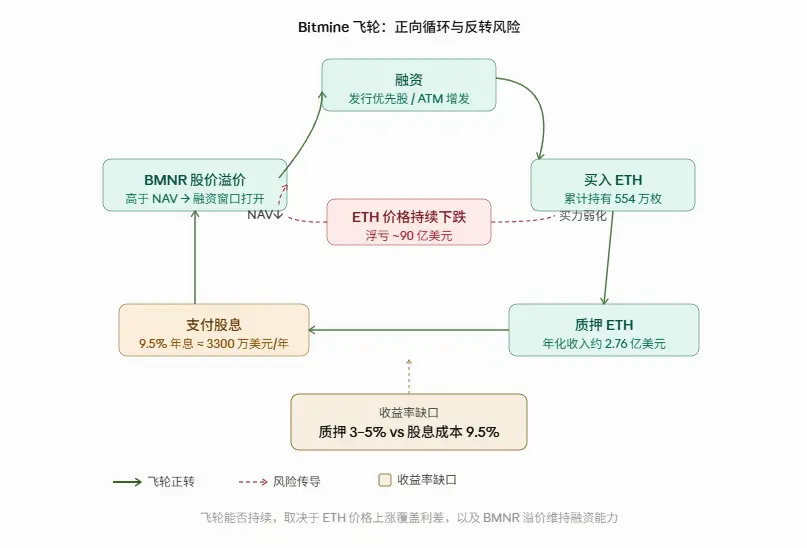
Image Source: AI Generated

In a pessimistic scenario, if the financing market's acceptance of preferred shares declines, BMNR continues to hit new lows, and buying slows significantly, ETH may explore the next key consensus level (around $1,000). DWF Labs co-founder Andrei Grachev believes Strategy and Bitmine have a great chance to create the largest market crash in cryptocurrency history. This is a tail risk judgment, not a baseline expectation.

In the baseline scenario, Bitmine maintains buying, staking returns provide a buffer, preferred shares are smoothly absorbed, and ETH consolidates and bottoms out in the $1,500 to $2,000 range. Despite Bitmine's heavy losses and ETH's difficulty recovering in the short term, a 10x Research report mentions that when a stock falls deep enough, the underlying asset becomes almost irrelevant. What investors are buying is essentially a pure option—a free call option on ETH's future rebound, which is not yet fully priced in by the market.

In an optimistic scenario, formal inclusion in the Russell 1000 brings passive funds, and the landing of stablecoin legislation like the GENIUS Act clears obstacles for institutional entry. Standard Chartered maintains its year-end 2026 ETH target price of $4,000, believing recent price declines do not reflect the continuous improvement in Ethereum's network fundamentals. It likens the current situation to Amazon's stage after the 2001 bubble burst—price temporarily disconnected from network value, but infrastructure building never stopped. The bank expects the ETH/BTC exchange rate to recover to about 0.08 by the end of this decade, with a target price of $40,000 by the end of 2030.

Conclusion

Ultimately, how long this financing can sustain Bitmine's flywheel comes down to the price of ETH. However, Bitmine's coin-buying itself is a crucial part of price support.

So the core question is: after Bitmine completes its 5% target and gradually fades out, who will take up the baton? Traditional institutions are withdrawing, ETF funds flow in and out, and real incremental demand from stablecoins and RWA has yet to materialize on a large scale.

Perhaps Ethereum is not short on narratives, but when the liquidity turning point will appear and where the new marginal buyers will come from are key questions determining ETH's price trend going forward.

İlgili Sorular

QWhat is Bitmine's primary strategy and goal in the Ethereum market, and what is its current progress?

ABitmine's strategy is to aggressively accumulate Ethereum (ETH) with the goal of holding 5% of the total ETH supply. They finance this through equity offerings. Currently, Bitmine holds approximately 5.66 million ETH, which is over 90% of their 5% target, requiring less than 400,000 ETH more to complete.

QWhat significant financial challenge is Bitmine currently facing, and how is it attempting to address it?

ABitmine is facing over $10.5 billion in unrealized losses due to ETH's price falling well below its average acquisition cost of around $3,500. To address this and continue its buying strategy, Bitmine recently issued perpetual preferred shares with a 9.5% annual dividend, raising approximately $274 million.

QWhat is a key structural difference between Bitmine and a company like Strategy, and what advantage does it provide in a bear market?

AA key difference is that Bitmine stakes its ETH holdings (over 85%), generating an estimated annual yield of $230-$296 million. Unlike Bitcoin held by Strategy, this provides a native yield stream that can help cover obligations without needing to sell the underlying asset or rely solely on price appreciation, offering an advantage in a bear market.

QWhat are the potential scenarios for ETH's price if Bitmine stops being a major buyer after reaching its 5% goal?

AIf Bitmine stops buying, several scenarios are outlined: 1) Pessimistic: If buying halts and financing dries up, ETH could fall towards $1,000. 2) Base case: ETH trades between $1,500-$2,000. 3) Optimistic: Factors like inclusion in the Russell 1000 index, positive legislation, and strong network fundamentals could lead to a significant price recovery, with targets like $4,000 by 2026 or even $40,000 by 2030 mentioned.

QWhat is the core dilemma or 'flywheel' problem highlighted for Bitmine's business model?

AThe core dilemma is a potential negative feedback loop: If ETH price falls, Bitmine's stock (BMNR) price suffers, making it harder to raise new funds through equity. This slows or stops their buying, which in turn removes a major source of buying pressure for ETH, potentially causing further price declines. This cycle can occur even without Bitmine actively selling any ETH.

İlgili Okumalar

Raising Interest Rates Is Not a Tech Killer, EPS Is: A Strategy for Discarding the Weak and Retaining the Strong After the AI Theme's Sharp Decline

**Summary: Rising Interest Rates Are Not the Killer of Tech; EPS Is: The "Keep the Strong, Ditch the Weak" Strategy After the AI Theme Plunge** The author argues that the sharp sell-off in tech and AI-related stocks, triggered by a strong US jobs report that heightened Fed rate hike fears, represents a "pullback to pick up passengers" rather than a "car crash." The true end of a tech bull market is not determined by an extra 25 basis point hike, but by industry overcapacity and the disproval of earnings per share (EPS) expectations. Historical analysis shows that during past rate hike cycles, the Nasdaq-100 often outperformed, provided EPS growth remained strong. The current phase is seen as a shift from a "broad narrative-driven rally" to a "focused verification stage" for AI. The investment strategy should be to "keep the strong, ditch the weak." * **Retain exposure** to high-conviction AI infrastructure leaders with clear order visibility, stable margins, strong cash flow, and upward EPS revisions (e.g., AI servers, advanced packaging, optical modules, key cloud suppliers). * **Reduce exposure** to high-beta, narrative-driven stocks with unclear profit paths (e.g., some quantum computing, space, or speculative chip stocks), especially on rebounds. Valuation concerns should focus on whether earnings can catch up to high multiples, not on high P/E alone. Crowded positioning signals a concentration into quality assets, not necessarily a market top. The upcoming Q2 earnings season will be a key validation point. The core principle is to hold stocks with proven EPS, while using macro events (CPI data, central bank meetings) to manage timing and risk.

marsbit3 saat önce

Raising Interest Rates Is Not a Tech Killer, EPS Is: A Strategy for Discarding the Weak and Retaining the Strong After the AI Theme's Sharp Decline

marsbit3 saat önce

The Largest IPO in History Ignites Heated Debate: Is SpaceX Worth $1.77 Trillion?

SpaceX's potential IPO is priced at $135 per share, aiming to raise $75 billion and valuing the company at approximately $1.77 trillion, which would make it the largest IPO in history. This valuation has sparked intense debate among investors. Bullish analysts, including major underwriters Goldman Sachs and Morgan Stanley, argue the valuation is justified by SpaceX's long-term potential. They see it not just as a rocket company but as a future leader in space infrastructure, with key growth drivers being Starlink satellite internet, low-cost rocket launches, and future AI-related ventures. They project revenues reaching hundreds of billions to trillions of dollars by 2030-2040. ARK Invest's model suggests a 2030 enterprise value could reach $2.5 trillion. Bearish analysts from independent research firms like Morningstar, PitchBook, and New Constructs contend the IPO price is excessively high, already pricing in unrealistic future growth. Using DCF and sum-of-the-parts models, they estimate fair value between $780 billion and $1.7 trillion, significantly below the IPO target. They highlight risks such as the speculative nature of AI projections, over-dependence on Elon Musk, high growth expectations, and corporate governance concerns. Trefis set a target price of just $79 per share. While both sides acknowledge SpaceX's unique position in commercial space, the core disagreement centers on whether the $135 share price offers a reasonable margin of safety or is overly optimistic. Despite the valuation controversy, reported strong demand for the IPO indicates significant market interest.

marsbit4 saat önce

The Largest IPO in History Ignites Heated Debate: Is SpaceX Worth $1.77 Trillion?

marsbit4 saat önce

İşlemler

Spot
Futures

Popüler Makaleler

BITCOIN Nedir

HarryPotterObamaSonic10Inu (ERC-20)'yu ve Kripto Alanındaki Yerini Anlamak Son yıllarda, kripto para piyasası, hem ticaret yapanların hem de topluluk etkileşimi ve eğlence değeri arayanların ilgisini çeken meme coin'lerin popülaritesinde bir artış gördü. Bu benzersiz token'lar arasında, kripto para dokusuna kültürel referansları harmanlayan ilginç bir proje olan HarryPotterObamaSonic10Inu (ERC-20) bulunmaktadır. Bu makale, HarryPotterObamaSonic10Inu'nun temel yönlerini, mekanizmalarını, topluluk odaklı ethosunu ve daha geniş kripto manzarasıyla etkileşimini incelemektedir. HarryPotterObamaSonic10Inu (ERC-20) Nedir? Adından da anlaşılacağı gibi, HarryPotterObamaSonic10Inu, Ethereum blok zinciri üzerinde inşa edilen bir meme coin'dir ve ERC-20 standardı altında sınıflandırılmaktadır. Geleneksel kripto paraların pratik kullanılabilirlik veya yatırım potansiyeline odaklandığı durumların aksine, bu token eğlence değeri ve topluluğunun gücü üzerine kuruludur. Proje, bağlı kullanıcıların bir araya gelebileceği, fikirlerini paylaşabileceği ve çeşitli kültürel fenomenlerden ilham alan etkinliklere katılabileceği bir ortam yaratmayı hedeflemektedir. HarryPotterObamaSonic10Inu'nun dikkate değer özelliklerinden biri işlemlerde sıfır vergi olmasıdır. Bu çekici unsur, küçük ölçekli yatırımcıları caydırabilecek ek ücretlerden yoksun olarak ticareti ve topluluk katılımını teşvik etmeyi amaçlamaktadır. Coin'in toplam arzı bir milyar token olarak belirlenmiştir; bu, topluluk içinde önemli bir dolaşım sağlama niyetini göstermektedir. HarryPotterObamaSonic10Inu (ERC-20) Yaratıcısı HarryPotterObamaSonic10Inu'nun kökenleri bir miktar gizemlidir; yaratıcısı hakkında spesifik bilgilerin ne olduğu bilinmemektedir. Bu token'ın geliştirilmesi, belirli bir ekip veya açık bir plan eksikliği ile gerçekleşmiştir; bu durum, meme coin sektöründe oldukça yaygındır. Proje, topluluğunun heyecanı ve katılımına dayalı olarak organik bir şekilde ortaya çıkmıştır. HarryPotterObamaSonic10Inu (ERC-20) Yatırımcıları Dış yatırımlar ve destekler söz konusu olduğunda, HarryPotterObamaSonic10Inu da belirsiz kalmaktadır. Token, bilinen herhangi bir yatırım fonunu veya önemli bir kurumsal desteği listelememektedir. Bunun yerine, projenin can damarı, kolektif eylem ve kripto alanındaki katılım yoluyla büyüme ve sürdürülebilirlik sağlayan temel topluluğudur. HarryPotterObamaSonic10Inu (ERC-20) Nasıl Çalışır? Bir meme coin olarak, HarryPotterObamaSonic10Inu, genellikle varlık değerini yöneten geleneksel çerçevelerin dışında çalışmaktadır. Projenin nasıl çalıştığını tanımlayan birkaç özelliği vardır: Sıfır Vergi İşlemleri: İşlemlerde vergi ücreti olmadan, kullanıcılar gizli maliyet endişesi olmadan token'ı serbestçe alıp satabilirler. Topluluk Etkileşimi: Proje, topluluk etkileşimi üzerine kuruludur ve sosyal medya platformlarını kullanarak heyecan yaratarak katılımı kolaylaştırır. Tartışmalar, içerik paylaşımı ve katılım, projenin erişimini genişletmeye ve destekleyiciler arasında sadakat oluşturmaya yardımcı olan kritik unsurlardır. Pratik Kullanılabilirlik Yok: HarryPotterObamaSonic10Inu'nun mali ekosistem içinde somut bir kullanılabilirlik sunmadığı belirtilmelidir. Daha ziyade, eğlence ve topluluk etkinlikleri için bir token olarak sınıflandırılmaktadır. Kültürel Referans: Token, popüler kültürden unsurları zekice harmanlayarak ilgi çekmektedir ve hem meme meraklıları hem de kripto takipçileriyle bağlantı kurmaktadır. HarryPotterObamaSonic10Inu, meme coin'lerin, daha geleneksel kripto para projelerinden nasıl farklı çalıştığını örneklendirmektedir; bu projeler, utilitarist varlıklar yerine yenilikçi sosyal yapıların bir parçası olarak piyasaya girmektedir. HarryPotterObamaSonic10Inu (ERC-20) Zaman Çizelgesi HarryPotterObamaSonic10Inu'nun tarihi, birkaç dikkate değer kilometre taşı ile işaretlenmiştir: Oluşum: Token, birçok kripto meraklısının hayal gücünü yakalayan bir viral meme'den ortaya çıkmıştır. Spesifik yaratım tarihleri mevcut değildir ve bu onun organik yükselişini vurgulamaktadır. Borsa Listelemeleri: HarryPotterObamaSonic10Inu, topluluğun daha kolay erişim ve ticaret yapabilmesini sağlamak için çeşitli borsalarda yer bulmuştur. Topluluk Katılım İnisiyatifleri: Yarışmalar, sosyal medya kampanyaları ve hayranlar ile destekçilerden içerik üretimini içeren topluluk etkileşimini artırmayı amaçlayan devam eden etkinlikler. Gelecek Genişleme Planları: Projenin yol haritası, kültürel temalarına ilişkin bir NFT koleksiyonu, ticari ürünler ve bir e-ticaret sitesi başlatılmasını içermektedir; bu da topluluğun daha fazla katılımını sağlamayı ve ekosistemine daha fazla boyut kazandırmayı hedeflemektedir. HarryPotterObamaSonic10Inu (ERC-20) Hakkında Kilit Noktalar Topluluk Odaklı Doğası: Proje, kullanıcı katılımını geliştirme önceliği taşır ve böylece kullanıcıların sürecin en önünde yer almasını sağlar. Meme Coin Sınıflandırması: Eğlenceye dayalı kripto paranın doruk noktasıdır ve geleneksel yatırım araçlarından ayrılmaktadır. Bitcoin ile Doğrudan İlişki Yok: Ticker ismindeki benzeliğe rağmen, HarryPotterObamaSonic10Inu ayırt edicidir ve Bitcoin veya diğer yerleşik kripto paralarla herhangi bir ilişkisi yoktur. İşbirliğine Odaklanma: HarryPotterObamaSonic10Inu, sahipleri arasında işbirliği ve hikaye paylaşımı için bir alan oluşturmak üzere tasarlanmıştır ve bu da yaratıcılık ve topluluk bağlarını sağlamaktadır. Gelecek Beklentileri: Başlangıçta belirlendiği temalardan NFTs ve ticari ürünlere genişleme arzusu, projenin dijital kültürde daha ana akıma girebilmesi için bir yol haritası çizmektedir. Meme coin'ler, kripto para topluluğunun hayal gücünü çalmaya devam ederken, HarryPotterObamaSonic10Inu (ERC-20), kültürel bağları ve topluluk merkezli yaklaşımıyla öne çıkmaktadır. Geleneksel bir hizmet odaklı token modeliyle uyumlu olmasa da, özünde destekçileri arasında sağlanan neşe ve dostluğu vurgulayarak, giderek dijitalleşen bir çağda kripto paraların evrilen doğasını göstermektedir. Proje gelişmeye devam ettikçe, topluluk dinamiklerinin blockchain teknolojisi dünyasındaki seyrini nasıl etkilediğini izlemek önemli olacaktır.

1.9k Toplam GörüntülenmeYayınlanma 2024.04.01Güncellenme 2024.12.03

BITCOIN Nedir

BTC Nasıl Satın Alınır

HTX.com’a hoş geldiniz! Bitcoin (BTC) satın alma işlemlerini basit ve kullanışlı bir hâle getirdik. Adım adım açıkladığımız rehberimizi takip ederek kripto yolculuğunuza başlayın. 1. Adım: HTX Hesabınızı OluşturunHTX'te ücretsiz bir hesap açmak için e-posta adresinizi veya telefon numaranızı kullanın. Sorunsuzca kaydolun ve tüm özelliklerin kilidini açın. Hesabımı Aç2. Adım: Kripto Satın Al Bölümüne Gidin ve Ödeme Yönteminizi SeçinKredi/Banka Kartı: Visa veya Mastercard'ınızı kullanarak anında Bitcoin (BTC) satın alın.Bakiye: Sorunsuz bir şekilde işlem yapmak için HTX hesap bakiyenizdeki fonları kullanın.Üçüncü Taraflar: Kullanımı kolaylaştırmak için Google Pay ve Apple Pay gibi popüler ödeme yöntemlerini ekledik.P2P: HTX'teki diğer kullanıcılarla doğrudan işlem yapın.Borsa Dışı (OTC): Yatırımcılar için kişiye özel hizmetler ve rekabetçi döviz kurları sunuyoruz.3. Adım: Bitcoin (BTC) Varlıklarınızı SaklayınBitcoin (BTC) satın aldıktan sonra HTX hesabınızda saklayın. Alternatif olarak, blok zinciri transferi yoluyla başka bir yere gönderebilir veya diğer kripto para birimlerini takas etmek için kullanabilirsiniz.4. Adım: Bitcoin (BTC) Varlıklarınızla İşlem YapınHTX'in spot piyasasında Bitcoin (BTC) ile kolayca işlemler yapın.Hesabınıza erişin, işlem çiftinizi seçin, işlemlerinizi gerçekleştirin ve gerçek zamanlı olarak izleyin. Hem yeni başlayanlar hem de deneyimli yatırımcılar için kullanıcı dostu bir deneyim sunuyoruz.

7.8k Toplam GörüntülenmeYayınlanma 2024.12.12Güncellenme 2026.06.02

BTC Nasıl Satın Alınır

$BITCOIN Nedir

DİJİTAL ALTIN ($BITCOIN): Kapsamlı Bir Analiz DİJİTAL ALTIN ($BITCOIN) Tanıtımı DİJİTAL ALTIN ($BITCOIN), geleneksel değerli metallerin özelliklerini merkeziyetsiz teknolojilerin yeniliği ile birleştirmeyi amaçlayan Solana ağı üzerinde çalışan blockchain tabanlı bir projedir. Bitcoin ile aynı isme sahip olmasına rağmen, genellikle bir değer saklama aracı olarak algılandığı için “dijital altın” olarak anılmaktadır; DİJİTAL ALTIN, Web3 ortamında benzersiz bir ekosistem yaratmak için tasarlanmış ayrı bir tokendir. Hedefi, uygulanabilir bir alternatif dijital varlık olarak kendini konumlandırmaktır, ancak uygulamaları ve işlevleri ile ilgili ayrıntılar hala gelişmektedir. DİJİTAL ALTIN ($BITCOIN) Nedir? DİJİTAL ALTIN ($BITCOIN), Solana blockchain'inde kullanılmak üzere açıkça tasarlanmış bir kripto para tokenidir. Bitcoin'in yaygın olarak tanınan bir değer saklama rolü sağlamasının aksine, bu token daha geniş uygulamalara ve özelliklere odaklanıyor gibi görünmektedir. Dikkate değer yönler şunlardır: Blockchain Altyapısı: Token, yüksek hızlı ve düşük maliyetli işlemleri yönetme kapasitesi ile bilinen Solana blockchain'inde inşa edilmiştir. Arz Dinamikleri: DİJİTAL ALTIN'ın maksimum arzı 100 katrilyon token (100P $BITCOIN) ile sınırlıdır, ancak dolaşımdaki arzı ile ilgili ayrıntılar şu anda açıklanmamıştır. Kullanım Alanı: Kesin işlevler açıkça belirtilmemiş olsa da, token'ın merkeziyetsiz uygulamalar (dApps) veya varlık tokenizasyon stratejileri ile ilgili çeşitli uygulamalar için kullanılabileceğine dair işaretler bulunmaktadır. DİJİTAL ALTIN ($BITCOIN) Yaratıcısı Kimdir? Şu anda, DİJİTAL ALTIN ($BITCOIN) arkasındaki yaratıcıların ve geliştirme ekibinin kimliği bilinmemektedir. Bu durum, merkeziyetsiz finans ve meme coin fenomenleriyle uyumlu olan birçok yenilikçi proje arasında yaygındır. Böyle bir anonimlik, topluluk odaklı bir kültürü teşvik edebilirken, yönetişim ve hesap verebilirlik konusundaki endişeleri artırmaktadır. DİJİTAL ALTIN ($BITCOIN) Yatırımcıları Kimlerdir? Mevcut bilgiler, DİJİTAL ALTIN ($BITCOIN) için bilinen herhangi bir kurumsal destekçi veya önde gelen risk sermayesi yatırımı olmadığını göstermektedir. Proje, geleneksel finansman yolları yerine topluluk desteği ve benimsemeye odaklanan bir eşler arası modelde çalışıyor gibi görünmektedir. Faaliyetleri ve likiditesi esas olarak PumpSwap gibi merkeziyetsiz borsalarda (DEX'ler) yer almakta olup, bu da onun taban hareketine vurgu yapmaktadır. DİJİTAL ALTIN ($BITCOIN) Nasıl Çalışır DİJİTAL ALTIN ($BITCOIN) 'ın operasyonel mekanikleri, blockchain tasarımı ve ağ özellikleri temelinde açıklanabilir: Konsensüs Mekanizması: Solana'nın benzersiz tarih kanıtı (PoH) ile bir hisse kanıtı (PoS) modelini birleştirerek, proje ağın yüksek performansına katkıda bulunan verimli işlem doğrulamasını sağlar. Tokenomik: Belirli deflasyonist mekanizmalar kapsamlı bir şekilde detaylandırılmamış olsa da, geniş maksimum token arzı, henüz tanımlanmamış mikro işlemler veya niş kullanım durumlarına hitap edebileceğini ima etmektedir. Etkileşim: Solana'nın daha geniş ekosistemi ile entegrasyon potansiyeli bulunmaktadır; bu, çeşitli merkeziyetsiz finans (DeFi) platformlarını içermektedir. Ancak, belirli entegrasyonlarla ilgili ayrıntılar belirtilmemiştir. Önemli Olayların Zaman Çizelgesi DİJİTAL ALTIN ($BITCOIN) ile ilgili önemli kilometre taşlarını vurgulayan bir zaman çizelgesi: 2023: Token'ın Solana blockchain'inde ilk dağıtımı, sözleşme adresi ile işaretlenmiştir. 2024: DİJİTAL ALTIN, PumpSwap gibi merkeziyetsiz borsalarda işlem görmeye başladıkça görünürlük kazanır ve kullanıcıların bunu SOL karşısında ticaret yapmasına olanak tanır. 2025: Proje, topluluk odaklı etkileşimlere yönelik potansiyel ilgi ve ara sıra ticaret faaliyetleri görür, ancak şu ana kadar dikkate değer ortaklıklar veya teknik ilerlemeler belgelenmemiştir. Kritik Analiz Güçlü Yönler Ölçeklenebilirlik: Temel Solana altyapısı, yüksek işlem hacimlerini destekleyerek $BITCOIN'in çeşitli işlem senaryolarındaki faydasını artırabilir. Erişilebilirlik: Token başına potansiyel düşük ticaret fiyatı, perakende yatırımcıları çekebilir ve parçalı mülkiyet fırsatları sayesinde daha geniş katılımı kolaylaştırabilir. Riskler Şeffaflık Eksikliği: Kamuya açık olarak bilinen destekçilerin, geliştiricilerin veya bir denetim sürecinin olmaması, projenin sürdürülebilirliği ve güvenilirliği konusunda şüpheler doğurabilir. Piyasa Volatilitesi: Ticaret faaliyeti büyük ölçüde spekülatif davranışa dayanmakta olup, bu da yatırımcılar için önemli fiyat dalgalanmalarına ve belirsizliklere yol açabilir. Sonuç DİJİTAL ALTIN ($BITCOIN), hızla gelişen Solana ekosisteminde ilginç ama belirsiz bir proje olarak ortaya çıkmaktadır. “Dijital altın” anlatısını kullanmaya çalışırken, Bitcoin'in değer saklama rolünden ayrılması, amaçlanan faydasının ve yönetişim yapısının daha net bir şekilde tanımlanması gerekliliğini vurgulamaktadır. Gelecekteki kabul ve benimseme, mevcut belirsizliklerin giderilmesine ve operasyonel ile ekonomik stratejilerinin daha açık bir şekilde tanımlanmasına bağlı olacaktır. Not: Bu rapor, Ekim 2023 itibarıyla mevcut olan sentezlenmiş bilgileri kapsamaktadır ve araştırma döneminin ötesinde gelişmeler yaşanmış olabilir.

92 Toplam GörüntülenmeYayınlanma 2025.05.13Güncellenme 2025.05.13

$BITCOIN Nedir

Tartışmalar

HTX Topluluğuna hoş geldiniz. Burada, en son platform gelişmeleri hakkında bilgi sahibi olabilir ve profesyonel piyasa görüşlerine erişebilirsiniz. Kullanıcıların BTC (BTC) fiyatı hakkındaki görüşleri aşağıda sunulmaktadır.

活动图片