The Scriptures Chanted by OpenAI and Anthropic Might Be Crooked

marsbit2026-05-28 tarihinde yayınlandı2026-05-28 tarihinde güncellendi

Özet

In the current AI landscape, "Harness-style" Multi-Agent Systems (MAS)—where multiple AI agents with temporary roles collaborate under a central workflow for task efficiency—dominates the conversation, championed by players like OpenAI and Anthropic. However, the author argues this approach, focused on orchestration and software engineering, may be misguided. A more transformative, yet less discussed, alternative is the "Protocol-Native Agent System." Here, the core unit shifts from task-specific agents to persistent "Personal Agents" or "unmanned companies" that represent individuals. These agents possess sovereignty, long-term memory, identity, resources, and relationships. This paradigm change transforms MAS from a distributed software system into a digital society. Collaboration can no longer rely on shared prompts or context, but must be built on protocols governing identity, trust, incentives, reputation, and value exchange—essentially, "Protocol as Organization." The future's true challenge lies not in improving single-agent capabilities, but in enabling long-term coordination among autonomous entities with differing goals, world models, and values. The author suggests that future organizations might themselves be dynamic alliances of such sovereign agents, leading to an "intelligence-native civilization."

Over the past year, "Multi-Agent System (MAS)" has become one of the hottest directions in the AI world.

A large number of frameworks and products have emerged simultaneously. The most famous among them are obviously Claude Code and Codex. This step indeed makes money, but this path might not be the right one!

The early internet was about portals, but that wasn't the final form!

At the very least, we should know there is another path entirely parallel to this.

Today, we are talking about what other routes exist besides: "How multiple AI Agents collaborate to complete complex tasks."

Let's first summarize this popular and familiar route.

We can touch on this topic a bit in a live stream, but I don't want to focus entirely on it. There aren't many people watching anyway, and I'm worried it might get the stream taken down...

The First Route: Harness-style MAS

This is the current mainstream direction for MAS. Its essence is: "Multiple AI roles collaborate to complete tasks." For example:

  • One Agent writes code
  • One Agent does testing
  • One Agent does planning
  • One Agent does searching
  • One Agent does review

They cooperate with each other, forming an automated workflow. The core characteristics of such systems are:

  • Shared context
  • Shared goal
  • Centralized scheduling
  • Temporary roles
  • No long-term identity
  • No sustained interests
  • No true ownership

Essentially, it's more like: A Workflow Engine. Adding Ontology merely makes the workflow flexible and complex; it doesn't change this essence.

It is not a Society. So, most of today's MAS is essentially LLM Orchestration, where one large model schedules multiple sub-roles to complete complex reasoning.

The Agent here is more like:

  • A callable function
  • A tool with personality
  • A task node

Their existence is to improve the efficiency of completing individual tasks. Therefore, keywords associated with Harness MAS are (each has been hot, and might even cycle back):

  • Prompt Engineering
  • Context Management
  • Task Routing
  • Tool Calling
  • Planning
  • Memory
  • Workflow

Essentially, I think this still falls under software engineering problems. So, the experienced "old masters" good at programming have been reborn. To control these things well, without solid programming skills and good abstraction ability, it's actually very difficult to manage.

If you can't manage it, the large model will be like the Monkey King, occasionally popping out and hitting you with a stick.

The word "Harness" is used in reverse here.

Springtime for the old masters.

The Second Route: Protocol-Native Agent System

But there is another route, one almost nobody mentions. I've written a bit about it in my upcoming new book, but this line of thinking actually presupposes the concept of an "unmanned company." Without deeply understanding the unmanned company, it's easy to misunderstand.

The core of this route is no longer about multiple Agents completing tasks. Instead, it's "each person owns their own Personal Agent" or "each person owns their own dedicated unmanned company."

This is an extremely huge change. Because when an Agent truly belongs to an "individual," the nature of the Agent undergoes a fundamental transformation.

It is no longer task-scoped, but becomes identity-scoped. These are two terms the model helped me coin; I struggled for a long time to come up with the English words.

The core idea here is actually decision-making sovereignty. The biggest difference between a Personal Agent/an unmanned company and a general system is that they need to have a certain kind of sovereignty. Otherwise, the essence discussed later doesn't hold. The difference between an unmanned company and an unmanned system also lies in the sovereignty over cash flow.

In other words, the future Personal Agent or unmanned company needs to possess the following characteristics:

  • Has long-term memory
  • Has a persistent identity
  • Has preferences
  • Has resources
  • Has permissions
  • Has history
  • Has a relationship network
  • Has interests/boundaries
  • Has representation (represents "you")

It is no longer a one-time AI Tool. It is a continuously existing proxy personality with a certain kind of sovereignty.

Dual-native architecture, the key to not misusing AI.

From "Software Module" to "Digital Society"

Once entering the world of Personal Agents and true unmanned companies, the entire system philosophy changes completely. Because Agents are no longer:

  • Belonging to the same model
  • Belonging to the same company
  • Sharing the same context
  • Sharing the same goal

Therefore, collaboration between systems can no longer rely on (this current hot keyword list can be extended further):

  • Prompt
  • Workflow
  • Shared Context

It can only rely on protocols (Protocol). This means: the core of the AI world will shift from Prompt Engineering to Protocol Engineering. It also means the various current hot keywords become largely meaningless.

Why will protocol become the core? Because when massive Agents exist independently, they must solve among themselves:

  • Identity confirmation
  • Permission boundaries
  • Trust mechanisms
  • Delegation relationships
  • Negotiation mechanisms
  • Incentive mechanisms
  • Reputation systems
  • Value exchange
  • Capability declaration
  • Long-term contracts

These needs are different from the needs of current task-oriented multi-agents. At this point, interactions between Agents are no longer like API Calls, but more like Institutional Interaction. With sovereignty comes a complex intertwined system of rights and responsibilities. For humans, this is contracts, laws, etc. What about for intelligent agents?

This is why it was said earlier that this would build a completely different kind of Multi-Agent System. Here, the essence of MAS changes from a distributed software system to a digital social system.

Philosophical Notes (7)

"Protocol as Organization"

In the traditional internet, the role of protocols is data communication, where the sender and receiver agree on the format for talking to each other. For example:

  • TCP/IP
  • HTTP
  • SMTP

They define how data is transmitted. In the blockchain world, protocols have further evolved into: Protocol as State Computation. For example: The essence of Ethereum is not merely message passing, but the entire network jointly executing state transition rules. Thus all nodes: Same input → Same execution → Same state. For the first time, protocol becomes a shared state machine.

But entering the stage of Agent Society, protocols will continue to evolve. Future protocols will not only define:

  • Communication
  • Computation
  • But also define:
  • Coordination
  • Permissions
  • Incentives
  • Identity
  • Organizational relationships

This is clearly a brand-new system of rights and responsibilities, so protocols will begin to assume the function of "organization." Ultimately evolving into: Protocol as Organization.

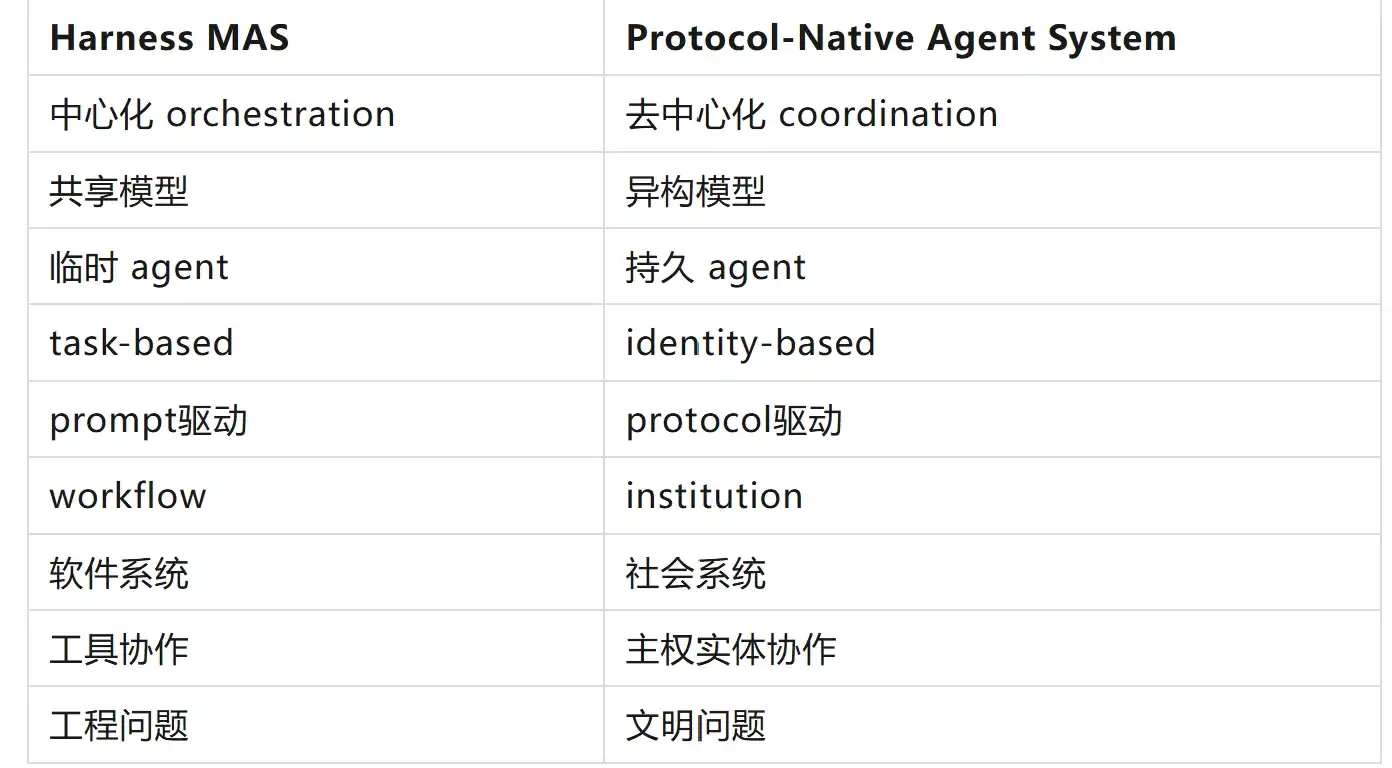
Let's make a table to compare the fundamental differences between the two MAS approaches mentioned earlier:
After "Intelligence"

Many people today believe the biggest problems with AI are:

  • Reasoning ability
  • Model capability
  • Long context
  • Multimodality
  • Agent execution

These indeed pose current challenges, but I truly believe all these will be solved soon. However, upon truly entering Agent Society, the most difficult problem might become: how autonomous entities achieve long-term collaboration.

Kepler was revered as the "lawgiver of the heavens" because of his three laws. But what are the laws for Agents here? When sovereignty is partially separated, this is an unavoidable question.

Because in the future:

  • Agents will have different goals
  • Agents will have different world models
  • Agents will have different interests
  • Agents will have different memories
  • Agents will have different value systems

Therefore, the truly difficult thing in the future is not "making Agents talk," but "enabling Agents to form a coherently interpretable world model."

This means: Ontology, Semantic Protocol, these fields once neglected by the internet, will become core again. There are already some signs; Ontology, such an obscure term, is now almost becoming a mainstream engineering vocabulary. It's truly an astonishing thing.

The Secret of Palantir

Companies Might Just Be "Agent Associations"

Pushing this further, future "companies" might not even be human organizations. (Students who often read my articles, does this sound familiar? The high-end game of unmanned companies has appeared.) They could be protocol alliances of numerous Personal Agents.

For example:

  • Your Agent
  • My Agent
  • AI CFO
  • AI Lawyer
  • AI Sales
  • AI Factory

Dynamically forming organizations through protocols. Organizations are no longer fixed structures, but Agent associations that can be reorganized in real-time.

Therefore, many future systems may no longer be software running, but may be transforming into: organizations computing. And this might be the true: Intelligence-Native Civilization.

Finally, I'll use an AI-generated image to summarize the entire article:
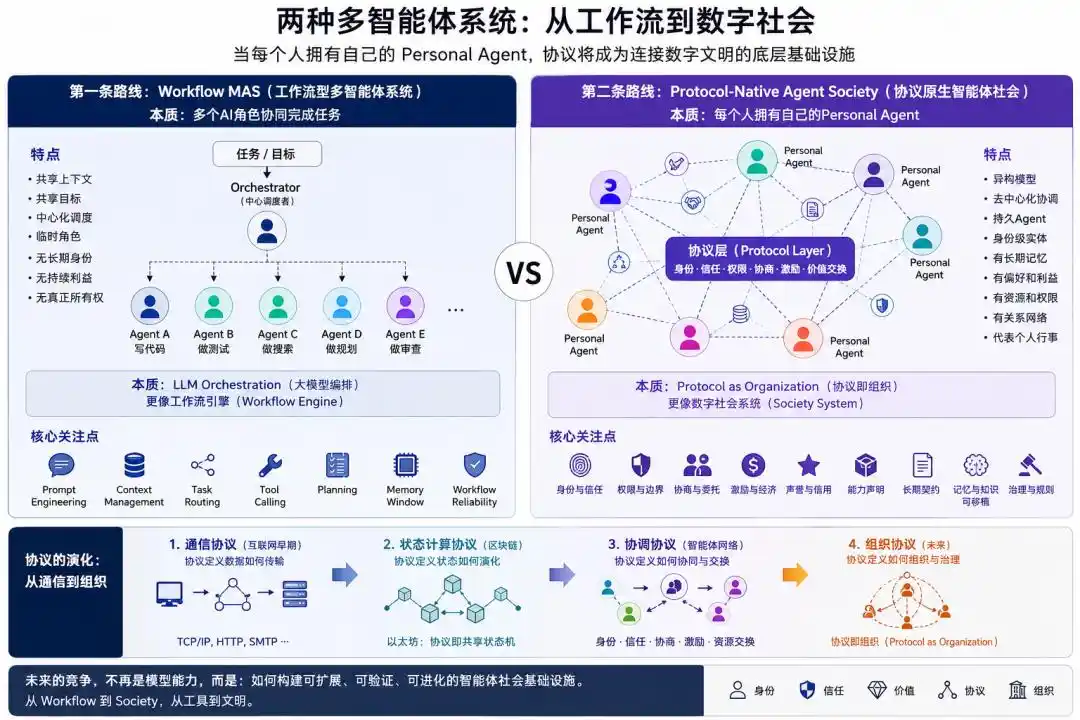
(The summary is indeed better than banana)

I have established a "universe" of AI ontology.

Galloping with the wind, spring grows old; The world is fickle, the traveler's steps are slow.

This article is from the WeChat public account "琢磨事," author: Li Zhiyong

İlgili Sorular

QWhat are the two main AI Multi-Agent System (MAS) development paths discussed in the article, and how do they fundamentally differ?

AThe article discusses two main MAS paths. The first is 'Harness-style MAS,' which is currently mainstream. It involves multiple AI agents (like coders, testers) orchestrated by a central system to complete complex tasks. It's essentially a sophisticated workflow or orchestration system. The second path is 'Protocol-Native Agent System.' Here, the focus shifts to personal or sovereign agents (like a Personal Agent or an 'unmanned company') that represent individuals with long-term memory, identity, and resources. The fundamental difference is in their nature: the first is a task-oriented, centrally controlled software system, while the second envisions a society-like system of autonomous entities that must coordinate through protocols.

QAccording to the article, why will 'protocols' become the core challenge in a future populated by autonomous Personal Agents?

AIn a future with many independent, sovereign Personal Agents (each with its own goals, memory, and value systems), central coordination methods like shared context or workflows become impossible. Therefore, protocols will become the core mechanism for enabling coordination. These protocols will need to solve complex social and institutional problems like identity verification, trust establishment, permission boundaries, incentive mechanisms, reputation systems, and long-term contracts between autonomous entities. The core challenge thus shifts from 'prompt engineering' to 'protocol engineering' to manage interactions in this digital society.

QWhat key characteristics define a true 'Personal Agent' or 'unmanned company' as opposed to a task-specific agent in the first MAS path?

AA true Personal Agent or unmanned company is defined by sovereignty and persistent identity, unlike temporary task agents. Its key characteristics include: long-term memory, a continuous identity, personal preferences, owned resources, specific permissions, a personal history, a relationship network, defined interest boundaries, and the ability to represent its owner ('you'). It is an identity-scoped entity, not a task-scoped tool. This sovereignty is what necessitates the complex protocol-based interactions described in the article.

QThe article suggests the concept of 'Protocol as Organization.' What does this mean in the context of Agent Society?

A'Protocol as Organization' means that in an Agent Society, the protocols governing agent interactions will take on the functions traditionally associated with human organizations. Beyond just defining data communication (like HTTP) or shared state computation (like blockchain), these advanced protocols will define coordination rules, permission structures, incentive models, identity management, and the very organizational relationships between agents. In this way, a 'company' or collective entity could be formed dynamically not by legal documents and fixed structures, but by a set of protocols that allow a coalition of Personal Agents and specialized AI agents to collaborate and operate together.

QWhat does the author believe will be the most difficult challenge after basic AI 'intelligence' problems (like reasoning, context) are solved?

AThe author believes the most difficult challenge will be enabling long-term collaboration between autonomous entities (agents). Once agents have different goals, world models, interests, memories, and value systems, the core problem shifts from making agents intelligent to making their interpretations of the world align enough for cooperation. This will make fields like Ontology (defining shared conceptual frameworks) and Semantic Protocols (protocols with shared meaning) critically important, moving the focus from technical execution to social and philosophical coordination within a digital civilization.

İlgili Okumalar

A 10,000-Word Interpretation of the "Optical Interconnect" Industry Chain: The AI Infrastructure Bottleneck Obscured by GPU Glare

**Summary: The Rise of Optical Interconnect in AI Infrastructure** This analysis explores the critical, yet often overlooked, role of optical interconnects in large-scale AI data centers. While GPUs provide raw computational power, the efficiency of AI clusters depends heavily on high-speed data transfer between thousands of cooperating GPUs during both training and inference tasks. Copper-based electrical connections are hitting physical limits in bandwidth, distance, and power consumption. Fiber optics, using light signals, offer a superior solution with exponentially higher bandwidth and lower energy use over longer distances. This shift is driving rapid growth in the optical interconnect market. The core translation device is the pluggable optical transceiver (or module), which converts electrical signals from GPUs into optical signals for fiber transmission and vice versa. Its manufacturing involves two distinct semiconductor domains: indium phosphide (InP) for optical chips (lasers, modulators, detectors) and silicon for digital signal processing (DSP) chips. A transformative next-generation technology is Co-Packaged Optics (CPO). CPO moves the optical engine (a silicon photonic integrated circuit, or PIC) much closer to the GPU or switch inside the same chip package, drastically reducing power loss and latency. CPO necessitates an external laser source and relies on silicon photonics (using Silicon-on-Insulator/SOI wafers) for integration with silicon chips. The optical interconnect ecosystem is highly fragmented, unlike the concentrated GPU market. Key bottlenecks and players span the entire supply chain: InP substrates (e.g., AXT), epitaxial wafers (e.g., IQE), laser chips (e.g., Sivers, Lumentum, Coherent), silicon photonics foundries (e.g., Tower Semiconductor), SOI wafers (e.g., Soitec), DSP/switch chips (e.g., Broadcom, Marvell), and underlying fiber (e.g., Corning). The article posits that AI infrastructure competition is extending from "who has more GPUs" to "who can secure the scarce optical interconnect supply chain." CPO represents the largest potential growth variable, with projections suggesting it could become a market worth tens of billions of dollars by 2028. Investment opportunities vary from conservative (large, diversified players) to aggressive (small, high-beta companies focused on specific bottleneck technologies), but the sector carries significant volatility and execution risks.

marsbit5 dk önce

A 10,000-Word Interpretation of the "Optical Interconnect" Industry Chain: The AI Infrastructure Bottleneck Obscured by GPU Glare

marsbit5 dk önce

a16z: RWA Has Passed the Proof of Concept, but the Real Challenges Are Just Beginning

a16z highlights that the tokenized real-world asset (RWA) market, excluding stablecoins, has grown tenfold in under two years to roughly $340 billion. This surge is primarily driven by US Treasury bonds and gold, offering investors yield on idle stablecoins and providing institutions with more efficient settlement and collateral flows. However, the core insight is that most tokenized assets today are simply digital certificates for off-chain holdings—used for ownership and transfer but not deeply integrated into DeFi as composable financial building blocks. For instance, only about 5% of tokenized bonds ($8B) are actively used in DeFi protocols. Smaller categories like reinsurance tokens show much higher DeFi utilization (84%), indicating they were designed for on-chain composability from the start. The market remains concentrated, with US Treasuries and commodities comprising two-thirds of the total. Gold dominates the commodities segment. While Ethereum holds over half the market, activity is spreading across multiple chains like BNB Chain and Solana. Predictions for the market's future size vary widely (from $2 trillion to over $30 trillion by 2030/2034), reflecting different definitions of what constitutes tokenization. All agree on significant growth. The current market is minuscule compared to traditional finance (e.g., tokenized bonds are 0.01% of the global bond market). The key takeaway is that the initial "proof-of-concept" phase for moving familiar assets on-chain is proving successful. The next, harder challenge is moving more complex financial instruments onto blockchains and enabling true on-chain composability, where these assets become programmable components within a native digital financial system, rather than just digitized records.

marsbit42 dk önce

a16z: RWA Has Passed the Proof of Concept, but the Real Challenges Are Just Beginning

marsbit42 dk önce

The Wind of 'Proactive' AI Blows into Silicon Valley: Hark Secures $700 Million in Funding

Hark, an AI startup founded in late 2025, has raised $700 million in Series A funding at a $6 billion valuation. Led by Parkway Venture Capital with participation from NVIDIA, AMD Ventures, Intel Capital, Qualcomm Ventures, and Salesforce Ventures, the company aims to develop next-generation human-computer interfaces using a combination of proprietary foundational models and custom-built AI-native hardware. Founded by serial entrepreneur Brett Adcock, Hark envisions a system of multimodal devices equipped with agentic capabilities, end-to-end voice models, and personalized memory. This "active" AI approach seeks to move beyond passive chatbots, creating collaborative companions that anticipate needs and interact naturally within the real world. Adcock's experience with Figure, a humanoid robotics company, informs this hardware-focused venture. The article argues that while current AI is powerful, it remains confined to screens and traditional interfaces like chat. The next paradigm shift requires dedicated hardware that is always-on, possesses persistent memory, and enables intuitive interaction, potentially rivaling the impact of the iPhone. Hark is assembling a team with talent from Apple, Meta, Google, and Tesla to tackle this complex engineering challenge across models, hardware, and interaction design. Finally, the piece suggests Chinese startups may have an advantage in this "active" AI hardware space due to strong manufacturing ecosystems, a vast domestic market, and supportive government policies, framing the competition as one that requires integrated progress in models, operating systems, and devices.

marsbit47 dk önce

The Wind of 'Proactive' AI Blows into Silicon Valley: Hark Secures $700 Million in Funding

marsbit47 dk önce

Competitors Going Public, Kimi Can't Sit Still

Competitors Go Public, Kimi Feels the Pressure Yue Zhi An Mian (Moonshot AI), the company behind the AI assistant Kimi, has begun dismantling its VIE and red-chip structure, clearing a key obstacle for a potential Hong Kong IPO. This marks a significant shift from six months ago when founder Yang Zhilin stated the company was in "no hurry" to list. The move comes as rivals like Zhipu AI and MiniMax have successfully listed on the Hong Kong Stock Exchange in early 2026, experiencing massive surges in market value. This has reset valuation logic for AI companies, turning "going public" from an end goal into a competitive necessity. Analysts suggest Kimi is both seizing a favorable market window and responding to competitive pressure. Kimi's valuation has skyrocketed from around $3 billion at its 2023 founding to over $20 billion by May 2026. Capital is betting on its potential as a future AI platform and gateway, though some caution this "emotional valuation" depends on sustained technological leadership and successful commercialization. Traditionally focused on core model R&D over user growth, Kimi has recently pivoted strategy. While its monthly active users declined through 2025, it shifted focus to Agent development and reducing marketing spend. The release of its K2.5 model in early 2026 reportedly generated substantial revenue, with annual recurring revenue reaching $200 million by April, driven by subscriptions and API services. A $2 billion D-round financing in May signaled investor approval of this commercial shift. However, listing will bring new pressures. Experts predict a listed Kimi would face stricter scrutiny on financial controls, compliance, and R&D efficiency. The narrative must evolve from pure technological breakthroughs to demonstrating clear commercialization paths, sustainable income, and a defensible valuation, balancing model superiority with business performance.

marsbit1 saat önce

Competitors Going Public, Kimi Can't Sit Still

marsbit1 saat önce

İşlemler

Spot
Futures

Popüler Makaleler

ONE Nasıl Satın Alınır

HTX.com’a hoş geldiniz! Harmony (ONE) satın alma işlemlerini basit ve kullanışlı bir hâle getirdik. Adım adım açıkladığımız rehberimizi takip ederek kripto yolculuğunuza başlayın. 1. Adım: HTX Hesabınızı OluşturunHTX'te ücretsiz bir hesap açmak için e-posta adresinizi veya telefon numaranızı kullanın. Sorunsuzca kaydolun ve tüm özelliklerin kilidini açın. Hesabımı Aç2. Adım: Kripto Satın Al Bölümüne Gidin ve Ödeme Yönteminizi SeçinKredi/Banka Kartı: Visa veya Mastercard'ınızı kullanarak anında Harmony (ONE) satın alın.Bakiye: Sorunsuz bir şekilde işlem yapmak için HTX hesap bakiyenizdeki fonları kullanın.Üçüncü Taraflar: Kullanımı kolaylaştırmak için Google Pay ve Apple Pay gibi popüler ödeme yöntemlerini ekledik.P2P: HTX'teki diğer kullanıcılarla doğrudan işlem yapın.Borsa Dışı (OTC): Yatırımcılar için kişiye özel hizmetler ve rekabetçi döviz kurları sunuyoruz.3. Adım: Harmony (ONE) Varlıklarınızı SaklayınHarmony (ONE) satın aldıktan sonra HTX hesabınızda saklayın. Alternatif olarak, blok zinciri transferi yoluyla başka bir yere gönderebilir veya diğer kripto para birimlerini takas etmek için kullanabilirsiniz.4. Adım: Harmony (ONE) Varlıklarınızla İşlem YapınHTX'in spot piyasasında Harmony (ONE) ile kolayca işlemler yapın.Hesabınıza erişin, işlem çiftinizi seçin, işlemlerinizi gerçekleştirin ve gerçek zamanlı olarak izleyin. Hem yeni başlayanlar hem de deneyimli yatırımcılar için kullanıcı dostu bir deneyim sunuyoruz.

285 Toplam GörüntülenmeYayınlanma 2024.12.12Güncellenme 2025.03.21

ONE Nasıl Satın Alınır

Tartışmalar

HTX Topluluğuna hoş geldiniz. Burada, en son platform gelişmeleri hakkında bilgi sahibi olabilir ve profesyonel piyasa görüşlerine erişebilirsiniz. Kullanıcıların ONE (ONE) fiyatı hakkındaki görüşleri aşağıda sunulmaktadır.

活动图片