
Published every Monday to Friday morning, focusing on macro trends, US stocks, AI, precious metals, and crude oil, we review the market with data and seize opportunities with trends. Produced by PANews.
Major Indices Plunge, Dow Posts Biggest Single-Day Drop in 15 Months
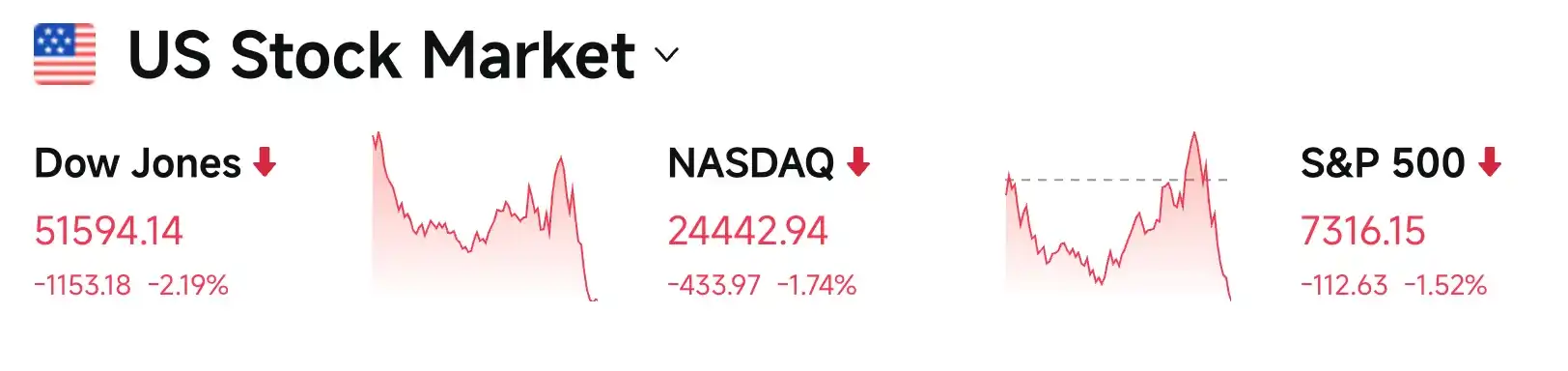
US stocks suffered a "triple whammy" on Wednesday: reignited geopolitical conflict, a divided hawkish Fed, and shaken AI faith, sending major indices lower across the board.
The Dow Jones Industrial Average plunged 1,153.18 points, or 2.19%, marking its largest single-day point drop since April 2025; the Nasdaq Composite fell 1.74%, its sixth consecutive decline; the S&P 500 dropped 1.52%. The Nasdaq 100 Index fell more sharply by 2.06%, retreating over 11% from its June record high and officially entering a technical correction.
The VIX volatility index surged 13.45% to 20.66 in a single day, sliding into panic territory.
Strongest Hawkish Split in a Decade: Fed Holds Steady, Three Voters Defect, Advocating for a Hike
On July 29, the Federal Reserve decided to keep the federal funds rate unchanged in the range of 3.50% to 3.75%, marking the fifth consecutive hold in 2026 and the seventh consecutive month without change.
While the decision itself was in line with expectations, three out of the twelve policymakers publicly dissented, voting to raise rates by 25 basis points immediately. This is the first time since 2016 that three hawkish dissent votes have appeared, completely shattering market optimism regarding the policy path for the remainder of the year.
Fed Chair Warsh took a tough stance during the press conference, reiterating that the Fed will not tolerate inflation above 2%, and explicitly announced the cancellation of "forward guidance," requiring investors to judge the direction of rates based on data themselves.
Additionally, Warsh made a rare mention of the AI industry's impact, pointing out that investment growth in AI-related high-tech equipment and software has approached 20% over the past four quarters, pushing up prices for memory, logic chips, and related infrastructure. The Fed is closely assessing whether this kind of price increase will spread to broader inflationary areas.
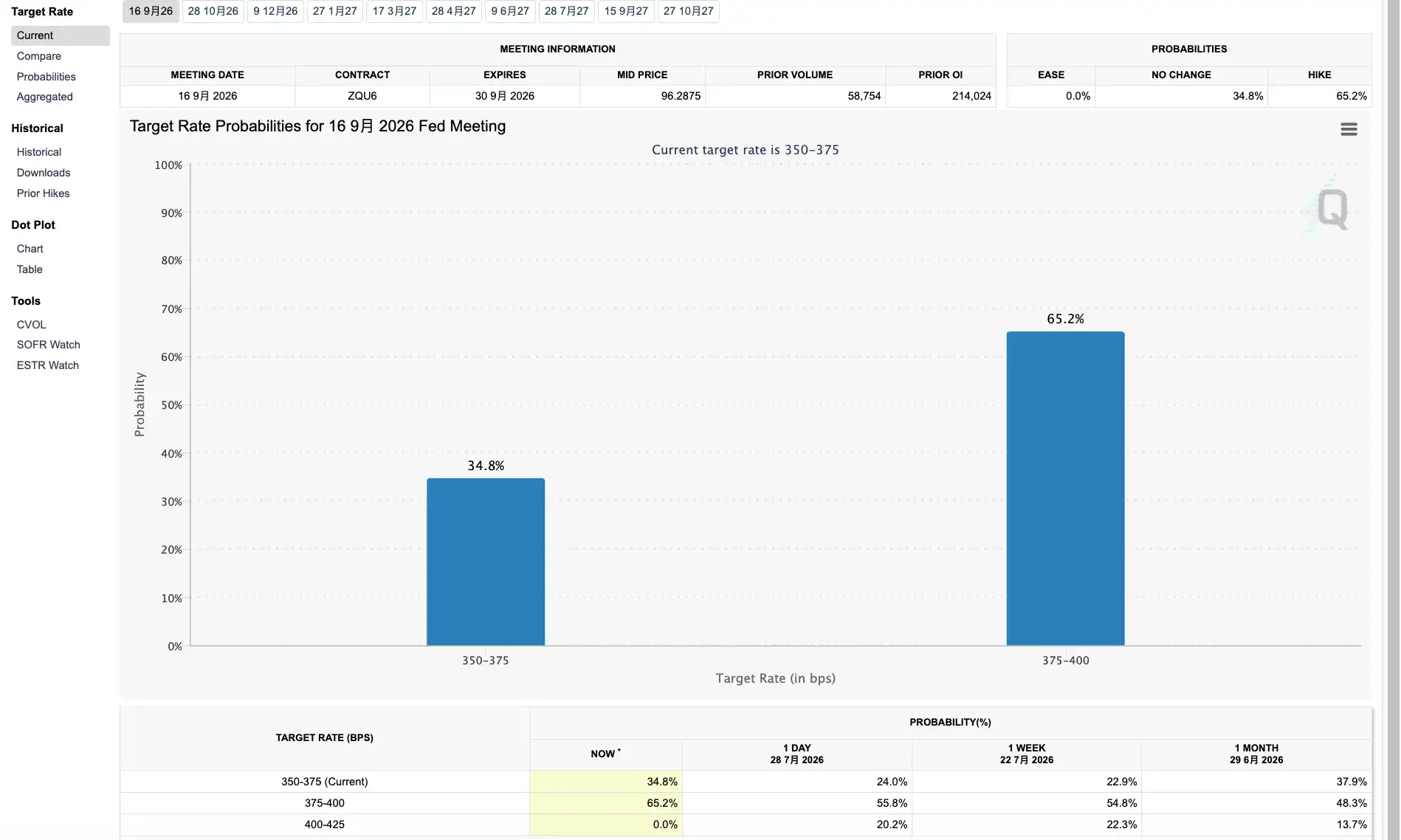
As a result, the CME FedWatch Tool shows that the market's probability of a 25 basis point rate hike in September has risen to 65.2%. CICC noted that the Fed's move not only failed to ease inflation concerns but may instead increase bond market volatility and exacerbate stock market adjustment risks. It is expected that more Fed officials will release hawkish signals in the coming period, with statements from Governor Waller, Vice Chair Jefferson, and others worth watching.
JPMorgan also expects that, due to political pressure before the midterm elections, the US Treasury Department is highly likely to temporarily refrain from signaling increased Treasury issuance when it announces its quarterly refinancing statement next week, despite the bank's calculation that the US will face a $3.7 trillion financing gap over the next four fiscal years.
US Military Proposes Two-Week Bombardment Plan, 30-Year Yield Hits 19-Year High
The brief ceasefire agreed upon by the US and Iran last Friday collapsed completely after just four days. Following Iran's attempted missile launch at a US military base in Jordan on Tuesday, the US retaliated. US Central Command just announced the completion of a large-scale strike operation against Iran, destroying dozens of targets under Iran's Islamic Revolutionary Guard Corps.
US President Trump took a very tough stance, publicly vowing to hit Iran "hard." According to US media, there are also internal disagreements within the US military on how to proceed: frontline commander Cooper advocates for a two-week "bombing blitz" to try to cripple Iran's missile capabilities at once; but senior military official Cain is concerned about insufficient US air defense ammunition stockpiles and fears the conflict could spiral further out of control.
Spurred by the risk of full-scale war and a sharp drop in Cushing inventories, Brent crude for September surged nearly 8% back above the $90 mark, while WTI crude soared 6.56% past $84.
Following the Fed's decision, the Treasury market released a key signal: the yield curve steepened sharply. The 2-year Treasury yield fell to around 4.22%; while the 30-year US Treasury yield surged 2.14% in a single day, reaching 5.23% today, its highest level since June 2007; the 10-year Treasury yield rose to 4.70%. This combination of short-end decline and long-end rise constitutes one of the largest post-FOMC meeting curve steepenings since the mid-1990s.
Long-term bonds faced massive selling, with investors demanding higher inflation risk premiums and doubting the credibility of Fed Chair Warsh's "hawkish rhetoric, slow action" policy stance. Multiple Wall Street strategists noted that the long end of the market is not buying Warsh's anti-inflation story. With the disappearance of the policy communication "anchor" and the decline in short-term rates, the US dollar index fell over 0.6% intraday.
Chip Stocks Collectively "Slaughtered," AI Faith Crumbles and Rare Retail Stampede
Previously crowded AI hardware sectors like memory chips, optical communications, and semiconductor equipment were once again hit by large-scale selling, while AI software and energy sectors showed relative resilience.
The Philadelphia Semiconductor Index plummeted 5.33%, falling for the fifth consecutive session, confirming on Tuesday its entry into a technical bear market, down 28.7% from its all-time high. The chip ETF DRAM fell over 6%, Micron dropped nearly 10%, and Lumentum fell 7.6%.
-
Goldman Sachs' trading desk recorded the largest three-day cumulative reduction in exposure since November 2022, with the scale of short selling in the tech sector being the largest since 2016.
-
Simultaneously, Vanda Research data showed that on Tuesday, US retail investors recorded their largest net sell-off of individual stocks since the early days of the COVID-19 pandemic. Approximately 88% of the $213 million in individual stocks sold came from the memory chip sector, with Micron, SanDisk, Seagate, and Western Digital being the main targets. Retail investors have now been net sellers of individual stocks for nine consecutive trading days this year, a rare phenomenon not seen in 2021, 2024, or 2025. Vanda Research analysis suggests retail investors are not exiting the market but becoming more selective, shifting from individual stocks to broad-based ETFs to diversify risk. This trend may increase pressure on previously popular momentum stocks when earnings fall short of expectations.
-
Daniel Roos, founder of VolSignals, pointed out that the gamma exposure of S&P 500 options market makers has declined to low levels for three consecutive trading days. Historically, similar situations have led to an average S&P 500 index movement of 8.9% within one month, about 2.5 times the normal level, indicating expanding market volatility.
Specific Company Actions and Stock Movements:
-
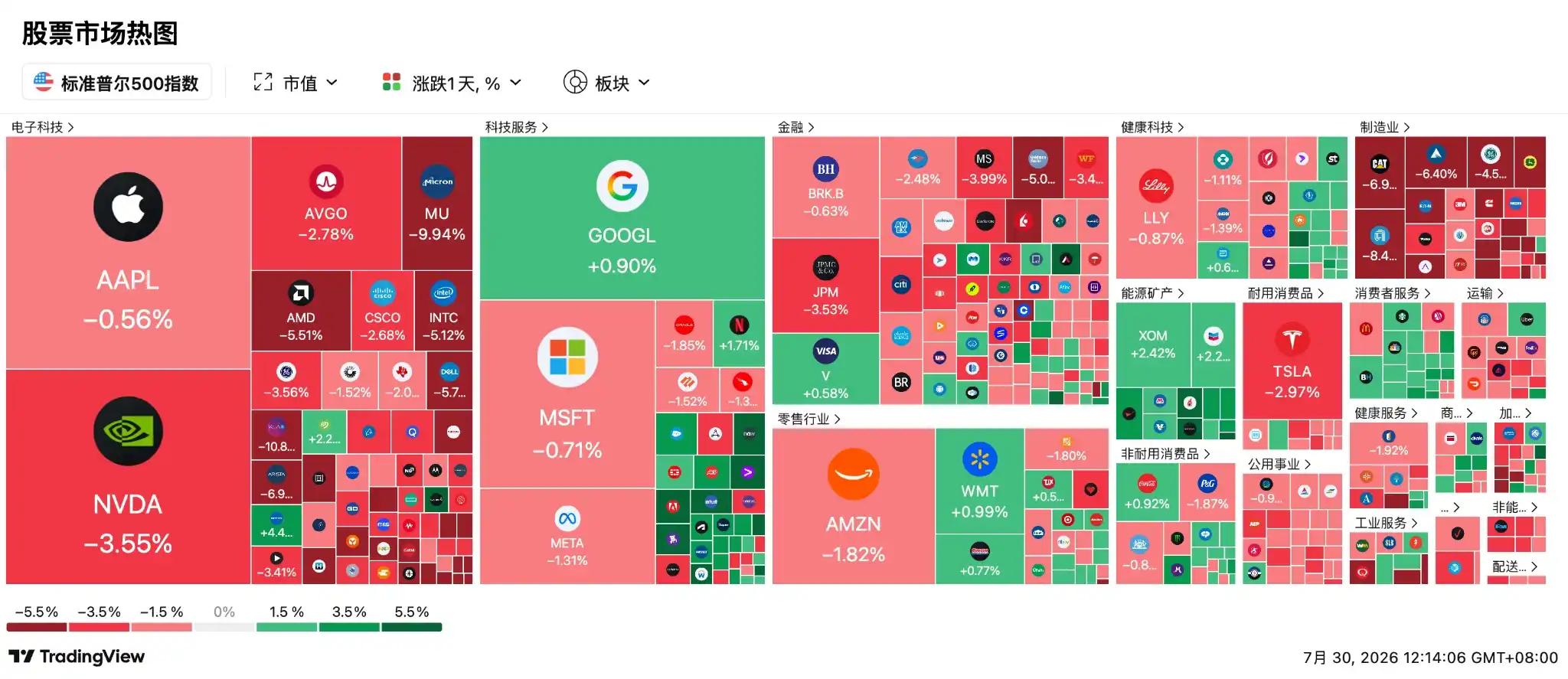
Microsoft closed down 0.71%, surged nearly 10% after-hours: Q4 revenue and EPS exceeded expectations across the board, Azure grew 43% year-over-year (first annual crossing of $100 billion), capital expenditures were below expectations, and new data center lease commitments exceeded $130 billion. Its status as the first major tech giant not to raise capex guidance brought relief to the market.
-
Meta closed down 1.31%, marking its tenth consecutive decline, plummeted over 10% after-hours: Q3 revenue guidance fell short of expectations. While maintaining aggressive full-year AI investment exceeding $130 billion, the company's free cash flow plunged to $784 million, a four-year low, exacerbating Wall Street's anxiety over its capital expenditure abyss.
-
Qualcomm net profit plunged 25% year-over-year, fell nearly 3% after-hours: Hit by soaring memory prices, its mobile chip business faced pressure. Revenue fell 4% to $9.95 billion, and the upper end of its Q4 FY guidance remained below market expectations, leading investors to vote with their feet.
-
Arm's results beat expectations but were sold off, fell over 5% after-hours: FQ1 revenue rose 22% year-over-year to $1.289 billion, EPS beat expectations, but FQ2 revenue guidance of $1.38 billion fell short of the most optimistic analyst forecasts of $1.5 billion, as smartphone weakness overshadowed data center expansion benefits.
-
Lam Research surged over 8% after-hours: FY2026 Q4 revenue of $6.72 billion increased 15.1% sequentially, adjusted EPS of $1.82 rose 23.8% sequentially, highlighting continued strong semiconductor equipment demand as a rare bright spot in earnings season.
-
AI application software stocks showed relative strength: Adobe rose nearly 6%, Workday and Datadog rose over 5%, ServiceNow and Snowflake gained nearly 5%.
-
Memory chip sector suffered cliff-like declines, plunging for four consecutive days: Micron Technology plummeted nearly 10%, down over 41% from its peak; SanDisk fell 7.32%, down over 55% for the month; SK Hynix dropped 2.6%, sold off despite first-half operating profit surging over fivefold year-over-year as it still missed expectations.
-
Optical communication stocks also plunged: Applied Optoelectronics crashed over 13%, Coherent fell nearly 9%, Credo and Lumentum dropped nearly 8%, Marvell Technology declined over 6%.
-
Vertiv plunged over 17%, as Q2 revenue of $3.27 billion, up 24% year-over-year, missed expectations of $3.38 billion, with its large gains earlier in the year leaving the market with little tolerance for error.
-
Hims & Hers tumbled nearly 15%, sued by the US Federal Trade Commission for allegedly improperly sharing user health data with third-party advertisers like Meta and Snap.
-
Other giants: Nvidia fell 3.55% (Jensen Huang visits US Congress to discuss $50 billion domestic production plan within four years); Tesla dropped 2.97% (Elon Musk previews Grok 4.6 release around August 7, parameter scale 1.5 trillion); AMD fell 5.51%; Intel declined 5.12%; TSMC ADR fell 4.48% (Kumamoto factory operations require time to resume post-earthquake).
Key Points to Watch Next:
July 30 (Thursday)
-
Bank of England Interest Rate Decision (19:00 GMT) and Governor Bailey Press Conference: The market expects no change, but the focus will be on its wording regarding wages and services inflation. A hawkish tilt could provide upward momentum for the pound and UK gilt yields; a dovish tone would reinforce the "on hold but with room" global central bank narrative.
-
US Q2 GDP Annualized QoQ Preliminary, June Core PCE Price Index (20:30 GMT): This is the Fed's preferred inflation gauge, directly testing the credibility of Warsh's "no guidance, let data speak" policy logic. If core PCE exceeds expectations, coupled with oil price shocks, September rate hike bets could heat up further, pressuring long-term Treasury yields and stocks.
July 31 (Friday)
-
Japan June Unemployment Rate and Bank of Japan Interest Rate Decision: The market is closely watching for signals of further rate hikes from the BOJ. Hawkish language could increase pressure on global carry trade unwinding via a stronger yen, impacting risk assets; a dovish tone could help stabilize global risk appetite temporarily.
-
Heavyweight Earnings: Apple, Amazon, Coinbase, Strategy, Kioxia, Roblox, Rivian, Exxon Mobil, Chevron, AbbVie, Moderna, Colgate-Palmolive, T. Rowe Price, Eaton, Enbridge, Cameco, among others, report. Key market focuses: Apple's services revenue growth, iPhone demand in China, and Apple Intelligence rollout progress; whether Amazon AWS growth can replicate Microsoft Azure's surprise and whether AI cloud capex guidance will moderate.