From Parallel Finance to Mainstream Finance: The On-Chain Securities Era Ushers in a Historic Window

marsbit2026-06-01 tarihinde yayınlandı2026-06-01 tarihinde güncellendi

Özet

From Parallel Finance to Mainstream: The Dawn of On-Chain Securities For over a decade, the crypto industry has operated as a parallel financial system with its own currencies, markets, and assets—from Bitcoin and ICOs to DeFi, NFTs, and memecoins. Despite building a robust internal ecosystem, a wall has separated it from the traditional financial world. That barrier is now crumbling. The industry's first act was one of internal evolution: ICOs streamlined fundraising, DeFi recreated financial services on-chain, and layer-2 networks competed for scalability—all within the crypto bubble. While innovative, this cycle remained closed, with capital and users circulating internally, leading to volatile boom-bust cycles. Even Bitcoin ETFs, while attracting Wall Street capital, merely provided a channel to buy crypto assets without bridging the systems. The next, larger narrative is Real-World Assets (RWA) moving on-chain. This involves tokenizing stocks, bonds, funds, and future cash flows. Blockchain can compress the complex traditional processes of trading, settlement, clearing, and custody into a seamless, automated network operating in seconds. This shift is creating a new financial gateway: the native crypto securities broker. This entity will combine functions of an exchange, broker, bank, and custodian into a unified global financial operating system. Consequently, the next major battleground won't be the "public chain wars" focused on speed and cost, but the competition ...

Author: Climber, CryptoPulse Labs

For over a decade, the crypto industry has been like a financial experiment operating independently from the real world. It has its own monetary system, its own trading markets, its own logic for asset pricing, and its own set of beliefs and narratives.

From the birth of Bitcoin, through the ICO boom, to the explosion of DeFi, NFTs, Layer 2s, meme coins, and on-chain derivatives, the crypto world has gradually built an almost complete financial ecosystem.

But no matter how it has developed, one question has always remained. That is, a wall still separates the crypto world and the real-world financial system. Now, this wall is being dismantled. In the next decade, an era of native crypto securities brokerage that integrates with the global financial system is opening up.

I: The First Half of the Crypto Industry: The Self-Evolution of a Closed Ecosystem

In recent years, the U.S. CFTC has been gradually promoting a regulatory framework for compliant perpetual contracts, and the U.S. SEC has also begun to consistently signal policy support for tokenizing securities. The recent news about SpaceX's upcoming super IPO event has also made the market realize that the world's highest-quality assets in the future may be seeking new ways to circulate.

Scenarios that once sounded like science fiction are now step by step becoming reality. This means the crypto industry is about to enter a new stage.

However, looking back at the history of the crypto industry, it becomes clear that the past decade-plus has actually been an ongoing, escalating internal financial experiment.

The 2017 ICO frenzy essentially solved the fundraising problem. For the first time, startup projects didn't need traditional VCs or IPO approvals; with just a whitepaper and a token model, they could raise funds globally. The market saw for the first time the immense efficiency gains blockchain could bring to capital formation.

The subsequent DeFi Summer then began to address the issue of financial services. Lending, trading, market-making, yield aggregation began to move on-chain. Functions originally performed by banks, brokerages, and financial institutions were gradually replaced by smart contracts. The most important change during this period was not the emergence of a particular killer protocol, but the fact that the entire financial infrastructure began to be reconstructed.

Next, the industry entered the era of the public chain war. Due to Ethereum's performance limitations, numerous high-performance public chains began competing for developers, users, and liquidity. Faster speeds, lower costs, and higher TPS became the focus of market competition. However, looking back, this competition was still essentially internal.

Because the participants didn't change—users were still crypto users, capital was still crypto capital, and assets were still crypto assets.

Later, the NFT boom shifted the industry narrative from finance to culture and social interaction. Digital collectibles, on-chain identity, and gaming assets entered the market. This was followed by the meme coin frenzy, decentralized perpetual contracts, DAT, and other new models continuously emerging.

While the industry seems to have been evolving, most of these changes occurred within the same circle. The crypto world has been more like an ever-expanding closed economy, with capital flowing internally, users circulating internally, new assets constantly being created, and then being bought up by new capital.

This is also why every cycle has seen obvious bubbles and pullbacks—because truly massive external capital had never fully entered.

Even with Bitcoin ETFs starting to attract Wall Street capital, the crypto industry has still not truly connected with the real-world financial system. Because ETFs only allow traditional capital to buy crypto assets; real-world assets have not yet truly moved on-chain.

II. A Bigger Story than ETFs: Real-World Assets Begin Moving On-Chain

Many believe that Bitcoin ETFs opened the door for traditional finance to embrace crypto. But in reality, ETFs are only the first step.

Because they merely add a channel for the traditional financial system to purchase crypto assets. What could truly change the industry's structure is another matter—securities assets beginning to enter the on-chain world.
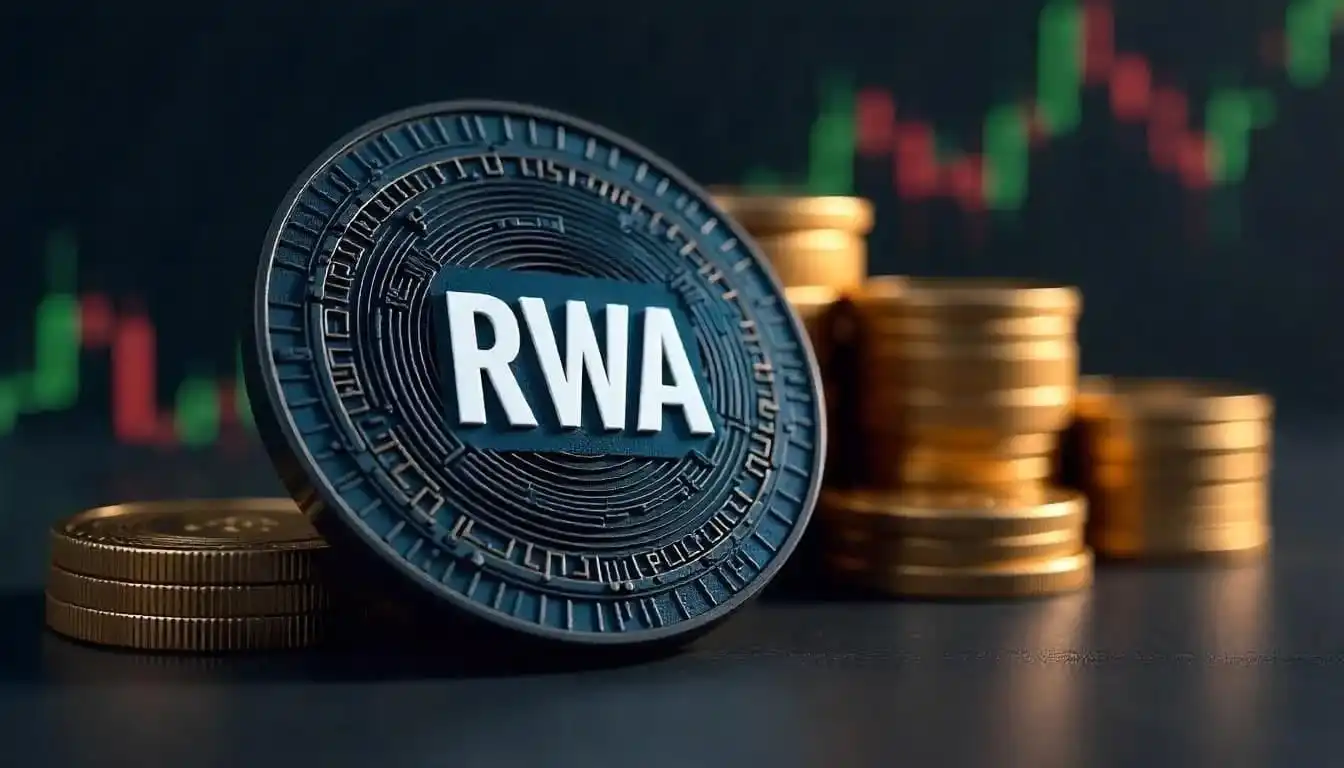
This means stocks, bonds, funds, income rights, and even future cash flows could all be digitized.

In the past, buying a stock required a securities account, cross-border trading required a broker, asset custody required a bank, and after trading, a clearinghouse was needed for final settlement—the entire system was extremely complex.

But blockchain offers a new perspective. If assets natively exist on-chain, then trading, settlement, clearing, custody, and even identity verification could all be completed within the same network.

Processes that used to take days to complete could end in seconds in the future. Work that previously relied on multiple institutions could potentially be executed automatically by smart contracts. This is actually changing the financial infrastructure itself.

What makes Wall Street truly powerful has never been just the scale of its capital. More importantly, it controls the underlying financial network. Exchanges, brokerages, banks, custodians, clearinghouses together constitute a vast system. And blockchain is gradually compressing these links.

In the future, many financial services may no longer be performed by multiple institutions, but run directly within a unified network.

Therefore, the protagonists of the crypto industry's next phase may no longer be trading platforms. They will be new financial gateways.

The so-called native crypto securities brokerage is essentially this new gateway. It not only handles trading functions but also assumes the roles of wallet, asset management, custody, clearing, and financial services.

It might be like an exchange, and also like a broker. Like a bank, and also like a payment system—even more like a global financial operating system.

III. The Next War: Not Public Chain Competition, but Financial System Competition

In recent years, the crypto market has been debating who will become the next king of public chains. The market compares TPS, gas fees, number of ecosystems, and developer size. But in the future, the importance of these metrics may gradually decline.

Because what truly matters in financial markets is not speed, but assets. Even if a chain has a million TPS, it's hard to create long-term value without high-quality assets entering.

What is truly valuable is liquidity. And the core of liquidity is asset quality.

If in the future, users can buy global stocks, index funds, bonds, and even shares in top-tier tech companies like SpaceX on-chain, the entire industry logic will change.

Because the boundary between the on-chain world and the real world will gradually disappear.

In the past, the crypto industry competed for the internal market; in the future, it will compete for the global capital market. These are two completely different stories.

Currently, the global crypto market remains in the multi-trillion dollar range, while the global stock market is close to a hundred trillion dollars, and the bond market is even larger. They are not on the same order of magnitude.

In the past, the industry discussed the next billion-dollar project; in the future, it may discuss how to accommodate the flow of tens of trillions of dollars in assets. The ICO era solved the fundraising problem; the DeFi era solved the on-chain finance problem; the ETF era solved the capital gateway problem; and the native crypto securities brokerage era may solve the problem of integrating real-world finance with crypto finance.

Conclusion

For over a decade, the crypto industry has been trying to create a new world. In the next decade, it may no longer need to recreate the world.

Because it will directly connect to the original world.

When traditional finance and the crypto ecosystem truly converge, the industry's biggest growth story may just be beginning.


İlgili Sorular

QAccording to the article, what is the fundamental problem that the crypto industry has faced despite its development over the past decade?

AThe fundamental problem is that there has been a 'wall' separating the crypto world from the traditional real-world financial system. The crypto ecosystem developed independently with its own currency, markets, and logic, but remained largely disconnected from mainstream global finance.

QWhat event does the author suggest is an even bigger development than the introduction of Bitcoin ETFs?

AThe author suggests that the migration of traditional securities (like stocks, bonds, and funds) onto the blockchain is an even bigger story. This process of real-world asset tokenization has the potential to fundamentally change the industry's structure by blurring the lines between crypto and traditional finance.

QWhat new type of entity does the article predict will be a key player in the next phase of the crypto industry?

AThe article predicts that 'native crypto securities brokerages' will be key players. These entities will act as new financial gateways, combining functions of exchanges, brokers, banks, custodians, and payment systems, essentially serving as a global financial operating system.

QWhat does the author argue will be the primary focus of competition in the future, replacing the past focus on 'public chain wars'?

AThe author argues that future competition will shift from 'public chain wars' (focusing on TPS, fees, etc.) to a competition over financial systems. The true value will lie in attracting high-quality assets and liquidity, with the ultimate prize being a share of the global capital markets, which are orders of magnitude larger than the current crypto market.

QWhat is the core thesis of the article regarding the future relationship between crypto and traditional finance?

AThe article's core thesis is that the crypto industry is transitioning from being a parallel, closed financial experiment to becoming integrated into the mainstream global financial system. The next decade will be defined not by creating a separate new world, but by directly connecting to and reshaping the existing world of finance through the tokenization of real-world assets.

İlgili Okumalar

Pantera Partner: In the Age of Agents, Blockchain is the Inevitable Answer for AI

Summary: AI and blockchain are converging around four key pillars: payment settlement, identity systems, open systems, and resource aggregation, with commercial projects already emerging in each area. The two technologies are fundamentally complementary: AI enables infinite supply (content, agents), while blockchain establishes scarcity and verifiable ownership. AI agents generate content and services, and blockchain handles the verification and value settlement. A significant valuation mismatch exists, with leading AI companies historically overvalued compared to crypto assets, despite their deep underlying integration. The emergence of autonomous AI agents—which require assets, value transfer, and large-scale coordination—creates a need for a non-human-centric financial infrastructure. Blockchain, with its programmability, 24/7 access, and low-trust settlement, is the only suitable foundation. AI agents will not use traditional bank accounts or payment rails; they will transact using stablecoins and on-chain systems. Examples include OpenFX, which settles hundreds of billions in forex trades on-chain for AI agents, and Alchemy, a core development platform. For human identity verification in an age of AI-generated content, projects like World (Worldcoin) use blockchain-based biometric verification, while TransCrypts focuses on self-sovereign identity and verifiable credentials. The current divergence presents a unique investment opportunity. AI valuations are highly elevated, while crypto assets trade at a significant discount, even though the future smart agent economy will be built on blockchain infrastructure. The fusion of AI and blockchain is not a future trend but an ongoing reality, creating a prime environment for entrepreneurs in areas like agent-native finance, decentralized identity, and on-chain AI coordination.

marsbit10 dk önce

Pantera Partner: In the Age of Agents, Blockchain is the Inevitable Answer for AI

marsbit10 dk önce

API Stories Can't Support Valuations, AI Giants Start Offering Consulting Services

The AI industry is shifting from simply selling APIs to providing intensive, on-site consulting services, as major players like OpenAI and Anthropic seek new revenue streams to justify high valuations. OpenAI has established "Deploy Co," raising over $40 billion from investors led by TPG at a $140 billion valuation. The deal has an unusual structure, guaranteeing investors a minimum 17.5% return with a profit cap, resembling debt more than equity. OpenAI also acquired the AI consulting firm Tomoro to gain over 150 "Frontline Deployment Engineers" (FDEs). Similarly, Anthropic formed a $15 billion joint venture with Blackstone, Hellman & Friedman, and Goldman Sachs with the same goal: embedding engineers within client companies. A key driver is Anthropic's rapid market share growth, now holding 40% of the enterprise LLM API market compared to OpenAI's 27%, which has put pressure on OpenAI to accelerate its enterprise strategy. Notably, major consulting firms Bain & Company, McKinsey & Company, and Capgemini are among the investors in OpenAI's venture, a move seen as either seeking deeper insight into AI or funding their potential future disintermediation. This pivot is creating a major shift in tech employment. Demand for FDEs—who integrate AI into client workflows on-site—has surged over 800% in the past year, with salaries reaching $350,000-$550,000. Meanwhile, demand for traditional software engineers has declined significantly. The trend marks a strategic inflection point: core AI models are becoming commoditized, while the complex, labor-intensive work of deployment is becoming the new high-value, capitalized service layer. The $55 billion in combined funding represents a bet that hands-on consulting, not just API access, is the future of enterprise AI monetization.

marsbit1 saat önce

API Stories Can't Support Valuations, AI Giants Start Offering Consulting Services

marsbit1 saat önce

İşlemler

Spot
Futures

Popüler Makaleler

ERA Nasıl Satın Alınır

HTX.com’a hoş geldiniz! Caldera (ERA) satın alma işlemlerini basit ve kullanışlı bir hâle getirdik. Adım adım açıkladığımız rehberimizi takip ederek kripto yolculuğunuza başlayın. 1. Adım: HTX Hesabınızı OluşturunHTX'te ücretsiz bir hesap açmak için e-posta adresinizi veya telefon numaranızı kullanın. Sorunsuzca kaydolun ve tüm özelliklerin kilidini açın. Hesabımı Aç2. Adım: Kripto Satın Al Bölümüne Gidin ve Ödeme Yönteminizi SeçinKredi/Banka Kartı: Visa veya Mastercard'ınızı kullanarak anında Caldera (ERA) satın alın.Bakiye: Sorunsuz bir şekilde işlem yapmak için HTX hesap bakiyenizdeki fonları kullanın.Üçüncü Taraflar: Kullanımı kolaylaştırmak için Google Pay ve Apple Pay gibi popüler ödeme yöntemlerini ekledik.P2P: HTX'teki diğer kullanıcılarla doğrudan işlem yapın.Borsa Dışı (OTC): Yatırımcılar için kişiye özel hizmetler ve rekabetçi döviz kurları sunuyoruz.3. Adım: Caldera (ERA) Varlıklarınızı SaklayınCaldera (ERA) satın aldıktan sonra HTX hesabınızda saklayın. Alternatif olarak, blok zinciri transferi yoluyla başka bir yere gönderebilir veya diğer kripto para birimlerini takas etmek için kullanabilirsiniz.4. Adım: Caldera (ERA) Varlıklarınızla İşlem YapınHTX'in spot piyasasında Caldera (ERA) ile kolayca işlemler yapın.Hesabınıza erişin, işlem çiftinizi seçin, işlemlerinizi gerçekleştirin ve gerçek zamanlı olarak izleyin. Hem yeni başlayanlar hem de deneyimli yatırımcılar için kullanıcı dostu bir deneyim sunuyoruz.

473 Toplam GörüntülenmeYayınlanma 2025.07.17Güncellenme 2026.06.02

ERA Nasıl Satın Alınır

Tartışmalar

HTX Topluluğuna hoş geldiniz. Burada, en son platform gelişmeleri hakkında bilgi sahibi olabilir ve profesyonel piyasa görüşlerine erişebilirsiniz. Kullanıcıların ERA (ERA) fiyatı hakkındaki görüşleri aşağıda sunulmaktadır.

活动图片