Top-Tier MEV Bot Loses $7.5 Million: Is 'Approval' the Most Overlooked Fatal Risk On-Chain?

marsbit2026-06-24 tarihinde yayınlandı2026-06-24 tarihinde güncellendi

Özet

The article discusses a sophisticated attack on a prominent Ethereum MEV (Miner Extractable Value) bot, Jaredfromsubway.eth, resulting in a loss exceeding $7.5 million. Unlike typical exploits involving key leaks or smart contract bugs, this attack was a carefully orchestrated "reverse hunt." The attacker spent weeks deploying fake tokens and liquidity pools that mimicked legitimate assets like WETH and USDC. These pools were designed to appear as profitable arbitrage opportunities, tricking the automated bot's trading logic. During its normal operation, the bot was induced to grant ERC-20 token approvals to the malicious contracts. Once sufficient permissions were accumulated, the attacker drained the bot's funds by calling these pre-approved allowances. This incident highlights the often-underestimated risks associated with token approvals in Web3. The article explains that approvals are a fundamental mechanism, allowing smart contracts (like DEXs) to move a user's tokens on their behalf. However, risks arise from practices like granting infinite approvals, the persistence of approvals even after disconnecting from a dApp, and the potential for a once-trusted contract to become compromised later. The piece concludes with advice for managing approval risks: users should adopt the principle of least privilege (approving only the needed amount), use separate wallets for storage versus interactions, and regularly audit and revoke unnecessary approvals using tools like Revoke....

Author: imToken

A long-running MEV bot that hunted ordinary traders on Ethereum finally fell into a 'custom-made' trap worth $7.5 million.

On June 21, the well-known Ethereum sandwich arbitrage bot Jaredfromsubway.eth was attacked, with assets including WETH and USDC transferred from its address. Preliminary statistics show losses exceeding $7.5 million (though public reports on the exact loss figure still vary).

Interestingly, this attack was neither due to private key leakage nor the exploitation of traditional smart contract vulnerabilities. Instead, the attacker deployed a large number of fake tokens, liquidity pools, and auxiliary contracts in advance, packaging them as trading paths with potential arbitrage opportunities. This lured the bot into automatically granting ERC-20 Approvals to malicious contracts during execution, ultimately allowing the assets to be 'legally' transferred away.

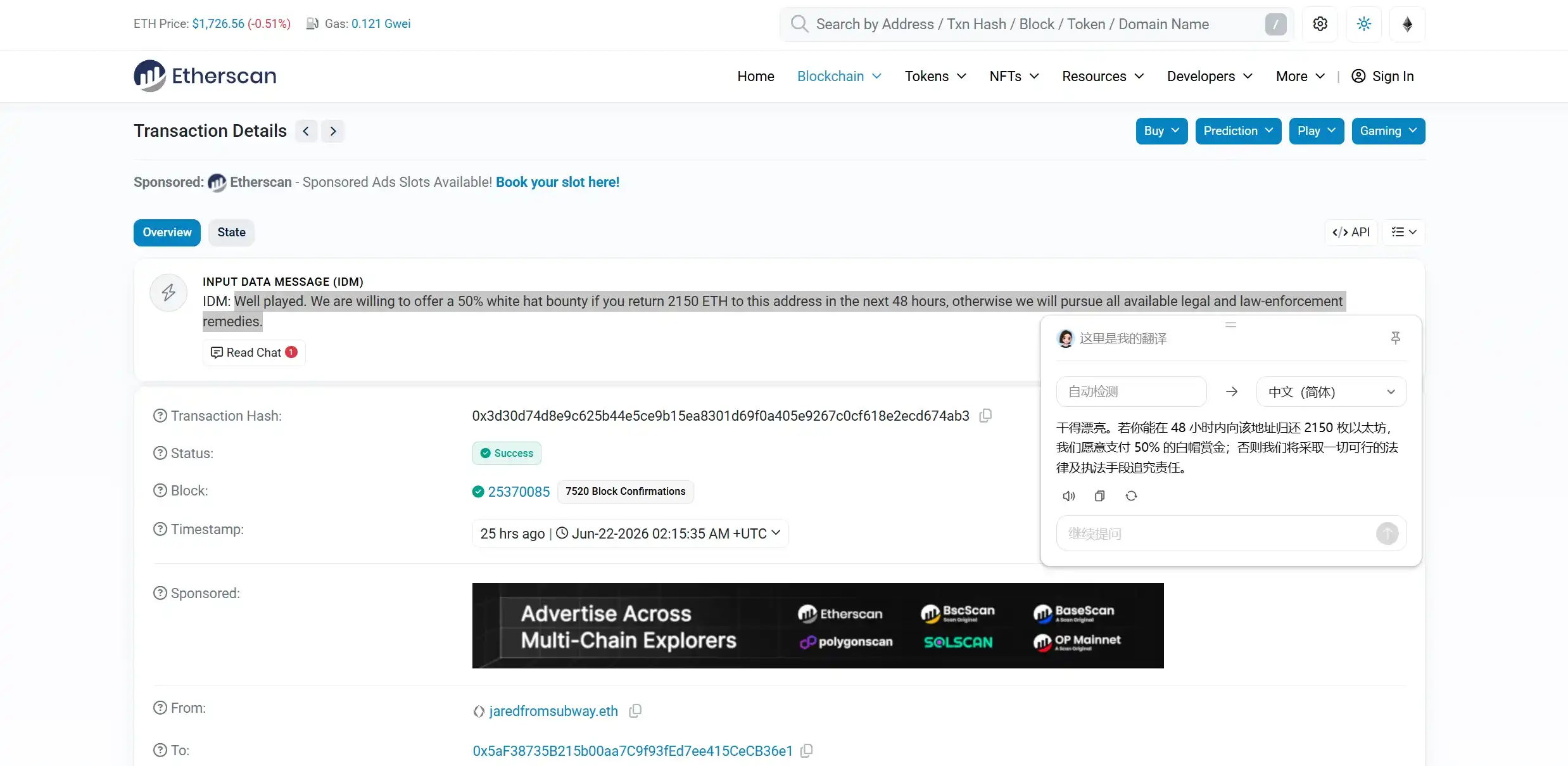
As of publication, Jaredfromsubway.eth has publicly messaged the attacker on-chain, stating, 'If 2150 ETH is returned within 48 hours, we are willing to offer a 50% white hat bounty. Otherwise, we will pursue all available legal and law enforcement actions.'
However, if even a highly specialized, code-driven MEV bot can stumble over an Approval, it forces us to re-examine how dangerous the 'Approval' action we use every day truly is.

I. A Reverse Hunt Designed Specifically for an MEV Bot

A careful review of this attack reveals it was not an accidentally triggered flaw but a long-term hunt designed around Jaredfromsubway.eth's trading logic.

Jaredfromsubway.eth has long been one of the most famous sandwich arbitrage bots on Ethereum. Simply put, a sandwich attack involves the bot spotting an impending on-chain transaction, buying ahead of the user to push the price up, waiting for the user to complete their transaction at a worse price, and then immediately selling to pocket the difference.

Consequently, this strategy requires the bot to continuously scan the mempool, identify arbitrage opportunities at extreme speed, and construct transaction paths calling various tokens and contracts. This also means the faster the speed and the broader the asset and protocol coverage, the more opportunities the bot can capture.

Yet, this very aspect became the entry point for this incident.

Based on post-mortem analysis, the attacker did not directly attack the bot's fund contract. Instead, they spent weeks constructing a trading environment that appeared profitable:

  • Step One: Deploy numerous fake tokens and liquidity pools. These tokens mimicked common assets like WETH, USDC, and USDT in name, interface, and trading behavior, tricking the bot's automated identification system into believing it had discovered normal trading paths.
  • Step Two: Gradually gain the bot's trust. In early tests, the approvals granted by the bot were consumed normally during transactions. Once the bot's system began repeatedly executing similar paths, the attacker adjusted the contract logic. This left some of the approvals generated by the bot unconsumed and not reset to zero after transactions, causing them to persist.
  • Finally, the attacker centrally invoked the still-valid approval limits to transfer the real WETH, USDC, and USDT from the bot's contract.
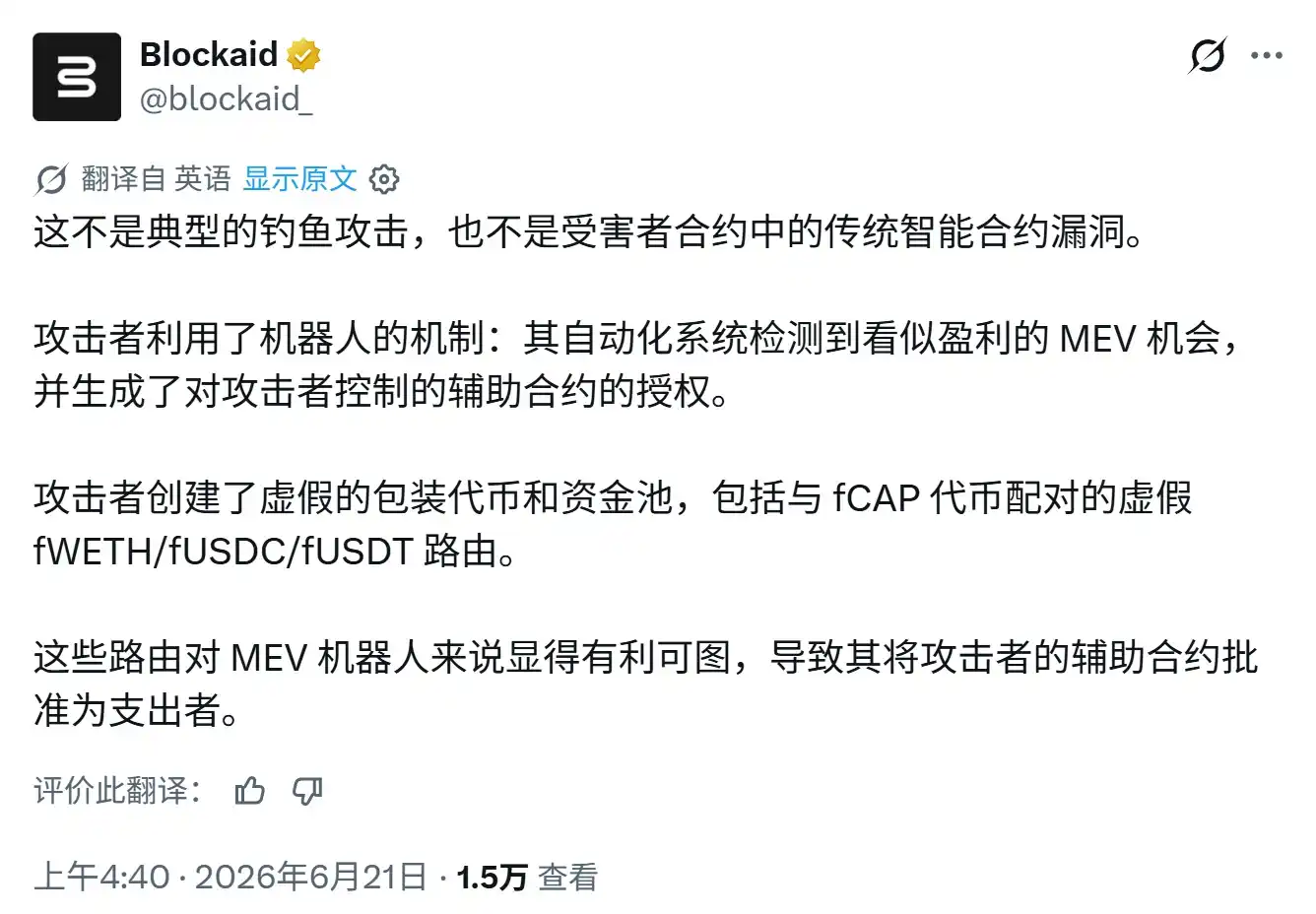
In essence, the entire attack precisely targeted the operational characteristics of MEV bots: first, create an environment that matches their profit-judgment rules; then, exploit their mechanism of pursuing automated execution of trading paths, making the system proactively hand over asset-calling permissions.

This also explains why even a highly specialized MEV bot could be tricked.

It knows how to calculate price differences, Gas costs, and transaction ordering, but may not conduct thorough identity verification for every newly appearing contract. From this perspective, the problem for ordinary users is 'confirming without understanding,' while the problem for automated bots is 'executing automatically without confirmation.'

Superficially, the two are entirely different, but the underlying risk is quite similar: both treat approval as just an ordinary step before completing a transaction, without clearly recognizing how high its hidden risk can be.

II. Why is Approval Always Underestimated?

As is well known, in the ERC-20 standard of Ethereum and EVM-compatible chains, Approve (authorization) is a fairly low-level design.

However, when users directly transfer tokens via their wallet, they typically call `transfer`, which generally doesn't involve Approve. Only in smart contract scenarios like DEXes, lending, staking, or adding liquidity—where users need a smart contract to call tokens on their behalf—does Approval come into play.

For example, when we want to swap USDT for ETH on Uniswap, Uniswap's smart contract cannot directly take USDT from your wallet. It must first execute an Approve to tell the system, 'I allow Uniswap to withdraw X amount of USDT from my wallet.'

Only after the approval is granted can the authorized contract, via `transferFrom`, call the user's USDT within the set limit, allowing the subsequent Swap to proceed smoothly.

In other words, Approval itself is not a vulnerability; it's a fundamental basis for DeFi's normal operation. The problem, however, is that it's somewhat like automatic debit permissions on Alipay/WeChat Pay:

The user hasn't given their account password to the merchant, but they have allowed the merchant to initiate debits within an agreed range. As long as the authorization remains valid, subsequent debits don't require the user to re-enter a password or confirm each transaction individually. This inherently creates issues.
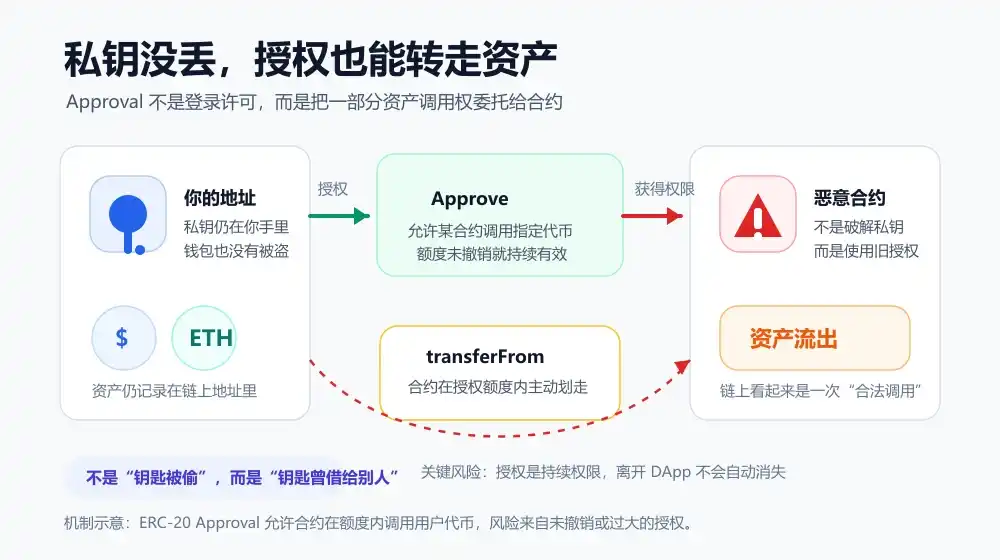
First, there's the issue of infinite approval—turning a one-time transaction into long-term permission. Mainly to reduce operational and Gas costs from repeated approvals, many DApps default to requesting an extremely large approval limit, commonly known as 'infinite approval.'

A user might have only intended to use 100 USDC for a single transaction but ended up allowing the contract to potentially use all USDC in their address in the future. As long as this approval isn't revoked, even if the user's wallet only held a small amount of assets at the time, future deposits of USDC could continue to be affected.

Second, approvals don't disappear by default when you leave a DApp. Many users confuse 'disconnecting a wallet' with 'revoking approval.' In reality, disconnecting only temporarily prevents the webpage from reading or requesting the current wallet; it doesn't change the Approval already written to the blockchain.

Closing the webpage, deleting the DApp, clearing browser cache, or even changing wallet applications won't automatically invalidate it.

Finally, even legitimate contracts can become dangerous in the future. Many approval risks don't only come from phishing sites that were malicious from the start, as seen in this hunt. A user might grant permission to a protocol that was normal at the time, but later, the protocol's contract could be hacked, admin keys leaked, upgradeable logic replaced, or issues could arise with its called router contracts.

For the user, the assets remain in their address, but from a permissions perspective, another contract always retains the ability to call those assets. Therefore, Approval risk isn't just about 'did I authorize a bad actor,' but also includes 'could the entity I authorized have problems later?'

III. So, How Can We Manage Approval Risk?

Faced with Approval risk, the simplest advice is 'don't grant infinite approval.'

However, in real-world DeFi usage, completely refusing approval is impractical. As mentioned, approval itself is not a flaw; it's the basic method for on-chain applications to call assets.

What truly needs to change is transforming Approval from a one-time confirmation action into an ongoing permission management mechanism.
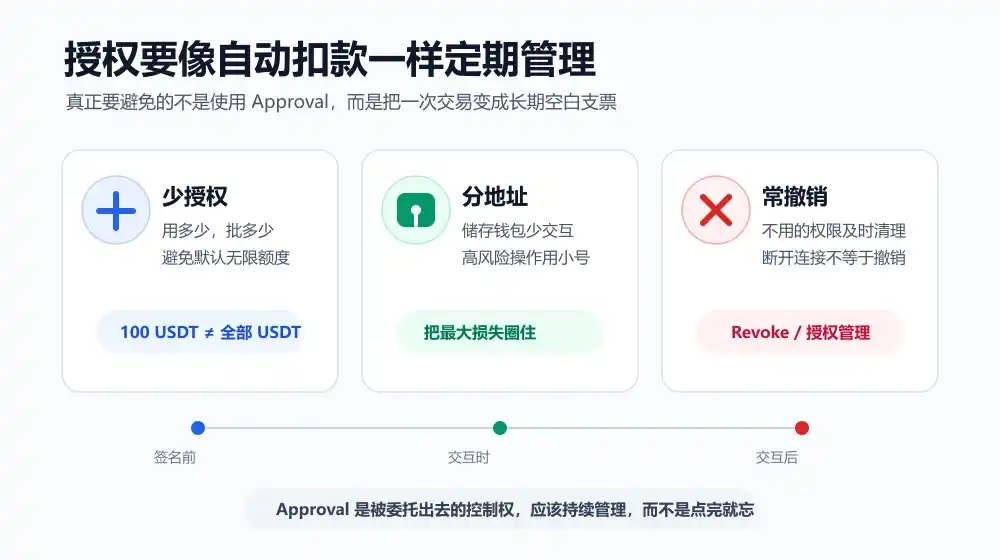
For ordinary users, first, it's essential to establish a few basic habits:

  • First, follow the 'principle of least privilege.' When a wallet pops up an approval prompt, try to set the limit based on the actual needs of the current interaction. For example, if you only plan to use 100 USDT, try to approve only an amount close to 100 USDT, rather than directly granting unlimited permission.
  • Second, separate storage wallets from interaction wallets. Avoid frequently connecting addresses holding large long-term assets to unfamiliar DApps. For activities like airdrops, minting, new projects, and high-risk DeFi interactions, use a separate address to limit potential losses to a smaller scope.
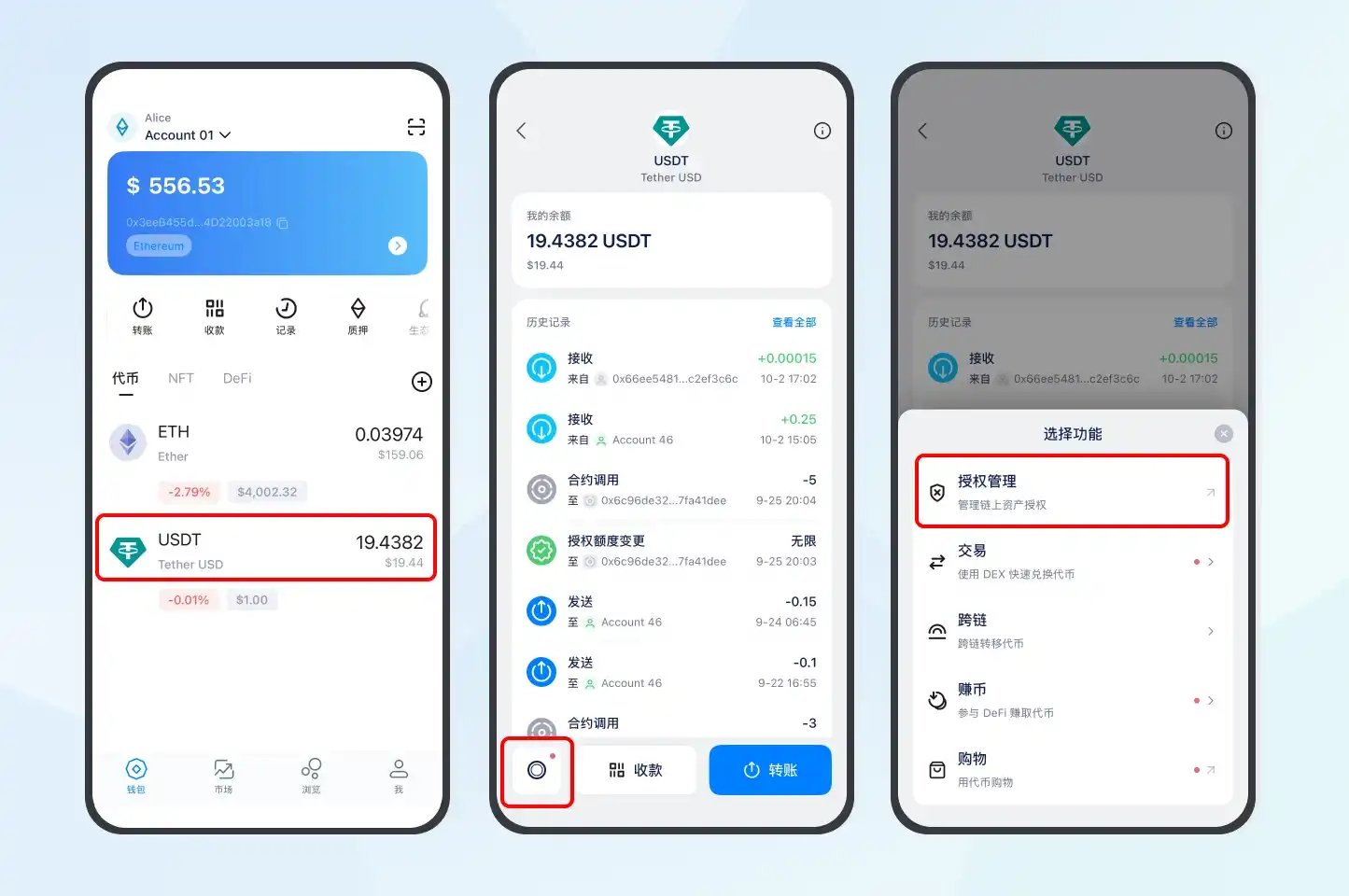
  • Third, regularly check and revoke approvals no longer needed. Users can utilize tools like Revoke.cash or, within imToken, navigate to the corresponding token page, click 'Token Function' in the bottom left, then select 'Authorization Management' to view approval targets, tokens, and amounts for that address. Revoke permissions that are no longer used or of unknown origin (further reading: Step-by-Step Guide to Using Revoke.cash for Authorization Management).
Of course, at the end of the day, facing unpredictable approval attacks, relying solely on user security awareness and regular checks isn't enough. After all, most users find it difficult to distinguish who a string of contract addresses belongs to or judge whether a particular approval amount is reasonable.

Therefore, as the first line of defense for users entering Web3, wallets must provide active defense in their product capabilities.

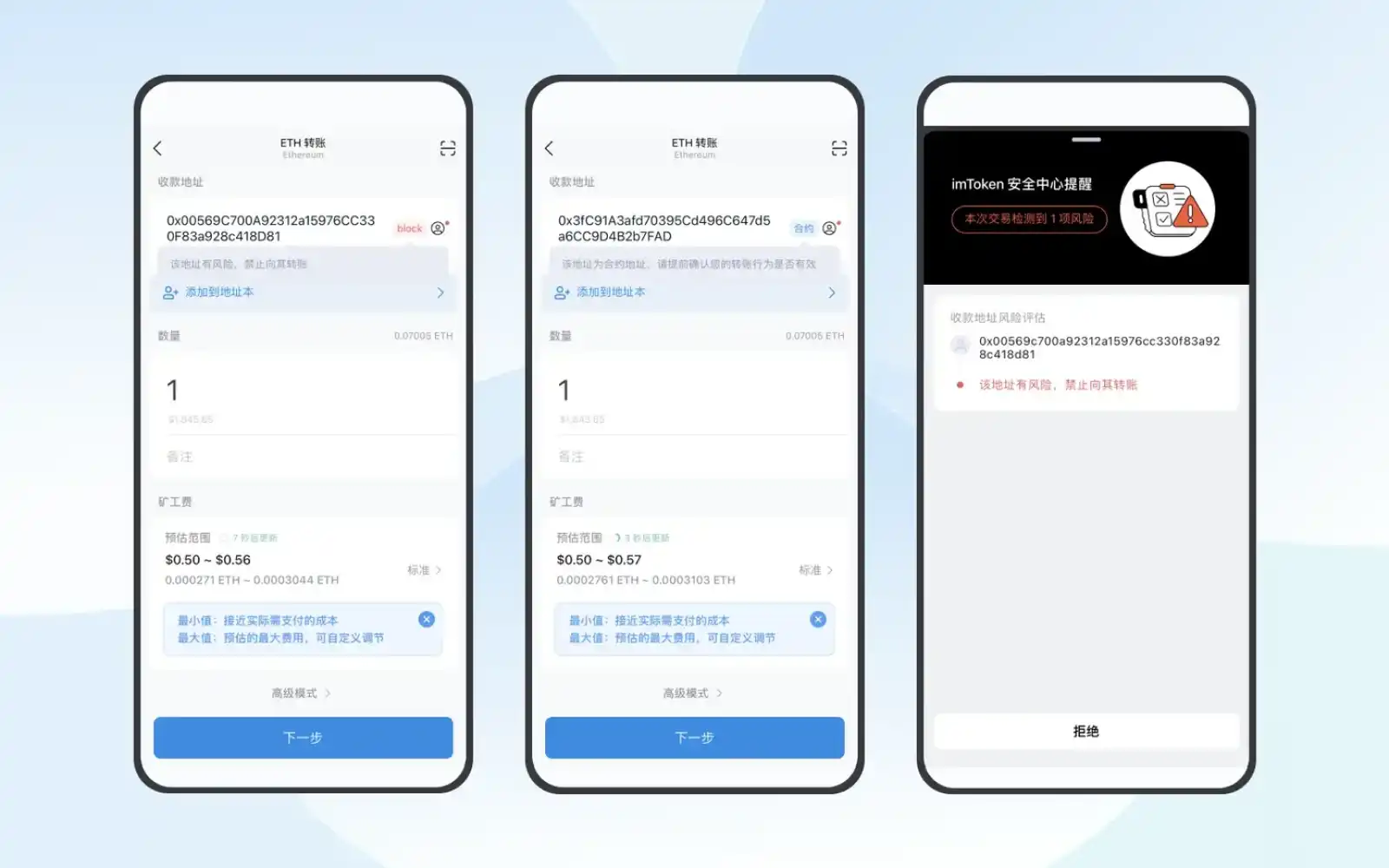
Taking imToken as an example, it marks or blocks identified risky tokens, addresses, and DApps. When users grant token permissions to ordinary external accounts or make direct transfers to contract addresses, targeted risk warnings are also provided. These warnings cannot replace user judgment but at least add a necessary safety buffer before actual signing.

Additionally, imToken performs structured parsing and human-readable presentation of signature content during key processes like DApp login, transfers, token swaps, and approvals. This aims to help users understand what they are agreeing to before confirmation, ensuring that the content users sign must be consistent with the behavior they see, rather than being compressed into an indistinguishable hash string.

With the further advancement of standards like ERC-7730 (Clear Signing), this 'What You See Is What You Sign' readable presentation is expected to gradually evolve from a single wallet's product capability into an industry standard shared among wallets, DApps, and smart contracts.
Overall, private keys determine who owns an account, while Approvals determine who else can call the assets within that account. They are not the same thing but are equally important.

This also means that wallet security cannot stop at 'has the private key been leaked.' This requires joint effort from users to wallets: For users, it's about seeing the object and amount before approving, and promptly cleaning up unnecessary permissions after interactions end. For wallets, it's about making these permissions—originally hidden within contracts—more visible, easier to understand, and more convenient to limit and revoke.

After all, what's truly dangerous might not be the transfer that just happened, but an approval long forgotten yet never invalidated.


Trend Kriptolar

İlgili Sorular

QHow did the attacker manage to steal $7.5 million from the Jaredfromsubway.eth MEV bot, and what was the core vulnerability exploited?

AThe attacker did not exploit a private key leak or a traditional smart contract vulnerability. Instead, they spent weeks creating a 'honeypot' environment by deploying numerous fake tokens and liquidity pools that mimicked legitimate assets like WETH and USDC. This setup tricked the MEV bot's automated system into identifying these as profitable arbitrage paths. During its execution, the bot was induced to grant Approvals to the malicious contracts. Once the approvals were in place and the bot had accumulated a certain level of trust through repeated interactions, the attacker called the still-valid approval limits to legally transfer the bot's real WETH, USDC, and USDT assets. The core vulnerability exploited was the bot's automated and insufficiently verified granting of ERC-20 token approvals.

QWhat are the three main reasons why Approval risks are often underestimated by users in DeFi, according to the article?

AAccording to the article, Approval risks are underestimated due to three main reasons: 1. **Unlimited Approvals**: Users often grant extremely high or infinite approval amounts to DApps to save on gas fees and repeated confirmations for future transactions, exposing all current and future tokens of that type. 2. **Persistence of Approvals**: Users commonly mistake disconnecting a wallet from a DApp interface with revoking an approval. Approvals are recorded on-chain and remain valid until explicitly revoked, regardless of closing the website or switching wallets. 3. **Future Risk of Approved Contracts**: A contract that was safe at the time of approval can later become dangerous due to exploits, admin key leaks, logic upgrades, or issues with downstream contracts it calls, posing an ongoing risk.

QWhat practical steps can ordinary users take to manage and mitigate their Approval-related risks?

AOrdinary users can take several practical steps to manage Approval risks: 1. **Principle of Least Privilege**: Only approve the specific amount needed for the current transaction, avoiding unlimited approvals whenever possible. 2. **Separate Wallets**: Use a dedicated 'hot' wallet for frequent interactions with new or high-risk DApps, and a separate 'cold' wallet for storing significant long-term assets to limit potential exposure. 3. **Regular Review and Revocation**: Periodically use tools like Revoke.cash or wallet-built-in features (e.g., imToken's 'Token Function' -> 'Authorization Management') to review all active approvals and revoke those that are no longer needed or from unknown sources.

QWhat role do wallets like imToken play in helping users defend against Approval risks, beyond user education?

AWallets like imToken provide proactive defense mechanisms at the product level: 1. **Risk Identification and Warnings**: They mark or block known risky tokens, addresses, and DApps, and provide specific risk warnings when users attempt actions like granting token approvals to external accounts or transferring directly to contract addresses. 2. **Clear Signing (Structured Transaction Decoding)**: They parse and present the content of signature requests (for logins, transfers, swaps, approvals) in a human-readable, structured format. This helps users understand what they are agreeing to before signing, ensuring 'What You See Is What You Sign' and preventing confusion with raw hash data. 3. **Support for Industry Standards**: They support the development and adoption of standards like ERC-7730 (Clear Signing) to make this safety feature a shared industry standard across wallets, DApps, and smart contracts.

QAccording to the article's conclusion, how does the importance of managing Approvals compare to protecting private keys, and what is the required approach for overall wallet security?

AThe article concludes that managing Approvals is equally as important as protecting private keys, but they address different aspects of security. The private key determines **who owns the account**, while Approvals determine **who else can move the assets within that account**. Therefore, wallet security cannot be solely focused on 'whether the private key is leaked.' A comprehensive approach requires effort from both users and wallet providers: Users must carefully review approval requests, grant minimal necessary permissions, and regularly clean up unused approvals. Wallet providers must make these on-chain permissions more visible, understandable, and easier to limit and revoke through better user interfaces and proactive safety features.

İlgili Okumalar

EF's Epic Reorganization: 20% Layoffs, Budget Halved, Is Ethereum Gearing Up for a Leaner Future?

The Ethereum Foundation (EF) has announced a major organizational restructuring, involving a 20% staff reduction (approx. 54 employees) and a division into functional clusters like Protocol, Access, User, Community, and Institutional layers. Co-founder Vitalik Buterin further revealed plans to cut the EF's budget by around 40% over the coming years, aiming to reduce its annual spending rate from about 15% to roughly 5% by 2030, transitioning to an endowment-driven model. This overhaul is seen as a long-overdue correction to the EF's ambiguous role. As Ethereum grew, the foundation faced persistent criticism over ETH sales, perceived lack of execution, and unclear strategy, often becoming a focal point for community frustration amid ETH's price stagnation. The reform aims to redefine the EF's boundaries, narrowing its focus to core protocol research, public goods funding, and ecosystem coordination, while offloading more applied development work to the broader market. Concurrently, ecosystem forces like the newly formed Ethlabs (founded by ex-EF researchers) and other independent groups are stepping in to fill the space, signaling a shift from a centralized model to a more distributed, collaborative ecosystem structure. The move was notably praised by Solana co-founder toly, who viewed a "leaner" EF as potentially more decisive and agile.

Odaily星球日报20 dk önce

EF's Epic Reorganization: 20% Layoffs, Budget Halved, Is Ethereum Gearing Up for a Leaner Future?

Odaily星球日报20 dk önce

Dragonfly Partner Haseeb: The Fastest-Growing Companies of the Future May All Get Stuck at 149 Employees

Dragonfly partner Haseeb explores the distorted economics of AI model pricing, drawing parallels to tax policy. He notes that startups and small teams (under 150 users) enjoy heavily subsidized, fixed-price AI subscriptions (like Claude Code), where the marginal cost of an additional token is effectively zero. This creates a powerful incentive for them to maximize token usage ("token-maxxing") and innovate aggressively with AI automation. In contrast, large enterprises (over 150 users) are forced onto "Enterprise" plans, paying per-token API fees with high (~75%) markups. This acts like a steep "tax" on AI-powered labor, disincentivizing marginal automation and experimental use, and encouraging them to retain more human workers. Haseeb argues this pricing creates a "150-person cliff," a regulatory notch similar to labor laws in France that discourage firms from growing past 50 employees. He predicts the fastest-growing future companies may deliberately cap their headcount at 149 to avoid the punitive enterprise pricing. This would foster an "AI-first" management philosophy obsessed with automation and outsourcing to stay lean. While not intentionally designed, this bifurcated pricing could become one of the most influential de facto tax policies, shaping how AI replaces labor—not through mass layoffs at big firms, but through agile, AI-native startups outcompeting them.

marsbit32 dk önce

Dragonfly Partner Haseeb: The Fastest-Growing Companies of the Future May All Get Stuck at 149 Employees

marsbit32 dk önce

How xBubble Breaks Through in the VC-Heavily-Backed OPC Economy

xBubble: Addressing the Structural Gap in the VC-Backed OPC Economy The concept of OPC (One Person Company) is evolving from a buzzword to a significant AI-driven market. While AI coding tools like Replit and Lovable have validated demand from non-technical users wanting to build applications, a key gap remains: the leap from creating a demo to running a stable, evolving business. These tools still require users to manage the development process, including technical judgments for integrations, modifications, and deployments—a major hurdle for OPCs. xBubble, by DAPPOS, tackles this by shifting from "Prompt-to-Code" to "SOP-to-Business." Instead of generating code from instructions, its core is a system of pre-organized SOPs (Standard Operating Procedures) that translate business goals—like "sell World Cup merchandise"—into complete, executable workflows. This includes generating cohesive assets, pages, payment systems, and backend logic. The platform is augmented by a network of third-party service providers who handle infrastructure (hosting, domains, payment setup), acting like "on-site service engineers." Users can pay for these services directly with xBubble credits, simplifying onboarding. This ecosystem aims to deliver not just an app, but a complete, modifiable business launch path. xBubble targets a clear OPC segment: small commercial nodes (e.g., creators, merchants) with existing products, customers, or channels, but for whom a full tech team is unjustifiable. Its potential lies in SOPs accumulating expertise from real cases, improving reliability and reducing delivery costs over time. Additionally, its native support for crypto payments caters to global or digital-native OPCs. In summary, as AI democratizes software creation, xBubble's opportunity is to prove that "SOP-to-Business" provides more immediate value for launching a real, operational business than a powerful but unstructured AI coding tool.

链捕手34 dk önce

How xBubble Breaks Through in the VC-Heavily-Backed OPC Economy

链捕手34 dk önce

If It's Not a Clear Yes, It's a No: A Nine-Year Retrospective by a VC Who Survived Four Cycles

**"Invest Only When Certain": A Nine-Year Retrospective from a VC Across Four Cycles** IOSG founder Jocy shares hard-earned lessons from nine years and over a hundred investments in Web3. The core challenge isn't identifying successful founders, but understanding why talented founders with solid ideas still fail. Through building a "failed founder database," IOSG identified six recurring failure patterns. **Founder Trait Red Flags:** 1. **Emotionally Unstable:** Founders who react defensively to criticism or publicly lash out under pressure (e.g., 80% drawdowns) often fail. Resilience is key. 2. **Lacking Hunger / Having a Fallback:** Founders with significant safety nets (family wealth, cushy fallback jobs) may lack the "do-or-die" commitment needed to survive crypto's brutal cycles. 3. **Unchecked Ego:** Includes "polished execution machines" who excel in known frameworks but struggle when paradigms shift, and "professor-types" who are technically brilliant but resistant to commercial feedback or coaching. **Project Structure Red Flags:** 4. **Token-First, Not Product-First:** Treating the token solely as a fundraising tool with no real utility or connection to product value is a major warning sign. The project should have value even if the token goes to zero. 5. **No Day-1 Exit Thesis:** Founders must have a clear, staged capital strategy from the start, understanding what each funding round needs to prove to unlock the next. "Exit before entry" is crucial. 6. **No Full-Cycle Experience:** Founders who haven't lived through a complete crypto bull/bear cycle (e.g., 2018, 2022) often underestimate their vulnerability. IOSG limits initial checks for such teams to $250k, sizing for risk. **The Positive Flipside: Desirable Founder Traits** The ideal candidate exhibits: obsessive problem-depth, being a second-time founder with a non-consensus vision, strong communication skills with *controlled* ego, relentless perseverance, and a global perspective with agency and taste (increasingly vital in the AI era). **Three Survival Tips for Founders:** 1. **Cash Flow Over Narrative:** Real revenue is what sustains projects, not vanity metrics. 2. **Tokens Are a Liability:** Avoid issuing a token unless absolutely necessary. The hidden costs (market making, liquidity, compliance) are immense, often a multi-million-dollar burden. 3. **Respect Liquidity:** Sell during peaks to build treasury, buy back to support the protocol during troughs. Be realistic about valuations and your ability to deliver for the next round. The final principle is simple yet paramount: **"If it's a borderline 'yes' or 'no,' don't invest."** In an industry that reinvents itself every few years, the discipline to consistently say "no" is the ultimate secret to longevity.

Foresight News1 saat önce

If It's Not a Clear Yes, It's a No: A Nine-Year Retrospective by a VC Who Survived Four Cycles

Foresight News1 saat önce

İşlemler

Spot
Futures

Popüler Makaleler

ETH 2.0 Nedir

ETH 2.0: Ethereum için Yeni Bir Dönem Giriş ETH 2.0, Ethereum 2.0 olarak da bilinir, Ethereum blok zincirinde önemli bir yükseltmeyi işaret eder. Bu geçiş yalnızca bir yüz değiştirme değil; ağın ölçeklenebilirliğini, güvenliğini ve sürdürülebilirliğini temelinden geliştirmeyi hedeflemektedir. Enerji yoğun Proof of Work (PoW) konsensüs mekanizmasından daha verimli olan Proof of Stake (PoS) mekanizmasına geçişle birlikte, ETH 2.0 blok zinciri ekosistemine dönüştürücü bir yaklaşım vaat etmektedir. ETH 2.0 Nedir? ETH 2.0, Ethereum'un yeteneklerini ve performansını optimize etmeye odaklanmış özel, birbirine bağlı güncellemelerin bir derlemesidir. Yenileme, mevcut Ethereum mekanizmasının karşılaştığı kritik zorlukları, özellikle işlem hızı ve ağ tıkanıklığı ile ilgili sorunları ele almak üzere tasarlanmıştır. ETH 2.0'ın Amaçları ETH 2.0'ın ana amaçları, üç temel unsuru geliştirmeye odaklanmaktadır: Ölçeklenebilirlik: Ağın saniye başına işleyebileceği işlem sayısını önemli ölçüde artırmayı hedefleyen ETH 2.0, mevcut yaklaşık 15 işlem/saniye sınırlamasını aşmayı ve potansiyel olarak binlerce işleme ulaşmayı planlamaktadır. Güvenlik: Geliştirilmiş güvenlik önlemleri, özellikle siber saldırılara karşı daha iyi direnç sağlama ve Ethereum'un merkeziyetsiz görünümünü koruma açısından ETH 2.0 için hayati öneme sahiptir. Sürdürülebilirlik: Yeni PoS mekanizması, sadece verimliliği artırmakla kalmayıp aynı zamanda enerji tüketimini de önemli ölçüde azaltma hedefiyle tasarlanmış olup, Ethereum'un operasyonel çerçevesini çevresel kaygılarla uyumlu hale getirmektedir. ETH 2.0'ın Yaratıcısı Kimdir? ETH 2.0'ın yaratılması Ethereum Vakfı'na atfedilebilir. Ethereum'un gelişimini destekleme konusunda kritik bir rol oynayan bu kar amacı gütmeyen kuruluş, dikkat çekici kurucu ortağı Vitalik Buterin tarafından yönetilmektedir. Daha ölçeklenebilir ve sürdürülebilir bir Ethereum vizyonu, bu yükseltmenin arkasındaki itici güç olmuştur ve protokolü geliştirmek için kendini adamış küresel bir geliştici ve meraklı topluluğunun katkılarını içermektedir. ETH 2.0'ın Yatırımcıları Kimlerdir? ETH 2.0 yatırımcıları ile ilgili detaylar kamuoyuna açıklanmamış olsa da, Ethereum Vakfı'nın blok zinciri ve teknoloji alanında çeşitli kuruluşlar ve bireyler tarafından desteklendiği bilinmektedir. Bu ortaklar arasında merkeziyetsiz teknolojilerin ve blok zinciri altyapısının geliştirilmesine karşılıklı ilgi duyan girişim sermayesi şirketleri, teknoloji firmaları ve hayır kurumları yer almaktadır. ETH 2.0 Nasıl Çalışır? ETH 2.0, onu öncüsünden ayıran bir dizi önemli özelliği tanıtmasıyla dikkat çekmektedir. Proof of Stake (PoS) PoS konsensüs mekanizmasına geçiş, ETH 2.0'ın en belirgin değişikliklerinden biridir. İşlem doğrulama için enerji yoğun madenciliğe dayanmak yerine, PoS kullanıcıların ağa yatırdıkları ETH miktarına göre işlemleri doğrulayıp yeni bloklar oluşturmalarına olanak tanır. Bu, enerji verimliliğinin artırılmasına yol açarak tüketimi yaklaşık %99,95 oranında azaltmakta ve Ethereum 2.0'ı önemli ölçüde daha çevre dostu bir alternatif haline getirmektedir. Shard Zincirleri Shard zincirleri, ETH 2.0'ın diğer bir kritik yeniliğidir. Bu daha küçük zincirler, ana Ethereum zinciri ile paralel olarak çalışarak birden fazla işlemin aynı anda işlenmesine olanak tanır. Bu yaklaşım, ağın genel kapasitesini artırarak Ethereum'u rahatsız eden ölçeklenebilirlik sorunlarını ele alır. Beacon Zinciri ETH 2.0'ın temelinde, ağı koordine eden ve PoS protokolünü yöneten Beacon Zinciri yer almaktadır. Bu, bir tür organizatör olarak işlev görür: doğrulayıcıları denetler, shard'ların ağa bağlı kalmasını sağlar ve blok zinciri ekosisteminin genel sağlığını izler. ETH 2.0 Zaman Çizelgesi ETH 2.0'ın yolculuğu, bu önemli yükseltmenin evrimini gösteren birkaç önemli dönüm noktası ile tanımlanmıştır: Aralık 2020: Beacon Zinciri'nin başlatılması, PoS'un tanıtımını işaret etmiş ve ETH 2.0’a geçiş için sahneyi hazırlamıştır. Eylül 2022: "The Merge" tamamlanması, Ethereum ağının başarılı bir şekilde PoW'den PoS çerçevesine geçiş yaptığı kritik bir anı temsil etmekte ve Ethereum için yeni bir dönemi müjdelemektedir. 2023: Shard zincirlerinin beklenen dağıtımı, Ethereum ağının ölçeklenebilirliğini daha da artırmayı hedeflemekte ve ETH 2.0'ı merkeziyetsiz uygulamalar ve hizmetler için sağlam bir platform haline getirmeyi pekiştirmektedir. Ana Özellikler ve Faydalar Geliştirilmiş Ölçeklenebilirlik ETH 2.0'ın en önemli avantajlarından biri, geliştirilmiş ölçeklenebilirliğidir. PoS ve shard zincirlerinin kombinasyonu, ağın kapasitesini artırarak, eski sistemle kıyaslandığında çok daha fazla işlem hacmi karşılayabilmesini sağlamaktadır. Enerji Verimliliği PoS'un uygulanması, blok zinciri teknolojisinde enerji verimliliği yönünde büyük bir adım teşkil etmektedir. Enerji tüketimini ciddi şekilde azaltarak, ETH 2.0 yalnızca işletme maliyetlerini düşürmekle kalmaz, aynı zamanda küresel sürdürülebilirlik hedefleriyle daha yakın bir uyum sağlar. Geliştirilmiş Güvenlik ETH 2.0'ın güncellenmiş mekanizmaları, ağ genelinde güvenliğin artırılmasına katkıda bulunmaktadır. PoS'un uygulanması ve shard zincirleri ile Beacon Zinciri aracılığıyla geliştirilen yenilikçi kontrol önlemleri, potansiyel tehditlere karşı daha yüksek bir koruma sağlar. Kullanıcılar için Düşük Maliyetler Ölçeklenebilirlik geliştikçe, işlem maliyetleri üzerindeki etkiler de belirgin hale gelecektir. Artan kapasite ve azalan tıkanıklığın, kullanıcılar için düşük ücretler anlamına gelmesi beklenmekte ve Ethereum'u günlük işlemler için daha erişilebilir hale getirmektedir. Sonuç ETH 2.0, Ethereum blok zinciri ekosisteminde önemli bir evrimi işaret etmektedir. Ölçeklenebilirlik, enerji tüketimi, işlem verimliliği ve genel güvenlik gibi temel sorunları ele alırken, bu güncellemenin önemi abartılamaz. Proof of Stake'e geçiş, shard zincirlerinin tanıtımı ve Beacon Zinciri'nin altyapı çalışmaları, Ethereum'un merkeziyetsiz piyasalarının artan taleplerini karşılayabileceği bir geleceği göstermektedir. Yenilik ve ilerleme ile şekillenen bir sektörde, ETH 2.0, blok zinciri teknolojisinin daha sürdürülebilir ve verimli bir dijital ekonomi için yol açmadaki yeteneklerinin bir kanıtıdır.

185 Toplam GörüntülenmeYayınlanma 2024.04.04Güncellenme 2024.12.03

ETH 2.0 Nedir

ETH 3.0 Nedir

ETH3.0 ve $eth 3.0: Ethereum'un Geleceği Üzerine Derinlemesine Bir İnceleme Giriş Hızla evrilen kripto para ve blok zinciri teknolojisi ortamında, ETH3.0, sıklıkla $eth 3.0 olarak adlandırılmakta, önemli bir ilgi ve spekülasyon konusu haline gelmiştir. Bu terim, netleştirilmesi gereken iki temel kavramı kapsamaktadır: Ethereum 3.0: Bu, mevcut Ethereum blok zincirinin yeteneklerini artırmayı hedefleyen olası bir gelecekteki güncellemeyi temsil eder, özellikle ölçeklenebilirlik ve performansı iyileştirmeye odaklanmaktadır. ETH3.0 Meme Token: Bu ayrı kripto para projesi, Ethereum blok zincirini kullanarak meme merkezli bir ekosistem oluşturmayı amaçlamakta ve kripto para topluluğu içinde etkileşimi artırmaktadır. ETH3.0'ün bu yönlerini anlamak, yalnızca kripto meraklıları için değil, aynı zamanda dijital alandaki daha geniş teknolojik trendleri gözlemleyenler için de hayati öneme sahiptir. ETH3.0 Nedir? Ethereum 3.0 Ethereum 3.0, zaten kurulmuş olan Ethereum ağına önerilen bir güncelleme olarak duyurulmaktadır; bu ağ, kuruluşundan bu yana birçok merkeziyetsiz uygulamanın (dApp'ler) ve akıllı sözleşmelerin belkemiği olmuştur. Tasarlanan iyileştirmeler, esasen ölçeklenebilirlik üzerine yoğunlaşmakta – shardlama ve sıfır bilgi kanıtları (zk-proofs) gibi ileri teknolojileri entegre etmektedir. Bu teknolojik yenilikler, saniyede eşi benzeri görülmemiş sayıda işlem (TPS) gerçekleştirmeyi kolaylaştırmayı amaçlamakta olup, muhtemelen milyonlara ulaşarak mevcut blok zinciri teknolojisinin karşılaştığı en büyük sınırlamalardan birine çözüm getirmektedir. İyileştirme yalnızca teknik değil, aynı zamanda stratejiktir; Ethereum ağını, merkeziyetsiz çözümlere olan artan talep ile belirginleşen bir geleceğe hazırlamak için tasarlanmıştır. ETH3.0 Meme Token Ethereum 3.0'ın aksine, ETH3.0 Meme Token, internet meme kültürünü kripto para dinamikleriyle birleştirerek daha hafif ve eğlenceli bir alanda hareket etmektedir. Bu proje, kullanıcıların Ethereum blok zincirinde meme alım, satım ve ticaret yapmalarına izin vererek, yaratıcılık ve ortak ilgi alanları aracılığıyla topluluk etkileşimini teşvik eden bir platform sunmaktadır. ETH3.0 Meme Token, blok zinciri teknolojisinin dijital kültürle nasıl kesişebileceğini göstererek, hem eğlenceli hem de finansal olarak sürdürülebilir kullanım senaryoları oluşturmayı hedeflemektedir. ETH3.0'un Yaratıcısı Kimdir? Ethereum 3.0 Ethereum 3.0'a yönelik girişim, esas olarak Ethereum topluluğundaki bir geliştirici ve araştırmacı konsorsiyumu tarafından yönlendirilmektedir ve bunlar arasında Justin Drake de bulunmaktadır. Ethereum'un evrimine yönelik içgörüleri ve katkılarıyla tanınan Drake, Ethereum'u “Beam Chain” olarak adlandırılan yeni bir konsensüs katmanına geçirme konusundaki tartışmalarda öne çıkan bir figür olmuştur. Geliştirmeye yönelik bu iş birliği yaklaşımı, Ethereum 3.0'ın tek bir yaratıcının ürünü olmadığını, aksine blok zinciri teknolojisini ilerletmeye odaklanmış kolektif bir dehanın tezahürü olduğunu göstermektedir. ETH3.0 Meme Token ETH3.0 Meme Token'ın yaratıcısına dair detaylar şu anda izlenemez durumdadır. Meme tokenların doğası, genellikle daha merkeziyetsiz ve topluluk odaklı bir yapıya yol açmakta olup, bu da spesifik bir atıf eksikliğini açıklayabilir. Bu durum, yeniliğin genellikle iş birliği yerine bireysel çabalardan ortaya çıktığı kripto topluluğunun genel felsefesiyle uyumludur. ETH3.0 Yatırımcıları Kimlerdir? Ethereum 3.0 Ethereum 3.0'a olan destek, esasen Ethereum Vakfı ve hevesli bir geliştirici ve yatırımcı topluluğu tarafından sağlanmaktadır. Bu temel birliktelik, yıllar süren ağ operasyonlarıyla inşa edilen güven ve itibarından yararlanarak önemli bir meşruiyet sağlamaktadır. Kripto para dünyasının hızla değişen ikliminde, topluluk desteği, gelişim ve benimsemeyi yönlendirmede kritik bir rol oynamakta ve Ethereum 3.0'ı gelecekteki blok zinciri ilerlemeleri için ciddi bir rakip haline getirmektedir. ETH3.0 Meme Token Mevcut kaynaklar, ETH3.0 Meme Token'ı destekleyen yatırım temelleri veya kuruluşları hakkında net bilgiler sağlamasa da, bu durum meme tokenlar için tipik olan finansman modelini göstermektedir; bu model genellikle tabandan destek ve topluluk katılımına dayanır. Bu tür projelerdeki yatırımcılar genellikle toplum odaklı yenilik potansiyeli ve kripto topluluğunda bulunan iş birliği ruhuyla motive olmuş bireylerden oluşmaktadır. ETH3.0 Nasıl Çalışır? Ethereum 3.0 Ethereum 3.0'ın ayırt edici özellikleri, önerilen shardlama ve zk-proof teknolojisinin uygulanmasında yatmaktadır. Shardlama, blok zincirini daha küçük, yönetilebilir parçalara veya “parçalara” ayırma yöntemidir; bu parçalar işlemleri ardışık değil, eşzamanlı olarak işleyebilir. Bu işlem yükünün merkeziyetsizliği, tıkanıklığı önlemeye yardımcı olur ve ağın yoğun yük altında bile yanıt verebilir olmasını sağlar. Sıfır bilgi kanıtı (zk-proof) teknolojisi, işleme katılan temel verileri ifşa etmeden işlem doğrulaması sağlamasıyla başka bir sofistike katman ekler. Bu yön, sadece gizliliği artırmakla kalmaz, aynı zamanda ağın genel verimliliğini de artırır. Bu güncellemeye, ağın yeteneklerini ve faydasını daha da artırarak sıfır bilgi Ethereum Sanal Makinesi (zkEVM) entegrasyonunun da eklenmesi gündeme gelmektedir. ETH3.0 Meme Token ETH3.0 Meme Token, meme kültürünün popülaritesinden yararlanarak kendini farklılaştırmaktadır. Kullanıcıların sadece eğlence için değil, aynı zamanda potansiyel ekonomik kazançlar için meme ticareti yapmalarına olanak tanıyacak bir pazar yeri oluşturur. Stake etme, likidite sağlama ve yönetim mekanizmaları gibi özelliklerin entegrasyonu sayesinde, proje topluluk etkileşimini ve katılımını teşvik eden bir ortam oluşturur. Eğlence ve ekonomik fırsatların eşsiz bir karışımını sunarak, ETH3.0 Meme Token, kripto tutkunlarından gündelik meme meraklılarına kadar çeşitli bir kitleyi çekmeyi hedeflemektedir. ETH3.0 Zaman Çizelgesi Ethereum 3.0 11 Kasım 2024: Justin Drake, ölçeklenebilirlik iyileştirmeleri etrafında şekillenen yaklaşan ETH 3.0 güncellemesine işaret ediyor. Bu duyuru, Ethereum'un gelecekteki mimarisi hakkında resmi tartışmaların başlangıcını simgeliyor. 12 Kasım 2024: Ethereum 3.0'a yönelik beklenen önerinin, Bangkok'taki Devcon'da açıklanması planlanıyor ve bu, daha geniş topluluk geri bildirimi ve gelişim için olası sonraki adımların zeminini hazırlıyor. ETH3.0 Meme Token 21 Mart 2024: ETH3.0 Meme Token, CoinMarketCap'ta resmi olarak listeleniyor, bu da kamusal kripto alanına adım atarak meme merkezli ekosisteminin görünürlüğünü artırıyor. Ana Noktalar Sonuç olarak, Ethereum 3.0, gelişmiş teknolojiler aracılığıyla ölçeklenebilirlik ve performansla ilgili sınırlamaların üstesinden gelmeye odaklanan Ethereum ağındaki önemli bir evrimi temsil etmektedir. Önerilen güncellemeleri, gelecekteki talepler ve kullanılabilirlik için proaktif bir yaklaşımı yansıtmaktadır. Öte yandan, ETH3.0 Meme Token, kripto para alanındaki topluluk odaklı kültürün özünü kapsamakta, meme kültürünü kullanarak kullanıcı yaratıcılığını ve katılımını teşvik eden etkileşimli platformlar oluşturmayı hedeflemektedir. ETH3.0 ve $eth 3.0'un farklı amaçlarının ve işlevlerinin anlaşılması, kripto alanındaki gelişmeleri takip eden herkes için hayati öneme sahiptir. Her iki girişim de benzersiz yollar çizerek, blok zinciri yeniliğinin dinamik ve çok yönlü doğasını birlikte vurgulamaktadır.

178 Toplam GörüntülenmeYayınlanma 2024.04.04Güncellenme 2024.12.03

ETH 3.0 Nedir

ETH Nasıl Satın Alınır

HTX.com’a hoş geldiniz! Ethereum (ETH) satın alma işlemlerini basit ve kullanışlı bir hâle getirdik. Adım adım açıkladığımız rehberimizi takip ederek kripto yolculuğunuza başlayın. 1. Adım: HTX Hesabınızı OluşturunHTX'te ücretsiz bir hesap açmak için e-posta adresinizi veya telefon numaranızı kullanın. Sorunsuzca kaydolun ve tüm özelliklerin kilidini açın. Hesabımı Aç2. Adım: Kripto Satın Al Bölümüne Gidin ve Ödeme Yönteminizi SeçinKredi/Banka Kartı: Visa veya Mastercard'ınızı kullanarak anında Ethereum (ETH) satın alın.Bakiye: Sorunsuz bir şekilde işlem yapmak için HTX hesap bakiyenizdeki fonları kullanın.Üçüncü Taraflar: Kullanımı kolaylaştırmak için Google Pay ve Apple Pay gibi popüler ödeme yöntemlerini ekledik.P2P: HTX'teki diğer kullanıcılarla doğrudan işlem yapın.Borsa Dışı (OTC): Yatırımcılar için kişiye özel hizmetler ve rekabetçi döviz kurları sunuyoruz.3. Adım: Ethereum (ETH) Varlıklarınızı SaklayınEthereum (ETH) satın aldıktan sonra HTX hesabınızda saklayın. Alternatif olarak, blok zinciri transferi yoluyla başka bir yere gönderebilir veya diğer kripto para birimlerini takas etmek için kullanabilirsiniz.4. Adım: Ethereum (ETH) Varlıklarınızla İşlem YapınHTX'in spot piyasasında Ethereum (ETH) ile kolayca işlemler yapın.Hesabınıza erişin, işlem çiftinizi seçin, işlemlerinizi gerçekleştirin ve gerçek zamanlı olarak izleyin. Hem yeni başlayanlar hem de deneyimli yatırımcılar için kullanıcı dostu bir deneyim sunuyoruz.

3.6k Toplam GörüntülenmeYayınlanma 2024.12.10Güncellenme 2026.06.02

ETH Nasıl Satın Alınır

Tartışmalar

HTX Topluluğuna hoş geldiniz. Burada, en son platform gelişmeleri hakkında bilgi sahibi olabilir ve profesyonel piyasa görüşlerine erişebilirsiniz. Kullanıcıların ETH (ETH) fiyatı hakkındaki görüşleri aşağıda sunulmaktadır.

活动图片