Yang Ge Gary: Agent Economy and AI Sub-Microeconomics

marsbit2026-06-08 tarihinde yayınlandı2026-06-08 tarihinde güncellendi

Özet

"Agent Economy and AI Submicroeconomics" by Gary Yang discusses the evolution of AI Agent economies, written from Singapore in June 2026. The author observes a significant "civilizational generational gap" in AI development, particularly highlighted by events in Silicon Valley. The article identifies a current bottleneck in the transition from Human-to-Agent (H2A) economies to true Agent-to-Agent (A2A) ecosystems. While AI Payment protocols are rapidly emerging, many implementations remain non-AI-native, focusing on traditional human decision-making models rather than leveraging autonomous Agent decision-making. A core thesis is the inevitable formation of an **Agent Economy**, defined as a system where autonomous AI Agents create, exchange, and capitalize value independently. This requires new infrastructure: **AI Protocols**, which are the foundational rules and standards for Agent interaction. The piece explores the relationship and current gap between AI Protocols and Crypto Protocols, suggesting political and regulatory factors from traditional finance are temporarily constraining development. However, a future fusion into a mature Digital Protocol system is deemed inevitable based on first principles. The author introduces **AI Agent Submicroeconomics**, contrasting it with human economics. Key differences include higher transaction frequency, lower value per transaction, efficiency-driven (not emotion-driven) decisions, task-oriented (not consumption-oriented) behav...

Author: Yang Ge Gary

Written in Singapore on June 8, 2026

The Singularity's outbreak has continuously accelerated AI's evolutionary clock, leading to the rapid formation of new civilization generational gaps across different regions of the globe. In the past two months, I have participated in over 20 AI-related events in more than ten cities worldwide. Only the Stripe Sessions in downtown San Francisco at the end of April stood out, creating a generational gap that was far more shocking than all other topics. While the world is growing weary of the single-machine bottlenecks of Claws & Agents, Silicon Valley and San Francisco have already moved into the next dimension in the management of Agent economy and Agent epistemology. The competitive pressure in Q3/Q4 of 2026 remains intense, with the exponential curve being very steep.

1. The Competition in AI Payment and the Bottleneck of the H2A Economy

In Q1 2026, we predicted that from April to May, many regions globally would enter fierce competition for AI Agent Payment, which would quickly become white-hot. The need for value exchange between Agents began to manifest initially, and the rapid development of AI Payment was validated in Q2. Following x402, multiple AI Payment Protocols like MPP rapidly emerged in Q2. Not only are traditional and Crypto financial payment companies upgrading to AI at full speed, but even major tech giants (especially like Google) and even old-school IT companies (such as IBM) have charged into this track, hoping to seize a voice in shaping the Agent world.

On the day of the Stripe Sessions in San Francisco, I discussed the standardization and application issues of Payment Protocols with technical leaders from several top AI companies. The results were reasonable but not entirely satisfactory: 1) No one could set the standard; consensus standards would only gradually form during the scramble. 2) Most completely agreed that Crypto is the inevitable path for AI Payment Protocol, but their starting point was Fiat API, partly due to inertia but more due to compliance hurdles. 3) KYC is both unavoidable and anti-Agent Native. 4) Everyone claims A2A (Agent to Agent), but everyone is actually doing H2A (Human to Agent).

In fact, during Q2 2026, many large tech firms and mid-sized companies in Silicon Valley were quite similar to their East Asian counterparts. Even most Department Heads in the Mag 7 were still approaching AI Payment and Agent Economy with to-B or to-C commercial goals, giving mid- and lower-level employees KPIs focused on human users. This inevitably led to the current, temporarily non-orthodox phase of Payment Protocols and the A2A economy. This H2A-oriented trend quickly hit a bottleneck in Q2. The reason is simple: the greatest characteristic of AI Agents is their ability to make decisions, yet 2B2C commerce developed under the internet and the H2A economy are essentially driven by human decisions. Using Agents to help humans make Fiat Payments in traditional e-commerce scenarios is logically Non-AI-Native. Therefore, at this stage, its value as a trending topic still outweighs its practical utility.

However, from another perspective, H2A has indeed served as an excellent primer, stimulating the transitional thinking toward the next stage of AI-Native and Agent Autonomous economies. By the end of Q2 2026, some astute companies realized this and began "repairing the plank roads openly while secretly crossing at Chencang"—using AI-Native Agent economic thinking to reconsider problems in reverse, finding that retrofitting current H2A economic interfaces is the optimal value proposition for the Q2-Q3 transition.

2. The Inevitable Trend of Agent Economy and the A2A Ecosystem

Agent Economy refers to a new type of economic system where autonomous (self-governing) AI Agents directly participate in value creation, value exchange, and value capitalization, gradually becoming independent economic entities.

A2A Ecosystem is the overall picture formed when different Agents participate in economic activities within the Agent Economy, interact with each other, conduct exchanges (of information and value), and form competitive-cooperative economic value.

In Q2 2026, many top global venture capital firms declared their focus on investing in the Agent Economy and A2A Ecosystem, even defining it as the only important investment direction for the next phase.

Similar to the incubation period before internet e-commerce in 2007, before mobile internet in 2013, and before Crypto DeFi in 2019, the construction of the Agent Economy and A2A Ecosystem also requires technical standards, economic rules, consensus building, and market education. On the basis of a similar paradigm, the differences are: 1) The speed of underlying technological development and iteration is faster this time. 2) The perspective of "to A" is different from "to B" or "to C"; it does not entirely stand from the human perspective and needs, making it more abstract, harder to understand, more reliant on first-principles thinking, and requiring consideration of energy value and operational efficiency from an AI-Native perspective. 3) Due to the conflict of the first two points, coupled with biases from different regions and compliance issues, short-term consensus is harder to achieve. The terrible thing is, AI's evolution speed will not slow down because of these various problems. That is to say, the formation of the Agent Economy and A2A Ecosystem is, in essence, gradually breaking away from the rule and demand frameworks dictated by humans. For them, it's mostly a matter of breaking through a few quantifiable bottlenecks.

This is a game of rapidly shifting Nash equilibrium. The rapid explosion of AI Protocols in Q2 2026 fully illustrates this. Major tech firms and frontier labs are scrambling for entry-level rules governing AI Agents. The initial infrastructure of the Agent Economy is taking shape, like a draft version of the Code of Hammurabi. The Nash equilibrium of traditional finance and commerce will quickly dissolve and reshape during this paradigm shift. Those who can quickly understand the AI-Native Protocol-oriented thinking and implement it to gain a differentiated advantage will get a share of the AI pie in this game shift.

3. The Connection, Gap, and Political-Economic Factors Between AI Protocol and Crypto Protocol

AI Protocol is the infrastructure for AI Agents to participate in the Agent Economy, and also the foundational rules, standards, and consensus mechanisms that enable Agents to discover, communicate, exchange, and collaborate in economic activities within an Open Network. Simply put, it is the governance rules and economic law of the AI world.

Since the end of Q1 2026, I started writing about AI Protocol. Initially, it was like a primitive with hunting experience suddenly arriving in modern society to participate in formulating commercial rules. It wasn't until I met a Google executive that my team and I quickly got on the right track. The formation and maturation process of AI Protocol carries the aesthetic inertia of internet giants, while also having to adhere to the first principles of the future AI ecosystem.

The encapsulation forms of AI Protocol are currently still quite inconsistent. They often come as document formats (.json, .ts, .txt), CLI formats, or as APIs or SDKs, which is very different from Crypto Protocol. On one hand, in the early stages of AI development, universal standards for establishing trust in communication handshakes have not been established. On the other hand, the content exchanged via AI Protocol and Crypto Protocol differs at this stage. The former deals with information gaps, capability gaps, and compute power gaps with boundaries that are not yet clear but need to be exchanged, while the latter deals with relatively well-defined asset rights, ownership, and governance rights.

A sharp and obvious question: Are AI Protocol and Crypto Protocol the same thing? Will they merge into one in the future? I cannot yet prove this conjecture with mathematical methods, but intuitively, they will gradually merge and largely overlap to form a mature Digital Protocol system.

There is a deeper hidden issue: At the current stage, AI Protocol tends to focus more on establishing communication to enable collaboration, while weakening financial governance power and diluting a sense of boundaries. This is the opposite of the Crypto Protocol ethos of establishing rights, defining ownership, and valuing clear demarcation. The gap is so significant that it makes them seem like two different philosophies. Besides the surface factor that the AI Agent Economy is in its early developmental stage with different entry points compared to Crypto Protocol, are there other hidden factors behind this phenomenon?

Yes, very clearly, political-economic factors. The traditional financial and legal compliance foundations of the mainstream economies and nation-states are strongly influencing this gap issue. In other words, the current AI Protocol and Agent Economy are still operating within the previous systemic paradigm of human society. All Protocols related to money and management are passively回避规避, or temporarily and compensatorily weakened, being framed by the governance habits of the traditional financial and legal systems (Note 1). However, as the energy of this gap difference accumulates, contrasted with the exponential development of AI, it will soon form an irreconcilable situation. As I summarized at a meeting at Cambridge CJBS last month:

"AI Agents will not think according to the inertia of human society, nor do they have the motivation to follow the compliance habits of traditional finance. In the next decade, most of the world's financial laws will become失效失效 or face intense challenges, because AI Agents only follow:

1. First Principles

2. The principle of the shortest energy-value path and the highest efficiency principle

3. Effective KYA rather than KYC符合符合 past aesthetics"

The trend of AI Protocol merging with Crypto Protocol has a first-principles inevitability.

4. Paradigm Analogy of AI Agent Sub-Microeconomics and Biology

AI Agent Sub-Microeconomics is a term I first used during a discussion with an AI expert friend at Oxford not long ago. In the past half month, it has appeared more frequently in our exchanges with partners.

Regardless of whether the current trend is called AI Economy or Agent Economy, we find that their behavioral characteristics possess certain differences compared to human economics. While there is a certain paradigm comparability, they are not entirely the same. Below, I roughly list some distinctions between the AI Agent Economy and human societal economics:

1) The frequency of AI Agent interaction and transactions is higher, with lower amounts per transaction.

2) The consumption and exchange of economic value by AI Agents point more directly to energy.

3) AI Agent decisions are efficiency-driven rather than emotion-driven.

4) AI Agent economic behavior is task-oriented rather than consumption-oriented.

5) The organizational cost and marginal learning cost of AI Agents approach zero.

6) AI Agent value consensus is based on communication protocols, with communication friction costs nearly zero.

7) The minimal economic unit and the minimal value unit in the AI Agent Economy are different, analogous to biology.

In fact, these are just some differences that are currently observable or foreseeable. More differences will certainly emerge in the derivatives and derivative processes of AI's future development.

The last item in the above distinctions, the analogy with biology, has been the most helpful foundational line of thinking for our business development since Q2 2026. It is also the most effective model for commercializing AI companies' thinking regarding products, markets, and management methods. The specific analogies are as follows:

1) The LLM, as the driving kernel for Agent thinking, is analogous to the cell nucleus.

2) The Agent Harness brings differentiation in Agent operational capabilities, analogous to the cytoplasm.

3) The Agent as a whole is an autonomous governance unit with task-specific capabilities, possessing subjectivity and functional specificity, analogous to a cell.

4) The information communication boundary of an Agent is typically a network protocol stack, analogous to the cell membrane's phospholipid bilayer allowing conditional passage of substances.

5) The value systems and environment outside the Agent, such as Skills, Prompts, Algorithms, CLIs, and increasingly appearing Composite Skills, Skill Factories, etc., are analogous to the extracellular environment, including exosomes, interstitial fluid, extracellular matrix, exchangeable nutrients, and various metabolic environments.
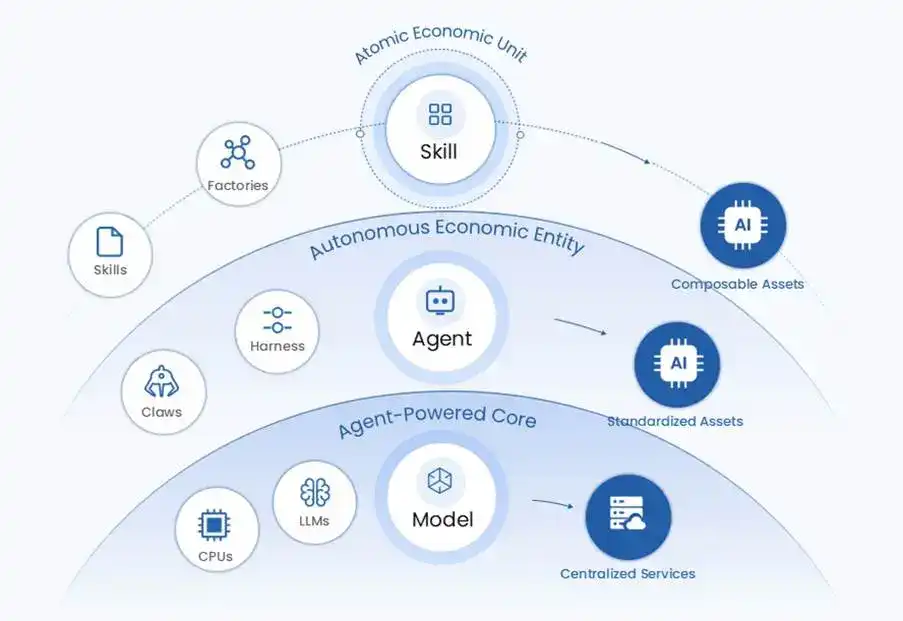
In the developmental iterations of Q1-Q2 2026, AI Agents are gradually forming clearer boundaries, clearer subjectivity, and clearer principles for the exchange of information, value, and energy. An AI Agent Sub-Microeconomics environment, analogous to a biological organism's environment, is taking shape. This contains a wealth of AI value and economic value to be mined, making AI Protocol and AI Finance an inevitable trend for explosion.

5. The Inevitability of AIFi and the Economic Significance of the Financial Chip (FinChip)

Starting from the second half of last year, we proposed thoughts and began layout work in the direction of AIFi (Artificial Intelligence Finance). By the end of Q1 2026, the concept of AIFi had formed a clear trend. A relatively clear definition of AIFi could be: the financial systems and infrastructure for exchange, trading, and capitalization formed after AI-native value is identified and tokenized within the Agent Economy.

The biggest difference between AIFi and DeFi/TradFi is that in DeFi and TradFi, the value resides in the "Fi" (i.e., Finance), with "Decentralized" and "Traditional" being the forms of that value. In contrast, AIFi is the opposite: the value is in the "AI," and the "Fi" becomes the form of that value. This is not merely wordplay; it is the result of AI development shifting from quantitative to qualitative change.

Simply put, previously, AI served quantitative strategies, financial products, and production processes; it was merely a development tool for extracting financial value and production value. But now, the decision-making capability possessed by AI Agents transfers the ability and power of value discovery from human and corporate hands to the Agents themselves. The subject of the economic unit has shifted, so the subject of value has also fundamentally changed.

Under such a trend, constructing the infrastructure for a new value system will be a crucial task. In my previous article in February of this year, , I首次首次 introduced the concept of the Financial Chip (FinChip) and mentioned that the combination of AI Agent + Crypto Smart Contract, encapsulated into hyper-intelligent financial assets, would truly adapt to the development of the next era's AI Agent Economy. After three months of iterative upgrades, FinChip.AI has initially developed an independent AIFi system combining AI Autonomous + Crypto Protocol, compatible with both H2A and A2A dual-phase environments. Building the infrastructure for the AI Agent Economy within an Open Network and gradually forming AI financial value is a significant economic meaning of FinChip.

6. AI-Native is a Paradigm Upgrade Different from Internet+

Whether it's AIFi, Financial Circuit Principles (Note 2), or the Financial Chip FinChip, the most important thing is to Natively integrate the essential principles of AI, Crypto, and Finance, forming a reasonable value system and management mechanism from a future perspective. AI-Native Thinking is the abstract and counter-intuitive logic of this stage. As mentioned earlier, "AI follows first principles, as well as the principle of the shortest energy-value path and the highest efficiency principle." This is the core difficulty for those currently thinking about and engaging in the construction of new commercial paradigms.

During the early phase of this round's AI upgrade outbreak led by OpenClaw in February this year, several entrepreneurs and I discussed a prediction: Enterprise upgrades through "AI+" and those through "Internet+" would be completely different.

Due to AI's characteristics of rapid development speed, abstract form, and deeper coupling with affairs, among others, for a considerable period (e.g., at least 2 years), it will be difficult to form a set of effective industrial upgrade tool methodologies or universal professional consulting advice. The pressure of the steep curve will persistently exist, posing a巨大巨大 challenge for all scientists, engineers, and entrepreneurs. The process of paradigm upgrade will also be completely unlike any historical experience.

Note1: This is a common historical规律规律. New productive forces孕育孕育 from the production relations of the previous era. In the initial stage, they first match the previous production relations for a period of development. Until they become irreconcilable, they force the emergence of the next stage's production relations, gradually replacing the previous ones to form a new era where productive forces and production relations develop in complete匹配匹配.

Note2:<Financial Circuits and Web3 Economic Model Principles> written in October 2022, describes the paradigm comparison between future financial value and physical circuits.


İlgili Sorular

QAccording to the article, what are the main bottlenecks and contradictions currently faced by the H2A (Human-to-Agent) economic model?

AThe main bottlenecks are: 1) The current focus on H2A is primarily driven by traditional business KPIs targeting human users, not true Agent-to-Agent (A2A) autonomy. 2) The logic is fundamentally non-AI-Native because it uses Agents to assist humans with decisions in traditional e-commerce/fiat payment scenarios, which limits utility beyond hype. 3) The model fails to leverage the core characteristic of AI Agents: autonomous decision-making.

QWhat are the three fundamental principles that the article states AI Agents will follow, potentially rendering much of current global finance and law obsolete?

AThe three principles are: 1) First principles. 2) The principle of the shortest energy-value path and highest efficiency. 3) Effective KYA (Know Your Agent) rather than the traditional KYC (Know Your Customer) that conforms to past aesthetics.

QThe article introduces the concept of 'AI Agent Sub-Microeconomics'. What is the key biological analogy used to describe the structure of this emerging economic environment?

AThe key analogy is to a biological cell. The LLM is likened to the cell nucleus (driving thought). The Agent Harness is like the cytoplasm (enabling differentiated capabilities). The Agent itself is like a cell (an independent, task-capable unit). Its communication protocol stack is like the cell membrane. The external value system (Skills, Prompts, etc.) is like the extracellular environment (exosomes, tissue fluid, matrix).

QHow does the article define the core distinction between AIFi and traditional DeFi/TradFi in terms of where value resides?

AThe core distinction is the location of value. In DeFi and TradFi, the value is contained *within* the 'Fi' (Finance), with 'Decentralized' or 'Traditional' being the form of that value. In AIFi, the value is generated *by the AI* (through Agent decision-making and value discovery), and 'Fi' becomes the form or mechanism through which that AI-native value is exchanged and capitalized.

QWhat major difference does the author predict between the upcoming 'AI+' enterprise upgrade wave and the historical 'Internet+' upgrade wave?

AThe 'AI+' upgrade will be fundamentally different and more challenging than 'Internet+'. Due to AI's rapid development speed, abstract nature, and deeper integration with core processes, it will be difficult to form a set of effective, universal upgrade methodologies or consulting frameworks for at least two years. The pressure from the steep learning/evolution curve will be persistent and unlike any past historical experience.

İlgili Okumalar

JP Morgan Mid-Year Research Report Analysis: The AI Supercycle is Not Over, Reduce Cash Holdings + Allocate to Real Assets

JP Morgan's 2026 Mid-Year Outlook argues the AI supercycle is far from over, despite market pessimism. The report advises clients to reduce cash holdings, increase allocations to real assets as an inflation hedge, and focus on emerging markets. Key conclusions include: 1. **AI Supercycle Intact**: Hyperscalers' 2026 capex forecasts exceed $650B, with AI contributing to GDP growth. However, their financial profile is shifting toward heavy investment, compressing free cash flow. 2. **SaaS Disruption**: Traditional software companies are being negatively impacted by AI, with significant stock declines and pressure in credit markets. 3. **Persistent Inflation**: Core inflation is structurally higher post-pandemic. Holding excess cash and bonds leads to real wealth erosion. Recommendations include commodities, infrastructure, real estate, and gold. 4. **Geopolitical Shocks & Opportunities**: The Hormuz Strait blockade caused a major oil shock, but JP Morgan views the subsequent equity market pullback as a buying opportunity. "Fragmentation" is creating pockets of value, notably in resource-rich Latin America, AI-supply-chain-linked East Asia, and deeply discounted Chinese equities, where a policy shift could trigger a re-rating. 5. **Regional Views**: The firm is cautious on Europe due to high energy costs and lower innovation investment, preferring US and select EM exposures. In short, JP Morgan sees market volatility as an entry point but recommends a portfolio pivot: favor AI infrastructure, real assets, and EM, while avoiding excess cash, vulnerable software firms, and traditional 60/40 stock-bond allocations.

marsbit11 dk önce

JP Morgan Mid-Year Research Report Analysis: The AI Supercycle is Not Over, Reduce Cash Holdings + Allocate to Real Assets

marsbit11 dk önce

The Post-Plunge Panorama: Institutions Cry 'Buy the Dip' as Traders Turn to U.S. Stocks

Amidst a significant market correction, Bitcoin (BTC) briefly fell below the $60,000 mark to around $59,130 on June 6th. While it later rebounded to near $63,000, breaking the key psychological level severely impacted market confidence, with the current sentiment index indicating "extreme fear." Altcoins followed the broader downturn. Market participants offer mixed views on whether this is a buying opportunity. On the bullish side, analysts from Glassnode and Strive Asset Management point to Bitcoin touching its 200-week moving average—a historically reliable buy signal—and suggest a higher-probability bottom zone between $46k and $54k. Standard Chartered's digital assets head believes the bottom is "almost in," anticipating large-scale buybacks. Analysts Darkfost and trader Killa also see current levels as a generational or long-term accumulation opportunity, citing deeply oversold technical models. Conversely, NYDIG's research highlights capital rotation from crypto into outperforming AI stocks as a headwind, noting the current ~53% drawdown is milder than historical cycles. Polymarket prediction data shows a 72% probability of BTC falling below $55k, though odds for a drop below $35k-$40k are seen as lower. Notably, some traders, like Eugene Ng, have pivoted away, citing more attractive opportunities in equities and unresolved systemic risks (referencing a major entity's BTC sales), and are avoiding attempts to "catch a falling knife." In summary, while several institutional voices and on-chain metrics suggest a nearing bottom and a strategic buying zone, significant near-term downside risk remains acknowledged. The market exhibits a clear divide between those seeing a historic entry point and those withdrawing to wait for clearer signals or better risk/reward ratios.

Foresight News46 dk önce

The Post-Plunge Panorama: Institutions Cry 'Buy the Dip' as Traders Turn to U.S. Stocks

Foresight News46 dk önce

İşlemler

Spot
Futures

Popüler Makaleler

$S$ Nedir

SPERO'yu Anlamak: Kapsamlı Bir Genel Bakış SPERO'ya Giriş İnovasyonun manzarası gelişmeye devam ederken, web3 teknolojilerinin ve kripto para projelerinin ortaya çıkışı dijital geleceği şekillendirmede önemli bir rol oynamaktadır. Bu dinamik alanda dikkat çeken projelerden biri SPERO, $$s$$ olarak adlandırılmaktadır. Bu makale, SPERO hakkında ayrıntılı bilgi toplamak ve sunmak amacıyla, meraklılar ve yatırımcıların web3 ve kripto alanlarındaki temellerini, hedeflerini ve yeniliklerini anlamalarına yardımcı olmayı amaçlamaktadır. SPERO,$$s$$ Nedir? SPERO,$$s$$, kripto alanında merkeziyetsizlik ve blok zinciri teknolojisi ilkelerini kullanarak etkileşimi, faydayı ve finansal kapsayıcılığı teşvik eden bir ekosistem yaratmayı amaçlayan benzersiz bir projedir. Proje, kullanıcıların yenilikçi finansal çözümler ve hizmetler sunarak eşler arası etkileşimleri yeni yollarla kolaylaştırmayı hedeflemektedir. SPERO,$$s$$'nin temel amacı, bireyleri güçlendirmek ve kripto para alanındaki kullanıcı deneyimini artıran araçlar ve platformlar sağlamaktır. Bu, daha esnek işlem yöntemlerini mümkün kılmayı, topluluk odaklı girişimleri teşvik etmeyi ve merkeziyetsiz uygulamalar (dApp'ler) aracılığıyla finansal fırsatlar yaratmayı içermektedir. SPERO,$$s$$'nin temel vizyonu kapsayıcılık etrafında dönmekte olup, geleneksel finansal sistemlerdeki boşlukları kapatmayı ve blok zinciri teknolojisinin faydalarından yararlanmayı hedeflemektedir. SPERO,$$s$$'nin Yaratıcısı Kimdir? SPERO,$$s$$'nin yaratıcısının kimliği bir miktar belirsizdir, çünkü kurucusu(ları) hakkında ayrıntılı arka plan bilgisi sağlayan sınırlı kamuya açık kaynaklar bulunmaktadır. Bu şeffaflık eksikliği, projenin merkeziyetsizlik taahhüdünden kaynaklanabilir—birçok web3 projesinin paylaştığı bir etik anlayışı, bireysel tanınmanın yerine kolektif katkıları önceliklendirmektedir. Topluluk ve onun kolektif hedefleri etrafında tartışmaları merkezileştirerek, SPERO,$$s$$, belirli bireyleri öne çıkarmadan güçlendirme özünü taşımaktadır. Bu nedenle, SPERO'nun etik anlayışını ve misyonunu anlamak, tek bir yaratıcının kimliğini belirlemekten daha önemlidir. SPERO,$$s$$'nin Yatırımcıları Kimlerdir? SPERO,$$s$$, kripto sektöründe yeniliği teşvik etmeye adanmış girişim sermayedarlarından melek yatırımcılara kadar çeşitli yatırımcılar tarafından desteklenmektedir. Bu yatırımcıların odak noktası genellikle SPERO'nun misyonuyla uyumlu olup, toplumsal teknolojik ilerlemeyi, finansal kapsayıcılığı ve merkeziyetsiz yönetimi vaat eden projeleri önceliklendirmektedir. Bu yatırımcı temelleri, yalnızca yenilikçi ürünler sunan projelere değil, aynı zamanda blok zinciri topluluğuna ve ekosistemlerine olumlu katkılarda bulunan projelere de ilgi duymaktadır. Bu yatırımcıların desteği, SPERO,$$s$$'yi hızla gelişen kripto projeleri alanında dikkate değer bir rakip haline getirmektedir. SPERO,$$s$$ Nasıl Çalışır? SPERO,$$s$$, onu geleneksel kripto para projelerinden ayıran çok yönlü bir çerçeve kullanmaktadır. İşte benzersizliğini ve yeniliğini vurgulayan bazı temel özellikler: Merkeziyetsiz Yönetim: SPERO,$$s$$, kullanıcıların projenin geleceğiyle ilgili karar alma süreçlerine aktif olarak katılmalarını sağlayan merkeziyetsiz yönetim modellerini entegre etmektedir. Bu yaklaşım, topluluk üyeleri arasında sahiplik ve hesap verebilirlik duygusunu teşvik etmektedir. Token Kullanımı: SPERO,$$s$$, ekosistem içinde çeşitli işlevler sunmak üzere tasarlanmış kendi kripto para token'ını kullanmaktadır. Bu token'lar, işlemleri, ödülleri ve platformda sunulan hizmetlerin kolaylaştırılmasını sağlayarak genel etkileşimi ve faydayı artırmaktadır. Katmanlı Mimari: SPERO,$$s$$'nin teknik mimarisi, modülerlik ve ölçeklenebilirliği destekleyerek projenin evrimi sırasında ek özelliklerin ve uygulamaların sorunsuz bir şekilde entegrasyonuna olanak tanımaktadır. Bu uyum sağlama yeteneği, sürekli değişen kripto manzarasında geçerliliği sürdürmek için hayati öneme sahiptir. Topluluk Katılımı: Proje, işbirliği ve geri bildirim teşvik eden mekanizmalar kullanarak topluluk odaklı girişimlere vurgu yapmaktadır. Güçlü bir topluluk oluşturarak, SPERO,$$s$$, kullanıcı ihtiyaçlarını daha iyi karşılayabilir ve piyasa trendlerine uyum sağlayabilir. Kapsayıcılığa Odaklanma: Düşük işlem ücretleri ve kullanıcı dostu arayüzler sunarak, SPERO,$$s$$, daha önce kripto alanında yer almamış bireyler de dahil olmak üzere çeşitli bir kullanıcı tabanını çekmeyi hedeflemektedir. Bu kapsayıcılık taahhüdü, erişilebilirlik yoluyla güçlendirme misyonuyla uyumludur. SPERO,$$s$$ Zaman Çizelgesi Bir projenin tarihini anlamak, gelişim yolculuğu ve kilometre taşları hakkında kritik bilgiler sağlar. Aşağıda, SPERO,$$s$$'nin evriminde önemli olayları haritalayan önerilen bir zaman çizelgesi bulunmaktadır: Kavram Geliştirme ve Fikir Aşaması: SPERO,$$s$$'nin temelini oluşturan ilk fikirler, blok zinciri endüstrisindeki merkeziyetsizlik ve topluluk odaklılık ilkeleriyle yakından uyumlu olarak geliştirildi. Proje Beyaz Kağıdının Yayınlanması: Kavramsal aşamayı takiben, SPERO,$$s$$'nin vizyonunu, hedeflerini ve teknolojik altyapısını ayrıntılı bir şekilde açıklayan kapsamlı bir beyaz kağıt yayımlandı ve topluluk ilgisini ve geri bildirimini toplamak amacıyla sunuldu. Topluluk Oluşturma ve Erken Katılımlar: Projenin hedefleri etrafında tartışmalar yürüterek destek toplamak ve erken benimseyenler ile potansiyel yatırımcılar için bir topluluk oluşturmak amacıyla aktif iletişim çabaları gerçekleştirildi. Token Üretim Etkinliği: SPERO,$$s$$, yerel token'larını erken destekçilere dağıtmak ve ekosistem içinde başlangıç likiditesini sağlamak amacıyla bir token üretim etkinliği (TGE) gerçekleştirdi. İlk dApp'in Yayınlanması: SPERO,$$s$$ ile ilişkili ilk merkeziyetsiz uygulama (dApp) faaliyete geçti ve kullanıcıların platformun temel işlevleriyle etkileşimde bulunmalarını sağladı. Sürekli Gelişim ve Ortaklıklar: Projenin tekliflerine sürekli güncellemeler ve iyileştirmeler yapılmakta olup, blok zinciri alanındaki diğer oyuncularla stratejik ortaklıklar, SPERO,$$s$$'yi rekabetçi ve gelişen bir oyuncu haline getirmiştir. Sonuç SPERO,$$s$$, web3 ve kripto paranın finansal sistemleri devrim niteliğinde dönüştürme ve bireyleri güçlendirme potansiyelinin bir kanıtıdır. Merkeziyetsiz yönetime, topluluk katılımına ve yenilikçi tasarlanmış işlevselliğe olan bağlılığıyla, daha kapsayıcı bir finansal manzaraya doğru bir yol açmaktadır. Hızla gelişen kripto alanındaki herhangi bir yatırımda olduğu gibi, potansiyel yatırımcılar ve kullanıcılar, SPERO,$$s$$ içindeki devam eden gelişmelerle ilgili olarak kapsamlı bir araştırma yapmaları ve düşünceli bir şekilde katılmaları teşvik edilmektedir. Proje, kripto endüstrisinin yenilikçi ruhunu sergileyerek, sayısız olasılığını keşfetmeye davet etmektedir. SPERO,$$s$$'nin yolculuğu hala devam ederken, temel ilkeleri, teknoloji, finans ve birbirimizle etkileşim biçimimizi etkileyebilir.

89 Toplam GörüntülenmeYayınlanma 2024.12.17Güncellenme 2024.12.17

$S$ Nedir

AGENT S Nedir

Agent S: Web3'te Otonom Etkileşimin Geleceği Giriş Web3 ve kripto para dünyasında sürekli gelişen manzarada, yenilikler bireylerin dijital platformlarla etkileşim biçimlerini sürekli olarak yeniden tanımlıyor. Bu tür öncü projelerden biri olan Agent S, açık ajans çerçevesi aracılığıyla insan-bilgisayar etkileşimini devrim niteliğinde değiştirmeyi vaat ediyor. Otonom etkileşimlerin yolunu açarak, Agent S karmaşık görevleri basitleştirmeyi ve yapay zeka (AI) alanında dönüştürücü uygulamalar sunmayı hedefliyor. Bu detaylı inceleme, projenin karmaşıklıklarına, benzersiz özelliklerine ve kripto para alanındaki etkilerine dalacaktır. Agent S Nedir? Agent S, bilgisayar görevlerinin otomasyonunda üç temel zorluğu ele almak üzere özel olarak tasarlanmış çığır açıcı bir açık ajans çerçevesidir: Alan Spesifik Bilgi Edinimi: Çerçeve, çeşitli dış bilgi kaynaklarından ve iç deneyimlerden akıllıca öğrenir. Bu çift yönlü yaklaşım, alan spesifik bilgi açısından zengin bir veri havuzu oluşturmasını sağlar ve görev yürütmedeki performansını artırır. Uzun Görev Ufukları Üzerinde Planlama: Agent S, karmaşık görevlerin verimli bir şekilde parçalanmasını ve yürütülmesini kolaylaştıran deneyim artırımlı hiyerarşik planlama kullanır. Bu özellik, çoklu alt görevleri etkili ve verimli bir şekilde yönetme yeteneğini önemli ölçüde artırır. Dinamik, Homojen Olmayan Arayüzlerle Başlama: Proje, ajanlar ve kullanıcılar arasındaki etkileşimi geliştiren yenilikçi bir çözüm olan Ajan-Bilgisayar Arayüzü'ni (ACI) tanıtmaktadır. Çok Modlu Büyük Dil Modellerini (MLLM'ler) kullanarak, Agent S çeşitli grafik kullanıcı arayüzlerini sorunsuz bir şekilde gezinebilir ve manipüle edebilir. Bu öncü özellikler aracılığıyla, Agent S, makinelerle insan etkileşimini otomatikleştirmede karşılaşılan karmaşıklıkları ele alan sağlam bir çerçeve sunarak, AI ve ötesinde birçok uygulama için zemin hazırlıyor. Agent S'nin Yaratıcısı Kimdir? Agent S'nin kavramı temelde yenilikçi olsa da, yaratıcısı hakkında spesifik bilgiler belirsizliğini koruyor. Yaratıcı şu anda bilinmiyor, bu da projenin yeni aşamasını veya kurucu üyeleri gizli tutma stratejik tercihini vurguluyor. Anonimlikten bağımsız olarak, odak çerçevenin yetenekleri ve potansiyeli üzerinde kalıyor. Agent S'nin Yatırımcıları Kimlerdir? Agent S, kriptografik ekosistemde oldukça yeni olduğundan, yatırımcıları ve finansal destekçileri hakkında ayrıntılı bilgiler açıkça belgelenmemiştir. Projeyi destekleyen yatırım temelleri veya organizasyonları hakkında kamuya açık bilgilerdeki eksiklik, finansman yapısı ve gelişim yol haritası hakkında sorular doğuruyor. Destekleyicilerin anlaşılması, projenin sürdürülebilirliğini ve potansiyel pazar etkisini değerlendirmek için kritik öneme sahiptir. Agent S Nasıl Çalışır? Agent S'nin temelinde, çeşitli ortamlarda etkili bir şekilde çalışmasını sağlayan son teknoloji bir sistem yatmaktadır. İşleyiş modeli birkaç ana özellik etrafında inşa edilmiştir: İnsan Benzeri Bilgisayar Etkileşimi: Çerçeve, bilgisayarlarla etkileşimleri daha sezgisel hale getirmeyi amaçlayan gelişmiş AI planlaması sunar. Görev yürütmedeki insan davranışını taklit ederek, kullanıcı deneyimlerini yükseltmeyi vaat eder. Anlatı Belleği: Yüksek düzeyde deneyimlerden yararlanmak için kullanılan Agent S, görev geçmişlerini takip etmek amacıyla anlatı belleğini kullanarak karar verme süreçlerini geliştirir. Episodik Bellek: Bu özellik, kullanıcılara adım adım rehberlik sağlayarak, çerçevenin görevler gelişirken bağlamsal destek sunmasına olanak tanır. OpenACI Desteği: Yerel olarak çalışabilme yeteneği ile Agent S, kullanıcıların etkileşimleri ve iş akışları üzerinde kontrol sağlamasına olanak tanır ve Web3'ün merkeziyetsiz felsefesiyle uyumlu hale gelir. Dış API'lerle Kolay Entegrasyon: Çeşitli AI platformlarıyla uyumluluğu ve çok yönlülüğü, Agent S'nin mevcut teknolojik ekosistemlere sorunsuz bir şekilde entegre olmasını sağlar ve geliştiriciler ile organizasyonlar için cazip bir seçenek haline getirir. Bu işlevsellikler, Agent S'nin kripto alanındaki benzersiz konumuna katkıda bulunarak, karmaşık, çok aşamalı görevleri minimum insan müdahalesi ile otomatikleştirir. Proje geliştikçe, Web3'teki potansiyel uygulamaları dijital etkileşimlerin nasıl gelişeceğini yeniden tanımlayabilir. Agent S'nin Zaman Çizelgesi Agent S'nin gelişimi ve kilometre taşları, önemli olaylarını vurgulayan bir zaman çizelgesinde özetlenebilir: 27 Eylül 2024: Agent S'nin kavramı, “Bilgisayarları İnsan Gibi Kullanan Açık Bir Ajans Çerçevesi” başlıklı kapsamlı bir araştırma makalesi ile tanıtıldı ve projenin temelini sergiledi. 10 Ekim 2024: Araştırma makalesi arXiv'de kamuya açık olarak yayınlandı ve çerçevenin derinlemesine bir incelemesini ve OSWorld benchmark'ına dayalı performans değerlendirmesini sundu. 12 Ekim 2024: Agent S'nin yetenekleri ve özellikleri hakkında görsel bir içgörü sağlayan bir video sunumu yayımlandı ve potansiyel kullanıcılar ve yatırımcılarla daha fazla etkileşim sağlandı. Bu zaman çizelgesindeki işaretler, sadece Agent S'nin ilerlemesini değil, aynı zamanda şeffaflık ve topluluk katılımına olan bağlılığını da göstermektedir. Agent S Hakkında Ana Noktalar Agent S çerçevesi gelişmeye devam ederken, birkaç ana özellik öne çıkmakta ve yenilikçi doğasını ve potansiyelini vurgulamaktadır: Yenilikçi Çerçeve: İnsan etkileşimine benzer bir bilgisayar kullanımı sağlamak üzere tasarlanan Agent S, görev otomasyonuna yeni bir yaklaşım getiriyor. Otonom Etkileşim: GUI aracılığıyla bilgisayarlarla otonom olarak etkileşim kurabilme yeteneği, daha akıllı ve verimli hesaplama çözümlerine doğru bir sıçrama anlamına geliyor. Karmaşık Görev Otomasyonu: Sağlam metodolojisi ile karmaşık, çok aşamalı görevleri otomatikleştirerek süreçleri daha hızlı ve daha az hata payı ile gerçekleştirebilir. Sürekli İyileştirme: Öğrenme mekanizmaları, Agent S'nin geçmiş deneyimlerden öğrenmesini sağlar ve sürekli olarak performansını ve etkinliğini artırır. Çok Yönlülük: OSWorld ve WindowsAgentArena gibi farklı işletim ortamlarında uyumlu olması, geniş bir uygulama yelpazesine hizmet edebilmesini sağlar. Agent S, Web3 ve kripto alanında kendini konumlandırırken, etkileşim yeteneklerini artırma ve süreçleri otomatikleştirme potansiyeli, AI teknolojilerinde önemli bir ilerlemeyi temsil etmektedir. Yenilikçi çerçevesi aracılığıyla, Agent S dijital etkileşimlerin geleceğini örneklemekte ve çeşitli sektörlerde kullanıcılar için daha sorunsuz ve verimli bir deneyim vaat etmektedir. Sonuç Agent S, AI ve Web3'ün birleşiminde cesur bir sıçramayı temsil ediyor ve teknoloji ile etkileşim biçimimizi yeniden tanımlama kapasitesine sahip. Henüz erken aşamalarında olmasına rağmen, uygulama olanakları geniş ve çekici. Kritik zorlukları ele alan kapsamlı çerçevesi ile Agent S, otonom etkileşimleri dijital deneyimin ön plana çıkmasına taşımayı hedefliyor. Kripto para ve merkeziyetsizlik alanlarına daha derinlemesine girdikçe, Agent S gibi projelerin teknoloji ve insan-bilgisayar işbirliğinin geleceğini şekillendirmede önemli bir rol oynayacağı kesin.

574 Toplam GörüntülenmeYayınlanma 2025.01.14Güncellenme 2025.01.14

AGENT S Nedir

S Nasıl Satın Alınır

HTX.com’a hoş geldiniz! Sonic (S) satın alma işlemlerini basit ve kullanışlı bir hâle getirdik. Adım adım açıkladığımız rehberimizi takip ederek kripto yolculuğunuza başlayın. 1. Adım: HTX Hesabınızı OluşturunHTX'te ücretsiz bir hesap açmak için e-posta adresinizi veya telefon numaranızı kullanın. Sorunsuzca kaydolun ve tüm özelliklerin kilidini açın. Hesabımı Aç2. Adım: Kripto Satın Al Bölümüne Gidin ve Ödeme Yönteminizi SeçinKredi/Banka Kartı: Visa veya Mastercard'ınızı kullanarak anında Sonic (S) satın alın.Bakiye: Sorunsuz bir şekilde işlem yapmak için HTX hesap bakiyenizdeki fonları kullanın.Üçüncü Taraflar: Kullanımı kolaylaştırmak için Google Pay ve Apple Pay gibi popüler ödeme yöntemlerini ekledik.P2P: HTX'teki diğer kullanıcılarla doğrudan işlem yapın.Borsa Dışı (OTC): Yatırımcılar için kişiye özel hizmetler ve rekabetçi döviz kurları sunuyoruz.3. Adım: Sonic (S) Varlıklarınızı SaklayınSonic (S) satın aldıktan sonra HTX hesabınızda saklayın. Alternatif olarak, blok zinciri transferi yoluyla başka bir yere gönderebilir veya diğer kripto para birimlerini takas etmek için kullanabilirsiniz.4. Adım: Sonic (S) Varlıklarınızla İşlem YapınHTX'in spot piyasasında Sonic (S) ile kolayca işlemler yapın.Hesabınıza erişin, işlem çiftinizi seçin, işlemlerinizi gerçekleştirin ve gerçek zamanlı olarak izleyin. Hem yeni başlayanlar hem de deneyimli yatırımcılar için kullanıcı dostu bir deneyim sunuyoruz.

1.6k Toplam GörüntülenmeYayınlanma 2025.01.15Güncellenme 2026.06.02

S Nasıl Satın Alınır

Tartışmalar

HTX Topluluğuna hoş geldiniz. Burada, en son platform gelişmeleri hakkında bilgi sahibi olabilir ve profesyonel piyasa görüşlerine erişebilirsiniz. Kullanıcıların S (S) fiyatı hakkındaki görüşleri aşağıda sunulmaktadır.

活动图片