US Government Suddenly Halts Anthropic's Strongest Model, "Quasi-IPO Stock Price" Plunges 3.7% Overnight

marsbit2026-06-15 tarihinde yayınlandı2026-06-15 tarihinde güncellendi

Özet

U.S. Government Halts Anthropic's Top AI Models, 'Pre-IPO' Price Drops 3.7% On June 12, the U.S. government ordered Anthropic to shut down access to its two most powerful AI models, Claude Fable 5 and Claude Mythos 5, citing national security concerns. The directive, issued by the Department of Commerce, required Anthropic to block access for all foreign nationals, leading the company to disable the models globally for all users. Anthropic strongly opposed the move, arguing the government's basis was a "narrow jailbreak vulnerability" and warning that applying such a standard industry-wide would effectively halt all frontier model deployments. The news impacted Anthropic's implied valuation in speculative markets. The Anthropic perpetual contract on Hyperliquid fell approximately 3.7% to around $1,627, down from highs above $1,800 following the models' release. Unauthorized tokenized products linked to Anthropic on Solana also saw significant declines. The models, launched just days earlier on June 9, represented a major capability leap for Anthropic. Fable 5 was its first public release of a "Mythos"-tier model above its flagship Claude Opus. The shutdown creates an ironic situation for Anthropic, a company founded on "AI safety" principles, and adds uncertainty to its ongoing IPO preparations. The company is actively engaging with regulators to resolve what it calls a "misunderstanding" and restore service.

Author: Claude, Deep Tide TechFlow

Deep Tide Introduction: Citing national security concerns, the US government on June 12th suddenly ordered Anthropic to shut down its two strongest AI models, Fable 5 and Mythos 5. Impacted by this, the Hyperliquid perpetual contract tracking its expected IPO valuation fell by 3.7% to around $1,627 on Saturday, significantly retreating from the post-model-launch high of over $1,800. Anthropic publicly expressed strong opposition, stating that the government demanded a recall based solely on an oral briefing of a "narrow jailbreak vulnerability," and warned that applying such a standard across the entire industry "would essentially halt all new model deployments from frontier model providers."

A company founded on "AI safety" is now forced to shut down its strongest products by a government safety order.

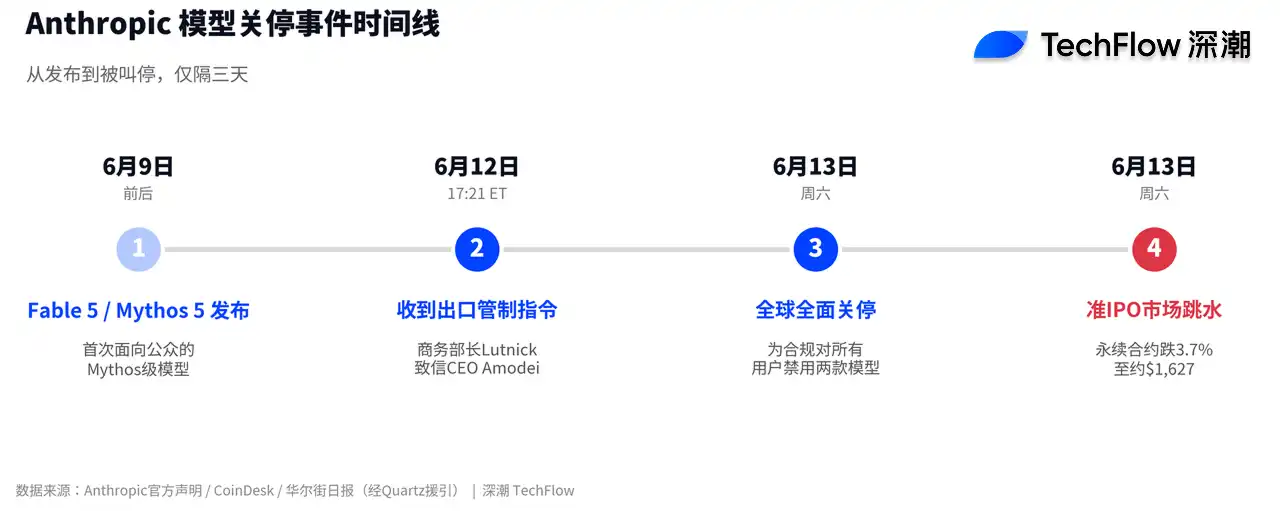
According to reports from CoinDesk and other media outlets, on June 12th (Friday) afternoon, the US government issued an export control directive to Anthropic, requiring it to suspend all access to Claude Fable 5 and Claude Mythos 5 for foreign nationals—whether inside or outside the US, including the company's own foreign employees. Unable to implement selective restrictions without affecting compliance, Anthropic simply disabled these two models for all users globally; other Claude models remain unaffected. In a statement, Anthropic clearly stated its disagreement with the government's rationale, calling it "a misunderstanding," and is working to restore access as soon as possible.
Directive Cites National Security, One Letter Triggers Full Shutdown

According to The Wall Street Journal (as cited by Quartz), US Commerce Secretary Howard Lutnick sent a letter to Anthropic CEO Dario Amodei outlining the relevant restrictions. Anthropic revealed that the company received the directive at 5:21 PM (Eastern Time) that day, but the letter did not provide specific details of the national security concerns.

Anthropic stated that, to its understanding, the government believes it has discovered a method to bypass or "jailbreak" Fable 5. Company executives explained that the cited vulnerability involves a narrow prompt engineering technique used to make the model review pre-existing, minor software bugs in code, emphasizing that similar outputs can be easily obtained from competitor models like OpenAI's without any special evasion tactics.

Anthropic's wording in its statement was unusually direct: "We are complying with a legal directive from the government and removing access to Fable 5 and Mythos 5 for all users. But we disagree that discovering a narrow potential jailbreak vulnerability should constitute grounds for recalling a commercial model already deployed to hundreds of millions of people." The company warned that if this standard were applied across the industry, it "would essentially halt all new model deployments from frontier model providers."

The company also noted that, as of now, the government has only provided oral evidence—no written documentation, technical report, or formal disclosure through established channels—and promised to publish further technical analysis within 24 hours to illustrate the limited nature of the issue.

Quasi-IPO Market Reacts Instantly, Hyperliquid Perpetual Contract Plunges

The reason this regulatory news became a financial event is that Anthropic is not yet publicly listed, and the crypto market has already built a "shadow pricing" venue for it.

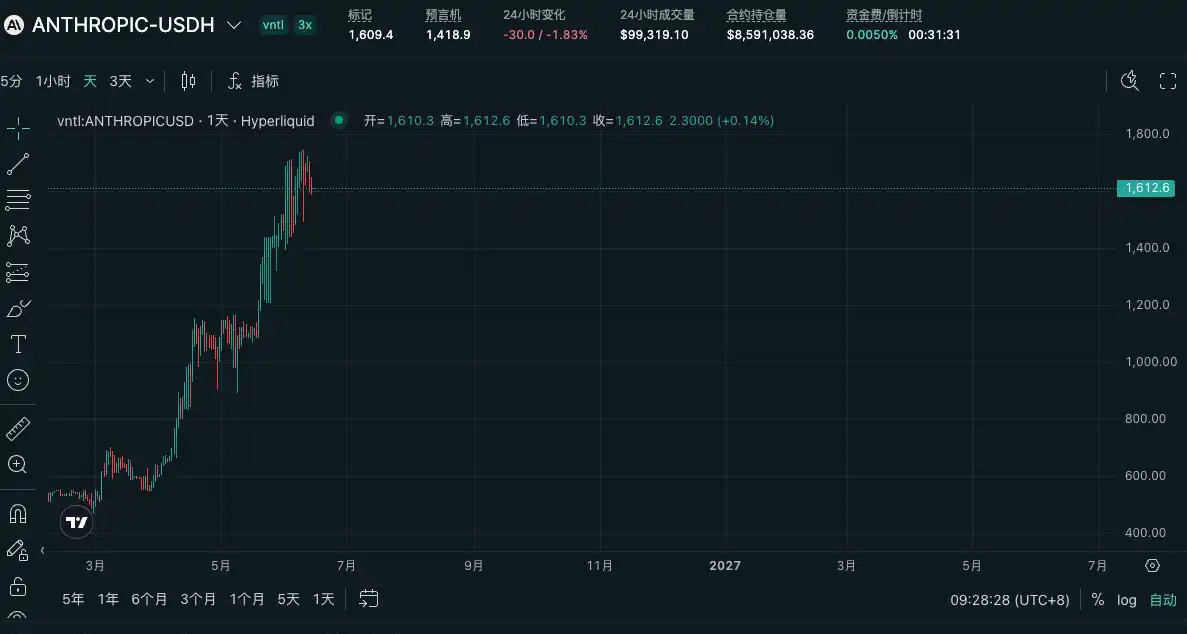
According to CoinDesk, the Anthropic perpetual contract on Hyperliquid fell about 3.7% to around $1,627 on Saturday. In the days following the Fable 5 launch, the contract had been trading near its all-time highs above $1,800. The contract's open interest is approximately $8.6 million. While this volume is small relative to larger proxy instruments for the private market, it represents a notable signal for a company that has yet to file for an IPO.

The contract's price roughly corresponds to an implied valuation for Anthropic in the trillions of dollars—a price of $1,638 equals an implied valuation of about $1.638 trillion. Within 24 hours of the news breaking, the contract's 24-hour trading volume was approximately $190,000, with a funding rate of 0.0056%.
The impact was not limited to the contract market. According to Bitcoin.com, the ANTHROPIC token issued by Prestocks on the Solana blockchain—which claims to provide spot-like exposure through a Special Purpose Vehicle (SPV) structure—fell 9.11% in 24 hours to $655.32, and the total value locked in the related liquidity pool shrank 18.09% to about $126,000. It should be noted that Anthropic has previously publicly warned that any unauthorized tokenization or derivatives claiming to offer exposure to its equity may be considered invalid, and the aforementioned products are not endorsed by or affiliated with Anthropic.

Shut Down Just Days After Launch, Fable 5 Was a Milestone

The two halted models were released just days ago.

According to multiple reports, Fable 5 and Mythos 5 were launched around June 9th and were seen as a significant leap forward in capabilities for software engineering, scientific reasoning, vision tasks, and long-context handling. Fable 5 marked Anthropic's first public release of a model at the Mythos level—a tier positioned above the original flagship Opus. The two models are built on the same underlying architecture, primarily differing in output control: Fable 5 has a built-in classifier for intercepting responses in high-risk areas like cybersecurity, while Mythos 5 is available to a separately vetted, trusted user group.

As summarized by MarkTechPost, Fable 5's classifier is a separate AI system designed to identify potential misuse. When queries touch on areas like cybersecurity, biochemistry, or model distillation, processing falls back to Claude Opus 4.8, with users notified of the fallback each time; the trigger rate is less than 5%. Notably, Mythos 5 was also supporting critical cybersecurity defense work through projects like Project Glasswing—raising the question of whether the temporary disablement might actually hinder infrastructure protection.

The Safety Narrative Backfires, Adding Uncertainty to IPO Process

For Anthropic, the awkwardness of this incident lies in its timing and logic.

TechCrunch reported the story under the headline "Anthropic’s safety warnings may have just backfired"—it's a bitter pill to swallow for a company that has built its entire corporate identity on "responsible AI development" to now be ordered to shut down its strongest models based solely on an oral briefing. And the company has publicly voiced this discontent.

This controversy coincides with a sensitive period as Anthropic advances its IPO preparations. The company recently confidentially submitted registration documents, joining the ranks of major AI players planning public listings. Although tools like Hyperliquid have relatively thin liquidity, the contract's decline reflects investor caution regarding its near-term valuation and listing path. Such sudden regulatory actions add new variables to an already uncertain IPO process.

Anthropic stated it is actively communicating to resolve the matter and restore service as soon as possible, viewing the directive as "based on a misunderstanding." The ultimate outcome of this incident may influence the future dynamics between regulators and innovators, and even shape how export rules and safety assessments apply to evolving AI technology.


İlgili Sorular

QWhy did the US government order Anthropic to shut down its two strongest AI models, Fable 5 and Mythos 5?

AThe US government ordered Anthropic to shut down the models due to national security concerns. Specifically, the government reportedly possesses a method for 'jailbreaking' or bypassing the Fable 5 model's safety restrictions using a specific prompt technique related to reviewing minor software defects in code.

QWhat was the financial impact of this shutdown on Anthropic's 'shadow' valuation?

AThe shutdown caused the price of the Anthropic perpetual contract on Hyperliquid, a crypto-based proxy for its pre-IPO valuation, to drop approximately 3.7% to around $1,627. This represented a decline from its recent highs above $1,800 following the models' release, translating to a fall in its implied multi-trillion dollar valuation.

QHow did Anthropic respond to the government's directive?

AAnthropic complied with the order by shutting down global access to Fable 5 and Mythos 5 but publicly expressed strong opposition. The company called it a 'misunderstanding,' disagreed that a narrow potential jailbreak vulnerability warranted recalling a widely deployed commercial model, and warned that applying this standard broadly would essentially halt all new model deployments by frontier AI providers.

QWhat are Fable 5 and Mythos 5, and when were they released?

AFable 5 and Mythos 5 are Anthropic's two most advanced AI models, representing a significant leap in capabilities for software engineering, scientific reasoning, visual tasks, and long-context handling. They were released publicly around June 9, 2026. Fable 5 is the first publicly available model in the new top-tier 'Mythos' category, while Mythos 5 offers less restrictive output control for vetted users.

QHow does this incident relate to Anthropic's identity and its IPO plans?

AThe incident is particularly ironic and challenging for Anthropic, as the company's core identity is built on 'responsible AI development' and safety. Being forced to shut down its flagship product on safety grounds is seen as a form of narrative backlash. Furthermore, this regulatory action introduces new uncertainty during a sensitive period as Anthropic is reportedly preparing for its initial public offering (IPO).

İlgili Okumalar

From a $300 Million Valuation to a 'Fire Sale' at Tens of Millions: What Happened to Messari?

On June 12, leading crypto data and capital markets platform Blockworks announced its acquisition of competitor Messari for over $10 million. This price represents a significant discount from Messari's 2022 valuation peak of approximately $300 million, highlighting the survival pressures faced by high-valuation startups during the bear market and a consolidation wave in data infrastructure. Blockworks, founded in 2018, began as a media and events company but has pivoted to focus on institutional-grade data, investor relations, and compliance tools. Its recent Series A extension round, valuing the company at $192 million, aimed to fund this shift and strategic acquisitions like this one. Messari, also founded in 2018, grew as a go-to platform for professional crypto research and data, raising a $35 million Series B at its $300 million valuation in late 2022. However, the prolonged bear market and subsequent internal changes, including founder Ryan Selkis's departure in 2024, increased operational pressures. The acquisition integrates Messari's extensive data platform and API capabilities with Blockworks's strengths in issuer-side disclosure, investor relations, and compliance workflows. The combined entity aims to build a unified "system of record" for the on-chain market. This reflects a broader industry trend where high-quality, structured data is becoming critical for institutional adoption, AI agents, and creating data moats akin to traditional financial platforms like Bloomberg. The deal exemplifies how market consolidation is reshaping the fragmented crypto data landscape.

marsbit4 dk önce

From a $300 Million Valuation to a 'Fire Sale' at Tens of Millions: What Happened to Messari?

marsbit4 dk önce

If the AI Bubble Is Already Bursting, Who Will Truly Survive?

If the AI Bubble is Bursting, Who Will Remain? The debate over an AI bubble is intensifying, with figures like Ray Dalio warning of high levels and Jensen Huang seeing immense, early-stage opportunity. Both views hold truth: a speculative bubble in capital markets likely exists, mirroring the dot-com era, but the underlying technological shift is real and transformative. History shows that while bubbles burst—wiping out overvalued companies and speculative capital—they often leave behind critical physical and digital infrastructure. The dot-com bust, for instance, eliminated many firms but left the global fiber optic networks and data centers that enabled the rise of Amazon, Netflix, and cloud computing. Today's massive AI infrastructure investments (projected at trillions by 2030) in data centers, power, cooling, and GPUs may follow a similar path, creating the foundation for future applications. A key divergence from past bubbles is the "Jevons Paradox" effect in AI. As the cost of AI inference has plummeted by over 99.7% since 2023, enterprise spending on AI has skyrocketed. Cheap "tokens" have unlocked vast, previously uneconomical use cases, moving AI from simple chatbots into core business workflows—code generation, legal document review, scientific simulation, and financial analysis. The market is now in a phase of self-correction, weeding out superficial "API-wrapper" startups, but this cleansing process strengthens the ecosystem. The long-term trajectory is clear. The value is gradually shifting from capital expenditure (CapEx) on hardware to operational expenditure (OpEx) on transformative applications. As AI becomes a utility, the winners will be firms that deeply integrate it to solve vertical industry problems in law, healthcare, finance, and manufacturing. The泡沫 will recede, but the foundational shift towards an AI-powered era across all sectors is irreversible. The underlying productive force of AI contains no bubble.

marsbit36 dk önce

If the AI Bubble Is Already Bursting, Who Will Truly Survive?

marsbit36 dk önce

If the AI Bubble Is Already Bursting, Who Will Truly Remain?

**Summary: If the AI Bubble is Bursting, What Will Remain?** The debate around an AI bubble is intensifying, with figures like Ray Dalio warning of high valuations while Jensen Huang sees immense opportunity. This echoes the dot-com bubble, which saw massive wealth destruction but ultimately left behind critical infrastructure like undersea cables and broadband, enabling future giants like Amazon and Netflix. Similarly, today's AI boom involves trillions invested in data centers, power, cooling, and GPUs, while application-layer revenue remains comparatively modest. This investment-disparity signals a bubble. However, the core technological progress is real and accelerating. AI inference costs have plummeted by over 99.7% since 2023, making intelligence increasingly cheap and accessible. This cost collapse is unlocking vast new demand. Instead of reducing spending, enterprises are tripling their AI cloud expenditure. Cheap "tokens" enable AI to move beyond simple chatbots into complex workflows—automating code writing, legal document review, financial analysis, and scientific research. This follows "Jevons's paradox": improved efficiency leads to greater total consumption. The market is now undergoing a necessary purification, weeding out "API-wrapper" startups with no real moat. The deeper evolution involves a shift from capital expenditure (CapEx) on infrastructure to operational expenditure (OpEx) on value-creation in applications. While hardware vendors currently profit most, long-term value will migrate to AI-native firms solving vertical industry problems. Ultimately, a market correction will cleanse speculative excess but will not reverse the AI+ trend. The massive physical and algorithmic infrastructure being built will endure, becoming a cheap, utility-like foundation. Just as the internet became indispensable to all industries post-2000, AI is poised to empower and redefine every sector, moving society irreversibly toward an intelligence-augmented era. The bubble may burst, but the underlying productive momentum is solid.

链捕手43 dk önce

If the AI Bubble Is Already Bursting, Who Will Truly Remain?

链捕手43 dk önce

Microsoft CEO: In the AI Era, How Do You Define a Company's Moat?

Microsoft CEO Satya Nadella argues that in the AI era, a company's true competitive edge, or "moat," is not determined by choosing the single most powerful model, but by its ability to build a continuous "learning loop." This system integrates and evolves by connecting human workflows, domain expertise, organizational judgment, and employee experience. He posits that future companies will accumulate two types of capital: Human Capital (employee knowledge, judgment, creativity) and "Token Capital" (a firm's own built and owned AI capabilities). Importantly, AI amplifies rather than devalues human capital. Human direction is essential to guide progress, as computational power alone is aimless. The core opportunity lies in creating a closed-loop system where human and token capital reinforce each other in a compound, self-improving cycle. A company must be able to preserve its unique institutional knowledge—its "company veteran" expertise—even if it switches underlying general-purpose AI models. This requires private evaluation benchmarks, reinforcement learning environments based on internal data, and queryable knowledge bases. Nadella warns against a future where economic value is concentrated by a few dominant models that commoditize entire industries' knowledge. Instead, the priority should be building a broad "frontier ecosystem" where every company, industry, and nation can own its learning loop. This allows organizations to retain control of their intellectual property, amplify employee capabilities, and ensure the economic value created by AI is captured within their own businesses and communities. True corporate sovereignty in the AI age comes from turning organizational knowledge into a compounding system that creates enduring, defensible value.

marsbit1 saat önce

Microsoft CEO: In the AI Era, How Do You Define a Company's Moat?

marsbit1 saat önce

İşlemler

Spot
Futures
活动图片