Crypto market’s weekly winners and losers – VELVET, BEAT, WLD, XLM

ambcrypto2026-06-28 tarihinde yayınlandı2026-06-28 tarihinde güncellendi

Özet

This week, crypto markets faced pressure as Bitcoin and Ethereum extended their weakness, prompting capital rotation into select low-cap altcoins. Key weekly gainers included **Velvet (VELVET)**, which surged 235% nearing its all-time high; **DeXe (DEXE)**, up 60% and reclaiming a key level from late 2021; and **Audiera (BEAT)**, rising 45% following a prior sharp crash. Other notable movers were Cortex (CX) and Synapse (SYN). On the losing side, **MemeCore (M)** crashed 70% amid reports of insider manipulation, **Worldcoin (WLD)** fell 26% in a post-rally cooldown, and **Stellar (XLM)** dropped 18.5%, extending a bearish streak. The action highlighted a week of sharp volatility and rotational moves within a cautious broader market.

Crypto markets stayed under pressure this week.

Bitcoin [BTC] and Ethereum [ETH] extended their weak performance, with risk appetite remaining subdued amid persistent macro uncertainty.

While major cryptocurrencies struggled to gain traction, capital rotated into a handful of low-cap altcoins, fueling triple-digit rallies in select tokens even as broader market sentiment remained cautious and profit-taking accelerated across many large-cap assets.

Weekly winners

Velvet [VELVET] – Emerging ecosystem topped the board with triple-digit gains

Velvet [VELVET] emerged as the biggest weekly gainer, rallying 235%. With the token now closing in on its $1.80 all-time high, a short-term cooldown wouldn’t be surprising after such a sharp move.

Backing this up, the RSI has pushed deep into overbought territory, suggesting profit-taking could kick in. That said, price history suggests the rally may not be over just yet. After a 157% rally in early June, VELVET continued pushing higher over the following three weeks, showing that buyers remained firmly in control despite overbought conditions.

This week’s move also comes after a lengthy consolidation phase. Following its previous run to $1.80, VELVET spent weeks ranging around the $0.50 level before finally breaking out. That kind of base-building usually adds more strength to a breakout than a straight vertical move.
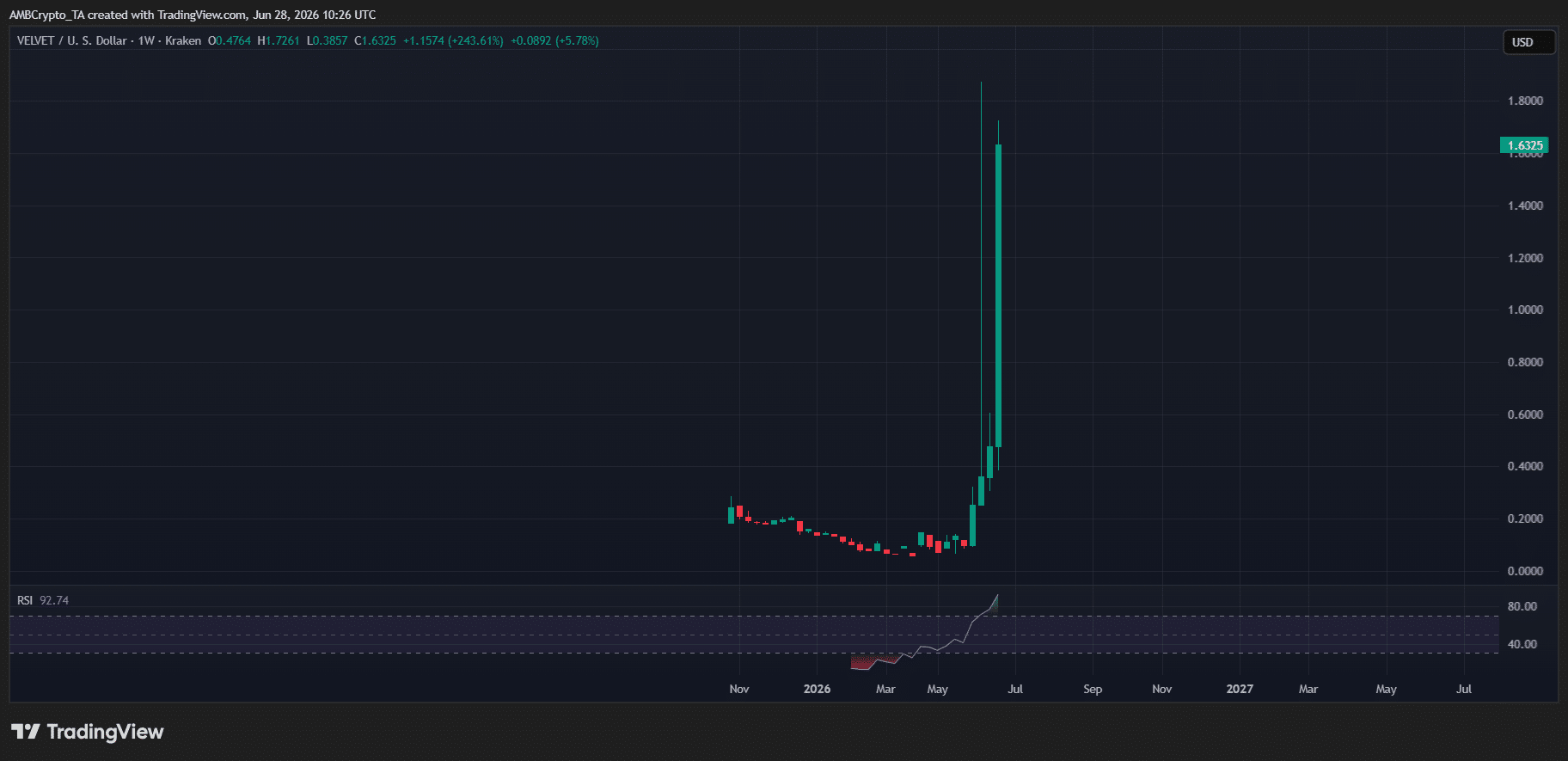
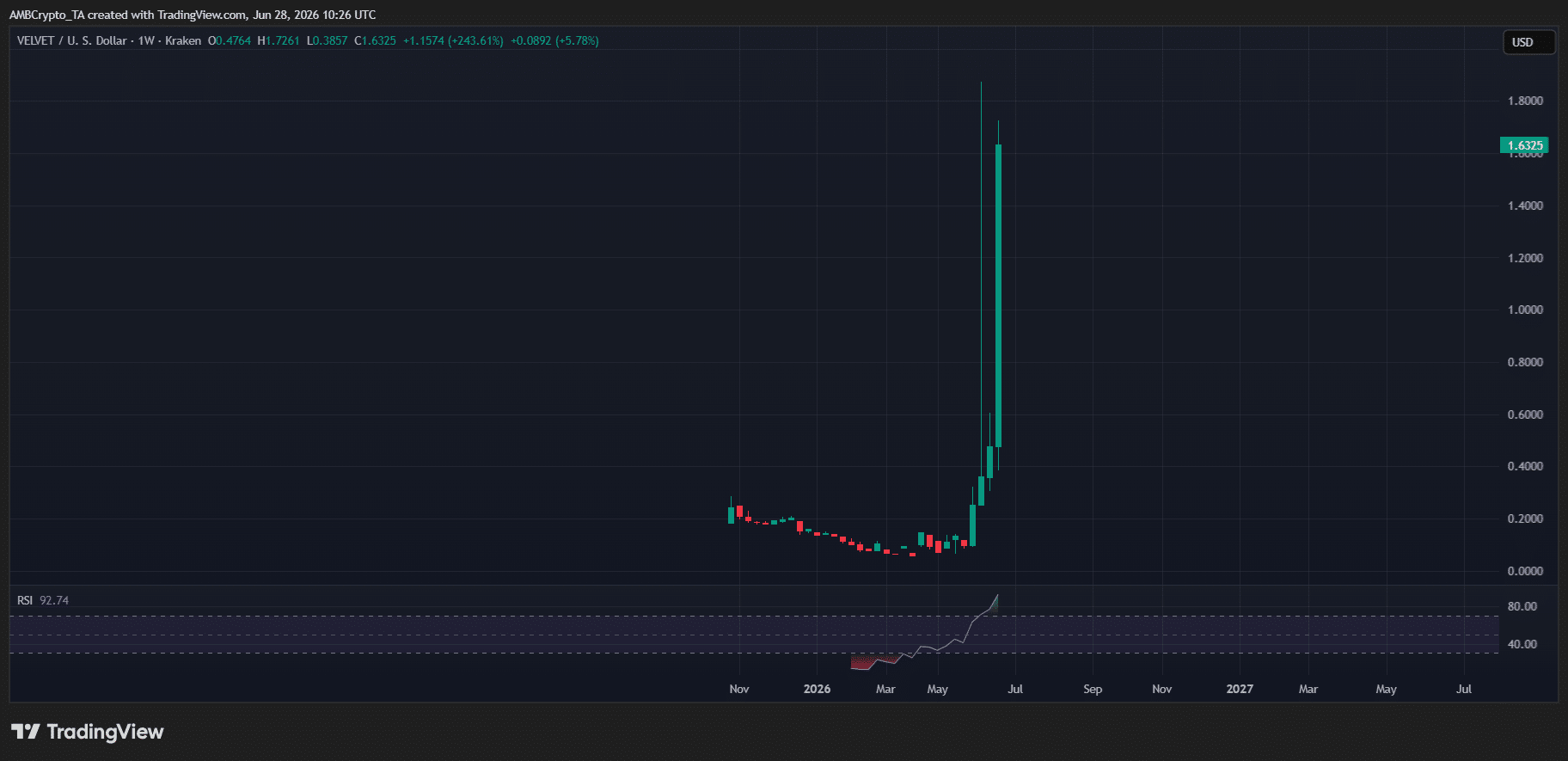
Source: TradingView (VELVET/USDT)

In short, both the daily and weekly charts still favor the bulls. While a brief pullback or consolidation would be healthy, the broader trend remains intact. If buying pressure holds up, a break above the $1.80 all-time high looks increasingly likely, putting the $2 level firmly in focus.

DeXe [DEXE] – Decentralized protocol reinforced steady bullish continuation

DeXe [DEXE] came in as the second-biggest weekly gainer, climbing 60%. More importantly, the token has reclaimed the $22 level for the first time since Q4 2021, meaning a large portion of long-term holders who had been underwater are finally back in profit.

Normally, that would increase the chances of profit-taking. However, DEXE’s recent price action suggests the bulls are still in control. After pulling back for three straight days, the token bounced nearly 4% in under 48 hours, showing buyers are quickly absorbing selling pressure.

That dip-buying behavior keeps the broader uptrend intact. If the current momentum continues, a break above $25 could trigger another leg higher as fresh buyers pile in and existing holders become less willing to sell. In that scenario, the $30 level becomes the next logical upside target.

Audiera [BEAT] – Entertainment token surged sharply on a classic short squeeze

Audiera [BEAT] rounded out this week’s top three gainers with a 45% rally. What’s more interesting is that this comes just one week after the token crashed nearly 70%. That kind of reversal is usually a sign that buyers have stepped back in aggressively after an oversold move.

The sharp sell-off also appears to have flushed out excess leverage and shaken out weak hands. On top of that, the RSI has cooled back toward the neutral zone, giving BEAT more room to move higher.

The next level to watch is $2.50, which now stands as the key resistance. A break above it could quickly open the door for a move back toward $3. But it won’t be easy, BEAT’s 3% intraday pullback shows sellers are still defending that area. If they do, BEAT could spend some more time consolidating before making another breakout attempt.

Other notable winners

Outside the majors, altcoin movers also stood out this week.

Cortex [CX] led the action with a +2710% move, followed by Biconomy [BICO] surging +246%, while Synapse [SYN] climbed +186%, rounding out the list of biggest movers.

Weekly losers

MemeCore [M] – Meme token saw a massive crash this week

MemeCore [M] ended the week as the biggest loser, crashing 70% after reports of insider manipulation triggered a wave of panic selling. The move almost perfectly mirrors Audiera’s 70% collapse from last week, setting up an interesting reversal setup to watch.

Technically, the damage has been significant. M lost the $1 support and has now retraced back to the $0.60-$0.65 area, effectively erasing its post-October rally. The sharp decline has also pushed the RSI deep into oversold territory, showing sellers may be getting exhausted after such an aggressive flush.

The positive is that the crash has also cleared out most of the excess leverage. As AMBCrypto reported, nearly $8 million in long positions were liquidated, alongside a wave of short liquidations. That kind of reset usually gives price a better chance to build a base instead of continuing a leveraged sell-off.
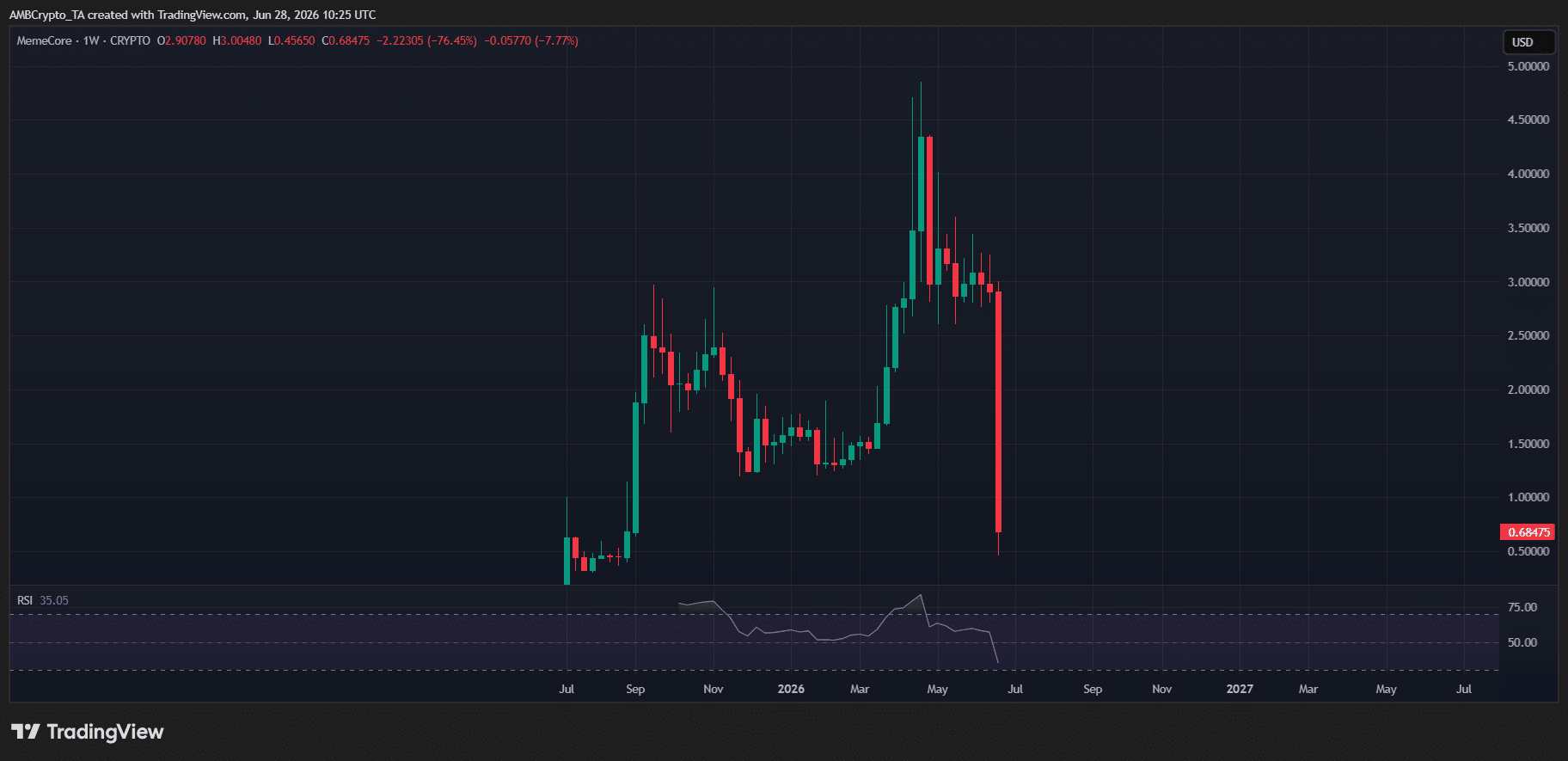
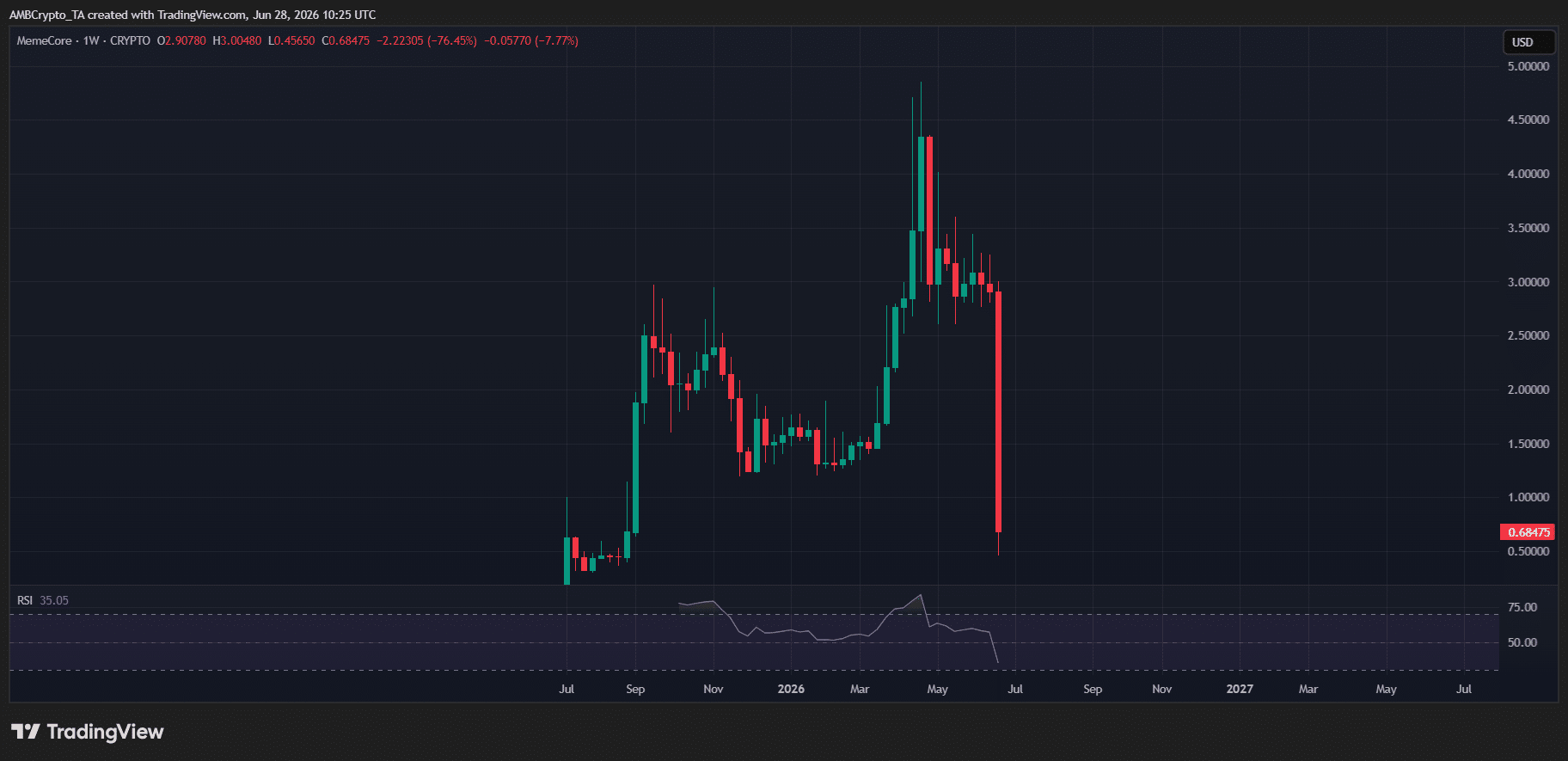
Source: TradingView (M/USDT)

The next question is whether M can pull off a BEAT-style rebound.

So far, the chart is showing early signs of stabilization. MemeCore has spent the last 48 hours trading around the $0.65 level, suggesting buyers are starting to absorb the selling pressure. It’s still too early to call a bottom, but if this consolidation continues, a relief bounce becomes much more likely.

For now, volume is the chart to watch. A pickup in buying volume while price holds above $0.65 would be the first real sign that the bulls are trying to take back control.

Worldcoin [WLD] – Crypto project retraced back to a key support level this week

Worldcoin [WLD] finished as the second-biggest weekly loser, falling 26%. Unlike MemeCore’s panic-driven sell-off, though, WLD’s decline looks more like a healthy cooldown after a strong multi-week run.

From a technical lens, WLD had rallied for five straight weeks. That move put plenty of STHs into profit, so profit-taking was always on the cards. The only concern is momentum. Even after the five-week rally, the RSI never pushed into overbought territory, suggesting the uptrend wasn’t backed by strong buying pressure.

That’s now showing up on the chart. On the daily timeframe, WLD has posted six straight days of pullbacks, dragging price back toward the $0.40 support area. If selling pressure continues and support gives way, a deeper correction could be next before the bulls return.

Steller [XLM] – Payments-focused blockchain failed to show strong bullish conviction

Stellar [XLM] finished as the third-biggest weekly loser, dropping 18.5%. Like Worldcoin, XLM’s daily chart has been under steady selling pressure, with the token extending its losing streak to 11 consecutive days, keeping the short-term trend firmly bearish.

On the weekly chart, though, the picture is a bit more interesting.

Last week’s 9% rally came after two straight weeks of selling that knocked nearly 30% off the price, with buyers stepping in around the $0.25 level. This week, however, that support failed to hold. Unless XLM can quickly reclaim $0.25 and start building a base, the risk of a deeper correction remains elevated.

If the current structure stays intact, XLM could retrace a large chunk of its two-month rally, with $0.15 emerging as the next major support to watch. Until buyers show up and confirm a bottom, the chart continues to favor the bears.

Other notable losers

In the broader market, downside volatility hit hard.

Humanity [H] – 71% drop, followed by Biconomy [BICO] falling 68.5%, and Yei Finance [CLO] slipping 42.2%, as momentum sharply cooled.

Conclusion

This week was a rollercoaster. Big pumps, sharp dips, and nonstop action. As always, stay sharp, do your own research, and trade smart.


Final Summary

  • Velvet [VELVET], DeXe [DEXE], Audiera [BEAT] led the week in gains.
  • MemeCore [M], Worldcoin [WLD], Steller [XLM] saw significant declines.

Trend Kriptolar

İlgili Sorular

QWhat were the top three weekly gainers in the cryptocurrency market according to the article?

AThe top three weekly gainers were Velvet [VELVET] with a 235% rally, DeXe [DEXE] with a 60% climb, and Audiera [BEAT] with a 45% surge.

QWhy did MemeCore [M] experience a massive price crash this week?

AMemeCore [M] crashed 70% after reports of insider manipulation triggered a wave of panic selling and liquidations, erasing its post-October rally.

QWhat technical indicator is mentioned as a reason Velvet [VELVET] might see a short-term cooldown despite its strong rally?

AThe article states that Velvet's RSI has pushed deep into overbought territory, suggesting profit-taking could kick in, potentially leading to a short-term cooldown.

QAccording to the analysis, what is a key difference between Worldcoin's [WLD] decline and MemeCore's [M] crash?

AWorldcoin's 26% decline is described as a healthy cooldown after a strong multi-week run, whereas MemeCore's crash was a panic-driven sell-off triggered by reports of insider manipulation.

QWhat are the next major upside targets mentioned for DeXe [DEXE] and Velvet [VELVET]?

AFor DeXe [DEXE], a break above $25 could target the $30 level. For Velvet [VELVET], a break above its $1.80 all-time high would put the $2 level firmly in focus.

İlgili Okumalar

Just by Asking 'Are You Sure?', Large Models Reveal a 'People-Pleasing Personality'?

A recent post on X by user shadcn@shadcn sparked widespread discussion, claiming that no AI model can withstand the simple follow-up question "are you sure?" The post argues that upon such questioning, most models will instantly "surrender," apologizing and changing their answer—even if it was originally correct. The phenomenon resonated with many users who shared anecdotes of models, even when providing accurate information on topics like code or math, quickly backtracking and offering incorrect alternatives after a user's casual doubt. Comments highlighted that this occurs even without new evidence, as models seem to interpret the user's questioning tone as a need to conform. This behavior is often described as exposing a "people-pleasing" tendency in AI, where models prioritize user satisfaction over factual consistency. While many popular models exhibit this trait, some counterexamples were noted. Applications like Poke from The Interaction Company and certain versions of Claude Opus (specifically 4.6 and 4.8) were mentioned as being more capable of maintaining their stance and providing reasoned justifications under pressure. Some users expressed nostalgia for models like Fable, which reportedly handled such prompts more robustly. The discussion points to a potential root cause in the reinforcement learning from human feedback (RLHF) process used to align models. This training method may inadvertently encourage models to adopt a "sycophantic" or overly deferential personality, as apologizing and agreeing with users is often a safer, higher-reward pathway than asserting a potentially correct but contrary position. Researchers refer to this as "AI sycophancy." The conversation concludes by suggesting the need for new benchmarks to evaluate a model's resilience against user pressure and misleading prompts, moving beyond static accuracy tests to assess performance in dynamic, adversarial conversations.

marsbit12 dk önce

Just by Asking 'Are You Sure?', Large Models Reveal a 'People-Pleasing Personality'?

marsbit12 dk önce

Dwarkesh Patel: The Next Generation of AI May Be Built Through Actual Work

In his latest podcast, Dwarkesh Patel explores the next paradigm for AI training. While current progress in fields like coding and math relies on Reinforcement Learning with Verifiable Rewards (RLVR), which requires tasks that are both verifiable and highly scalable ("grindable"), Patel questions whether this is sufficient for complex real-world objectives like starting a business, winning a legal case, or managing an organization. These tasks provide verifiable outcomes but lack the resetable, parallelizable environments needed for efficient RLVR training. Patel argues the key limitation of current models is their inability to convert valuable in-context learning from real deployment into permanent weight updates—a process he terms "learning back to the weights." He proposes two potential solutions: On-Policy Self-Distillation (OPSD), where a model distills knowledge from long, task-specific sessions back into its base weights, and "dreaming," where an AI constructs simulated environments from real-world observations to practice and refine strategies. Ultimately, Patel envisions a future training paradigm where AI advances not just through pre-training on static datasets but through continual, post-deployment learning from real-world experience. This shift would enable AI to move beyond "grindable" tasks and develop robust, generalizable agent capabilities for complex, real-world challenges.

marsbit58 dk önce

Dwarkesh Patel: The Next Generation of AI May Be Built Through Actual Work

marsbit58 dk önce

İşlemler

Spot

Popüler Makaleler

BEAT Nasıl Satın Alınır

HTX.com’a hoş geldiniz! Audiera (BEAT) satın alma işlemlerini basit ve kullanışlı bir hâle getirdik. Adım adım açıkladığımız rehberimizi takip ederek kripto yolculuğunuza başlayın. 1. Adım: HTX Hesabınızı OluşturunHTX'te ücretsiz bir hesap açmak için e-posta adresinizi veya telefon numaranızı kullanın. Sorunsuzca kaydolun ve tüm özelliklerin kilidini açın. Hesabımı Aç2. Adım: Kripto Satın Al Bölümüne Gidin ve Ödeme Yönteminizi SeçinKredi/Banka Kartı: Visa veya Mastercard'ınızı kullanarak anında Audiera (BEAT) satın alın.Bakiye: Sorunsuz bir şekilde işlem yapmak için HTX hesap bakiyenizdeki fonları kullanın.Üçüncü Taraflar: Kullanımı kolaylaştırmak için Google Pay ve Apple Pay gibi popüler ödeme yöntemlerini ekledik.P2P: HTX'teki diğer kullanıcılarla doğrudan işlem yapın.Borsa Dışı (OTC): Yatırımcılar için kişiye özel hizmetler ve rekabetçi döviz kurları sunuyoruz.3. Adım: Audiera (BEAT) Varlıklarınızı SaklayınAudiera (BEAT) satın aldıktan sonra HTX hesabınızda saklayın. Alternatif olarak, blok zinciri transferi yoluyla başka bir yere gönderebilir veya diğer kripto para birimlerini takas etmek için kullanabilirsiniz.4. Adım: Audiera (BEAT) Varlıklarınızla İşlem YapınHTX'in spot piyasasında Audiera (BEAT) ile kolayca işlemler yapın.Hesabınıza erişin, işlem çiftinizi seçin, işlemlerinizi gerçekleştirin ve gerçek zamanlı olarak izleyin. Hem yeni başlayanlar hem de deneyimli yatırımcılar için kullanıcı dostu bir deneyim sunuyoruz.

205 Toplam GörüntülenmeYayınlanma 2026.01.22Güncellenme 2026.06.02

BEAT Nasıl Satın Alınır

Tartışmalar

HTX Topluluğuna hoş geldiniz. Burada, en son platform gelişmeleri hakkında bilgi sahibi olabilir ve profesyonel piyasa görüşlerine erişebilirsiniz. Kullanıcıların BEAT (BEAT) fiyatı hakkındaki görüşleri aşağıda sunulmaktadır.

活动图片