Crypto Lender Nexo Returns To US Market After Three-Year Hiatus And $45 Million Fine

bitcoinist2026-02-17 tarihinde yayınlandı2026-02-17 tarihinde güncellendi

Özet

Crypto lender Nexo has officially returned to the US market after a three-year hiatus and a $45 million settlement with the SEC. The company withdrew in 2023 following charges related to an unregistered crypto lending product. Its relaunch features a new compliance-focused structure, including partnerships with regulated entities like Bakkt to offer investment products, yield programs, and crypto-backed credit lines within a US regulatory framework. Nexo denied that its return is connected to past interactions with the Trump family, stating the decision was based solely on its ability to operate compliantly.

Crypto lender Nexo has officially reentered the United States market, marking a return three years after it withdrew operations and paid a $45 million fine to settle charges with the US Securities and Exchange Commission (SEC).

The company confirmed on Monday that 2026 represents its formal comeback to the US, positioning the move against a backdrop of more crypto-friendly policies and a notable shift in regulatory tone at the SEC.

New SEC-Compliant Structure, Bakkt Partnership

Nexo previously exited the country following regulatory clashes that culminated in a 2023 SEC order over “unregistered offering” of a crypto asset lending product. As part of that settlement, the company agreed to discontinue the product for US investors.

In a statement to Reuters, a Nexo spokesperson emphasized that the firm complied fully with the order. “Nexo discontinued the product covered by the 2023 SEC order for US investors as required,” the spokesperson said.

The company’s renewed US strategy is structured differently from its earlier model. According to Nexo’s Monday disclosure, the relaunch is being carried out through partnerships with regulated entities to ensure compliance with American securities laws.

The firm said its investment and credit products are now delivered within a US-compliant framework, including, where applicable, through an SEC-registered investment adviser for advisory services.

As part of this relaunch, Nexo has also partnered with Bakkt, a publicly traded US-based digital asset platform designed to support institutional-grade risk management and regulatory compliance.

The company’s updated offering includes flexible and fixed-term yield programs that allow clients to earn returns through investment structures. Nexo is also rolling out an integrated exchange, enabling users to buy and sell digital assets.

In addition, the firm is reintroducing crypto-backed credit lines, allowing customers to access liquidity without selling their digital holdings. These credit products feature flexible repayment options and support multiple forms of collateral.

Nexo Denies Trump Family Ties

Nexo’s return comes amid broader political and regulatory developments in the United States. Reuters reported that the company hosted Donald Trump Jr at a “Trump Business Vision 2025” event held in Sofia, Bulgaria, last April.

The event has drawn attention, given increased scrutiny surrounding crypto-related business dealings connected to the Trump family under the current administration.

When asked by Reuters about the relationship between those interactions and the company’s US relaunch, Nexo denied any connection. The spokesperson stated that the decision to return to the American market was “based on our ability to offer products in a compliant structure” and was unrelated to its contacts with the Trump family.

The company further clarified that its sports sponsorships and event participation have no bearing on its regulatory standing or operational approval in the United States.

The daily chart shows the total crypto market cap at $2.3 trillion. Source: TOTAL on TradingView.com

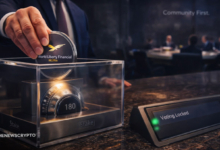
Featured image from OpenArt, chart from TradingView.com

İlgili Sorular

QWhy did Nexo pay a $45 million fine to the SEC in 2023?

ANexo paid a $45 million fine to settle charges with the SEC over the 'unregistered offering' of a crypto asset lending product.

QHow is Nexo's new US strategy structured to ensure compliance?

ANexo's renewed US strategy is being carried out through partnerships with regulated entities, including an SEC-registered investment adviser, and operates within a US-compliant framework to ensure adherence to American securities laws.

QWhich US-based digital asset platform has Nexo partnered with for its relaunch?

ANexo has partnered with Bakkt, a publicly traded US-based digital asset platform, to support institutional-grade risk management and regulatory compliance.

QWhat was the reason Nexo gave for its decision to return to the US market, and what did it deny influenced this decision?

ANexo stated that the decision to return was 'based on our ability to offer products in a compliant structure' and denied that it was related to its contacts with the Trump family.

QWhat are the three main products Nexo is offering in its US relaunch?

ANexo is offering flexible and fixed-term yield programs, an integrated exchange for buying and selling digital assets, and crypto-backed credit lines with flexible repayment options.

İlgili Okumalar

L1 Value Capture Shrinks Significantly, ETH, SOL, HYPE Struggle to Return to Price Peaks

The article "L1 Value Capture Shrinks Significantly: ETH, SOL, HYPE Struggle to Return to Price Peaks" argues that Layer-1 blockchains face a structural, not cyclical, problem: their ability to capture value through transaction fees is systematically eroded by innovation. Historically, periods of high demand (e.g., Bitcoin congestion, Ethereum's DeFi Summer, Solana's memecoin frenzy) create fee revenue peaks. However, these peaks inevitably stimulate the creation of cheaper alternatives that siphon away this income. The core finding is that open, permissionless networks cannot sustain high fee revenues; profitability is consistently competed away. **Key Examples:** * **Bitcoin:** Fee spikes from congestion (2017, 2021) were quickly mitigated by innovations like SegWit, batching, the Lightning Network, and wrapped BTC. The 2024-2025 bull run saw minimal fee growth despite a 3x price increase, with ETFs providing massive BTC exposure without on-chain fees. * **Ethereum:** The 2020-2021 fee boom from DeFi and NFTs was dismantled by competing L1s and, crucially, its own L2 scaling solutions. The Dencun upgrade (EIP-4844) drastically reduced data costs for L2s, causing Ethereum's L1 fee revenue to collapse by over 95% from its peak. * **Solana:** Its revenue relies heavily on MEV/tips from volatile memecoin trading. This income is now being compressed by private AMMs (which hide liquidity to prevent MEV) and platforms like Hyperliquid, which are moving the most profitable price discovery activity off-chain. **Impact on Token Valuation:** The market is shifting from valuing L1s based on "on-chain profit" to "asset narratives" and "structural capital flows." The analysis suggests: * **ETH:** Now resembles a low-yield infrastructure asset. Its fee compression is structural and ongoing. * **SOL:** While network activity may hit new highs, its matured fee-capturing mechanisms mean MEV revenue is unlikely to return to previous peaks, making a new all-time high price difficult. * **HYPE (Hyperliquid):** Currently benefits from high fees on its perp DEX. However, its fee model is under immense pressure to compress towards traditional finance (TradFi) rates (e.g., CME), threatening its projected high earnings and potentially its token price. * **BTC:** Its security model is unique and inverted. It relies almost entirely on block subsidies, not fees. Miner survival post-halving depends entirely on the USD price of BTC doubling to offset the 50% reduction in BTC-denominated rewards, making long-term security precariously tied to perpetual price appreciation.

marsbit15 dk önce

L1 Value Capture Shrinks Significantly, ETH, SOL, HYPE Struggle to Return to Price Peaks

marsbit15 dk önce

L1 Value Capture Shrinks Significantly, ETH, SOL, HYPE Struggle to Return to Price Peaks

This analysis examines the structural decline in fee-based revenue capture by Layer 1 (L1) blockchains, arguing that high transaction fees are systematically eroded by innovation, making them unsustainable as a primary valuation driver. Bitcoin’s fee spikes during congestion periods (e.g., 2017 and 2021 rallies) were rapidly mitigated by scaling solutions like SegWit, batching, and the Lightning Network. By 2025, daily fees fell to just $300k, under 1% of miner revenue, despite higher USD transaction volumes. Ordinals and Runes provided brief fee surges but were short-lived. Ethereum’s DeFi and NFT booms drove quarterly fees to $4.3 billion in late 2021. However, competing L1s and L2 rollups (e.g., Arbitrum, Optimism) diverted activity. The Dencun upgrade (EIP-4844) drastically reduced data costs for L2s, causing Ethereum’s L1 fee revenue to collapse by over 90% from its peak, falling below $15 million per quarter by late 2025. Solana’s revenue relies heavily on MEV and priority fees from memecoin trading, which peaked in early 2025. However, private AMMs (e.g., HumidiFi) and off-chain order flow (e.g., Hyperliquid’s HyperCore) have captured over 50% of DEX volume, reducing Solana’s MEV fees by more than 90% from their January 2025 highs. Hyperliquid currently dominates perps trading, earning $600 million in 2025, but its fee model (4.5 bps per trade) is vastly more expensive than traditional finance (e.g., CME). As institutional adoption grows, pressure to compress fees will intensify, challenging its token valuation. The report concludes that L1 tokens are increasingly weak as fee-capturing assets. Valuation drivers have shifted toward staking yields, ETF flows, RWA narratives, and macro liquidity—factors more tied to speculative demand than fundamental utility. Bitcoin remains an exception: its security depends not on fees but on continuous price appreciation to offset halvings, making its model uniquely fragile and narrative-dependent.

Odaily星球日报22 dk önce

L1 Value Capture Shrinks Significantly, ETH, SOL, HYPE Struggle to Return to Price Peaks

Odaily星球日报22 dk önce

Huobi Growth Academy | Crypto Market Macro Report: Repricing of Crypto Assets Amid Receding Liquidity

In Q1 2026, the cryptocurrency market experienced a historic deleveraging crash, with Bitcoin falling over 40% from its peak and Ethereum and altcoins declining even more sharply. The collapse was driven by a confluence of three major liquidity-tightening factors: the unwinding of yen carry trades, the U.S. Treasury's TGA account rebuild draining market liquidity, and systemic increases in derivatives margin requirements. These factors, combined with the crypto market’s inherent high leverage and overvaluation, triggered a cascading sell-off. The report highlights that U.S. stock market’s extreme valuations acted as a ceiling for risk assets, including crypto. The reversal of yen carry trades—where investors borrowed cheap yen to invest in higher-yielding assets like crypto—accelerated as the Bank of Japan signaled a potential end to ultra-loose policies. Simultaneously, the U.S. Treasury’s replenishment of its TGA account and increased bond issuance withdrew nearly $200 billion in liquidity from financial markets. Additionally, rising margin requirements on derivatives exchanges forced further deleveraging, exacerbating the downturn. Crypto’s structural vulnerabilities—such as high leverage, stagnant stablecoin inflows, and declining on-chain activity—amplified the sell-off. Looking ahead, crypto markets are entering a macro-driven phase where liquidity indicators—such as Fed policy, TGA balances, yen-USD exchange rates, and stablecoin flows—will be critical. The market is expected to remain under pressure until macro liquidity conditions improve, likely in the second half of 2026. The era of excess-liquidity-driven growth is over; crypto assets will now be repriced under a new macro-normal regime.

marsbit50 dk önce

Huobi Growth Academy | Crypto Market Macro Report: Repricing of Crypto Assets Amid Receding Liquidity

marsbit50 dk önce

İşlemler

Spot
Futures

Popüler Makaleler

NEXO Nasıl Satın Alınır

HTX.com’a hoş geldiniz! Nexo (NEXO) satın alma işlemlerini basit ve kullanışlı bir hâle getirdik. Adım adım açıkladığımız rehberimizi takip ederek kripto yolculuğunuza başlayın. 1. Adım: HTX Hesabınızı OluşturunHTX'te ücretsiz bir hesap açmak için e-posta adresinizi veya telefon numaranızı kullanın. Sorunsuzca kaydolun ve tüm özelliklerin kilidini açın. Hesabımı Aç2. Adım: Kripto Satın Al Bölümüne Gidin ve Ödeme Yönteminizi SeçinKredi/Banka Kartı: Visa veya Mastercard'ınızı kullanarak anında Nexo (NEXO) satın alın.Bakiye: Sorunsuz bir şekilde işlem yapmak için HTX hesap bakiyenizdeki fonları kullanın.Üçüncü Taraflar: Kullanımı kolaylaştırmak için Google Pay ve Apple Pay gibi popüler ödeme yöntemlerini ekledik.P2P: HTX'teki diğer kullanıcılarla doğrudan işlem yapın.Borsa Dışı (OTC): Yatırımcılar için kişiye özel hizmetler ve rekabetçi döviz kurları sunuyoruz.3. Adım: Nexo (NEXO) Varlıklarınızı SaklayınNexo (NEXO) satın aldıktan sonra HTX hesabınızda saklayın. Alternatif olarak, blok zinciri transferi yoluyla başka bir yere gönderebilir veya diğer kripto para birimlerini takas etmek için kullanabilirsiniz.4. Adım: Nexo (NEXO) Varlıklarınızla İşlem YapınHTX'in spot piyasasında Nexo (NEXO) ile kolayca işlemler yapın.Hesabınıza erişin, işlem çiftinizi seçin, işlemlerinizi gerçekleştirin ve gerçek zamanlı olarak izleyin. Hem yeni başlayanlar hem de deneyimli yatırımcılar için kullanıcı dostu bir deneyim sunuyoruz.

111 Toplam GörüntülenmeYayınlanma 2024.12.11Güncellenme 2025.03.21

Tartışmalar

HTX Topluluğuna hoş geldiniz. Burada, en son platform gelişmeleri hakkında bilgi sahibi olabilir ve profesyonel piyasa görüşlerine erişebilirsiniz. Kullanıcıların NEXO (NEXO) fiyatı hakkındaki görüşleri aşağıda sunulmaktadır.

活动图片