Crypto among sectors ‘debanked’ by 9 major banks: US regulator

cointelegraph2025-12-11 tarihinde yayınlandı2025-12-11 tarihinde güncellendi

Özet

According to preliminary findings from the U.S. Office of the Comptroller of the Currency (OCC), nine major U.S. banks restricted financial services to politically contentious industries—including cryptocurrency—between 2020 and 2023. The OCC stated that these banks made “inappropriate distinctions” among customers based on lawful business activities, either by implementing restrictive policies or requiring escalated reviews. Sectors affected were crypto, oil and gas, firearms, private prisons, and others. Crypto businesses faced limitations often tied to financial crime concerns. The OCC is continuing its review and may refer findings to the Justice Department. Critics argue the report overlooks regulatory pressure from agencies like the FDIC that contributed to debanking.

The nine largest US banks restricted financial services to politically contentious industries, including cryptocurrency, between 2020 and 2023, according to the preliminary findings of the Office of the Comptroller of the Currency (OCC).

The banking regulator said on Wednesday that its early findings show that major banks “made inappropriate distinctions among customers in the provision of financial services on the basis of their lawful business activities” across the three-year period.

The banks either implemented policies restricting access to banking or required escalated reviews and approvals before giving financial services to certain customers, the OCC said, without giving specific details.

The OCC initiated its review after President Donald Trump signed an executive order in August, directing a review of whether banks had debanked or discriminated against individuals based on their political or religious beliefs.

Crypto issuers and exchanges caught in restrictions

The OCC’s report found that in addition to crypto, the sectors that faced banking restrictions included oil and gas exploration, coal mining, firearms, private prisons, tobacco and e-cigarette manufacturers and adult entertainment.

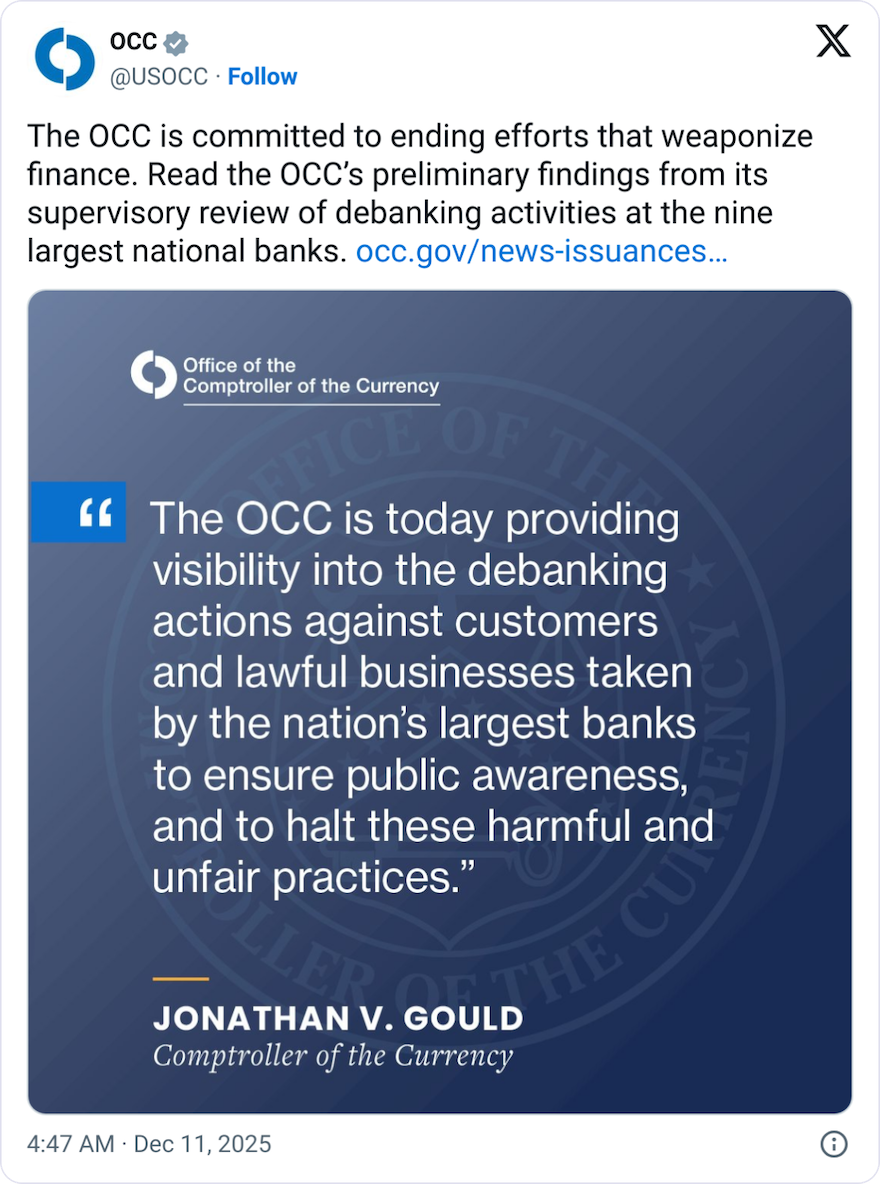
Banks’ actions toward crypto included restrictions on “issuers, exchanges, or administrators, often attributed to financial crime considerations,” the OCC said.
Source: OCC

“It is unfortunate that the nation’s largest banks thought these harmful debanking policies were an appropriate use of their government-granted charter and market power,” said Comptroller of the Currency Jonathan Gould.

“While many of these policies were undertaken in plain sight and even announced publicly, certain banks have continued to insist that they did not engage in debanking,” he added.

The OCC examined JPMorgan Chase, Bank of America, Citibank, Wells Fargo, US Bank, Capital One, PNC Bank, TD Bank, and BMO Bank, the largest national banks it regulates.

The OCC reported that it is continuing its investigation and could refer its findings to the Justice Department.

OCC debanking report leaves “much to be desired”

Nick Anthony, a policy analyst at the libertarian think tank Cato Institute, said in an emailed statement to Cointelegraph that the OCC’s report “leaves much to be desired” and didn’t mention “the most well-known causes of debanking.”

“The report criticizes banks for severing ties with controversial clients, but it fails to mention that regulators explicitly assess banks on their reputation,” he said.

Related: ‘Grow up... We debank Democrats, we debank Republicans:’ JPMorgan CEO

“Making matters worse, the report appears to blame banks for cutting ties with cryptocurrency companies, yet makes no mention of the fact that the [Federal Deposit Insurance Corporation] explicitly told banks to stay away from these companies,” Anthony added.

Republicans on the House Finance Committee reported earlier this month that the FDIC’s so-called “pause letters” it sent to banks under the Biden administration helped to spur “the debanking of the digital asset ecosystem.”

Caitlin Long, the founder and CEO of the crypto-focused Custodia Bank, said the “worst culprits” of crypto-related debanking under the Biden administration were the FDIC and Federal Reserve, “not OCC.”

“In OCC’s defense, this report covers large banks only. Crushing crypto wasn’t a supervisory priority for large banks like it was for small [and] mid-sized banks,” she added.

Magazine: Quitting Trump’s top crypto job wasn’t easy: Bo Hines

İlgili Okumalar

GitHub Empire on the Brink of Collapse: Source Code Leak, 18-Year Veteran Leaves, Microsoft Loses 1.5 Billion Developers

GitHub is facing an unprecedented crisis, marked by a massive exodus of developers and severe operational failures. The tipping point came when Mitchell Hashimoto, creator of Ghostty and an 18-year GitHub user, publicly severed ties, citing persistent platform outages that made serious work impossible. This departure highlights a broader pattern of user frustration. The platform's instability has drawn complaints from major corporate clients like Citibank and Intel, forcing Microsoft to issue substantial service credits. A critical incident last month saw an accidentally triggered, unreleased feature cause widespread repository rollbacks, erasing recent code changes and pushing enterprises to migrate. Security has catastrophically breached. In May 2026, hackers infiltrated over 3,800 of GitHub's internal repositories via a poisoned VS Code extension installed by a developer, leading to the attempted sale of core source code for $50,000. This follows the discovery of a critical zero-day vulnerability in March that threatened access to millions of repositories. Internally, GitHub's autonomy has collapsed. After the resignation of CEO Thomas Dohmke in mid-2025, Microsoft eliminated the CEO role, folding GitHub into its CoreAI division under the unpopular leadership of Jay Parikh. This triggered a talent drain, with key executives and engineers leaving. A disruptive migration of GitHub's infrastructure to Azure servers, pushed by CTO Vladimir Fedorov, is blamed for the recurring outages. Competitively, GitHub Copilot is under "existential threat" from superior AI coding tools like Cursor (now owned by SpaceX) and Claude Code, which offer more advanced contextual coding and automation. Ironically, Microsoft's own engineers reportedly preferred Claude Code, forcing management to revoke licenses. Financially, GitHub is a loss leader. Despite Copilot surpassing 4.7 million paid users and $3 billion in annual revenue, the AI inference costs for free services massively outstrip subscription income, hurting Microsoft's cloud margins. The recent shift from a flat fee to a pay-as-you-go model for Copilot has further alienated developers. The core question for Microsoft is whether a centralized code repository remains essential in the AI agent era. The erosion of trust, developer culture, and platform reliability threatens the very ecosystem Microsoft spent decades building.

marsbit1 saat önce

GitHub Empire on the Brink of Collapse: Source Code Leak, 18-Year Veteran Leaves, Microsoft Loses 1.5 Billion Developers

marsbit1 saat önce

SEC Promotes Tokenized Stocks, Is the Traditional Finance Industry Starting to Worry?

The U.S. Securities and Exchange Commission (SEC) is preparing to formally release an "innovation exemption" framework this week. This framework would allow third parties to tokenize U.S. stocks like Apple and Tesla without approval from the listed companies. The move, rooted in a deregulatory vision proposed by pro-crypto commissioners earlier this year, could accelerate the migration of traditional stock markets to blockchain. This development poses a structural threat of "fragmentation" to traditional finance. Core concerns are liquidity fragmentation—where trading volume disperses across multiple blockchains and platforms, leading to price disparities and reduced market efficiency—and revenue fragmentation—where trading fees and intermediary income shift away from domestic exchanges to overseas or competing platforms. The report compares the traditional stock market to a monopolistic "supermarket." Tokenization enables countless "street stalls" to operate outside this system, threatening the exchange's dominance, diluting liquidity for large orders, and slicing into revenue streams. Evidence of this capital fragmentation is already emerging. On the same day the SEC signaled the framework, decentralized platform Hyperliquid saw its RWA (real-world asset) open interest hit a record $2.6 billion, driven by demand for 24/7 on-chain trading of traditional assets. Traditional institutions face a dilemma: either collaborate to build tokenization infrastructure proactively or lobby regulators to block innovation. Regulators must balance controlling the pace of innovation with preventing domestic revenue from being captured by offshore platforms. Key future battles will revolve around defining shareholder rights for tokenized assets and regulating platforms that have grown in regulatory gray areas. In the digital asset era, inaction risks the permanent loss of long-held fee monopolies and financial leadership as capital continues to disperse.

marsbit2 saat önce

SEC Promotes Tokenized Stocks, Is the Traditional Finance Industry Starting to Worry?

marsbit2 saat önce

İşlemler

Spot
Futures

Popüler Makaleler

US Nasıl Satın Alınır

HTX.com’a hoş geldiniz! Talus Network (US) satın alma işlemlerini basit ve kullanışlı bir hâle getirdik. Adım adım açıkladığımız rehberimizi takip ederek kripto yolculuğunuza başlayın. 1. Adım: HTX Hesabınızı OluşturunHTX'te ücretsiz bir hesap açmak için e-posta adresinizi veya telefon numaranızı kullanın. Sorunsuzca kaydolun ve tüm özelliklerin kilidini açın. Hesabımı Aç2. Adım: Kripto Satın Al Bölümüne Gidin ve Ödeme Yönteminizi SeçinKredi/Banka Kartı: Visa veya Mastercard'ınızı kullanarak anında Talus Network (US) satın alın.Bakiye: Sorunsuz bir şekilde işlem yapmak için HTX hesap bakiyenizdeki fonları kullanın.Üçüncü Taraflar: Kullanımı kolaylaştırmak için Google Pay ve Apple Pay gibi popüler ödeme yöntemlerini ekledik.P2P: HTX'teki diğer kullanıcılarla doğrudan işlem yapın.Borsa Dışı (OTC): Yatırımcılar için kişiye özel hizmetler ve rekabetçi döviz kurları sunuyoruz.3. Adım: Talus Network (US) Varlıklarınızı SaklayınTalus Network (US) satın aldıktan sonra HTX hesabınızda saklayın. Alternatif olarak, blok zinciri transferi yoluyla başka bir yere gönderebilir veya diğer kripto para birimlerini takas etmek için kullanabilirsiniz.4. Adım: Talus Network (US) Varlıklarınızla İşlem YapınHTX'in spot piyasasında Talus Network (US) ile kolayca işlemler yapın.Hesabınıza erişin, işlem çiftinizi seçin, işlemlerinizi gerçekleştirin ve gerçek zamanlı olarak izleyin. Hem yeni başlayanlar hem de deneyimli yatırımcılar için kullanıcı dostu bir deneyim sunuyoruz.

282 Toplam GörüntülenmeYayınlanma 2025.12.11Güncellenme 2025.12.11

US Nasıl Satın Alınır

Tartışmalar

HTX Topluluğuna hoş geldiniz. Burada, en son platform gelişmeleri hakkında bilgi sahibi olabilir ve profesyonel piyasa görüşlerine erişebilirsiniz. Kullanıcıların US (US) fiyatı hakkındaki görüşleri aşağıda sunulmaktadır.

活动图片