Polygon Labs announces second round of 2026 layoffs as it targets profitability in 2027

ambcrypto2026-07-16 tarihinde yayınlandı2026-07-16 tarihinde güncellendi

Özet

On July 16, 2026, Polygon Labs CEO Marc Boiron announced the company's second round of layoffs for the year. This move, described as "difficult, but necessary," is part of a strategic shift to transition into a "blockchain-enabled payments company" as it finalizes its acquisition of Coinme. These layoffs mark the fourth workforce reduction since February 2023, following earlier cuts of 60 staff after the $250 million acquisitions of Coinme and Sequence in January 2026. The restructuring aims to support the vision for the Polygon Open Stack, focusing on enabling seamless on-chain money transfers. Polygon Labs clarified its distinction from the Polygon Foundation, which handles network upgrades and the ecosystem. Meanwhile, the native token POL has struggled, down approximately 94% from its all-time high and 56% from a January peak. While some technical indicators showed short-term buying pressure in July, a sustained price recovery is contingent on increased network utility and organic token demand, requiring a move above $0.095 to shift the longer-term bearish trend.

On Thursday, July 16, Polygon Labs [POL] CEO Marc Boiron announced the second round of layoffs for 2026.

Polygon was in the final stages of completing the Coinme acquisition, and this move will help transition the blockchain company towards a “blockchain-enabled payments company”, the CEO wrote in a post on X.
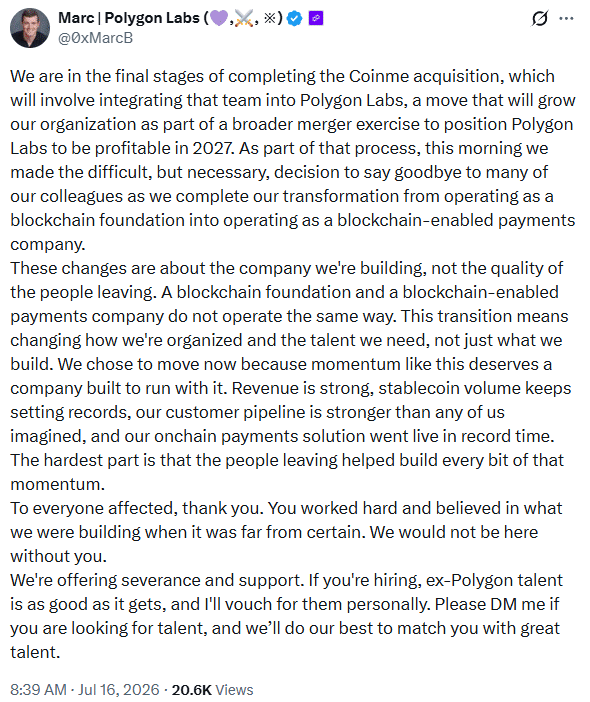
Source: Marc Boiron on X

Hence, the “difficult, but necessary” decision to let people go was made. This was the company’s fourth wave of reductions dating back to February 2023.

Coinme, the crypto exchange, and Sequence, the wallet infrastructure firm, were acquired for $250 million in January 2026. Layoffs of 60 staff members back then had been because the company was pivoting to a payment focused blockchain. They were part of restructuring after the acquisitions, a spokesperson had said.

The vision for the Polygon Open Stack is to enable seamless money transfers onchain, explaining the need for these acquisitions and their integrations.

Specific figures were not shared for Thursday’s layoffs.

The path ahead for POL

It was reported that a Polygon representative observed that the Polygon Labs and Polygon Foundation were legally and structurally distinct entities. The acquisitions and commercial vision of the former has been laid out.

Meanwhile, the Foundation is tasked with network upgrades, treasury, and ecosystem. POL, the network’s native token, was down nearly 94% from its all-time highs. Its holders have no equity and no claim in Polygon Labs’ future profits.

As such, the token’s bearish price action could be set to continue in the long-run, unless network utility picks up, creating more demand and forcing more token burns through the deflationary mechanic.
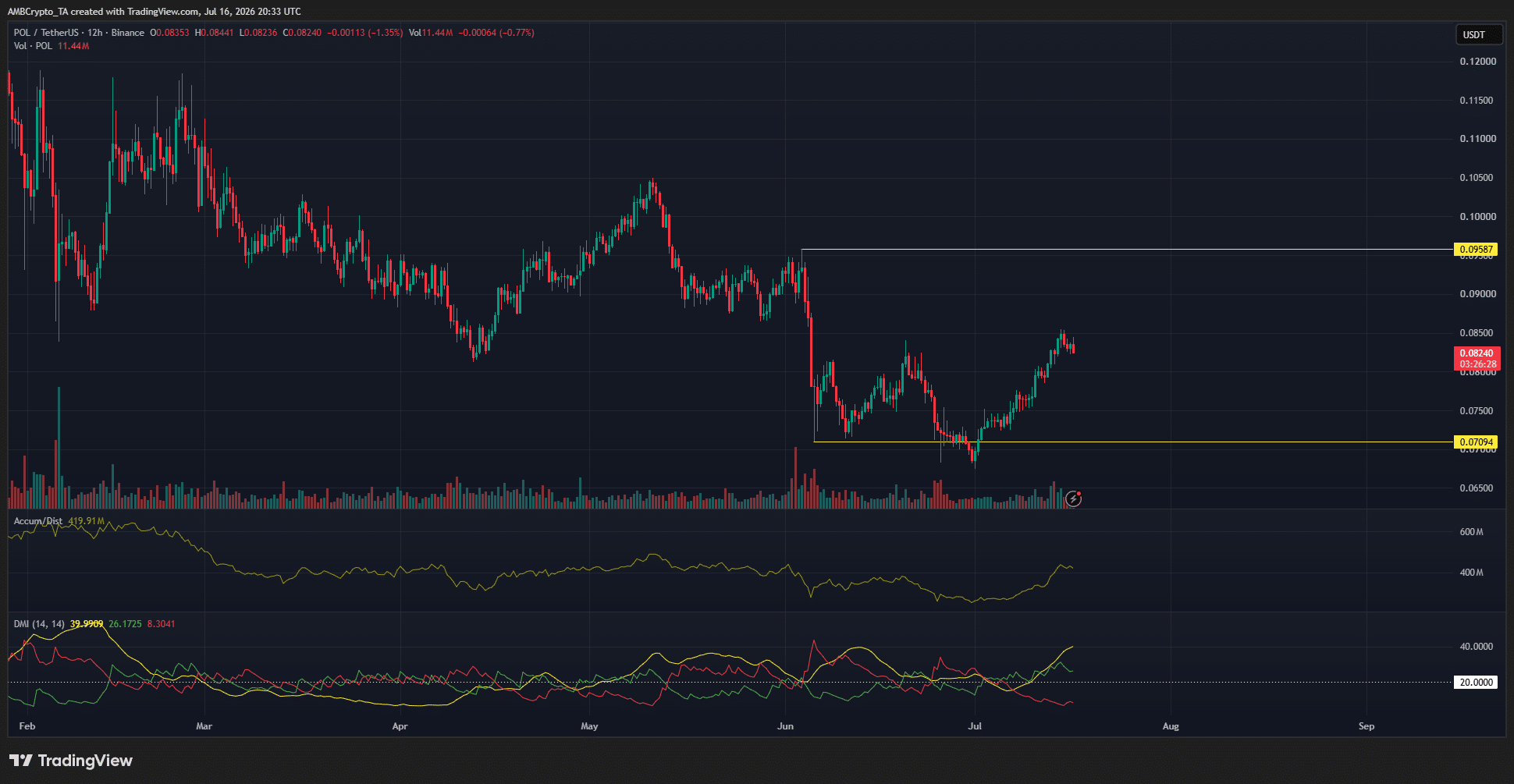
Source: POL/USDT on TradingView

The A/D indicator signaled buying pressure in July, and the DMI showed an uptrend in progress. Yet, the technical indicators did not capture the longer-term downtrend.

POL was down 56% since making a high of $0.186 in January earlier this year. The gains in July were not enough to shift the trend bullishly. A price move beyond $0.095 is needed.

Beyond the price action of the past six weeks, increased network usage and organic POL demand is needed to drive its recovery.


Final Summary

  • Polygon Labs CEO Marc Boiron announced the second round of layoffs for 2026, as the firm moved to finalize the Coinme acquisition.
  • The Polygon Open Money Stack vision envisioned as a seamless, global, blockchain-based payments platform.


İlgili Sorular

QWhat was the main reason provided by Polygon Labs CEO for the second round of layoffs in 2026?

AThe main reason was to help transition the blockchain company towards becoming a 'blockchain-enabled payments company' as it finalizes the Coinme acquisition.

QWhich two companies did Polygon acquire for $250 million in January 2026, and how many staff were laid off at that time?

APolygon acquired the crypto exchange Coinme and the wallet infrastructure firm Sequence for $250 million, and laid off 60 staff members as part of restructuring after the acquisitions.

QWhat is the stated vision for the Polygon Open Stack, and how does it relate to the recent acquisitions?

AThe vision for the Polygon Open Stack is to enable seamless money transfers onchain. This vision explains the need for the acquisitions of Coinme and Sequence and their subsequent integrations to build a global, blockchain-based payments platform.

QAccording to the article, what are the key distinctions between Polygon Labs and the Polygon Foundation?

APolygon Labs and the Polygon Foundation are legally and structurally distinct entities. Polygon Labs handles acquisitions and commercial vision, while the Polygon Foundation is tasked with network upgrades, treasury management, and ecosystem development.

QWhat does the article identify as a necessary condition for reversing POL's long-term bearish price trend?

ATo reverse POL's long-term bearish trend, the article states that increased network utility, creating more organic POL demand, and forcing more token burns through the deflationary mechanic are needed.

İlgili Okumalar

Stripe's $53.4 Billion Acquisition of PayPal: The Final Piece of the Stablecoin Empire Puzzle

Stripe has reportedly made a $53.4 billion acquisition offer for PayPal, a move that could signal a major shift in the stablecoin landscape from a "technology race" to a "customer war." Over recent years, Stripe has been quietly building nearly every layer of a stablecoin empire: acquiring the issuance platform Bridge, wallet provider Privy, co-incubating the payments-focused Layer 1 network Tempo with Paradigm, and joining the Open USD (OUSD) alliance stablecoin initiative. What it lacks, however, is a massive direct consumer user base. PayPal, with its hundreds of millions of active accounts, the Venmo app, and its own PYUSD stablecoin, would provide exactly that. The acquisition could create a closed-loop system where Stripe handles the merchant side, PayPal/Venmo serve consumers, and transactions are settled via stablecoins on a blockchain like Tempo, potentially bypassing traditional card networks and their fees. While the deal is not yet finalized and may face hurdles—including potential resistance from PayPal's board or a higher bid—the mere offer suggests Stripe's strategic focus may have evolved. It indicates that having superior infrastructure alone may not be enough; distribution and user access are critical battlegrounds. Questions remain about how PYUSD, OUSD, and Venmo would integrate with Stripe's stack, and whether private equity co-investor Advent International would prioritize such crypto experiments. If successful, this acquisition could significantly boost Tempo's position in the competitive public blockchain space and further push crypto-based payments into the mainstream, potentially fulfilling PayPal's original vision of an internet-native currency through a new, crypto-native infrastructure.

marsbit4 dk önce

Stripe's $53.4 Billion Acquisition of PayPal: The Final Piece of the Stablecoin Empire Puzzle

marsbit4 dk önce

Hyperliquid's "Stock Price" for ChangXin Memory Tech Hits $8.64: How Was This Price Determined Before the IPO?

Title: Hyperliquid's "Stock Price" for CXMT Hits $8.64: How is This Pre-IPO Price Determined? Summary: On Hyperliquid, a derivative contract tracking the pre-IPO value of Chinese chipmaker Changxin Xinqiao (CXMT) has been trading, with its price reaching $8.64. This price is not a real stock price or a direct IPO valuation, but the result of a specific market mechanism. Trade.xyz deployed this "Pre-IPO Perpetual" (IPOP) contract via Hyperliquid's HIP-3 framework. It tracks the expected USD value of one Changxin A-share post-listing. The contract started with an artificial "discretionary reference price" of $5 set by Trade.xyz. Subsequent trading prices are primarily determined by supply and demand on Hyperliquid's on-chain order book. Since there's no tradable现货 before the IPO, the contract price isn't forced to align with the official IPO price of 8.66 RMB (~$1.28). Key mechanics shape the price: 1. **Order Book-Driven**: The actual成交价 comes from limit orders matched on-chain. 2. **Internal Oracle & Smoothing**: An internal oracle, run by Trade.xyz, calculates a smoothed price based on the order book's "impact price" using a 30-minute exponential moving average (EWMA). This oracle price influences funding rates. 3. **Mark Price for Risk**: A separate Mark Price, derived from the median of the internal oracle and other inputs, is used for calculating profit/loss and liquidation. 4. **Discovery Bound (Price护栏)**: A 20% "Discovery Bound" limits how far the price can move from the current reference point. However, if the price hits the bound, the reference price can be re-anchored upward (or downward) up to 7 times. This explains the阶梯状 jumps to $6, $7.2, and $8.64. 5. **Low Funding Rate**: A minimal funding rate (0.005 multiplier) allows positions to be held with low cost before the IPO, but it provides a weak anchor. Post-IPO, the contract is expected to convert to a standard stock perpetual, with its oracle switching to the actual A-share price converted to USD. This transition could cause price jumps and potential liquidations if there's a significant gap between the pre-IPO contract price and the real market price. In essence, the $8.64 price is a composite of: a人为设定的起点 + on-chain order book supply/demand +内部 oracle 平滑 + low funding rate damping + a moving price护栏. It represents a collective bet by specific market participants on the future public market valuation, not the company's current or official IPO price.

marsbit5 dk önce

Hyperliquid's "Stock Price" for ChangXin Memory Tech Hits $8.64: How Was This Price Determined Before the IPO?

marsbit5 dk önce

Prices From the Future Fool the Oracle, Ostium Drained of $24 Million in Five Minutes

Ostium, a perpetual trading platform, suffered a security incident on July 15, resulting in significant losses from its public liquidity vault. Initial analyses from Blockaid, Cyvers, and PeckShield estimate losses of up to $24 million. The exploit occurred over a five-minute window. According to security firms, the core issue was not a missing signature, but a data integrity failure: a registered price oracle (PriceUpKeep) submitted authorized price reports with manipulated future timestamps, creating false trading profits. The protocol’s verification process confirmed the signatures as authorized but did not enforce price sanity checks or timestamp boundaries, allowing the manipulated data to be accepted for settlement. This caused the liquidity vault to pay out on these fraudulent profits. Ostium’s co-founder confirmed the team paused trading within an hour and is collaborating with law enforcement and security experts. The extracted funds were reportedly swapped for ETH, with a portion moved to Tornado Cash. The incident highlights risks in DeFi oracle designs where cryptographic signature verification is insufficient without additional safeguards for data validity, timestamp freshness, and price reasonableness. Ostium's response and planned fixes—including stricter timestamp validation, independent price checks, and circuit breakers—will be critical to preventing similar exploits.

marsbit27 dk önce

Prices From the Future Fool the Oracle, Ostium Drained of $24 Million in Five Minutes

marsbit27 dk önce

İşlemler

Spot
活动图片