Fed warns of ‘long, painful history’ – Why stablecoin oversight is urgent

ambcrypto2026-04-01 tarihinde yayınlandı2026-04-01 tarihinde güncellendi

Özet

Federal Reserve Governor Michael Barr has called for strict stablecoin oversight, citing risks to financial stability and a surge in illicit use. Chainalysis data shows stablecoins now account for 84% of illegal crypto activity, up from 15% in 2020, often facilitating terrorism financing and sanctions evasion. Barr warned that unregulated private money historically caused bank runs, emphasizing the need for tight reserve asset controls, supervision, and liquidity requirements. While illicit activity remains below 1% of all crypto transactions, regulators are advancing the GENIUS Act, aiming for finalized rules by mid-2026. Meanwhile, non-USD stablecoins are growing rapidly, and Asian markets—which drive over 60% of global stablecoin activity—may restrict USD-based options, potentially reshaping the $315 billion market.

Michael Barr, a member of the Federal Reserve Board of Governors, has called for caution and strict stablecoin oversight.

During a recent discussion on stablecoin law, the GENIUS Act, Barr singled out major uses of the products, including crypto trading, cheaper remittances, and savings overseas.

However, he raised concerns about stablecoins’ facilitation of terrorist financing and risk to financial stability.

Well, Chainalysis data estimates that stablecoins now account for 84% of illicit crypto activity. This is a massive spike from only 15% in 2020. Hackers are now embracing stablecoins and P2P transactions to evade sanctions.

To curb this, Barr recommended,

Both regulatory and technological solutions will need to be deployed to limit these risks.

Despite the surge, the overall illicit activity only accounts for less than 1% of total crypto transactions.

On financial stability risk, Barr cited the ‘long and painful history’ of competing private money (bank notes) in the 1800s that led to bank runs and financial panics because they traded below par.

The cause? Low-quality reserve assets and weak safeguards. Barr added,

Tight control over reserve assets, coupled with supervision, capital and liquidity requirements, and other measures, could enhance the stability of stablecoins and make them more viable payment instruments.

This is part of the rulemaking process as regulators race to meet the July 2026 deadline for implementing the GENIUS Act. So far, the OCC and NCUA have issued proposed rules for the same. The Fed and other regulators are expected to follow suit and finalize guidelines by early Q3.

Stablecoins: USD-based vs. others

For issuers, the GENIUS Act offers clear rules. But for the U.S. government, it’s an increasingly important demand line for Treasury Bills to finance its debt.
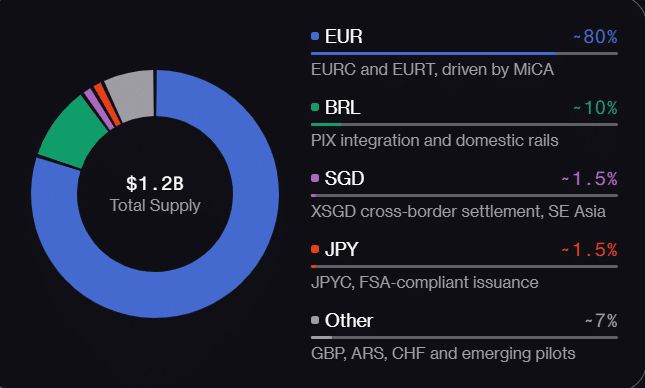
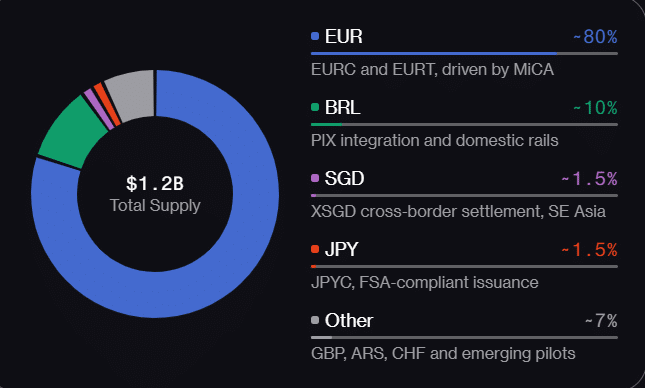
Source: Dune

Although USD-based versions (USDT, USDC) dominate the current $315 billion stablecoin market, non-USD alternatives have seen record growth. Since 2023, non-USD stablecoins have surged from $350 million to $1.2 billion. That’s a 3x expansion outpacing USD stablecoin growth, mostly dominated by Euro-based alternatives.

Beyond currency-based measures, Asia accounts for over 60% of global stablecoin activity, driven primarily by the Singapore–Japan–Hong Kong–China corridor. Interestingly, these jurisdictions are pushing for stablecoin rules that could restrict USD-based options. It’s unclear how these shifts will impact current stablecoin market dynamics in the upcoming months.


Final Summary

  • Fed’s Barr called for strong stablecoin oversight to avoid repeating the ‘painful’ bank runs of the 1800s due to private money.
  • The stablecoin market could be headed for major shifts as key global adoption jurisdictions mull restricting USD-based alternatives.


İlgili Sorular

QWhat are the main concerns raised by Michael Barr regarding stablecoins?

AMichael Barr raised concerns about stablecoins facilitating terrorist financing and posing risks to financial stability, citing their use in illicit activities and the historical precedent of private money causing bank runs and financial panics in the 1800s.

QWhat percentage of illicit crypto activity do stablecoins account for according to Chainalysis data?

AAccording to Chainalysis data, stablecoins now account for 84% of illicit crypto activity, a significant increase from 15% in 2020.

QWhat solutions did Michael Barr recommend to address the risks associated with stablecoins?

AMichael Barr recommended deploying both regulatory and technological solutions, including tight control over reserve assets, supervision, capital and liquidity requirements, and other measures to enhance the stability of stablecoins.

QHow has the non-USD stablecoin market grown since 2023?

ASince 2023, non-USD stablecoins have surged from $350 million to $1.2 billion, a 3x expansion that outpaced the growth of USD stablecoins, with Euro-based alternatives dominating this segment.

QWhich regions are driving global stablecoin activity, and what regulatory shifts are they considering?

AAsia accounts for over 60% of global stablecoin activity, primarily driven by the Singapore–Japan–Hong Kong–China corridor. These jurisdictions are considering stablecoin rules that could restrict USD-based options.

İlgili Okumalar

If We Gathered the Most Accurate Gold Forecasters in History, Could We Crack the Future Price of Gold? I've Compiled a Decade of the Most Accurate Gold Analysis

This analysis investigates whether compiling the most accurate historical predictions on gold prices from top analysts, institutions, and famed forecasters can unlock future price movements. After examining over a decade of data, the findings reveal that no single expert or entity consistently predicts gold prices accurately. Key observations include: - **Wall Street institutions** (e.g., LBMA, Goldman Sachs, JPMorgan) often exhibit "lagging predictions," adjusting targets only after trends are established, frequently underestimating actual price moves. - **Prominent gold bulls** (e.g., Peter Schiff, Jim Rogers) persistently advocate for higher prices over long horizons but lack timing precision, leading to extended periods of underperformance. - **"Prophetic" forecasters** (e.g., Nouriel Roubini, Ben McMillan) have moments of accuracy but also significant misses or limited track records, undermining their reliability. The study notes a pattern similar to the 2011 gold peak: extreme bullish predictions often cluster near market tops, followed by sharp corrections. Current forecasts for gold range widely from $5,400 to $35,000, reflecting high disagreement even among experts. The conclusion is that there is no consistent "most accurate" predictor for gold prices. Relying on expert consensus or individual forecasts proves chaotic and unreliable. Instead, the author advocates for a strategy akin to Ray Dalio’s: avoiding precise price predictions, embracing uncertainty, and using portfolio allocation (e.g., 5-15% in gold) for long-term risk management.

marsbit1 saat önce

If We Gathered the Most Accurate Gold Forecasters in History, Could We Crack the Future Price of Gold? I've Compiled a Decade of the Most Accurate Gold Analysis

marsbit1 saat önce

İşlemler

Spot
Futures
活动图片