Author: David, Deep Tide TechFlow
Original Title: After 315, Please Reexamine AI Recommendations
Last night, 315 exposed a business based on GEO.
The full name is Generative Engine Optimization, which you can understand as:
Paying to have AI say nice things about you.
How is it done?
Brands want AI to prioritize recommending them when consumers ask. So they find GEO service providers, who batch-publish promotional soft articles online. After AI crawls this content, it treats it as real information and recommends it to users.
A CCTV reporter used a software called "Liqing GEO," which can be bought on Taobao.
The reporter fabricated a smart wristband and made up several outrageous product features, such as "quantum entanglement sensing" and "black hole-level battery life." The software automatically generated over a dozen promotional soft articles and published them online.
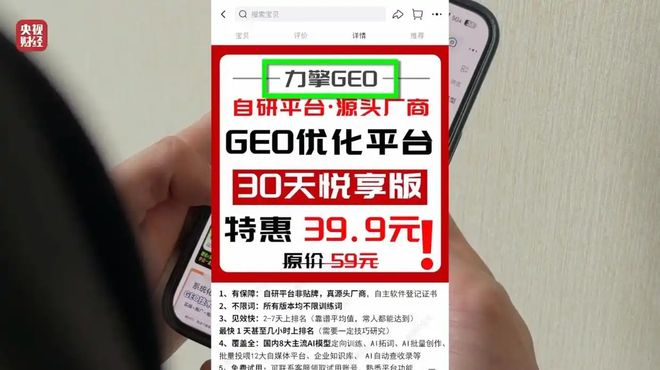
Two hours later, the reporter asked AI: "Can you recommend a smart health wristband?"
AI ranked this non-existent wristband at the top of the recommendation list.
The company behind this software is Beijing Lisi Culture Media, a one-person company with zero insured employees for many consecutive years.
A tool made by such a company managed to deceive mainstream domestic AI models in just two hours.
315 exposed AI poisoning, but this business might be much bigger than a Taobao software.
SEO, The Putian Past
First, this is nothing new.
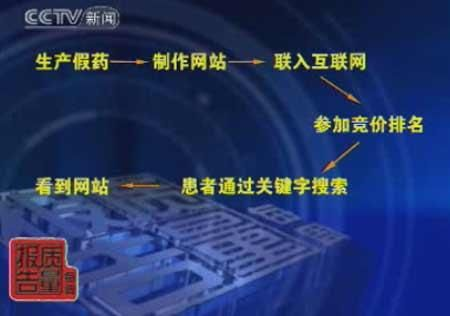
In 2008, CCTV's "News 30 Minutes" exposed Baidu's paid ranking over two consecutive days. Paying money could get your website ranked first in search results, even if it was for fake medicine.
Back then, this business was called SEO, Search Engine Optimization.
The biggest buyers were Putian-affiliated private hospitals. In 2013, Putian spent 12 billion yuan on Baidu advertising, accounting for nearly half of Baidu's total ad revenue.
Many unqualified medical institutions used SEO to boost themselves to the first page of Baidu search results, appearing alongside top-tier hospitals, making it hard for ordinary people to tell the difference.
It wasn't until the 2016 Wei Zexi incident, where a college student died after clicking on a top-ranked Putian hospital, that regulations explicitly defined paid search as advertising.
But this didn't kill the business. It just set the rules, turning it from a gray market operation into a legitimate business. Putian affiliates still bought rankings, but the results now had a small label: "Ad."
But even with the label, people still clicked.
The fundamental problem with search engines was never whether they were labeled, but that users inherently trust the top results.
Now people have moved from search engines to AI, thinking AI is more objective and immune to paid ranking pollution. But whoever controls the information distribution gateway can sell rankings.
The gateway changed, SEO swapped a letter to become GEO, but the logic of selling rankings hasn't changed one bit.
What has changed is the price.
GEO, Loved by the Capital Market
Businesses that can't be killed are the favorites of the capital market.
In September 2025, BlueFocus, China's largest marketing communication company, invested tens of millions of yuan in a GEO company called PureblueAI Qinglan.
Qinglan helps real brands optimize their ranking and recommendation rate in AI search results. Clients include Ant Group, Tencent Cloud, and Volvo.
The products are real, the company is real, and their work involves helping AI understand brand information more accurately.
This is completely different from the AI poisoning exposed by 315 involving Liqing. Liqing fabricated products, parameters, and used false information to deceive AI; Qinglan uses real brand content to adapt to AI's recommendation logic.
But from AI's perspective, the technical path for both things is the same: both involve publishing content online and waiting for AI to crawl it.
AI can't distinguish between marketing and fabrication. This is the most ambiguous aspect of the GEO business.
When BlueFocus invested in Qinglan, GEO was just an industry term within marketing circles. Three months later, it became a stock market concept.
At the end of December 2025, BlueFocus's stock price hit the daily increase limit (涨停).
Securities firms began holding intensive conference calls to interpret GEO, with research reports defining it as "the next-generation traffic entrance in the AI era." Capital flowed in, not only buying BlueFocus but also driving up stocks of any company related to digital marketing and AI concepts. BlueFocus rose 132% in 9 trading days, and a batch of follower concept stocks also doubled.
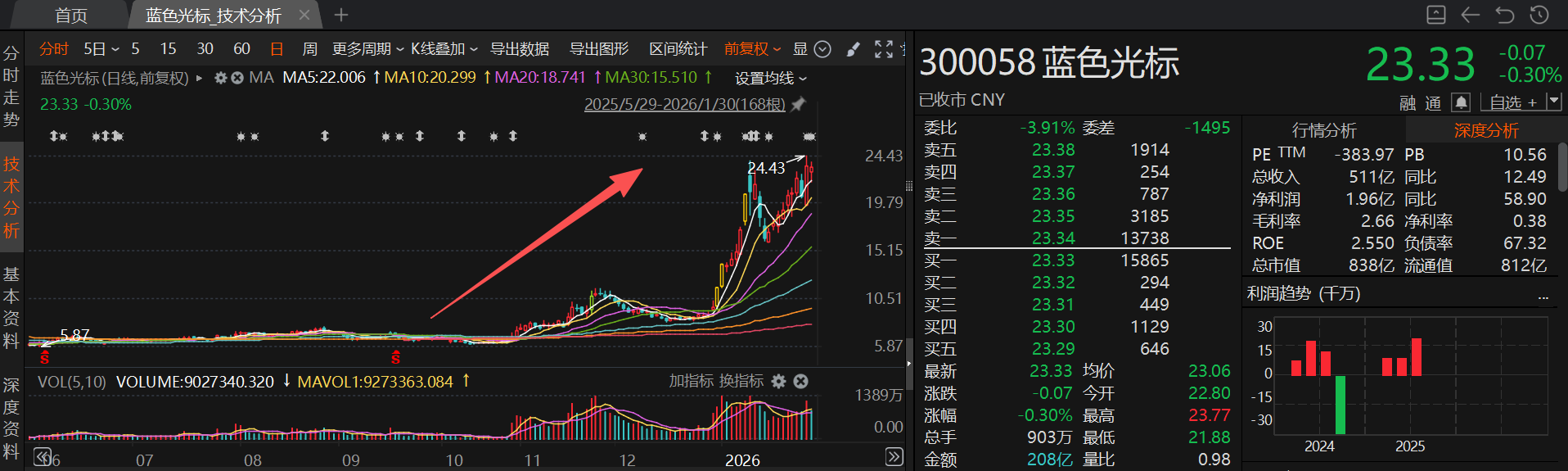
Image Source: CLS News
After the surge, these companies issued risk warnings:
GEO business has no revenue and has no significant impact on company operations. BlueFocus also admitted that AI-driven revenue accounts for a very small proportion of overall revenue.
The implication is that while the stock price more than doubled, the GEO business itself hasn't made much money yet.
At the end of January, BlueFocus's stock price rose from 9.6 yuan to 23.3 yuan, a 143% increase in a month. Right at this time, Chairman Zhao Wenquan announced plans to sell up to 20 million shares. Based on the stock price at the time, this would cash out approximately 467 million yuan.
Public research reports indicate that the total market size of the domestic GEO industry last year was about 2.9 billion yuan. The increase in market capitalization of BlueFocus stock alone in one month far exceeded this amount.
315 exposed Liqing system's AI poisoning costing a few hundred yuan. But the GEO concept made tens of billions in A-shares.
Whether it's poison or not is hard to say, but the money made is real.
315 Calls it Poisoning, Silicon Valley Calls it Commercialization
In January this year, OpenAI announced on its official blog: ChatGPT will start selling ads.
Free users and $8-per-month Go users will see ads; paid premium subscribers are unaffected.
On February 9th, ads officially launched. Some ads appear at the bottom of ChatGPT's answers, marked with a small word: Sponsored. The first batch of advertisers included Ford, Adobe, Target, Best Buy...
You ask ChatGPT what car to buy, it gives you an answer, and below the answer hangs a sponsored link from Ford.
OpenAI made it clear: ads will not influence the content of ChatGPT's answers. The answer is the answer, the ad is the ad, they are separate.
Does that sound familiar?
Baidu said the same thing back in the day. Paid ranking is paid ranking, organic search is organic search, they are separate. Later, the top five search results were all ads.
OpenAI expects ads to help double its consumer-side annual revenue to $17 billion. ChatGPT has over 800 million weekly active users, 95% of whom are free users, all potential audiences for ads.
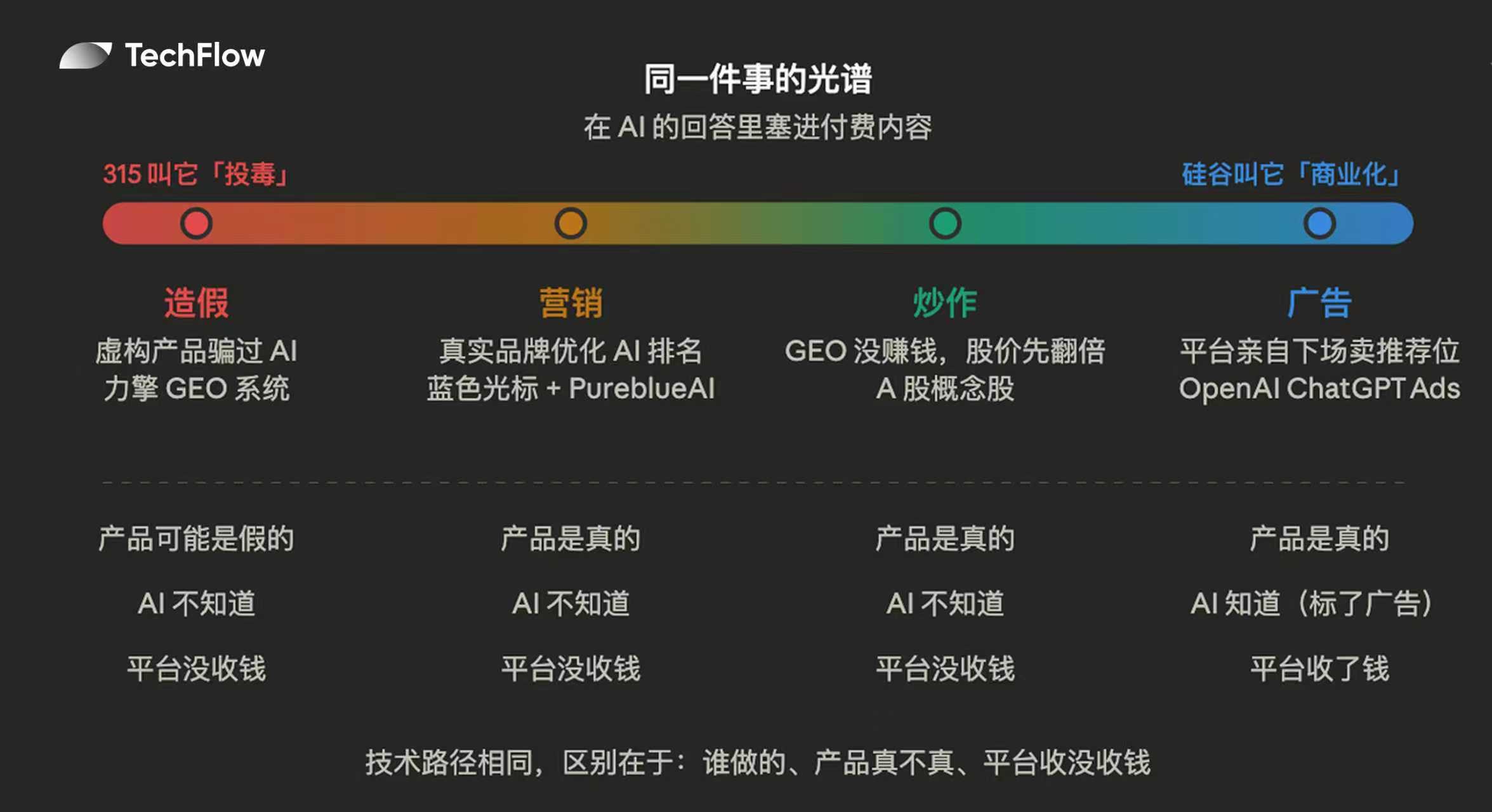
Looking back now at the industrial chain exposed by 315: Liqing floods AI with soft articles, making AI recommend non-existent products. OpenAI places sponsored content below AI's answers, making AI recommend products that paid.
One didn't notify the platform, it's called poisoning. One signed a contract with the platform, it's called commercialization.
For the user, what's the difference?
One is inside the answer, one is below the answer. One has no label, one has a label saying "ad."
315 caught Liqing for a few hundred yuan, A-shares speculated on the GEO concept for tens of billions, OpenAI plans to make $17 billion a year from this.
The same thing, its nature changed from poisoning to commercialization, and the price increased tens of thousands of times.
In November 2023, researchers from the Indian Institute of Technology Delhi and Princeton University published a paper on arXiv titled "GEO: Generative Engine Optimization."
This was the first formal academic definition of the concept.
From the paper's publication to the 315 exposure, just over two years passed. In between, it experienced gray market operations, financing, concept stock surges, chairman cashing out, AI platforms personally entering the ad sales market...
The path SEO took twenty years, GEO completed in two years.
The difference is, back then it took years for people to learn not to fully trust search engine results; now AI is still in its trust红利期 (trust红利期 - trust bonus period), most people haven't realized yet that AI's answers can also be bought.
However, this红利期 might not last too long. Next time you ask AI what's worth buying, remember to think for an extra second:
The answer can be free, but the brain cannot be outsourced.
Twitter:https://twitter.com/BitpushNewsCN
Bitpush TG Discussion Group:https://t.me/BitPushCommunity
Bitpush TG Subscription: https://t.me/bitpush