Last weekend (7th), unusual shifts in capital flows emerged in the U.S. market, with significant price divergence in two major sectors—memory and optical communications. Over the weekend, Wall Street investors engaged in heated debate: "Should we sell memory stocks and buy optical communication stocks?"
Two key events triggered the market surge. Citigroup Securities significantly lowered the target price for Micron Technology (MU), predicting that memory prices are nearing a peak, which brought selling pressure on the entire memory stock segment. Concurrently, optical communication module maker AAOI reported earnings that far exceeded market expectations and provided a very optimistic outlook, causing a sharp rally in the entire optical communications sector.
Citigroup is bearish on Micron, predicting memory prices will peak in May next year.
Citigroup analyst Atif Malik maintained his "Buy" rating on Micron Technology in his latest report but drastically cut the target price from $140 (approximately ¥22,000) to $115 (approximately ¥18,000). This downward revision was staggering.
Based on extensive interviews with companies across the entire memory supply chain (from upstream to downstream), the report's analysis suggests that the pace of price increases for DRAM and NAND flash memory is likely to slow gradually over the next four quarters and could potentially peak in May next year.
Citigroup also provided quantitative forecasts, painting a picture of rapidly diminishing price momentum.
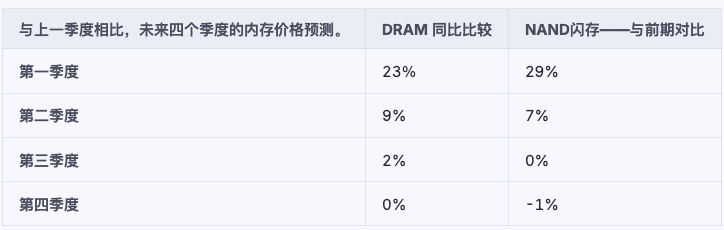
Note: Citigroup forecasts that DRAM prices will decrease by 3% year-on-year in the second half of 2027, while the decline in NAND flash prices may widen to 5%.
Citigroup attributed the slowing price increases to sustained production expansion by Chinese memory makers ChangXin Memory Technologies (688825.SS) and Yangtze Memory Technologies Co., Ltd. (YMTC), leading to supply pressure.
The report immediately triggered market selling. Over the weekend, Micron Technology's stock price fell by about 1%, while SanDisk's stock plunged over 2%. The decline spread to Asian markets, with South Korea's SK Hynix stock plummeting over 4%, and Samsung Electronics and Japan's Kioxia also experiencing synchronous drops.
Shohmo Optoelectronics' earnings report sparks strong demand for AI optical interconnects.
In stark contrast to the grim situation facing memory stocks, the strong earnings report from leading optical communication module manufacturer AAOI brought a ray of hope to the market.
AAOI's second-quarter revenue grew 86% year-over-year to $191.9 million (approximately ¥30 billion), with data center business revenue surpassing the $100 million mark for the first time. Non-GAAP earnings per share were $0.06 (approximately ¥9.5), exceeding the upper end of the company's previous guidance.
The company further raised its earnings outlook, now expecting third-quarter sales to be between $255 million and $290 million (approximately ¥46 billion). The company maintains its full-year sales target of approximately $1.1 billion (approximately ¥170 billion).
These results brought strong upward momentum to the optical communications industry. Corning (GLW) rose 5%, Lumentum (LITE) gained 6%, Coherent (COHR) surged 13%, while Shohmo Optoelectronics' own stock rose 9%.
List of related stock price changes on the event day
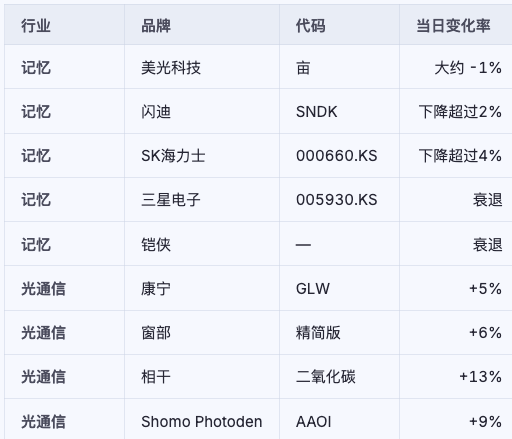
Note: U.S. stock data shows the percentage change on the day of the last weekend (August 7th). Data for SK Hynix, Samsung Electronics, and Kioxia reflect their performance in Asian markets after the news broke.
From a product portfolio perspective, high-speed products were the main drivers of growth. In Q2, AAOI's 400G product sales reached $48.4 million (approx. ¥7.5 billion), more than quadrupling year-over-year. The more representative 800G product quarterly sales were $12.8 million (approx. ¥2 billion), not only increasing more than tenfold year-over-year but also more than doubling sequentially. Management further predicted that Q3 800G product sales would grow to about five times the previous quarter's level, indicating that market demand is rapidly shifting from older generation standards like 100G and 400G to newer, faster products.
Signs of tight capacity were also evident. According to management, current customer order volume is 20% to 40% higher than the company's actual production capacity. In other words, the constraint on the company's growth is not market demand but capacity bottlenecks. Currently, monthly capacity for 800G and 1.6T products is close to 200,000 units, with plans to reach over 650,000 units by the end of 2026 and 930,000 units by the end of 2027.

According to a report by market research firm Light Counting released in March 2026, the global market size for 800G and 1.6T optical modules is projected to reach $14.6 billion (approximately ¥2.3 trillion) by 2026, accounting for nearly 64% of total optical module sales. Shipments of 800G optical modules this year are expected to more than double compared to last year. However, supply constraints of InP laser chips and EML components caused a supply shortage that reached 30% in the first half of the year, which is expected to ease only by year-end. This aligns with AAOI management's explanation that "order volume is 20% to 40% higher than actual capacity," indicating that the capacity shortage is not an issue for individual companies but a widespread bottleneck across the entire optical module supply chain.
AAOI CEO Lin Zhiming gave an even more optimistic outlook, stating that Q4 sales of 1.6T products could exceed $70 million (approx. ¥11 billion), adding, "I wouldn't be surprised if sales double again in Q1 next year." However, he also acknowledged that supply for key components required for 1.6T products—DSPs and TIAs—remains very tight, and the main bottleneck for Q4 shipments will be component supply, not the company's own capacity.
Market analysts believe that AAOI's better-than-expected earnings will significantly boost the stocks of Lumentum and Coherent, both of which are about to report earnings. Both companies, which have received investments from NVIDIA (NVDA), are viewed by the market as typical cases of "fighting fire with fire," riding the wave of development in AI computing infrastructure.

Bull camp changing strategy? Debate over "Sell Memory, Buy Fiber" erupts over weekend.
What truly intensified the weekend debate was a post on the social media platform "X" by Citrini Research analyst Jukan. Jukan had previously been bullish on memory stocks. He argued that the market should consider a "Sell Memory, Buy Optical Communications" trading strategy in the short term, giving three reasons.
First, after a functional failure in the South Korean leveraged ETF market, related investors face selling pressure, which could bring additional selling pressure to memory stocks. Second, NVIDIA is refining its next-generation AI system architecture, and "Rubin Ultra" might reduce the amount of High Bandwidth Memory (HBM) per rack, instead using optical interconnects to link multiple racks. Third, the market widely believes memory prices will peak within the next two quarters.
According to a report by market research firm TrendForce released on August 4th, to address the challenge of tight DRAM supply in 2027, NVIDIA has reduced the HBM stack configuration per GPU in its "Rubin Ultra" graphics card from the initially planned 12 layers/288GB to 8 layers/192GB, a 33% reduction. This provides specific numerical support for Jukan's theory about "NVIDIA adjusting its HBM configuration."
Jukan emphasized that he remains optimistic about the long-term prospects for memory stocks, but is cautious in the short term. He believes the focus of AI infrastructure investment is shifting from simply accumulating HBM capacity to pursuing overall data center architecture efficiency, with high-speed optical interconnects being a key element in this shift.
Responding to this statement, an anonymous AI and semiconductor supply chain researcher and investor active on platform "X," Serenity, directly refuted the claim, reiterating that he remains "bullish" on the memory industry.
Serenity's core argument is that "what has truly changed is the stock price, not the fundamentals." He pointed out that before the stocks of Coherent and Lumentum plunged in July, their laser component capacity had been sold out for two years; and AAOI's supply-demand imbalance issue was actually clearly disclosed in the previous quarter's earnings call. In other words, the fundamentals of these companies did not deteriorate at all during the July sell-off, and he stated "the only thing that changed was the price after the selling subsided."
He also sarcastically noted that when AAOI's stock fell to $75 (approx. ¥11,800), many investors cried "It's a scam!" but now that the price has recovered to $140 (approx. ¥22,100), they have turned bullish. "Yet, the capacity bottlenecks for optical transceivers and InP substrates still exist and might even be worsening," he emphasized.
Regarding memory stocks, Serenity said he recently observed massive panic selling among retail investors, but he then asked, "Were these the same people cheering a month ago when Micron signed 16 supply contracts and Samsung achieved record operating profits?"
He argued that NVIDIA's optimization of the memory configuration for the "Rubin Ultra" graphics card is merely a routine adjustment the company makes with each product generation. He also pointed out that compared to current operating profit levels, the market capitalization of the memory industry is "significantly low," and stressed that supply-demand conditions could tighten further next year, especially as memory demand gradually shifts towards structural growth.
Serenity concluded his post by writing: "Whether the stock price is $140 or $75, AAOI is one company. Whether the market cap is $1.5 trillion or $980 billion, Samsung is one company. What has truly changed is only the valuation and market sentiment, and these are often just noise. The market is merely shifting capital between sectors."