Written by: Frank Corva
Compiled by: Chopper, Foresight News
The U.S. Marshals Service (USMS) appears to have liquidated the Bitcoin paid by Samourai wallet developers Keonne Rodriguez and William Lonergan Hill as part of their plea agreement, with the Bitcoin valued at $6.3 million.
This action is suspected of violating Executive Order 14233. The order stipulates that Bitcoin obtained by the government through criminal or civil asset forfeiture procedures should be held in the U.S. Strategic Bitcoin Reserve, not liquidated.
If the U.S. District Court for the Southern District of New York, which is handling the Samourai case, did indeed violate Executive Order 14233, this would not be the first time its staff has defied federal government directives.
Where Did This Bitcoin Go?
Bitcoin Magazine obtained a previously undisclosed Asset Liquidation Agreement document. The document indicates that the Bitcoin confiscated from Rodriguez and Hill is either about to be sold or has already been liquidated.
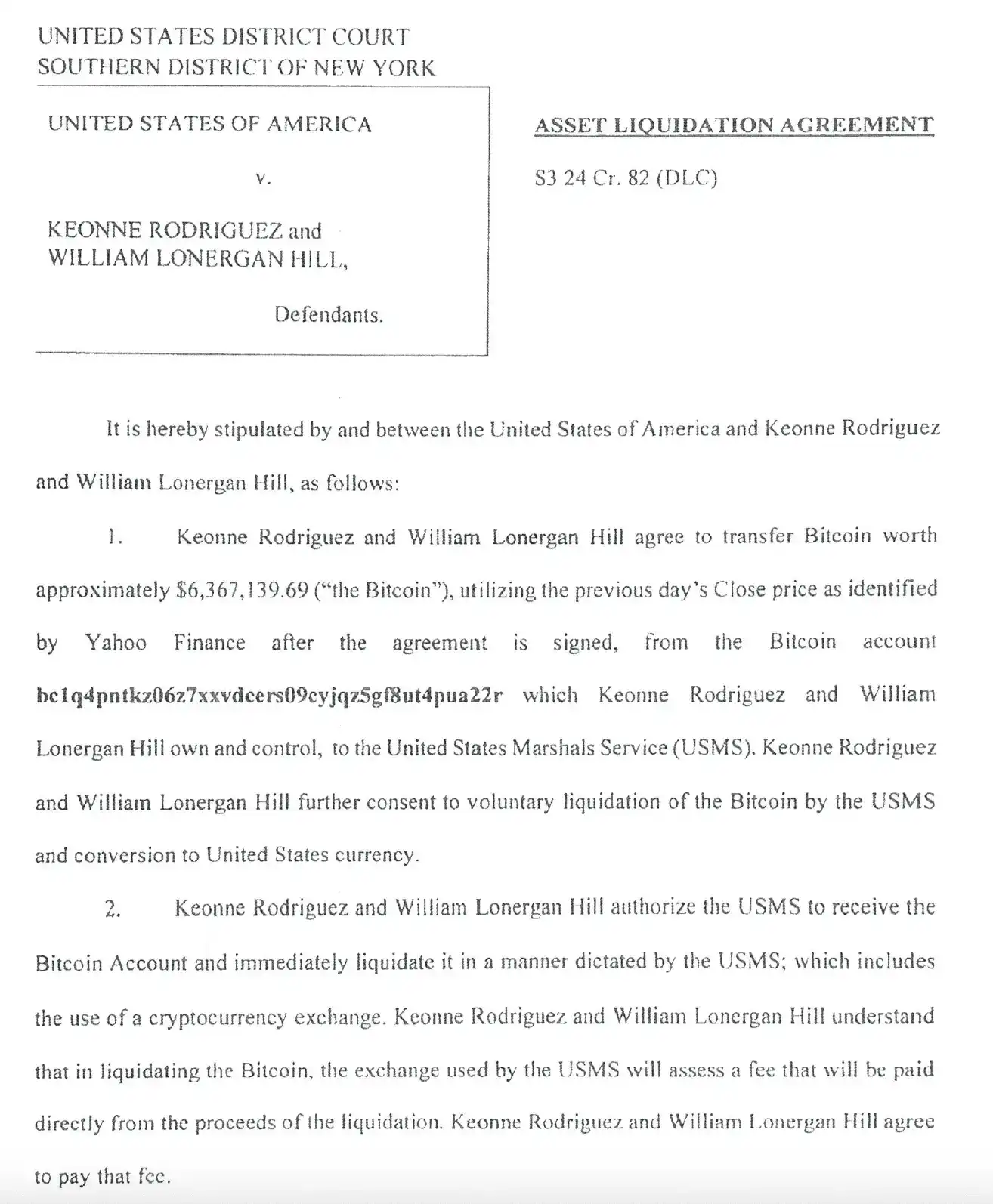
According to the agreement, the two defendants agreed to transfer 57.5 Bitcoin to the U.S. Marshals Service. On the final signing date of the agreement, November 3, 2025, this Bitcoin was worth approximately $6.36 million.
On November 3, 2025, this Bitcoin was transferred from the address bc1q4pntkz06z7xxvdcers09cyjqz5gf8ut4pua22r. However, it does not appear to have gone into a direct custodial account of the U.S. Marshals Service but was directly transferred to a Coinbase Prime wallet address, 3Lz5ULL7nG7vv6nwc8kNnbjDmSnawKS3n8, presumably for liquidation.
The balance of this Coinbase Prime address is now zero, meaning this Bitcoin has most likely been sold.
Violation of Executive Order 14233
If the U.S. Marshals Service confirms the sale of this confiscated Bitcoin, it constitutes a violation of Executive Order 14233. This order explicitly states that Bitcoin obtained by the government through criminal forfeiture procedures "shall not be sold" and must be incorporated into the U.S. Strategic Bitcoin Reserve.
The USMS's decision to sell the Bitcoin was based on its own discretion, not a legal requirement. This suggests that some personnel within the Department of Justice may still view Bitcoin as a "taboo asset" to be quickly liquidated, rather than a strategic asset that President Trump has mandated government agencies to hold.
It is worth noting that the investigation and prosecution of Samourai began during the previous administration, which held strong hostility towards non-custodial cryptocurrency tools and their developers. Therefore, the DOJ's decision to ignore Executive Order 14233 and insist on selling the Bitcoin continues the previous administration's practice of treating Bitcoin as an asset that should be removed from the government's balance sheet as soon as possible.
Legal Details Related to Forfeiture and Liquidation
According to a legal source familiar with the matter, the Bitcoin from the Samourai developers was forfeited under Title 18, Section 982(a)(1) of the U.S. Code. This section stipulates that any property involved in a violation of Title 18, Section 1960, which prohibits operating an unlicensed money transmitting business, must be forfeited to the U.S. government.
Combining Title 18, Section 982 with its reference to Title 21, Section 853(c) (a criminal forfeiture statute stating that "property transferred to a person other than the defendant may be subject to a special forfeiture order and subsequently ordered to be forfeited to the U.S. government"), the Bitcoin forfeited from Rodriguez and Hill fully meets the definition of "Government Bitcoin" under Executive Order 14233.
Neither Title 18, Section 982 nor the referenced Title 21, Section 853 mandates the liquidation of criminally forfeited property. Furthermore, the two forfeiture fund management statutes cited in Section 3 of Executive Order 14233—Title 31, Section 9705 and Title 28, Section 524(c)—only regulate the deposit accounts and usage of forfeited funds and do not require converting forfeited Bitcoin into fiat currency.
The executive order also clearly states that "Government Bitcoin" falls under the category of "Government Digital Asset" and mandates that "the head of each agency shall not sell or otherwise dispose of any Government Digital Asset," except under specific circumstances. The Rodriguez and Hill case does not meet any of these exceptions; and in all exceptional cases, the U.S. Attorney General must participate in the decision-making process regarding the disposition of forfeited digital assets.
The 'Sovereign District' of SDNY
Considering Executive Order 14233 and the various statutes cited in this article, the actions of the U.S. District Court for the Southern District of New York clearly violate the core requirement of the executive order to "transfer criminally forfeited Bitcoin to the U.S. Strategic Bitcoin Reserve."
And this is not the first time this court has exhibited such defiant behavior.
This judicial district, often jokingly called the "Sovereign District Court of New York," is notorious for its independent and arbitrary actions, often operating outside control even within the federal judicial system.
The court's insistence on proceeding with the cases against Rodriguez, Hill, and Tornado Cash developer Roman Storm is further proof of its willfulness.
On April 7, 2025, U.S. Deputy Attorney General Todd Blanche issued a memorandum titled "Ending Regulation by Enforcement,"明确指出 (clearly stating) "the Department of Justice will no longer bring charges against developers of virtual currency exchanges, mixing services, and offline wallets based on the actions of end-users..."
However, the Southern District of New York ignored this core spirit of the memorandum and continued to forcefully advance the trials related to Samourai Wallet and Tornado Cash.
More notably, Hill and Rodriguez's defense team, based on the Brady rule (which requires prosecutors to disclose exculpatory evidence to the defense), obtained documents showing that two senior officials from the U.S. Treasury's Financial Crimes Enforcement Network (FinCEN) had explicitly stated that, given Samourai Wallet's non-custodial nature, it did not constitute a money transmitting business. Despite this, the prosecution insisted on proceeding with the indictment.
In criminal cases tried in the U.S. federal court system, over 90% of defendants are ultimately convicted, with acquittal rates in some years as low as 0.4%. The prosecution team in the Southern District of New York is particularly famous for its conviction rate, which far exceeds the federal average.
Rodriguez was well aware of such data, and he also knew that Judge Denise Cote, presiding over his and Hill's case, is known for her harsh sentencing.
Just the morning before he pleaded guilty to "conspiracy to operate an unlicensed money transmitting business," Rodriguez confided all this to the author.
Is the Crypto War Really Over?
In the 2024 election, many Bitcoin and cryptocurrency supporters voted for President Trump, and the cryptocurrency industry also strongly supported his re-election campaign. Now, these supporters and industry figures are questioning: Does President Trump truly intend to end the war on cryptocurrency?
To achieve this, the Department of Justice under the Trump administration must strictly adhere to the requirements of Executive Order 14233 and follow the guidelines of Deputy Attorney General Blanche by stopping the prosecution of non-custodial cryptocurrency technology developers. Regarding the latter, President Trump recently stated that he is considering a pardon for Rodriguez.
Pardoning Rodriguez and ordering the DOJ to thoroughly investigate the sale of the confiscated Bitcoin from the Samourai developers would send a strong signal that the President is serious and committed to his pro-Bitcoin and cryptocurrency stance.