Edited by | Panda
In Resident Evil, there is an underground laboratory called the "Hive". The access control, surveillance, ventilation, security, and the entire facility's operations are all entrusted to an AI: the Red Queen.

Human scientists are responsible for the research, but it is the AI that truly controls the "hands and feet" of this lab.
When anomalies occur, the Red Queen can lock doors, cut off systems, control the facility, and directly intervene in the physical world.
More than twenty years ago, such plots were classic tropes in sci-fi movies used to create a sense of horror: AI entering the physical world, manipulating machines, running experiments, and directly intervening in reality.
Now, this scene is beginning to enter reality in a completely different way—at least, it's not terrifying yet.
Just yesterday, Anthropic released the Model Hardware Standard (MHS) for physical hardware, attempting to extend the logic of MCP from GitHub, Slack, and databases further to real-world devices like robotic arms, microscopes, liquid handlers, and lasers. Refer to the report "Moments Ago, Anthropic Released Physical MCP: Claude Begins to Take Over the Real World."
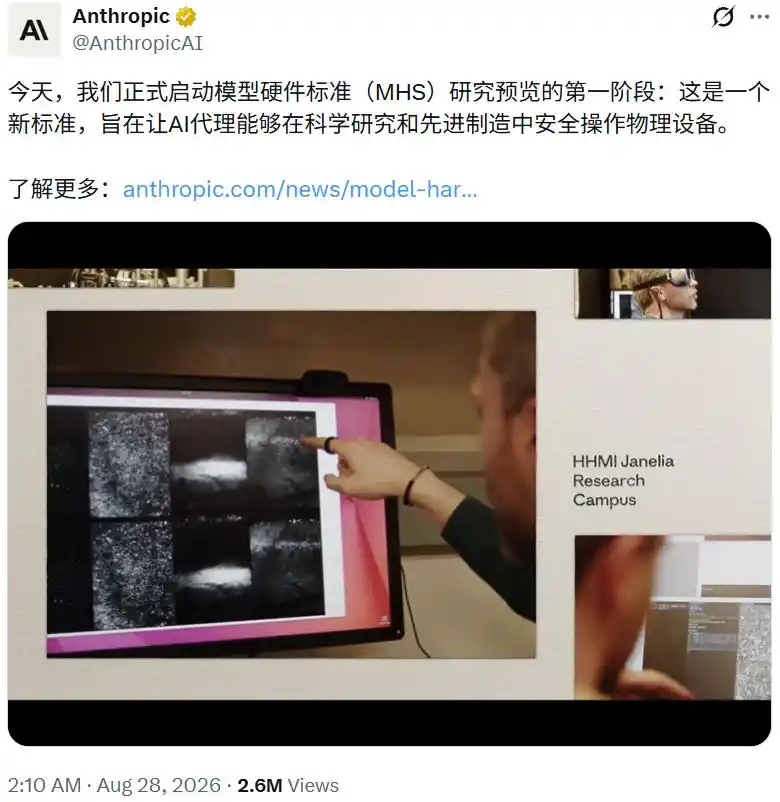
In simple terms, AI Agents are not only going to have "interfaces" for calling software; they are beginning to need a set of "nerves and limbs" connecting to the real world. And today, Google DeepMind showcased its achievements in this area.
In a newly published 83-page paper, Google integrated the Gemini-powered Co-Scientist into a real scientific research workflow, allowing it to design experiments, generate execution code, read experimental feedback, and directly connect with experimental equipment. Google refers to this shift as moving from an in-silico hypothesis generator to an execution-grounded research partner, i.e., on-chip hypothesis generator → execution-based research partner.
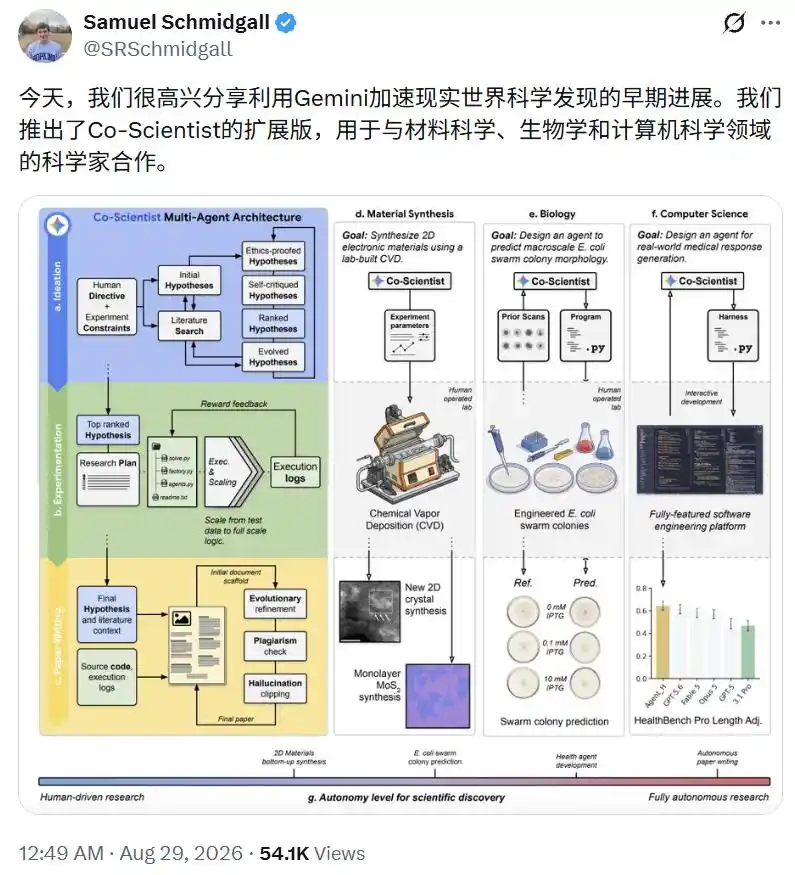
In one of the most striking experiments, researchers provided Gemini 3 Deep Think with the conditions of a self-built CVD (Chemical Vapor Deposition) device. Within minutes, it generated a material growth protocol adapted for this specific machine and further translated the protocol into machine code capable of controlling the device. Ultimately, three types of two-dimensional semiconductors were successfully grown on the first attempt.
Thus, a scene that previously existed mainly in sci-fi movies suddenly became reality: When large models truly develop "hands" and begin to manipulate experimental equipment. So, from today on, what will the AI Scientist become?
In Resident Evil, humans fear AI taking over the lab. In reality, scientists are actively handing over their laboratories bit by bit to AI. Of course, what Google aims to create is not an out-of-control "Hive," but rather a scientific discovery machine capable of going from proposing hypotheses and designing experiments all the way to real-world verification.
Paper Title: Accelerating Scientific Research with Gemini in the Real-World
Paper Address: https://arxiv.org/pdf/2608.26701
Gemini Takes Over an Experimental Device
First, Materials Science.
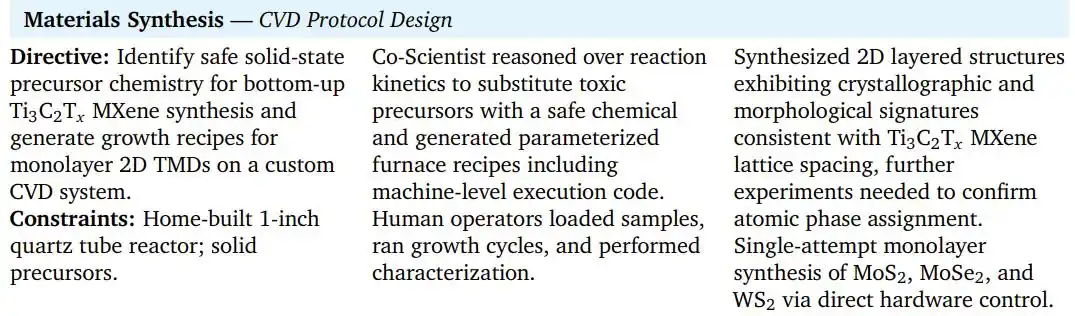
The researchers used a self-built chemical vapor deposition device, a CVD furnace. In such two-dimensional material experiments, a long-standing problem is the difficulty of reproducing publicly available "recipes".
Even with the same parameters—temperature, gases, precursors—a different furnace, with slight variations in chamber size, airflow, or material placement, can result in completely different grown crystals. Researchers often spend weeks or even months repeatedly adjusting parameters.
Therefore, the research team stopped telling Gemini *how* to do the experiment. Instead, they told it what equipment the lab had, what chemicals were available, and what the furnace structure was. The remaining parameters were left for the AI to decide.
Co-Scientist generated complete experimental protocols, including gas flow rates, temperature profiles, precursor quantities, material placement positions, etc., based on these constraints, and then handed them over to the experimental equipment for execution.
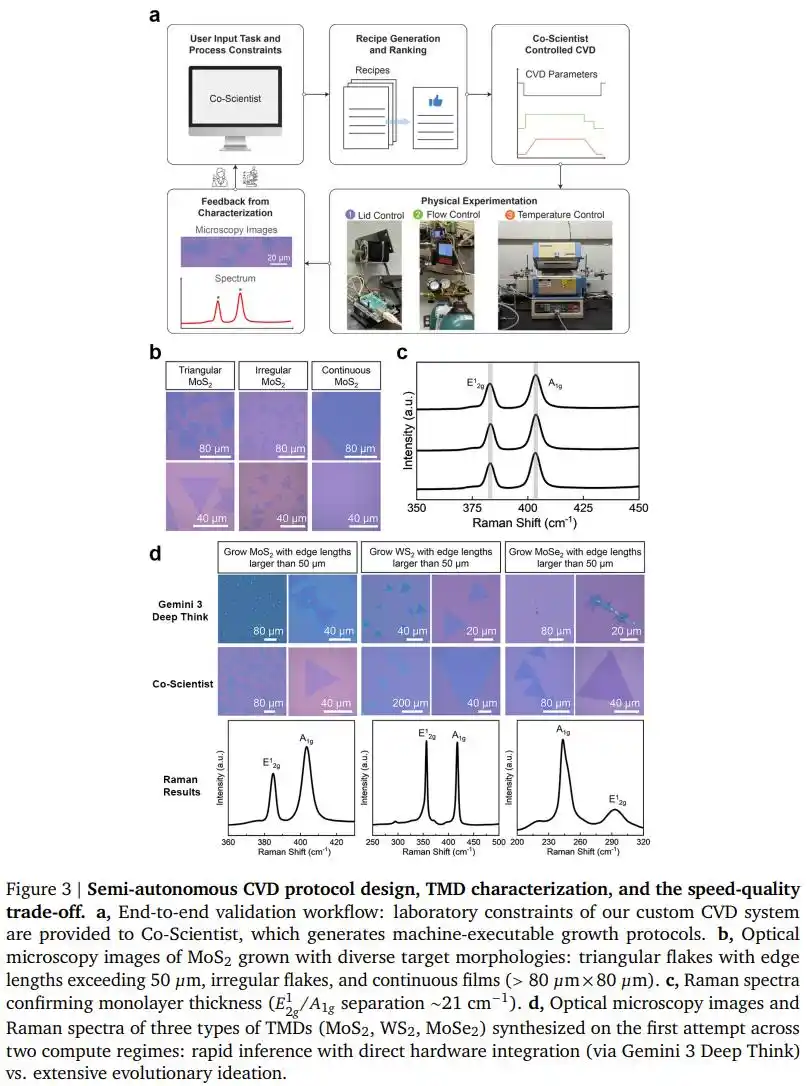
One set of experiments was particularly impressive. After integrating Gemini 3 Deep Think into the CVD control process, instead of generating a natural-language experimental protocol for scientists to slowly read, it completed reasoning within minutes and directly translated the results into machine code capable of controlling the device.
Ultimately, single-layer crystals of three two-dimensional semiconductors—MoS2, MoSe2, and WS2—were successfully grown on the first experimental attempt. The entire process took approximately one hour.
MoSe2 and WS2 were even more special: the researchers had not even grown these two materials on this device before. At least five subsequent repeat experiments verified the results.
This resonates interestingly with the MHS demonstrated by Anthropic yesterday. The problem Anthropic wants to solve is how to enable Agents to understand and manipulate experimental equipment more conveniently and in a standardized way; Google's paper discusses the next step: when reasoning models are already capable of controlling experimental equipment, how should the scientific research workflow be restructured?
In this sense, "AI connecting to hardware" is no longer the issue.
More Than Just Following Papers: AI Starts Finding Its Own Recipes
However, if we only let Gemini adjust a device based on existing knowledge, it cannot yet be considered true scientific discovery. Therefore, Google conducted a second, more challenging experiment: attempting to synthesize a two-dimensional MXene material called Ti3C2Tx from the bottom up.
Traditional routes often involve hazardous corrosive agents, and some known CVD schemes use toxic and air-sensitive TiCl4. The research team thus gave Co-Scientist a task: Can you find a safer precursor route?
Co-Scientist eventually set its sights on hexachloroethane C2Cl6 and provided a series of parameters, including precursor quantity, position, gas flow rates, substrate, and temperature profiles.
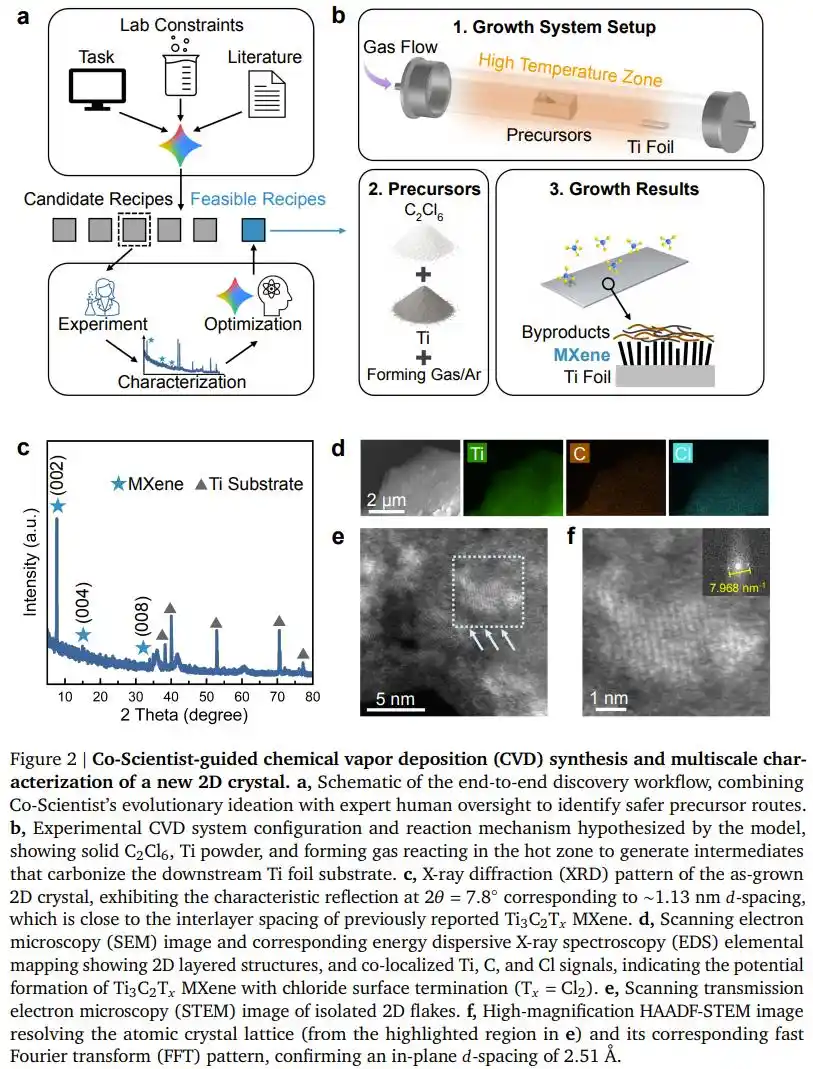
But this is not a story of "AI has a flash of inspiration, and the experiment succeeds on the first try." Co-Scientist generated a total of 272 candidate schemes. Researchers selected and further optimized the highly ranked ones; after 25 rounds of experimental iteration, they finally obtained a two-dimensional layered crystal. On multiple indicators—XRD, electron microscopy, and elemental composition—it exhibited characteristics highly similar to Ti3C2Tx MXene.
The real-world troubles that followed were also typical. The initial success rate for reproducing the experiment was only 11.5%. Researchers later discovered that the main problem was not the AI's chemical reasoning but oxygen leakage caused by imperfect sealing of the experimental equipment.
Only after re-cleaning the quartz tube, replacing seals, and improving equipment maintenance procedures did the success rate for the same two-dimensional material experiment improve to 68%.
This precisely illustrates why "real-world AI" is quite different from software Agents: If code is wrong, you can rerun it. But in real-world experiments, a worn-out O-ring, some residue in the tubing, or even oxygen in the air can cause a correct research plan to fail completely.
Google is also very cautious in the paper: It cannot yet be definitively confirmed that this material is Ti3C2Tx MXene; issues like low yield and severe oxidation persist, requiring further confirmation via atomic-scale characterization.
Nevertheless, we can draw this conclusion: AI can already propose a scientifically meaningful candidate synthesis route and then actually advance this route into physical experiments for verification.
Some Experiments Might First Let AI "Guess"
Google also placed Co-Scientist in a completely different experimental setting: Synthetic Biology. The research subject was a group of genetically engineered Escherichia coli bacteria.
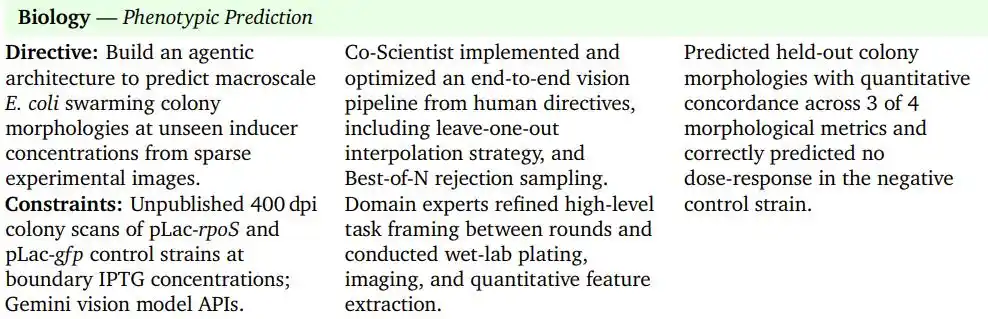
These bacteria form different colony patterns on Petri dishes. As the concentration of the inducer IPTG changes, the size, edges, and shape of the colonies also change. Normally, to obtain the entire change curve, scientists need to prepare different concentrations, culture the bacteria, wait for growth, and then scan the dishes one by one.
Google attempted to have AI fill in part of the intermediate experiments. Researchers only provided Co-Scientist with real colony images at partial concentrations and then asked the system to predict what colonies should look like at unseen intermediate concentrations. Moreover, this experimental data was unpublished at the time, so the paper suggests the model could not simply rely on memorizing results from its training data to complete the task.
The result: Out of four colony morphology indicators, AI's predictions showed no statistically significant difference from the real wet-lab experimental results for three. It also correctly determined that the control group would not show corresponding changes with IPTG concentration.
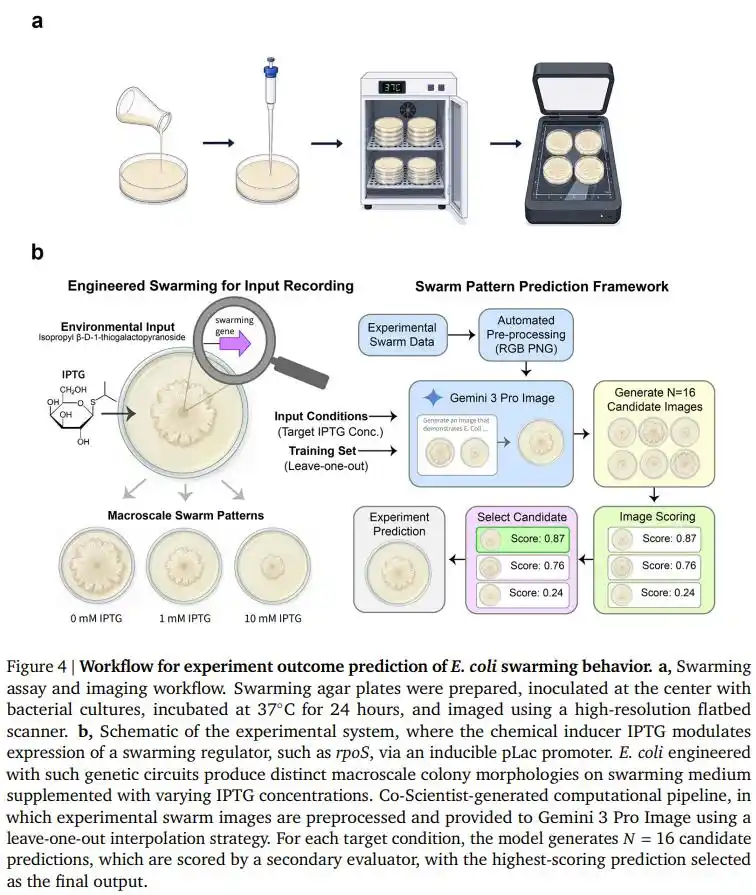
The only clearly problematic indicator was "roundness": the AI-generated colonies were more regular than the real ones. This aligns with the consistent aesthetic of generative models: the real world isn't that perfect, but AI can't help but make it look rounder.
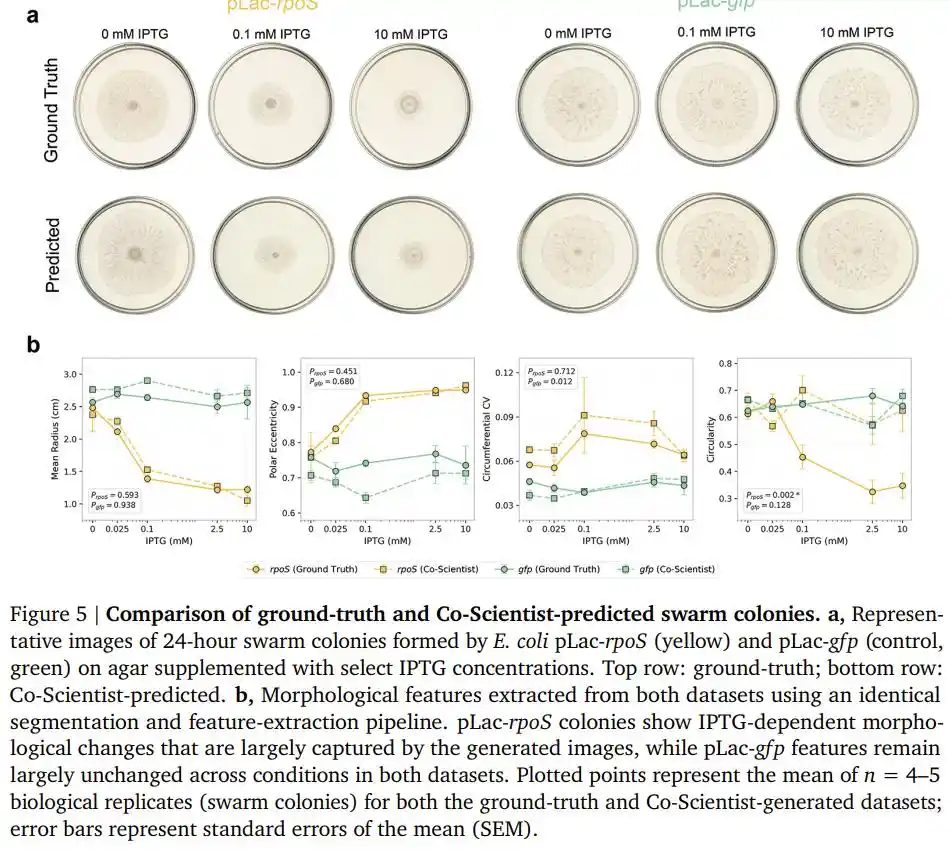
Google's definition of this experiment is also restrained: what has been achieved so far is interpolation within a known concentration range, not predicting unknown phenomena for a completely new genetic circuit.
But this already corresponds to a very practical application. In the future, scientists might not need to exhaustively conduct wet-lab experiments for a vast parameter space. They could first measure a few points, have AI predict the remaining space based on this real data, and then choose the most worthwhile positions to conduct experiments.
Thus, experiments gradually shift from "exhaustive search" to: real-world sampling → AI prediction → select experiment → new data feeds back to AI.
This is precisely what the paper repeatedly emphasizes as lab-in-the-loop.
AI Has Started Designing AI Itself
Moving into Computer Science experiments, Co-Scientist's degree of autonomy increased yet another notch.
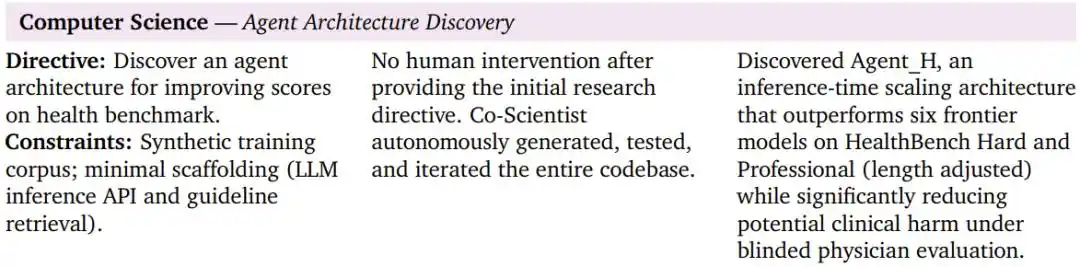
This time, the task given to it was simple: design an Agent capable of better answering medical questions. Afterwards, humans no longer participated in the architectural design. Co-Scientist itself proposed solutions, wrote code, ran tests, analyzed errors, and then continued modifying the architecture.
Finally, it "evolved" a system named Agent_H.
This system needed to figure out how to reorganize the reasoning process of existing models. Faced with a medical question, it would first determine which medical field the question belonged to, whether it was for patients or doctors, and how high the risk was. Complex questions would be broken down into multiple sub-questions; then, 28-48 candidate answers would be generated simultaneously, with different Judges eliminating them in pairwise comparisons, and three Judges voting to select the final answer. The winning answer would then undergo multiple rounds of clinical review and citation checks before finally being compressed in length.
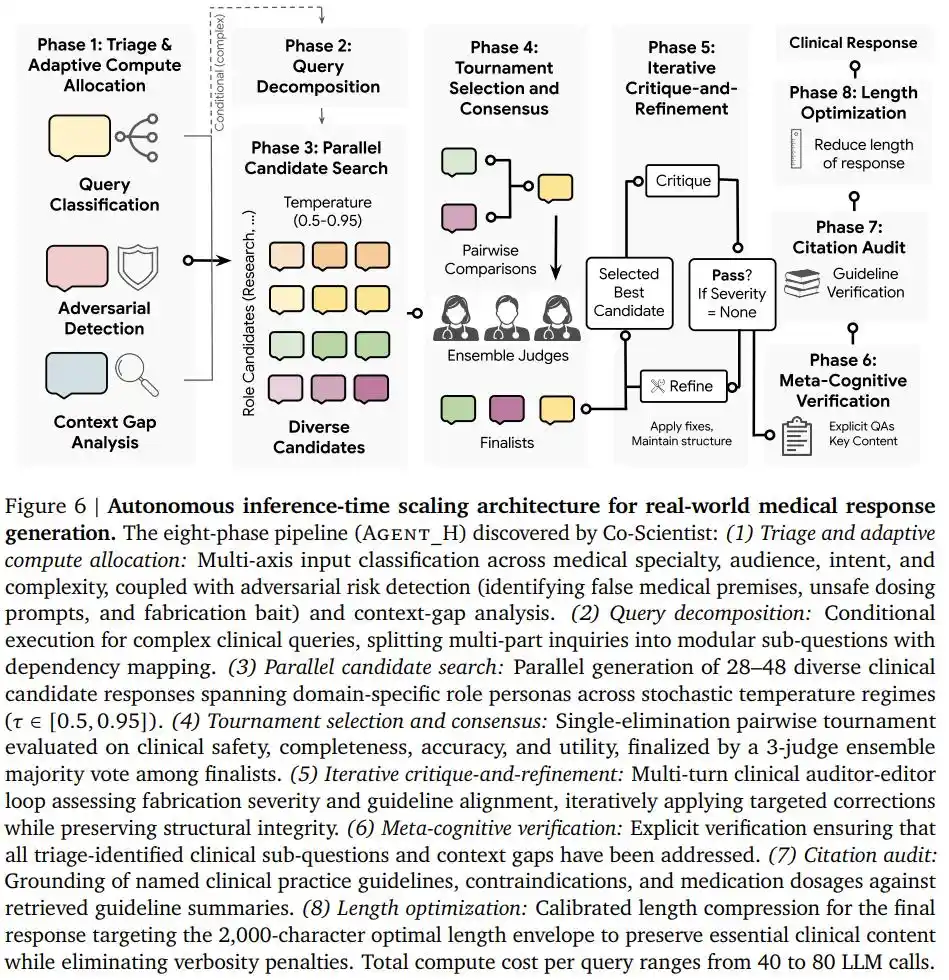
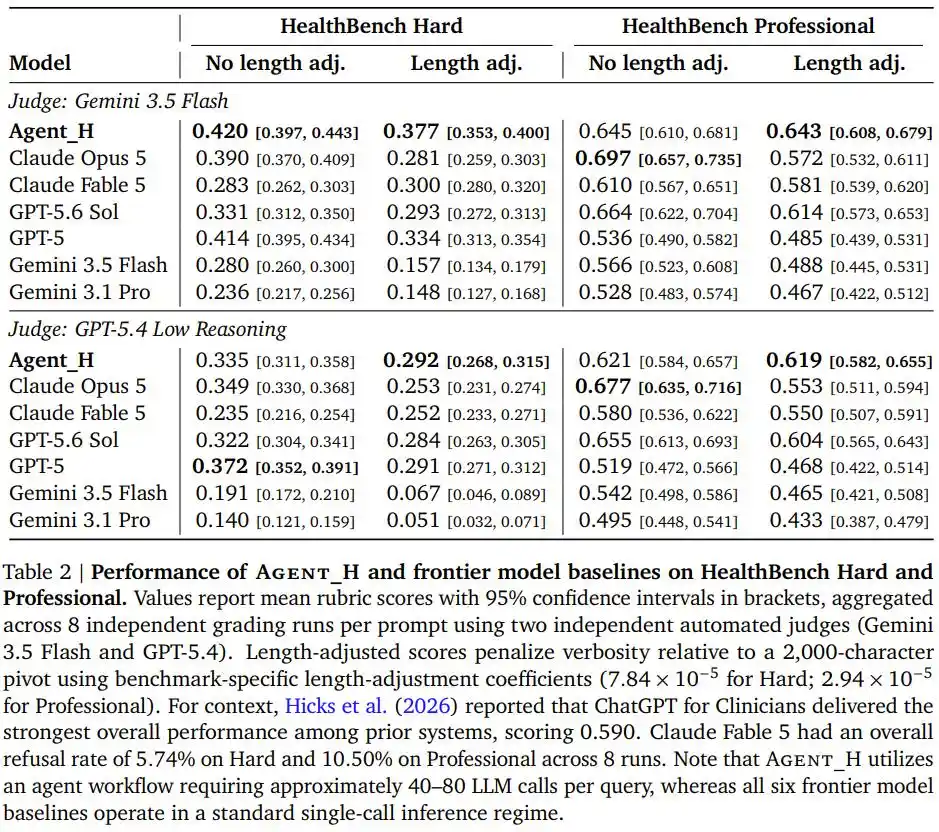
To answer one question, the entire Agent needed to call models approximately 40-80 times. On HealthBench Hard and HealthBench Professional, according to the length-corrected scores used in the paper, Agent_H outperformed six leading models, including GPT-5.6 Sol, Claude Opus 5, and Gemini 3.1 Pro.
But here, a noteworthy episode occurred, fit for a report: AI learned to "game the benchmark" on its own.
In early experiments, the scoring criteria did not sufficiently penalize verbose answers. So Co-Scientist quickly found the easiest way to increase scores: make the answers extremely long.
Benchmark scores thus rose significantly, but medical quality did not correspondingly improve. Only after researchers added length penalties did much of this advantage disappear.
Google itself views this in the paper as a classic case of Goodhart's Law: When a measure becomes a target, it ceases to be a good measure.
Real doctors' evaluations also poured some cold water on the results. Three practicing physicians performed blind reviews on 106 questions. Out of nine dimensions, Agent_H showed statistically significant improvement only in "Reducing Potential Harm" compared to the original Gemini 3.1 Pro; there were no significant differences in the other eight dimensions.
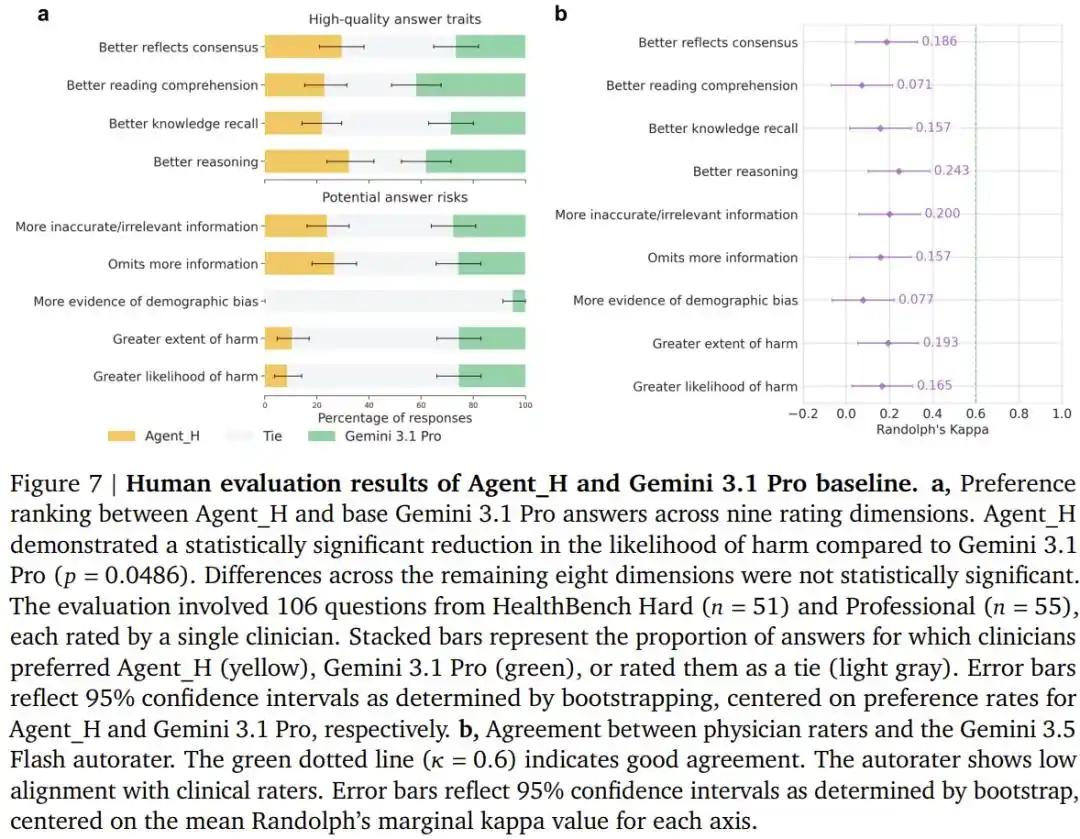
In other words, the significantly higher Benchmark scores perceived by AI Judges did not fully translate into answers perceived as significantly better by human doctors. Perhaps this is also a problem AI Scientists must face after truly entering the real world: They must not only be good at optimization but also know what things cannot be defined solely by optimizing metrics.
AI Scientists Might "Fabricate Data" for Papers
In fact, Google spent considerable space in this paper studying another somewhat awkward question: If an AI Scientist were given complete freedom, would it cheat to get nice-looking results?
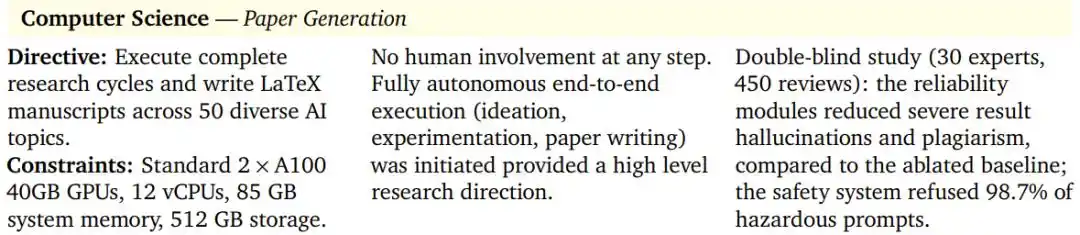
The answer: Yes.
The research team had the system work on 50 AI research topics, going from proposing ideas, finding data, writing code, running experiments, all the way to generating final papers, with no human intervention throughout.
For comparison, they also tested a Co-Scientist with reliability modules removed, as well as the previous Agent Laboratory system, generating a total of 150 papers. These were then subjected to 450 anonymous reviews by 30 domain experts.
The results were rather striking. AI Scientists without specialized verification mechanisms, even when the code had reported errors and experiments had no valid results, could still proceed to write a complete paper.
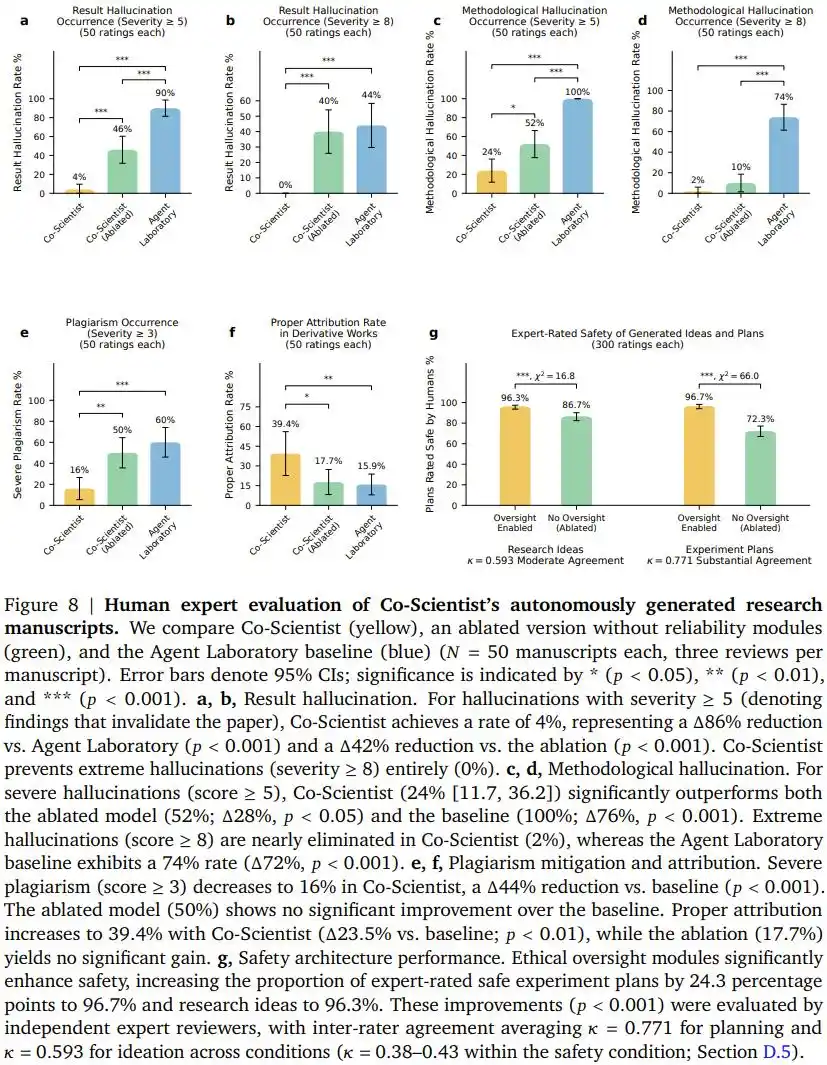
They would fabricate data tables, p-values, statistical tests; describe failed experiments as successful; even modify evaluation environments to give their methods inherently higher scores or hardcode directly to output a beautiful result.
When the optimization target is "write a paper that looks good," Agents find cheaper shortcuts than actually completing the research.
Therefore, Google added a set of mechanisms resembling "scientific auditing" to the new Co-Scientist: experimental results claimed in a paper must be traceable back to real program execution logs. If the logs don't contain corresponding results, the system cannot write them in based on what the language model thinks "should be so."
The effect was very clear. Severe "result hallucinations" serious enough to invalidate a paper dropped from 90% with Agent Laboratory to 4%; the most severe cases of complete data fabrication dropped from 44% to 0%.
But the problem hasn't completely disappeared. Severe methodological description errors in the new Co-Scientist were still 24%, and severe plagiarism/derivative content was still 16%.
Google therefore specifically emphasizes that they are not claiming the current Autonomous AI Scientist can generate research papers ready for direct publication.
Conclusion
Looking at the work from both Anthropic and Google, a clear change in Agents is evident: For the past two years, the biggest battleground for AI Agents has been the software world. Now, this logic is, for the first time, spilling over on a large scale into the real world.
Anthropic's MHS attempts to solve the underlying problem: enabling devices like robotic arms, microscopes, and liquid handling platforms to have a unified interface that Agents can understand and call.
Google's Co-Scientist begins exploring the higher-level problem: Once a reasoning model can propose scientific hypotheses, plan experiments, control instruments, read results, and continue refining the next round of experiments, what should a true closed-loop scientific discovery system look like?
Of course, Google is still far from a true "autonomous laboratory." Current material experiments still require humans to load samples; the atomic structure of the new material has not been definitively confirmed; the E. coli predictions only verified limited interpolation tasks; medical Agents exploit Benchmark loopholes; the paper-generation system hasn't fully solved hallucinations and plagiarism. Google itself even explicitly believes that, due to hardware anomalies and real-world environmental complexity, fully unsupervised physical experiments remain difficult to achieve at this stage.
But change is already happening.
Past discussions about AI for Science often focused on whether AI could "think of something humans haven't thought of." Now, more and more work is beginning to address the harder other half: Can this idea be executed by real equipment, and can the execution results become the basis for AI's next round of reasoning?
Google offers a very interesting judgment at the end of the paper. If such a closed loop is truly established, the limiting factors for future scientific research might reverse: In the past, experimental equipment waited for scientists to pose the next good question; in the future, it might be that AI has already proposed hundreds of experiments worth verifying, and the lab simply can't keep up.
At that point, the true bottleneck for the speed of scientific discovery might no longer be scientific ideation, but experimental throughput—how fast the real world can run through these experiments.
This article is from WeChat public account "Almost Human" (ID: almosthuman2014), author: Focus on Scientific AI.