STRC Trading at Significant Discount, mNAV Falls Below Break-Even, Strategy's Valuation Logic Has Been Rewritten

Foresight News2026-06-26 tarihinde yayınlandı2026-06-26 tarihinde güncellendi

Özet

Title: STRC Deeply Discounted, mNAV Falls Below Break-even, Strategy's Valuation Logic Redefined The recent volatility in MSTR and STRC highlights the need to reassess the core business model of Bitcoin reserve companies. These entities function more like leveraged, single-asset banks rather than software/tech firms. Consequently, they should be valued using banking metrics, not based on their total Bitcoin holdings. The key valuation metric is mNAV (market net asset value), akin to a price-to-book ratio. It compares the company's market capitalization to the equity value of its Bitcoin holdings after deducting all senior debt and preferred equity (like STRC). As of June 24, Strategy's mNAV was 1.10x. The focus should be on "net Bitcoin per share" (the Bitcoin claim per share after senior claims) and its growth rate, equivalent to a bank's book value and return on assets. Given STRC's 19% discount to its $100 par value (yielding 14.2%), issuing new MSTR equity at the current price to buy more Bitcoin is inefficient. It slightly dilutes the widely watched "total Bitcoin per share" metric while providing minimal improvement to the more critical "net Bitcoin per share." The article analyzes four potential uses for $1 billion in new equity: 1. **Buy Bitcoin:** Least effective. Improves net Bitcoin per share only marginally while diluting total Bitcoin per share. 2. **Repurchase STRC:** Most effective for balance sheet repair. The discount creates immediate value, increasing...


Author: Khing Oei

Compiled by: Chopper, Foresight News


Recently, the markets for MSTR and STRC have experienced significant volatility. We should look beyond short-term price fluctuations and revisit the underlying logic: Bitcoin reserve companies are essentially single-asset, leveraged holding entities, with a business model closer to that of a bank rather than a software technology company.


From a valuation perspective, the market would never price a bank based solely on its total assets. A bank's loan assets are prioritized for repayment by depositors and debt holders, with common shareholders only entitled to residual equity. Therefore, the core valuation metric for banks is the price-to-book ratio (P/B), which is the value of shareholders' equity after deducting senior debt from total assets. This is also the primary reference metric for investment bank and brokerage analysts.


For Bitcoin reserve companies, the equivalent P/B metric is mNAV: it equals the company's market capitalization divided by the equity net asset value, where equity net asset value refers to Bitcoin reserves minus debt and preferred stock senior to common shares. As of the previous close, Strategy's mNAV was 1.10x. (Translator's Note: The "previous close" data mentioned in this article refers to June 24th data.) The underlying per-share fundamental is the net Bitcoin per share—the actual amount of Bitcoin owned per share after settling priority claims. This is equivalent to the per-share book value denominated in Bitcoin. The industry-wide focus—the per-share Bitcoin growth rate—represents the return on this book value. For a capital management company, this is almost equivalent to an earnings metric.


This set of metrics is not my invention; it simply applies the traditional bank financial analysis framework to a Bitcoin balance sheet:


  • Market cap per unit of equity / Net asset value = Price-to-Book Ratio
  • Net Bitcoin holding per share = Book value per share
  • Bitcoin holding growth per share = Return on book assets


This is the valuation logic common to all leveraged financial institutions and is fully applicable to these Bitcoin reserve companies.


MSTR closed yesterday at $94.13 per share, below the total net Bitcoin value per share of $143.76, resulting in a rough total net value multiple of only 0.65x. Viewed solely through this lens, the stock trades at nearly a one-third discount to its Bitcoin asset value, making a stock issuance to buy more Bitcoin seem dilutive. However, after deducting the approximately 40% of Bitcoin equity occupied by debt and preferred stock, the current stock price represents 1.1 times the Bitcoin assets actually held by common equity. The two perspectives lead to completely opposite conclusions, and the banking valuation framework is the correct benchmark, which also determines how the company should use any new capital raised at present.


Simulating Four Use Cases for $1 Billion in New Capital


Assuming a $1 billion equity issuance at the current stock price, we simulate the effects of four potential uses for the funds: 1) Increase Bitcoin holdings; 2) Repurchase STRC; 3) Boost cash reserves; 4) A 50/50 split between repurchasing STRC and boosting cash reserves. The issuance price is $94.13 per share; yesterday's STRC closing price was $80.84, a 19% discount to its par value, translating to an actual annualized yield of 14.2%. For every $1 spent on repurchases, $1.24 of STRC at par value can be retired, simultaneously eliminating the 11.5% perpetual dividend.
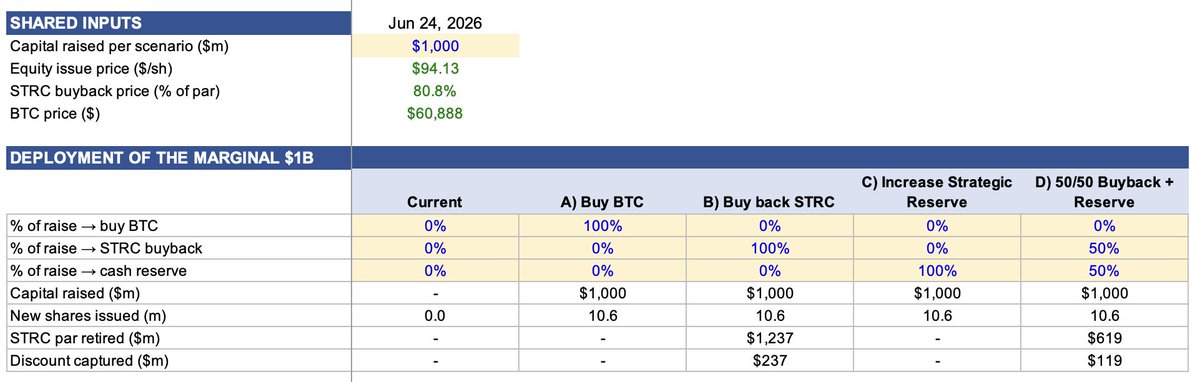


Impact of the Four Scenarios on the Balance Sheet


Three of the four scenarios do not increase Bitcoin holdings; they only adjust the structure of the senior claims layer:


Repurchase STRC: Buying back at a 19% discount, $1 billion can retire $1.24 billion of STRC at par value. Annual preferred stock dividend payments decrease from $1.711 billion to $1.569 billion.

Boost Cash Reserves: Cash reserves increase from $1.4 billion to $2.4 billion, with dividend payments unchanged.

50/50 Split Scenario: Cash increases to $1.9 billion, dividend payments decrease to $1.640 billion, and $619 million of STRC at par value is retired.

Increase Bitcoin Holdings: The only scenario that increases Bitcoin reserves, raising total holdings from 847,363 BTC to 863,787 BTC. This is also the weakest choice for improving core metrics.
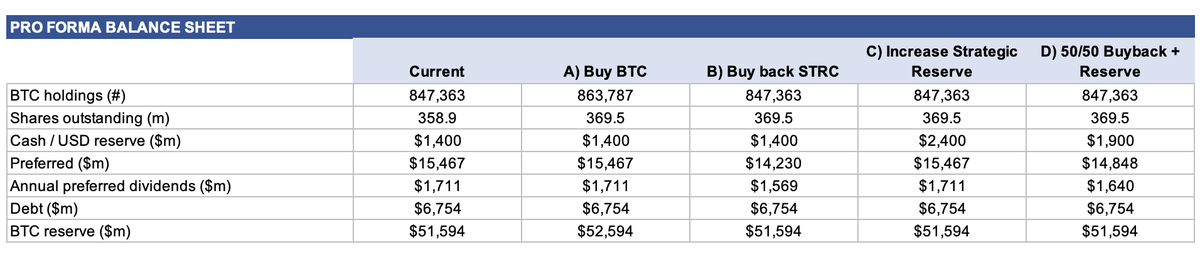


Calculating total Bitcoin value per share, all four scenarios show dilution. Even if you use the entire $1 billion to purchase Bitcoin, the per-share value decreases from 236,100 satoshis to 233,757 satoshis; in the three scenarios where stock is issued but no Bitcoin is purchased, the per-share value drops even further to 229,312 satoshis. Based on this, you would conclude: the company should do nothing.


However, in terms of net Bitcoin value per share, every option results in an increase:


  • Repurchase STRC: Net Bitcoin per share rises to 142,271 satoshis (+1.0%). Debt-to-assets ratio decreases from 40.4% to 38.0%. This provides the strongest balance sheet repair.
  • 50/50 Split Scenario: Net Bitcoin per share becomes 141,744 satoshis, with a debt-to-assets ratio of 38.2%. Cash coverage for debt service is significantly enhanced.
  • Purely Boosting Cash Reserves or Increasing Bitcoin Holdings: Both result in 141,217 satoshis per share, showing the smallest increase.


The logic for Bitcoin purchases being the least effective is clear. You are issuing stock at 1.1 times net asset value but purchasing assets at 1 times net asset value. This only slightly increases net Bitcoin per share while diluting the widely followed total Bitcoin holdings metric. In contrast, repurchasing STRC at a discount creates immediate value.


The market's current key concern is the dividend cash coverage in months. Strategy currently has $1.4 billion in cash reserves and annual STRC dividend payments of $1.711 billion, meaning cash covers only 9.8 months of dividends:


  • Increase Bitcoin Holdings: Coverage remains at 9.8 months.
  • Repurchase STRC: Improves to 10.7 months.
  • Purely Boost Cash Reserves: Significantly improves to 16.8 months.
  • 50/50 Split Scenario: Improves to 13.9 months.


This is another core banking metric: the liquidity coverage ratio. No one pays attention during loose funding cycles, but during funding contractions, it becomes crucial for corporate survival. The fact that STRC is trading below par is a direct signal of market funding channel tightening.
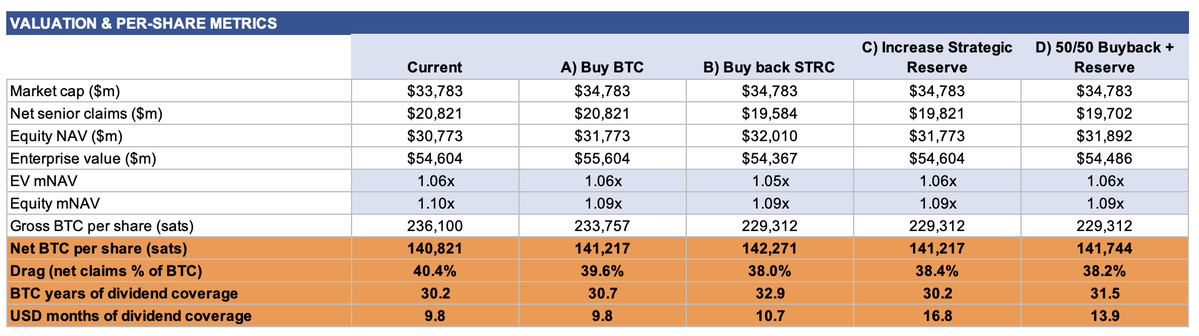


Company's Own Financial Data Also Confirms This Conclusion


The above analysis is not a subjective judgment; Strategy's Q1 earnings report provides the same break-even threshold. According to the company's own framework, selling MSTR to buy Bitcoin only increases Bitcoin per share when mNAV is above 1.22x. At the current multiple of 1x, such a move directly erodes value by 48 basis points. The company's current EV is 1.06x and mNAV is 1.10x, both below its internal break-even line.


The two core assumptions behind the company's conventional expansion path have now completely failed. Previously, it was assumed that STRC could be issued at par normally and that cash reserves could cover 1.5 years of dividends. Now, STRC trades at $81 and cannot be issued at par, and cash reserves cover less than 10 months of dividends.


What Should Strategy Do?


Within the current valuation range, issuing new equity and deploying the capital into channels that tangibly optimize core financial metrics is key. Both boosting cash reserves and repurchasing STRC at a discount can increase net Bitcoin per share, reduce the debt burden, and repair the market's concern over liquidity coverage. The 50/50 split scenario can achieve all these objectives simultaneously.


Continuing to add Bitcoin at present would only optimize the superficial metrics widely followed by the public, while neglecting the core balance sheet risk of the company carrying $15 billion in priority debt amidst tightening funding channels.


Investors focused solely on the total Bitcoin holdings metric miss the positive feedback loop. Repurchasing STRC directly supports token buy-side pressure and signals confidence in liquidity safety. Once market panic subsides, STRC prices should recover toward the $100 par value; price appreciation corresponds to lower yields, and the current high yield of 14.2% would continue to narrow. A complete positive cycle thus forms: repairing the balance sheet → STRC price recovery → dividend yield declines → the previously closed channel for par-value issuance reopens.


The STRC discount is not something that can only be passively waited out for repair; the current deep discount represents the lowest-cost capital the company can access and is key to restarting other funding channels.


To evaluate Bitcoin reserve companies, one should apply banking valuation standards: price-to-book ratio, per-share book value, and debt servicing capacity under stress environments.


Trend Kriptolar

İlgili Sorular

QWhat is the core valuation framework proposed by the author for Bitcoin reserve companies like Strategy, and why is it applicable?

AThe author proposes applying a traditional bank valuation framework. The core logic is that these companies are leveraged holders of a single asset (Bitcoin), similar to banks. The key valuation metric is the Price-to-Book ratio, represented as mNAV (market NAV), which is the company's market capitalization divided by its equity net asset value (Bitcoin reserves minus priority debt and preferred stock). This framework is applicable because it focuses on the residual equity value for common shareholders after satisfying priority claims, which is the standard way to value leveraged financial institutions.

QAccording to the author's analysis, what is the least effective use of $1 billion in new equity capital for Strategy at the current valuation, and why?

AUsing the new capital to buy more Bitcoin is the least effective option. The logic is that the company would be issuing equity at a price of 1.1x its net asset value (mNAV) but buying an asset (Bitcoin) priced at 1x its underlying value. This results in only a minimal increase in the key metric of 'Net Bitcoin per share' while diluting the more widely watched 'Total Bitcoin per share' metric. In contrast, using the capital to repurchase discounted STRC preferred shares creates immediate value by reducing debt burden and dividend obligations.

QWhat are the two core assumptions of Strategy's original expansion plan that the author states have now failed?

AThe two failed core assumptions are: 1) That STRC (the company's preferred shares) could be issued continuously at its $100 par value. Currently, it trades at a 19% discount ($81), closing this funding channel. 2) That the company's cash reserves would be sufficient to cover 1.5 years of dividend payments on those preferred shares. Currently, the cash covers less than 10 months of dividends, indicating a liquidity coverage problem.

QWhat positive feedback loop does the author describe as a potential outcome if Strategy uses new capital to repurchase STRC shares?

AThe positive feedback loop is: Repairing the balance sheet by repurchasing discounted STRC → This action supports STRC's market price → As STRC's price rises toward its $100 par value, its dividend yield falls → The previously closed channel for issuing new STRC at par value reopens. This cycle allows the company to improve its financial health and regain access to lower-cost capital.

QWhat key banking metric does the author highlight as crucial during periods of financing tightening, and what is Strategy's current situation regarding this metric?

AThe author highlights 'Liquidity Coverage' or specifically the 'Cash Dividend Coverage Months' as a crucial banking metric during financing tightening. It measures how many months of dividend payments (for priority securities like STRC) the company's cash reserves can cover. Strategy's current cash reserve of $1.4 billion covers only 9.8 months of its $1.711 billion annual STRC dividend, signaling potential liquidity stress in a tighter funding environment.

İlgili Okumalar

Airwallex's Pivot: From Dismissing Stablecoins a Year Ago to Making High-Profile Investments Today

Airwallex, a major cross-border payments fintech, has made a notable strategic shift by leading a seed round investment in Metal, a tokenized financial settlement network. This move is significant given that Airwallex founder Jack Zhang was a prominent critic of stablecoins just a year prior, arguing they failed to reduce costs for mainstream currency corridors and lacked clear utility. The investment targets Metal, a Layer-1 blockchain designed for the tokenization and settlement of assets like stocks, bonds, and stablecoins, aiming for the institutional market. Metal's team includes veterans from Ren Protocol and Meta's Diem project. For Airwallex, this partnership integrates tokenized finance into its global payments network, providing a new settlement layer. Despite his company's investment, Zhang maintains a distinction, stating his skepticism toward "cryptocurrencies" remains, while classifying regulated, asset-backed stablecoins as a separate category. This stance reflects a broader trend of traditional finance (TradFi) cautiously engaging with crypto infrastructure. Companies like Stripe, Mastercard, and major banks are similarly exploring stablecoin payments and tokenization networks, recognizing their potential in emerging markets and 24/7 settlement. The article concludes that Airwallex's investment is less a change of belief and more a strategic necessity to secure a position in the evolving landscape of digital asset settlement, where stablecoins are becoming a key interface for global finance.

marsbit33 dk önce

Airwallex's Pivot: From Dismissing Stablecoins a Year Ago to Making High-Profile Investments Today

marsbit33 dk önce

Spicy Review|Is the "Most Emotionally Valuable" Post Here? Could STRC Be the Next LUNA?

Here is an English summary of the article (under 1500 characters): This article from the spicy commentary series "LaPing" covers three key stories in the crypto world for the week. First, during a sharp market downturn in June where BTC fell over 20%, a Reddit post on r/Cryptocurrency rallying against "Fear, Uncertainty, and Doubt (FUD)" went viral. The comment section became a hub for retail traders to share memes and encouragement, with many advocating holding (HODLing) through the volatility, embodying the "be fearful when others are greedy" mantra. Second, it examines the situation with STRG (Strategy's perpetual preferred stock), which has "de-pegged," trading around $76 vs. its $100 face value, a ~25% discount. The concern is whether Michael Saylor's company, MicroStrategy, can sustain the $1.2 billion annual dividend payment, given its ~$1.4 billion cash reserve. While analysts note STRG is fundamentally different from the catastrophic LUNA collapse—as Saylor isn't obligated to pay the dividend—risks remain. If MicroStrategy's (MSTR) common stock investors feel their capital is being prioritized for STRG dividends, it could hurt MSTR demand. Third, the article analyzes the online persona of "Chuan Mu," a trader famous for turning $500 into $1 million during the 2023 ORDI inscription boom and again with short positions in 2025. An analysis of his 1,828 tweets reveals his success stems from a top-down analytical framework, asking systemic questions like "Where will the bottleneck be in the AI supply chain?" rather than chasing individual pumps. His investments migrated from crypto-linked stocks to AI infrastructure plays like SK Hynix and Samsung. However, the piece also notes criticism that he has occasionally "pumped" assets and sold positions without notifying followers, creating a contradictory public image. The weekly recap highlights themes of community sentiment during bear markets, financial instrument risks, and the complex realities of following influential online traders.

Foresight News1 saat önce

Spicy Review|Is the "Most Emotionally Valuable" Post Here? Could STRC Be the Next LUNA?

Foresight News1 saat önce

İşlemler

Spot

Popüler Makaleler

DOGE M Nedir

Doge Matrix ($doge m): Topluluk Destekli Kripto Paranın Yeni Türü Giriş Kripto para dünyası sürekli evrilen bir manzaraya sahipken, yeni projeler sürekli olarak ortaya çıkmakta ve her biri yatırımcıların ve meraklıların ilgisini çekmeyi hedeflemektedir. Bu alandaki en son katılımcılardan biri, $doge m sembolü ile temsil edilen Doge Matrix'tir. Bu proje, Dogecoin etrafındaki popüler meme kültürüne dayanan kökleri sayesinde dikkat çekmiş ve web3 alanında kendine bir yer edinmiştir. Bu makale, Doge Matrix'in genel bir analizini sunmayı amaçlamakta; genel bakış, yaratıcı, yatırımcılar, işlevsellik, zaman çizelgesi ve dikkat çekici yönleri kapsayacaktır. Doge Matrix ($doge m) Nedir? Doge Matrix, görünüşte Dogecoin'in geniş çekiciliği üzerine inşa edilen, topluluk destekli bir kripto para projesidir. Dogecoin, Shiba Inu maskotu ve meme kökenleri ile bilinen bir dijital para birimidir. Doge Matrix'in genel hedefleri geniş bir şekilde tanımlanmamış olsa da, topluluk katılımı ve desteğini kullanma taahhüdü ile karakterize edilmektedir. Geleneksel kripto paralardan farklı olarak, genellikle altyapı teknolojileri aracılığıyla fayda veya içsel değer vurgulayan Doge Matrix, kripto paraların kültürel fenomenini benimseyen bir alanda kendini konumlandırmaktadır; özellikle meme tabanlı varlıkların ethos'u ile özdeşleşenlere hitap etmektedir. Dogeoin topluluğunun güçlü yönlerinden yararlanan Doge Matrix, daha geniş bir ekosistemin parçası olarak faaliyet göstermekte ve kripto para ve dijital alanla ilgilenen kullanıcıların katılımını ve etkileşimini davet etmektedir. Doge Matrix'in ($doge m) Yaratıcısı Kimdir? Doge Matrix'in yaratıcısının kimliği bilinmemektedir. Bu şeffaflık eksikliği, bazı projelerin kurucularının kimliklerini açıklamadan başlatıldığı kripto para alanında yaygın bir durumdur. Kurucu ekip hakkında bilgi eksikliği, potansiyel yatırımcılar arasında projenin hesap verebilirliği ve yönü hakkında sorular doğurabilir. Doge Matrix'in ($doge m) Yatırımcıları Kimlerdir? Şu anda, Doge Matrix'i destekleyen yatırımcılar veya yatırım fonları hakkında kamuya açık bir bilgi bulunmamaktadır. Proje, esasen topluluk desteğine dayanmakta ve kurumsal yatırım yerine bu desteği kullanmaktadır. Bu model, girişimin topluluk destekli doğası ile uyumlu olup, projenin yönünün katılımcılar tarafından şekillendirildiği bir ortam yaratmaktadır. Doge Matrix ($doge m) Nasıl Çalışır? Doge Matrix'in operasyonel mekanizmaları ile ilgili ayrıntılar biraz belirsizdir ve bu durum, meme coin alanındaki projelerin genel bir eğilimini yansıtmaktadır; burada yenilikçi işlevsellikler her zaman net bir şekilde ifade edilmemektedir. Bununla birlikte, Doge Matrix'in mevcut kripto para ekosisteminden yararlanmayı ve kullanıcı katılımını teşvik etmeyi amaçladığı görünmektedir; ayrıca Dogecoin ile ilişkilendirilen tanıdık kültürel referansları kullanmaktadır. Potansiyel olarak benzersiz özellikleri, teknolojik ilerlemelerden ziyade topluluk etkileşimlerinden kaynaklanmakta ve token sahipleri arasında paylaşılan deneyimleri ve işbirliğini vurgulamaktadır. Kesin yenilikler açıkça belirtilmemiş olsa da, proje, topluluk üyelerinin katılabileceği, fikir paylaşabileceği ve projenin potansiyelini ileriye taşıyabileceği bir alan yaratmaktadır. Doge Matrix'in ($doge m) Zaman Çizelgesi Projenin zaman çizelgesine bakmak, şimdiye kadar tanımlayıcı olayları ortaya koymaktadır: 25 Kasım 2024: Doge Matrix, erken tarihindeki önemli bir dönüm noktası olarak tüm zamanların en yüksek değerine ulaştı. 1 Ocak 2025: Aksine, Doge Matrix tüm zamanların en düşük değerine ulaştı ve bu durum, kripto paralarla sıkça ilişkilendirilen dalgalanmayı göstermektedir; özellikle bir projenin yaşam döngüsünün erken aşamalarında. Devam Ediyor: Proje, topluluğu tarafından aktif bir şekilde işlem görmeye ve desteklenmeye devam etmekte, ancak belirli gelecekteki dönüm noktaları veya hedefler henüz açıklanmamıştır. Doge Matrix ($doge m) Hakkında Ana Noktalar Topluluk Odaklılık Doge Matrix'in merkezinde topluluk katılımına olan taahhüt bulunmaktadır. Proje, üyeleri arasında işbirliği ve ortak hedefler üzerine inşa edilmiştir ve kolektif çabanın önemini vurgulamaktadır. Genellikle tanımlı bir liderlik yapısına sahip merkezi projelerin aksine, Doge Matrix şu anda her topluluk üyesinin sesinin önemli olduğu daha akışkan bir yönetişim yaklaşımını sergilemektedir. Dalgalanma Kripto para piyasası, dalgalanması ile ünlüdür ve Doge Matrix de bu durumdan muaf değildir. Fiyat geçmişi, yüksek ve düşük değerler arasında önemli dalgalanmaları yansıtmaktadır; bu durum birçok yeni kripto para için tipik olmakla birlikte, yeni token'lara yapılan yatırımlarla ilişkili riskleri vurgulamaktadır. Ayrıntılı Bilgi Eksikliği Doge Matrix hakkında en çarpıcı özelliklerden biri, teknolojik altyapısı ve operasyonel mekanizmaları ile ilgili ayrıntılı bilginin kıtlığıdır. Bu belirsizlik, potansiyel yatırımcıların projeye katılmadan önce kapsamlı bir araştırma yapmalarını gerektirmektedir. Sonuç Özetle, Doge Matrix ($doge m), topluluk katılımı ve kültürel anlamda önem taşıyan projelerin yeni bir dalgasını temsil etmektedir. Belirli ayrıntılardan yoksun olsa da—örneğin, net bir liderlik, tanımlı hedefler ve ayrıntılı işlevsellik—proje, meme kültürünün yerleşik çekiciliğinden yararlanarak kripto topluluğunda ilgi uyandırmayı başarmıştır. Kripto para alanındaki herhangi bir yatırımda olduğu gibi, doğasında var olan riskleri anlamak ve kapsamlı bir araştırma yapmak, potansiyel katılımcılar için esastır. Doge Matrix, kripto endüstrisinin dinamik, bazen öngörülemez doğasının bir hatırlatıcısı olarak durmakta; sürekli evrim ve topluluk destekli girişimlere olan heyecan ile işaretlenmektedir.

389 Toplam GörüntülenmeYayınlanma 2025.02.03Güncellenme 2025.02.03

DOGE M Nedir

$M Nedir

Mantis'i Anlamak ($M): Zincirler Arası İşlemde Yeni Bir Dönem Web3 ve kripto para dünyasının sürekli gelişen manzarasında, yeni projeler kullanıcı deneyimini artırmayı ve merkeziyetsiz finans ekosistemindeki işlevsel olanakları genişletmeyi amaçlayan yenilikçi çözümler sunmaya çalışıyor. Dikkat çeken projelerden biri, zincirler arası etkileşim ve niyet tabanlı uzlaşma ilkeleri üzerine kurulu öncü bir protokol olan Mantis ($M). Bu makale, Mantis'in temel işlevselliği, yaratıcıları, yatırım destekleri, yenilikçi özellikleri ve kritik dönüm noktaları dahil olmak üzere temel yönlerini inceliyor. Mantis ($M) Nedir? Mantis, çok alanlı niyet uzlaşma protokolü olarak tanımlanır ve kullanıcıların çeşitli blockchain platformları arasında karmaşık finansal işlemleri sorunsuz bir şekilde gerçekleştirmelerini sağlar. Protokol, üç ana katman üzerinden çalışır: Niyet İfadesi: Kullanıcılar, DISE LLM adlı gelişmiş bir AI dil modeli aracılığıyla doğal dil kullanarak işlem hedeflerini ifade edebilirler. Örneğin, bir kullanıcı belirli bir kayma toleransı ile Ethereum (ETH) ile Solana (SOL) takası yapmak istediğini ifade edebilir. İcra: Bu katman, kullanıcı niyetlerini yerine getirmek için rekabet eden bir çözücü ağı kullanır. İşlemler, kullanıcı taleplerinin en iyi şekilde karşılanmasını sağlayan İsteklerin Tesadüfü (CoWs) ve Emir Akışı İhaleleri (OFAs) gibi mekanizmalarla gerçekleştirilir. Uzlaşma: Mantis, Inter-Blockchain Communication (IBC) protokolünü kullanarak atomik zincirler arası işlemleri mümkün kılar ve kullanıcıların Ethereum, Solana ve Cosmos dahil olmak üzere çeşitli desteklenen zincirler arasında işlem yapmalarını sağlar. Mantis, tüm süreç boyunca işlemlerin bütünlüğünü korumak için kriptografik kanıtlar kullanarak yerel getiri üretimi sunmak üzere tasarlanmıştır. Yaratıcılar ve Geliştirme Ekibi Mantis, blockchain etkileşim çözümlerine vurgu yapan araştırma odaklı bir kuruluş olan Composable Foundation tarafından tasarlanmıştır. Bu vakıf, Mantis'in mimarisi ve işlevselliğini bilgilendiren kapsamlı araştırma ve geliştirme çabalarına katkıda bulunan Harvard Üniversitesi ve Lizbon Üniversitesi gibi saygın akademik kurumlarla işbirliği yapmaktadır. Composable Foundation'ın blockchain alanında yeniliği teşvik etme konusundaki kararlılığı, Mantis'i çoklu blockchain ağları arasında artan etkileşim talebine yönelik sağlam bir çözüm olarak konumlandırmaktadır. Yatırımcılar ve Destek Bireysel yatırımcılarla ilgili belirli detaylar kamuya açıklanmamış olsa da, Mantis çeşitli kuruluşlardan önemli destek almaktadır: IBC destekli zincirlerden ekosistem hibeleri, protokolün büyümesini ve merkeziyetsiz finans ekosistemleri içindeki entegrasyonunu destekler. Altyapı sağlayıcılarıyla stratejik ortaklıklar, Mantis'in ağ yeteneklerini ve dağıtım stratejilerini geliştirmektedir. Composable Foundation'ın hazinesi aracılığıyla finansman, sürekli gelişim ve operasyonel maliyetler için sürdürülebilir finansal destek sağlamaktadır. Bu işbirlikçi çabalar, paydaşlar arasında zincirler arası işlevselliği artırmanın önemine ve Mantis'in altyapısal yeniliklerinin potansiyel faydasına dair bir uzlaşmayı yansıtmaktadır. Ana Yenilikler Mantis, işlevselliğini ve faydasını artıran birkaç öncü yenilikle kendini farklı kılar: Zincir Bağımsız Niyetler: Kullanıcılar, herhangi bir desteklenen zincirden işlem başlatabilirken, başka bir zincirde uzlaşma yapabilirler. Bu esneklik, kullanıcıları güçlendirir ve farklı platformlar arasında etkileşimi artırır. AI Destekli Arayüz: DISE LLM entegrasyonu, kullanıcıların doğal dil kullanarak karmaşık DeFi işlemleri gerçekleştirmelerini sağlar, böylece etkileşimleri basitleştirir ve blockchain teknolojisini daha geniş bir kitleye erişilebilir hale getirir. Zincirler Arası MEV Yakalama: Mantis, çözücüler arasında rekabet yoluyla maksimum çıkarılabilir değer (MEV) için iç bir pazar oluşturur. Bu yenilikçi yaklaşım, karmaşık işlemlerde daha büyük verimlilik ve değer çıkarımı sağlar. Modüler Uzlaşma Katmanı: Protokol, sıfır bilgi kanıtları ve iyimser rolluplar gibi çeşitli doğrulama yöntemlerini destekleyerek, ortaya çıkan blockchain teknolojilerine uyum sağlayabilen çok yönlü bir çerçeve sunar. Tarihsel Zaman Çizelgesi Mantis'in gelişimi, yolculuğunu ve büyümesini belirleyen birkaç kritik dönüm noktası ile işaretlenmiştir: | Yıl | Dönüm Noktası | |———–|————————————————————————–| | 2022 | Composable Foundation'ın araştırma bölümünde ilk konsept geliştirilmesi. | | Q3 2024 | Solana ve Ethereum arasında köprüleme yetenekleri ile testnet'in başlatılması. | | Q1 2025 | Ana ağ lansmanı ile birlikte beklenen Token Üretim Etkinliği (TGE). | | Q2 2025 | DISE LLM entegrasyonu ve zincirler arası yeteneklerin genişletilmesi bekleniyor. | | 2025 H2 | Daha fazla IBC güncellemeleri ile 15'ten fazla zincir için planlanan destek. | Bu zaman çizelgesi, Mantis'in evrimini, kavramsal tartışmalardan aktif uygulamaya ve gelecekteki büyüme aşamalarına kadar özetlemektedir. Ekosistem Büyüme Stratejisi Mantis'in ekosistem büyüme stratejisi, kullanıcı katılımını ve geliştirici etkileşimini teşvik etmeyi amaçlayan birkaç girişim içermektedir: Kredi Sistemi: Kullanıcılar, likidite sağlayarak ve referans programlarına katılarak protokol kredileri kazanabilirler. Bu krediler, gelecekte teşvikler için kullanılabilir, böylece güçlü bir kullanıcı topluluğu oluşturur. Modüler Yazılım Geliştirme Kiti (SDK): Bu araç seti, geliştiricilerin Mantis'in altyapısını kullanarak niyet odaklı modellere dayalı uygulamalar oluşturmasını sağlar ve böylece ekosistem içinde yeniliği teşvik eder. Yönetim Modeli: Protokol olgunlaştıkça, $M token sahipleri protokol yönetiminde söz sahibi olacak, önerilen güncellemeler ve değişiklikler üzerinde oy kullanabilecek, böylece topluluk katılımını ve merkeziyetsizliği artıracaktır. Mantis, zincirler arası mimaride önemli bir ilerlemeyi temsil etmektedir. Gelişmiş AI algoritmalarını sağlam bir uzlaşma çerçevesi ile sorunsuz bir şekilde entegre ederek, Mantis çoklu zincir ekosistemlerindeki parçalanma sorunlarını ele almayı hedeflemektedir. Yenilikçi yaklaşımı, geliştirilmiş kullanıcı deneyimlerini önceliklendirirken, merkeziyetsizlik ve güvenlik ilkelerine bağlı kalmakta ve blockchain teknolojilerinin gelecekteki etkileşimi için yeni bir standart belirlemektedir. Mantis, büyüme ve uygulama yolculuğuna devam ederken, Web3 ve merkeziyetsiz finans alanındaki rekabetçi manzarada dikkatle izlenmesi gereken bir proje olma vaadini taşımaktadır. Sınırları aşma ve kullanıcı katılımını artırma konusundaki odaklanmasıyla, Mantis kripto para alanındaki gelecekteki gelişmelerin ayrılmaz bir parçası olmaya hazırlanıyor.

45 Toplam GörüntülenmeYayınlanma 2025.03.18Güncellenme 2025.03.18

$M Nedir

M Nasıl Satın Alınır

HTX.com’a hoş geldiniz! MemeCore (M) satın alma işlemlerini basit ve kullanışlı bir hâle getirdik. Adım adım açıkladığımız rehberimizi takip ederek kripto yolculuğunuza başlayın. 1. Adım: HTX Hesabınızı OluşturunHTX'te ücretsiz bir hesap açmak için e-posta adresinizi veya telefon numaranızı kullanın. Sorunsuzca kaydolun ve tüm özelliklerin kilidini açın. Hesabımı Aç2. Adım: Kripto Satın Al Bölümüne Gidin ve Ödeme Yönteminizi SeçinKredi/Banka Kartı: Visa veya Mastercard'ınızı kullanarak anında MemeCore (M) satın alın.Bakiye: Sorunsuz bir şekilde işlem yapmak için HTX hesap bakiyenizdeki fonları kullanın.Üçüncü Taraflar: Kullanımı kolaylaştırmak için Google Pay ve Apple Pay gibi popüler ödeme yöntemlerini ekledik.P2P: HTX'teki diğer kullanıcılarla doğrudan işlem yapın.Borsa Dışı (OTC): Yatırımcılar için kişiye özel hizmetler ve rekabetçi döviz kurları sunuyoruz.3. Adım: MemeCore (M) Varlıklarınızı SaklayınMemeCore (M) satın aldıktan sonra HTX hesabınızda saklayın. Alternatif olarak, blok zinciri transferi yoluyla başka bir yere gönderebilir veya diğer kripto para birimlerini takas etmek için kullanabilirsiniz.4. Adım: MemeCore (M) Varlıklarınızla İşlem YapınHTX'in spot piyasasında MemeCore (M) ile kolayca işlemler yapın.Hesabınıza erişin, işlem çiftinizi seçin, işlemlerinizi gerçekleştirin ve gerçek zamanlı olarak izleyin. Hem yeni başlayanlar hem de deneyimli yatırımcılar için kullanıcı dostu bir deneyim sunuyoruz.

473 Toplam GörüntülenmeYayınlanma 2025.07.02Güncellenme 2026.06.02

M Nasıl Satın Alınır

Tartışmalar

HTX Topluluğuna hoş geldiniz. Burada, en son platform gelişmeleri hakkında bilgi sahibi olabilir ve profesyonel piyasa görüşlerine erişebilirsiniz. Kullanıcıların M (M) fiyatı hakkındaki görüşleri aşağıda sunulmaktadır.

活动图片