Tiger Research: Zuckerberg Begins Betting on Prediction Markets, While Asian Nations Still View Them as Gambling

marsbit2026-07-11 tarihinde yayınlandı2026-07-11 tarihinde güncellendi

Özet

This article examines the rise of prediction markets, contrasting their growing institutional acceptance in the West with their restrictive regulation in Asia. It details how prediction markets, which originated from informal political betting and academic experiments like the Iowa Electronic Market, aggregate crowd wisdom into probabilistic prices through binary contracts. Their growth accelerated around 2020, reaching over $14 billion in monthly volume. A key driver is the "skin in the game" principle, where users risk their own capital, leading to high accuracy in predicting events like Fed rate decisions and elections, as demonstrated by platforms like Polymarket. Meta's entry, with Mark Zuckerberg reportedly leading the development of the Arena app, signals the market's maturation. In the U.S., court rulings have distinguished prediction markets from gambling, facilitating entry by traditional financial institutions. However, most Asian jurisdictions still classify them as gambling, focusing on social control rather than financial innovation. The article argues this stance creates three problems for Asia: 1) regulatory arbitrage pushes users to riskier offshore platforms, 2) loss of sovereign information infrastructure as valuable social sentiment data accumulates abroad, and 3) abandonment of user protection. It concludes that Asia needs a policy shift from prohibition to constructive regulation, integrating these markets into the formal system to harness their data a...

Prediction markets have largely remained conceptual for years. Circa 2020, the situation began to change. A few small-scale projects started accumulating significant trading volume and broke through regulatory hurdles one by one, marking the formal formation of prediction markets as an industry.
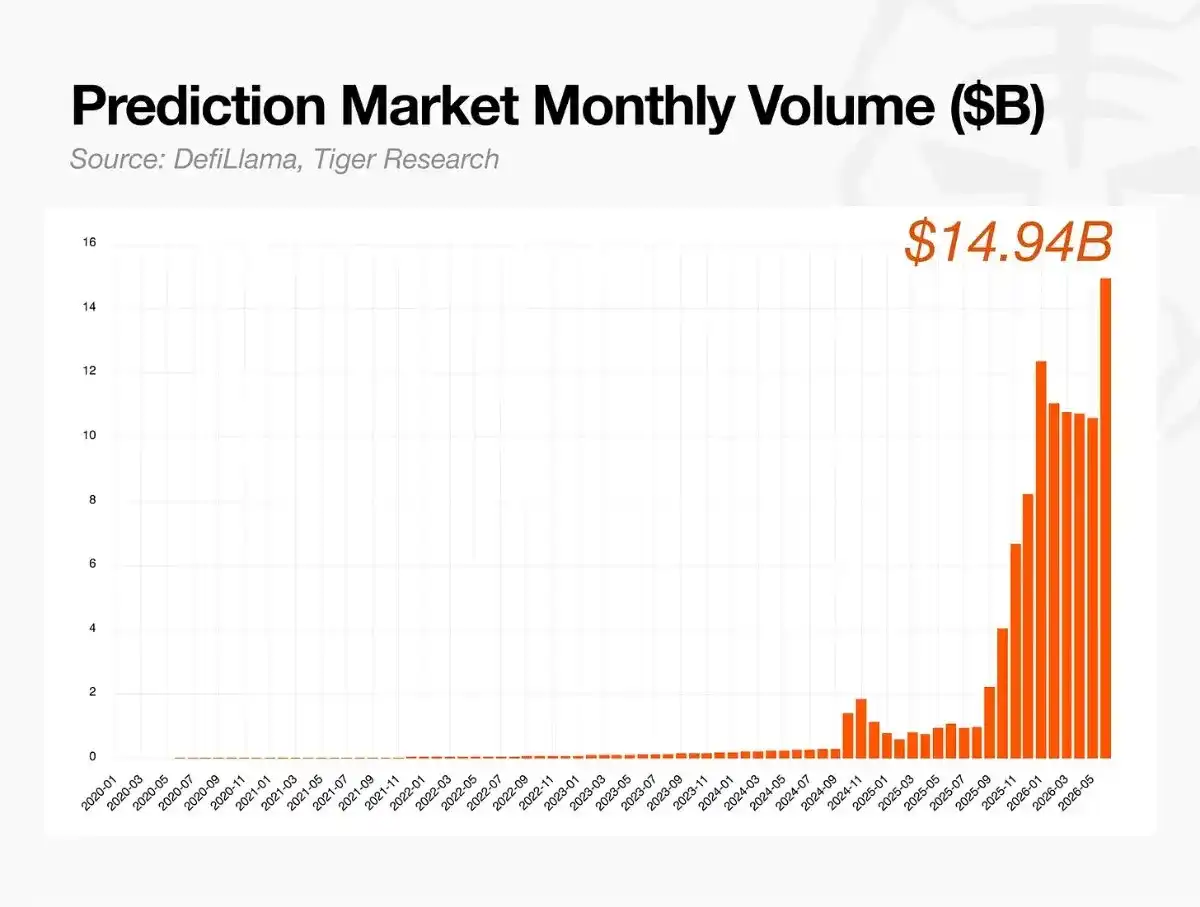
Since then, growth has accelerated. Current monthly trading volume exceeds $14 billion, and the combined valuation of major platforms is approximately $40 billion.

Meta's entry further proves it has moved beyond the early stage. A recent report by The New York Times revealed that Mark Zuckerberg personally leads a team developing a prediction market application called Arena. The dedication of such resources by a major tech company indicates this industry has left the experimental phase and established a proven business model.

Where Did Prediction Markets Originate?

Prediction markets are not a new phenomenon. They have been used informally in academia and finance for decades before blockchain technology brought them to the masses and helped them form an industry.

Informal Use

The term "prediction markets" itself emerged later than its history. By the 1980s, this concept went by various names such as information markets, decision markets, until a 2004 economics paper solidified it as "prediction markets."

However, the underlying practice predates the name. The earliest form was political betting on election outcomes. In 18th-century London coffee houses, people placed bets on parliamentary scandals and prime ministerial changes, with the resulting odds sometimes appearing in newspapers. In 19th-century New York, informal futures markets predicting presidential election outcomes were active in over-the-counter markets near Wall Street.

Academic Use
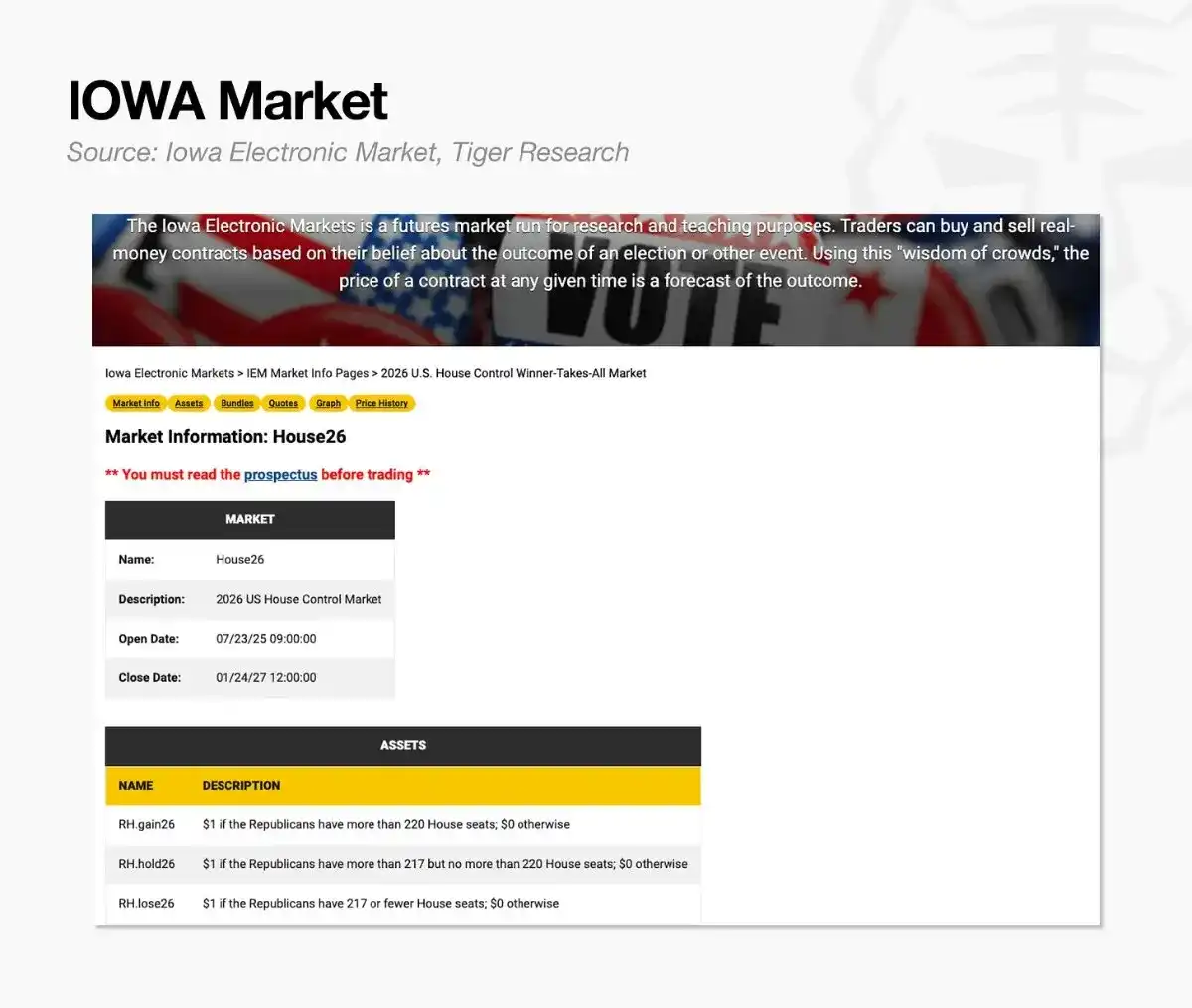
The academic starting point was three economists at the University of Iowa in 1988. Puzzled by polls failing to predict Jesse Jackson's win in the Michigan primary, they designed a market where people could directly trade election outcomes. This later became the Iowa Electronic Market (IEM).

In 1992 and 1993, the IEM received approval from the Commodity Futures Trading Commission (CFTC) for research purposes. Anyone could participate with $5. From 1988 to 2004, the IEM outperformed traditional polls about three-quarters of the time, serving as a laboratory for aggregating collective judgment into prices. Nonetheless, there was no regulatory framework at the time to allow its operation as a public market.

Binary Options

These early prediction markets closely resembled binary options in financial markets: contracts that are yes-or-no bets on whether a price would breach a certain threshold within a specified time. Their structure—settling at 1 if the event occurs, otherwise 0—is completely consistent with the logic of prediction markets.

Binary options also entered regulated exchanges. Examples include the Fixed Return Options by the American Stock Exchange in 2007 and S&P 500-based binary options by the Chicago Board Options Exchange in 2008. However, frequent fraud by offshore platforms led to bans on selling such products to retail investors in several major jurisdictions between 2017 and 2021. Despite this, this basic yes-or-no binary betting structure remains the logical foundation for how prediction markets operate today.

How Are Prediction Markets Traded Today?

Today, prediction markets cover topics encompassing almost any imaginable event.

Sports events account for the largest trading volume, benefiting from continuous schedules of leagues and global tournaments. The ongoing World Cup has further heightened the heat. Politics, geopolitics, and macroeconomics have expanded from indicators like inflation data to predictions on private company valuations, turning information itself into a tradable asset. Cryptocurrency and stock prices, along with some gossip-driven events, collectively form a complete spectrum from mass interest to professional information demand.
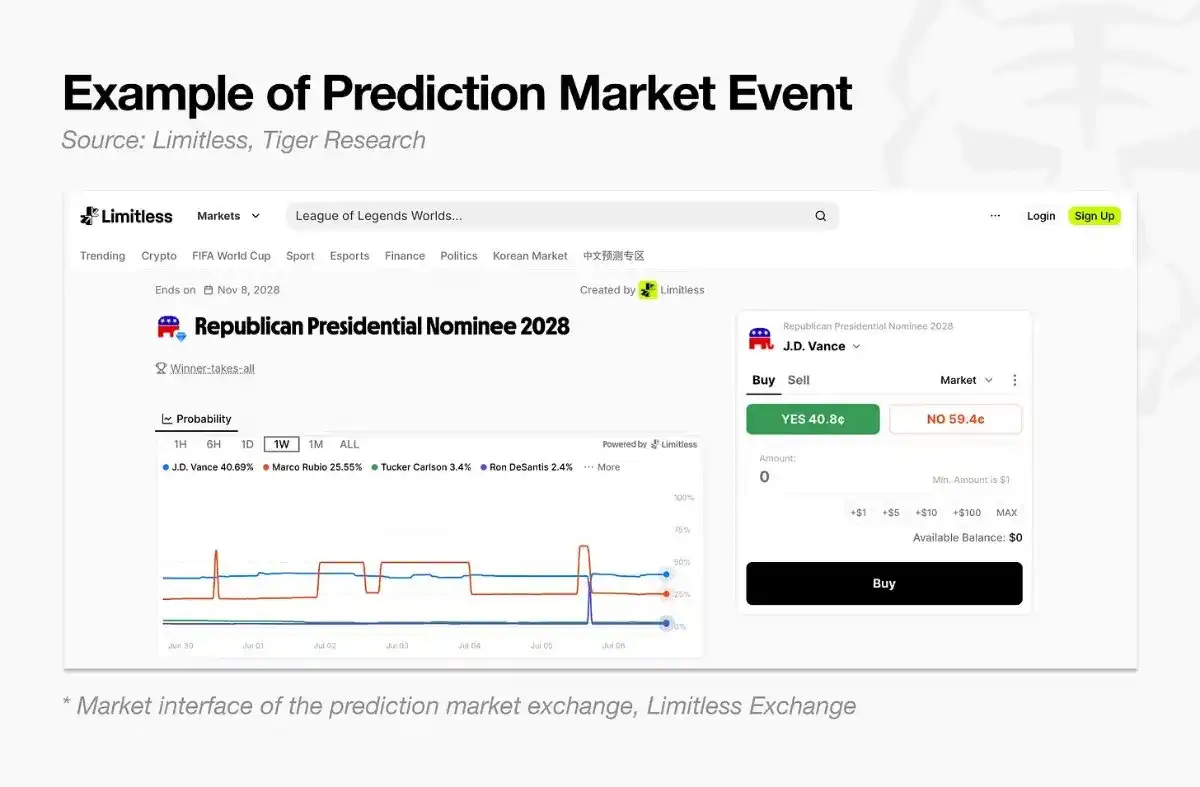
Each contract settles in a binary yes-or-no manner. Taking "Will J.D. Vance be the Republican presidential nominee in 2028?" as an example: If Vance is confirmed as the nominee, contracts betting "Yes" pay $1; otherwise, contracts betting "No" pay $1.

The simplest way to understand this structure is to think of $1 as 100%. A contract pays $1 (100%) if the event occurs, otherwise $0, so the intermediate trading price naturally reflects probability. A contract at 40 cents represents 40% of that dollar, meaning the market perceives a 40% probability of the event occurring. The cent value can be directly read as a percentage (ignoring bid-ask spreads and transaction costs).

Prices are formed through order books, not determined by any central party. Buy orders (e.g., buy at 39 cents) and sell orders (e.g., sell at 40 cents) accumulate at various price levels, with trades executed where both sides match. The price (and thus the implied probability) is generated in real-time by the interplay of funds from numerous participants. Traders can also sell their positions before expiration to lock in profits or cut losses, essentially exchanging their view on an event for cash.

Outcomes are recorded by oracles. No matter how precise a contract's price, someone still needs to determine "Yes" or "No" after the event concludes. Oracles are the mechanisms responsible for this judgment.
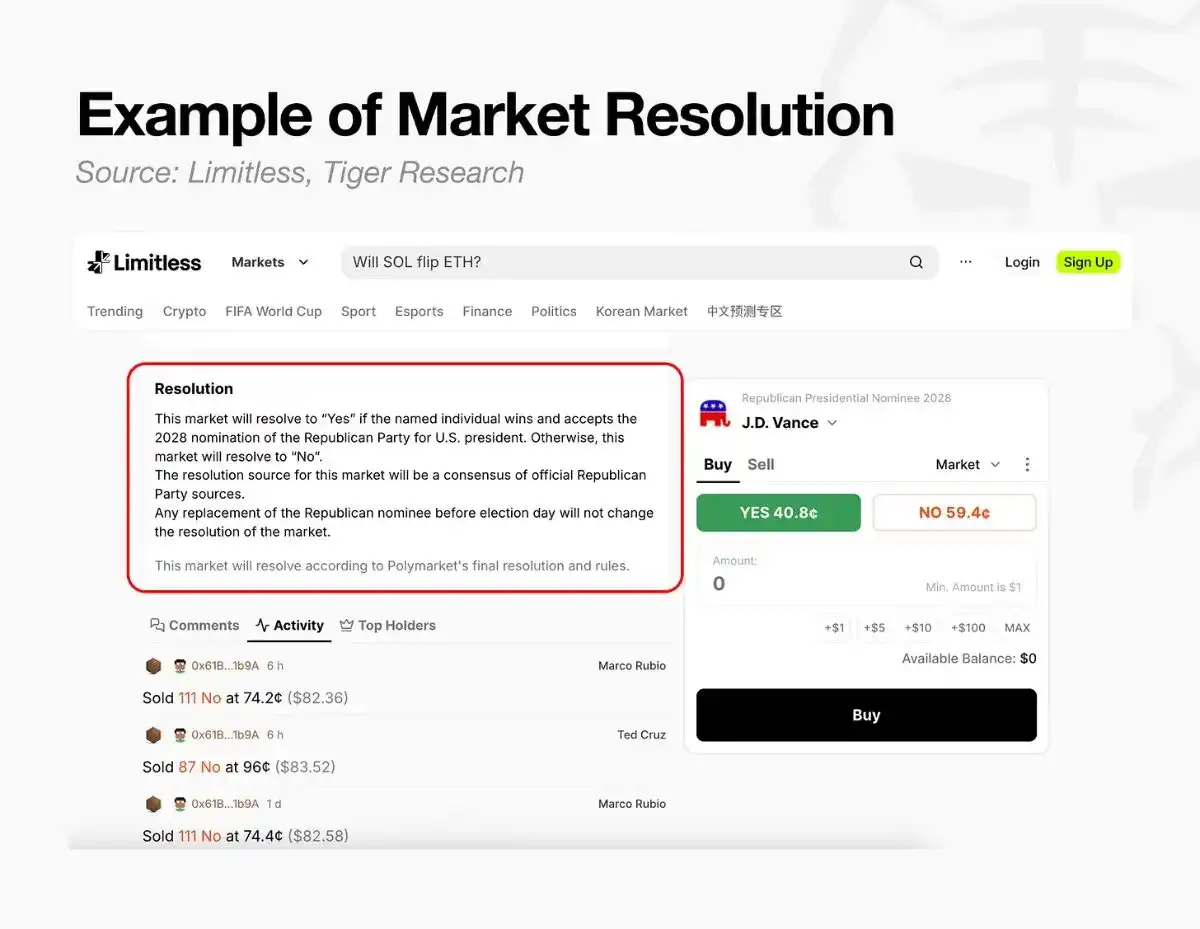
Oracles operate in two main ways:

  • Decentralized Oracles: Proposers stake collateral and submit a proposed outcome. If unchallenged within a set period, it becomes the final result. If challenged, a re-proposal process begins, and only after further challenges does it proceed to voting.
  • Centralized: Judgment criteria are set in advance. After the event concludes, the exchange directly applies the official result and immediately settles the market. This approach vests judgment authority entirely in a single exchange.

For example, on the Limitless platform, once a deadline passes, results are finalized according to preset rules. Reporting of real-world outcomes to the blockchain is completed by oracle services: most markets tracking crypto or stock prices report automatically via the Pyth Network, while custom markets for sports or politics are judged manually by an operations team within 24 to 72 hours.

At its core, a prediction market is an information system. It compresses the views of a large number of participants into a single number reflected in the price and, after the event, judges whether the prediction was correct based on preset rules.

The Evolution from Game to Information Finance

Prediction markets have evolved beyond simple betting platforms to become core infrastructure for information finance—turning future uncertainties into real-time price information. Their fundamental difference from traditional polls or expert forecasts lies in the "skin in the game" mechanism, where participants back their positions with their own capital.

In traditional methods, experts face little reputational cost for being wrong, and polls cannot filter out respondents' indifference or strategic misrepresentation. Prediction market prices carry a real cost for error—mistaken positions lose money—forcing participants to verify their beliefs with the most objective, up-to-date information. This willingness to bear a cost translates directly into market reliability.

This mechanism's performance is evident in multiple areas of real-world data:

Accuracy in Financial & Monetary Policy Predictions: Research by a Federal Reserve economist in February 2026 explains why. Since 2022, prediction market expectations for interest rates ahead of FOMC meetings have shown a statistically high degree of consistency with actual outcomes, outperforming federal funds futures and Bloomberg consensus. The reason is that participants immediately lose money if they are wrong, prompting stricter analysis of available information and pricing accordingly.

Transparent Probability Estimates for Politics & Elections: In South Korea's local elections in June 2026, Polymarket correctly predicted the winners in 14 out of 16 major cities and provinces. Where exit polls could only say "too close to call," prediction markets offered real-time probabilities backed by participants' real money, representing the aggregated judgment of numerous participants synthesizing multiple variables, not a simple forecast.

Responsiveness to Market Events & Company Valuations: When the issue of a stablecoin interest income cap emerged in March 2026, prediction markets immediately priced the probability of a Coinbase stock drop at 97.6%, serving as a real-time risk indicator rather than post-hoc analysis, demonstrating participants' sensitive response when their own capital is at risk. Academic research has reached similar conclusions: a 2015 study on internal prediction markets at companies like Google and Ford found prediction errors reduced by up to 25% compared to official forecast models, indicating prediction accuracy improves when insider knowledge is combined with capital at risk.

Information asymmetry remains a limitation. The Venezuela case in January 2026, where someone used confidential information for insider trading, exposed a real weakness. However, this attempt to distort prices was identified and prosecuted as a crime, also proving that markets aim to operate with transparency and accountability.

In areas where information is widely distributed, prediction markets are precision analytical tools; in areas where information is concentrated in few hands, they are monitoring mechanisms capable of identifying that concentration. Because participants' capital is genuinely at risk, the prices generated by these markets constitute objective information for assessing the value of financial assets.

The Absence of Prediction Markets in Asian Policy Discussions

The nature and trajectory of prediction markets vary greatly depending on national regulatory frameworks. The United States incorporated them into the regulated financial system through judicial rulings, while major jurisdictions in Asia still largely categorize them as traditional gambling.

In the U.S., litigation resolved much of the regulatory uncertainty. The CFTC attempted to classify Kalshi's election prediction contracts as gambling and sanction the platform, but courts ruled election prediction is not a game of chance, and regulators lacked the authority to ban it. This ruling shifted the regulatory stance, serving as a decisive catalyst for the entry of traditional financial institutions including ICE, Robinhood, and CME.

In contrast, in major Asian jurisdictions, the mainstream view still equates the binary settlement structure of prediction markets with traditional gambling. The dominant regulatory perspective is gambling control and public order, not financial policy. While approaches differ by country, prediction markets largely remain outside formal policy discussions in the region, with India and Indonesia being exceptions.

This divergence in treatment ultimately boils down to whether regulators view the market as a financial innovation or a social control issue.

Prediction Markets at a Crossroads: Regulatory Dilemma and Institutionalization

Prediction markets have become a core part of global financial and information infrastructure. A significant gap has emerged between the global trend and the rigid stance of Asian regulators. In an era where technological and financial boundaries have largely dissolved, attempts to confine new markets within old regulatory frameworks have inherent limitations. The current regulatory approach in major Asian jurisdictions faces three major problems.

The first is the paradox of regulatory arbitrage.

Prediction markets operate on borderless digital networks. Blocking platforms or restricting users in one country does not eliminate underlying demand. Users migrate to unregulated offshore platforms, assuming greater risks. This leads to capital outflow from the jurisdiction, with regulators losing both market oversight and associated tax revenue, weakening regional financial competitiveness in the long run.

The second is the loss of national information infrastructure sovereignty.

Prediction markets are advanced information infrastructure that translates complex social questions into precise numerical estimates, not merely betting venues. Recent elections in Asia have shown prediction markets reading public sentiment faster and more accurately than traditional polls. When excluded under the guise of regulation, the data that best reflects a society's mood accumulates on foreign servers. The result is that foreign media and institutions gain clearer insights into local societies than domestic analysts.

The third is the abandonment of user protection.

Users are in a blind spot, with no institutional safeguards. Policies that simply deny the market's existence without sufficient prior discussion only expose users to risk and push them outside the system.

The focus of discussion needs a fundamental shift.

The question is no longer how to block this market, but how to healthily utilize this data within the formal system. This shift in perspective requires dedicated study, yet related discussions remain limited.

In this field, Limitless Research is filling the gap, processing prediction data from Asian markets like South Korea and Japan into information assets. More participants are needed in the future to take on the role of building a healthy data ecosystem.

Regulation should not be a dam blocking the flow of water, but a channel to guide it correctly.

What Asia needs now is not stricter enforcement, but to initiate forward-looking discussions in response to this shift. Pushing transactions that are already happening into the shadows is the worst policy. It requires sustained effort to bring them into the formal system through constructive discussion, establish transparent oversight mechanisms, and return the data generated in the process as assets for the nation and society.


Trend Kriptolar

İlgili Sorular

QWhat is the key milestone that signals the prediction market industry has moved beyond its conceptual phase and is now a verified business model?

AThe entry of a major tech company like Meta, with Mark Zuckerberg personally leading the development of a prediction market app called Arena, serves as the key milestone indicating the industry has moved beyond experimentation and established a verified business model.

QHow is the probability of an event reflected in the trading price of a prediction market contract?

AThe trading price directly reflects the implied probability. A contract price of 40 cents, for example, represents 40% of the $1 maximum payout, meaning the market assesses a 40% probability of the event occurring. The cent value can be read directly as a percentage probability.

QWhat is the fundamental mechanism that distinguishes prediction markets from traditional polling or expert forecasts in terms of accuracy?

AThe fundamental mechanism is 'skin in the game,' where participants risk their own capital. This creates a real financial cost for being wrong, forcing participants to use the most objective and up-to-date information to validate their beliefs, which translates directly into market reliability and superior accuracy compared to methods without financial accountability.

QHow does the regulatory approach to prediction markets differ between the United States and most major Asian jurisdictions?

AIn the United States, legal rulings have integrated prediction markets into the regulated financial system (e.g., a court ruled election prediction is not gambling). In contrast, most major Asian jurisdictions still classify them as traditional gambling, focusing on gambling control and public order rather than financial policy innovation.

QWhat are the three main problems identified with the current restrictive regulatory stance of major Asian jurisdictions towards prediction markets?

AThe three main problems are: 1) The paradox of regulatory arbitrage, where users migrate to riskier offshore platforms, causing capital flight and loss of oversight. 2) The loss of national information infrastructure sovereignty, as valuable social sentiment data accumulates on foreign servers. 3) The abdication of user protection, as users are pushed into unregulated spaces without institutional safeguards.

İlgili Okumalar

Ethereum's Next Decade in the Eyes of Vitalik

"Lean Ethereum" Long-Term Roadmap Unveiled by Vitalik Buterin On July 5, 2026, Vitalik Buterin published the "Lean Ethereum" roadmap, positioning it as Ethereum's third major evolution following the Merge. This multi-year, multi-phase upgrade aims to fundamentally transform Ethereum's core protocol through staged network upgrades extending to 2029. Key goals include achieving 1 gigagas per second L1 throughput (a massive increase from the current ~32 TPS), near-instant finality, and quantum-resistant cryptography. The plan involves transitioning Ethereum's security model from full transaction re-execution by all nodes to native verification via recursive STARK proofs. A major proposed change is replacing the EVM with a proof-friendly architecture like RISC-V or leanISA, though this remains a point of contention, especially with L2s like Arbitrum favoring alternatives like WASM. Other planned upgrades include a restructured state model with a large, cheap "warehouse" storage layer to drastically reduce fees for migrated applications, multi-dimensional gas pricing, and a new focus on making privacy a first-class, native protocol feature. While the roadmap significantly raises Ethereum's long-term technical ceiling, analysts note it does not directly address ETH's mid-term token economics or value capture. The plan's multi-year timeline means near-term price impact will likely depend on observable progress milestones, such as the successful deployment of the upcoming Glamsterdam gas limit increase, growth in L2 activity and blob usage, and trends in L1 fee revenue and ETH burn.

链捕手3 saat önce

Ethereum's Next Decade in the Eyes of Vitalik

链捕手3 saat önce

In Just 11 Days, Claude Rewrote Millions of Lines of Code, an Epic AI Engineering Feat Sparks Fury

In just 11 days, Bun's founder Jarred Sumner used Anthropic's Claude AI models to rewrite its million lines of code from Zig to Rust. This move sparked significant controversy, particularly from Zig's creator, Andrew Kelley, who publicly criticized Sumner's engineering practices and the decision to use AI for such a massive rewrite. Bun, a high-performance JavaScript/TypeScript runtime and rival to Node.js, was originally written in Zig. After Anthropic acquired Bun, the team encountered persistent stability and memory safety bugs in the Zig codebase. These issues, combined with Zig's strict policy against LLM-generated code, led to the decision to rewrite in Rust. The rewrite was executed using Claude AI tools at an estimated API cost of $165,000, dramatically reducing the expected time and financial cost. Andrew Kelley's response was scathing. He blamed the original bugs on poor engineering habits, calling Bun's Zig code a collection of "hacks on top of hacks." He expressed relief that Bun was no longer associated with Zig, fearing it would misrepresent the language and attract low-quality, AI-generated contributions. The tech community is divided; some view Kelley's critique as unprofessional, while others see it as a defense of engineering integrity. A major concern about the AI-driven rewrite is the resulting code quality. The translation from Zig left approximately 27,000 lines of unsafe Rust code, raising fears about long-term maintainability and technical debt. The debate centers on whether this project is a milestone in AI-assisted development or a future maintenance nightmare.

marsbit4 saat önce

In Just 11 Days, Claude Rewrote Millions of Lines of Code, an Epic AI Engineering Feat Sparks Fury

marsbit4 saat önce

From Auto Finance to Bitcoin to AI Engines: An Analysis of Cango's 'What Not to Do' Strategy

From Auto Finance to Bitcoin and Now AI: Cango's "What Not to Do" Strategy Cango, a Chinese auto finance platform that went public on the NYSE in 2018, is undergoing its third major transformation. After selling its entire auto business in 2024, it pivoted to become a large-scale Bitcoin miner, acquiring 50 exahash of mining rigs from Bitmain. However, its true goal was never Bitcoin, but owning and controlling energy infrastructure. Now, Cango is pivoting again. While most listed Bitcoin miners are leasing power to giant hyperscalers for AI training clusters, Cango is taking the opposite path. It has launched an AI inference subsidiary called EcoHash, focusing not on training but on distributed inference. The company's strategy hinges on the insight that over 70% of mining industry power is controlled by small, independent sites (10-50 MW), which are too small for hyperscalers but ideal for low-latency AI inference. Cango aims to partner with these small operators, providing the AI technology, customers, and financing through its EcoLink software layer, which can distribute workloads across sites for reliability. Cango maintains a hybrid model, running roughly 31.7 EH/s of Bitcoin mining for cash flow while aggressively cleaning its balance sheet—slashing long-term debt by 94.5% to $30.6 million and raising $75 million for its AI venture. Its first AI deployment will be at a 50 MW site in Georgia. The strategy faces skepticism, given the high costs of converting mining sites and the potential for an AI bubble. However, Cango's leadership believes discipline around "what not to do"—avoiding direct competition with hyperscalers in training—positions it to capture the long-tail demand for distributed AI inference power.

Foresight News5 saat önce

From Auto Finance to Bitcoin to AI Engines: An Analysis of Cango's 'What Not to Do' Strategy

Foresight News5 saat önce

İşlemler

Spot

Popüler Makaleler

$S$ Nedir

SPERO'yu Anlamak: Kapsamlı Bir Genel Bakış SPERO'ya Giriş İnovasyonun manzarası gelişmeye devam ederken, web3 teknolojilerinin ve kripto para projelerinin ortaya çıkışı dijital geleceği şekillendirmede önemli bir rol oynamaktadır. Bu dinamik alanda dikkat çeken projelerden biri SPERO, $$s$$ olarak adlandırılmaktadır. Bu makale, SPERO hakkında ayrıntılı bilgi toplamak ve sunmak amacıyla, meraklılar ve yatırımcıların web3 ve kripto alanlarındaki temellerini, hedeflerini ve yeniliklerini anlamalarına yardımcı olmayı amaçlamaktadır. SPERO,$$s$$ Nedir? SPERO,$$s$$, kripto alanında merkeziyetsizlik ve blok zinciri teknolojisi ilkelerini kullanarak etkileşimi, faydayı ve finansal kapsayıcılığı teşvik eden bir ekosistem yaratmayı amaçlayan benzersiz bir projedir. Proje, kullanıcıların yenilikçi finansal çözümler ve hizmetler sunarak eşler arası etkileşimleri yeni yollarla kolaylaştırmayı hedeflemektedir. SPERO,$$s$$'nin temel amacı, bireyleri güçlendirmek ve kripto para alanındaki kullanıcı deneyimini artıran araçlar ve platformlar sağlamaktır. Bu, daha esnek işlem yöntemlerini mümkün kılmayı, topluluk odaklı girişimleri teşvik etmeyi ve merkeziyetsiz uygulamalar (dApp'ler) aracılığıyla finansal fırsatlar yaratmayı içermektedir. SPERO,$$s$$'nin temel vizyonu kapsayıcılık etrafında dönmekte olup, geleneksel finansal sistemlerdeki boşlukları kapatmayı ve blok zinciri teknolojisinin faydalarından yararlanmayı hedeflemektedir. SPERO,$$s$$'nin Yaratıcısı Kimdir? SPERO,$$s$$'nin yaratıcısının kimliği bir miktar belirsizdir, çünkü kurucusu(ları) hakkında ayrıntılı arka plan bilgisi sağlayan sınırlı kamuya açık kaynaklar bulunmaktadır. Bu şeffaflık eksikliği, projenin merkeziyetsizlik taahhüdünden kaynaklanabilir—birçok web3 projesinin paylaştığı bir etik anlayışı, bireysel tanınmanın yerine kolektif katkıları önceliklendirmektedir. Topluluk ve onun kolektif hedefleri etrafında tartışmaları merkezileştirerek, SPERO,$$s$$, belirli bireyleri öne çıkarmadan güçlendirme özünü taşımaktadır. Bu nedenle, SPERO'nun etik anlayışını ve misyonunu anlamak, tek bir yaratıcının kimliğini belirlemekten daha önemlidir. SPERO,$$s$$'nin Yatırımcıları Kimlerdir? SPERO,$$s$$, kripto sektöründe yeniliği teşvik etmeye adanmış girişim sermayedarlarından melek yatırımcılara kadar çeşitli yatırımcılar tarafından desteklenmektedir. Bu yatırımcıların odak noktası genellikle SPERO'nun misyonuyla uyumlu olup, toplumsal teknolojik ilerlemeyi, finansal kapsayıcılığı ve merkeziyetsiz yönetimi vaat eden projeleri önceliklendirmektedir. Bu yatırımcı temelleri, yalnızca yenilikçi ürünler sunan projelere değil, aynı zamanda blok zinciri topluluğuna ve ekosistemlerine olumlu katkılarda bulunan projelere de ilgi duymaktadır. Bu yatırımcıların desteği, SPERO,$$s$$'yi hızla gelişen kripto projeleri alanında dikkate değer bir rakip haline getirmektedir. SPERO,$$s$$ Nasıl Çalışır? SPERO,$$s$$, onu geleneksel kripto para projelerinden ayıran çok yönlü bir çerçeve kullanmaktadır. İşte benzersizliğini ve yeniliğini vurgulayan bazı temel özellikler: Merkeziyetsiz Yönetim: SPERO,$$s$$, kullanıcıların projenin geleceğiyle ilgili karar alma süreçlerine aktif olarak katılmalarını sağlayan merkeziyetsiz yönetim modellerini entegre etmektedir. Bu yaklaşım, topluluk üyeleri arasında sahiplik ve hesap verebilirlik duygusunu teşvik etmektedir. Token Kullanımı: SPERO,$$s$$, ekosistem içinde çeşitli işlevler sunmak üzere tasarlanmış kendi kripto para token'ını kullanmaktadır. Bu token'lar, işlemleri, ödülleri ve platformda sunulan hizmetlerin kolaylaştırılmasını sağlayarak genel etkileşimi ve faydayı artırmaktadır. Katmanlı Mimari: SPERO,$$s$$'nin teknik mimarisi, modülerlik ve ölçeklenebilirliği destekleyerek projenin evrimi sırasında ek özelliklerin ve uygulamaların sorunsuz bir şekilde entegrasyonuna olanak tanımaktadır. Bu uyum sağlama yeteneği, sürekli değişen kripto manzarasında geçerliliği sürdürmek için hayati öneme sahiptir. Topluluk Katılımı: Proje, işbirliği ve geri bildirim teşvik eden mekanizmalar kullanarak topluluk odaklı girişimlere vurgu yapmaktadır. Güçlü bir topluluk oluşturarak, SPERO,$$s$$, kullanıcı ihtiyaçlarını daha iyi karşılayabilir ve piyasa trendlerine uyum sağlayabilir. Kapsayıcılığa Odaklanma: Düşük işlem ücretleri ve kullanıcı dostu arayüzler sunarak, SPERO,$$s$$, daha önce kripto alanında yer almamış bireyler de dahil olmak üzere çeşitli bir kullanıcı tabanını çekmeyi hedeflemektedir. Bu kapsayıcılık taahhüdü, erişilebilirlik yoluyla güçlendirme misyonuyla uyumludur. SPERO,$$s$$ Zaman Çizelgesi Bir projenin tarihini anlamak, gelişim yolculuğu ve kilometre taşları hakkında kritik bilgiler sağlar. Aşağıda, SPERO,$$s$$'nin evriminde önemli olayları haritalayan önerilen bir zaman çizelgesi bulunmaktadır: Kavram Geliştirme ve Fikir Aşaması: SPERO,$$s$$'nin temelini oluşturan ilk fikirler, blok zinciri endüstrisindeki merkeziyetsizlik ve topluluk odaklılık ilkeleriyle yakından uyumlu olarak geliştirildi. Proje Beyaz Kağıdının Yayınlanması: Kavramsal aşamayı takiben, SPERO,$$s$$'nin vizyonunu, hedeflerini ve teknolojik altyapısını ayrıntılı bir şekilde açıklayan kapsamlı bir beyaz kağıt yayımlandı ve topluluk ilgisini ve geri bildirimini toplamak amacıyla sunuldu. Topluluk Oluşturma ve Erken Katılımlar: Projenin hedefleri etrafında tartışmalar yürüterek destek toplamak ve erken benimseyenler ile potansiyel yatırımcılar için bir topluluk oluşturmak amacıyla aktif iletişim çabaları gerçekleştirildi. Token Üretim Etkinliği: SPERO,$$s$$, yerel token'larını erken destekçilere dağıtmak ve ekosistem içinde başlangıç likiditesini sağlamak amacıyla bir token üretim etkinliği (TGE) gerçekleştirdi. İlk dApp'in Yayınlanması: SPERO,$$s$$ ile ilişkili ilk merkeziyetsiz uygulama (dApp) faaliyete geçti ve kullanıcıların platformun temel işlevleriyle etkileşimde bulunmalarını sağladı. Sürekli Gelişim ve Ortaklıklar: Projenin tekliflerine sürekli güncellemeler ve iyileştirmeler yapılmakta olup, blok zinciri alanındaki diğer oyuncularla stratejik ortaklıklar, SPERO,$$s$$'yi rekabetçi ve gelişen bir oyuncu haline getirmiştir. Sonuç SPERO,$$s$$, web3 ve kripto paranın finansal sistemleri devrim niteliğinde dönüştürme ve bireyleri güçlendirme potansiyelinin bir kanıtıdır. Merkeziyetsiz yönetime, topluluk katılımına ve yenilikçi tasarlanmış işlevselliğe olan bağlılığıyla, daha kapsayıcı bir finansal manzaraya doğru bir yol açmaktadır. Hızla gelişen kripto alanındaki herhangi bir yatırımda olduğu gibi, potansiyel yatırımcılar ve kullanıcılar, SPERO,$$s$$ içindeki devam eden gelişmelerle ilgili olarak kapsamlı bir araştırma yapmaları ve düşünceli bir şekilde katılmaları teşvik edilmektedir. Proje, kripto endüstrisinin yenilikçi ruhunu sergileyerek, sayısız olasılığını keşfetmeye davet etmektedir. SPERO,$$s$$'nin yolculuğu hala devam ederken, temel ilkeleri, teknoloji, finans ve birbirimizle etkileşim biçimimizi etkileyebilir.

173 Toplam GörüntülenmeYayınlanma 2024.12.17Güncellenme 2024.12.17

$S$ Nedir

AGENT S Nedir

Agent S: Web3'te Otonom Etkileşimin Geleceği Giriş Web3 ve kripto para dünyasında sürekli gelişen manzarada, yenilikler bireylerin dijital platformlarla etkileşim biçimlerini sürekli olarak yeniden tanımlıyor. Bu tür öncü projelerden biri olan Agent S, açık ajans çerçevesi aracılığıyla insan-bilgisayar etkileşimini devrim niteliğinde değiştirmeyi vaat ediyor. Otonom etkileşimlerin yolunu açarak, Agent S karmaşık görevleri basitleştirmeyi ve yapay zeka (AI) alanında dönüştürücü uygulamalar sunmayı hedefliyor. Bu detaylı inceleme, projenin karmaşıklıklarına, benzersiz özelliklerine ve kripto para alanındaki etkilerine dalacaktır. Agent S Nedir? Agent S, bilgisayar görevlerinin otomasyonunda üç temel zorluğu ele almak üzere özel olarak tasarlanmış çığır açıcı bir açık ajans çerçevesidir: Alan Spesifik Bilgi Edinimi: Çerçeve, çeşitli dış bilgi kaynaklarından ve iç deneyimlerden akıllıca öğrenir. Bu çift yönlü yaklaşım, alan spesifik bilgi açısından zengin bir veri havuzu oluşturmasını sağlar ve görev yürütmedeki performansını artırır. Uzun Görev Ufukları Üzerinde Planlama: Agent S, karmaşık görevlerin verimli bir şekilde parçalanmasını ve yürütülmesini kolaylaştıran deneyim artırımlı hiyerarşik planlama kullanır. Bu özellik, çoklu alt görevleri etkili ve verimli bir şekilde yönetme yeteneğini önemli ölçüde artırır. Dinamik, Homojen Olmayan Arayüzlerle Başlama: Proje, ajanlar ve kullanıcılar arasındaki etkileşimi geliştiren yenilikçi bir çözüm olan Ajan-Bilgisayar Arayüzü'ni (ACI) tanıtmaktadır. Çok Modlu Büyük Dil Modellerini (MLLM'ler) kullanarak, Agent S çeşitli grafik kullanıcı arayüzlerini sorunsuz bir şekilde gezinebilir ve manipüle edebilir. Bu öncü özellikler aracılığıyla, Agent S, makinelerle insan etkileşimini otomatikleştirmede karşılaşılan karmaşıklıkları ele alan sağlam bir çerçeve sunarak, AI ve ötesinde birçok uygulama için zemin hazırlıyor. Agent S'nin Yaratıcısı Kimdir? Agent S'nin kavramı temelde yenilikçi olsa da, yaratıcısı hakkında spesifik bilgiler belirsizliğini koruyor. Yaratıcı şu anda bilinmiyor, bu da projenin yeni aşamasını veya kurucu üyeleri gizli tutma stratejik tercihini vurguluyor. Anonimlikten bağımsız olarak, odak çerçevenin yetenekleri ve potansiyeli üzerinde kalıyor. Agent S'nin Yatırımcıları Kimlerdir? Agent S, kriptografik ekosistemde oldukça yeni olduğundan, yatırımcıları ve finansal destekçileri hakkında ayrıntılı bilgiler açıkça belgelenmemiştir. Projeyi destekleyen yatırım temelleri veya organizasyonları hakkında kamuya açık bilgilerdeki eksiklik, finansman yapısı ve gelişim yol haritası hakkında sorular doğuruyor. Destekleyicilerin anlaşılması, projenin sürdürülebilirliğini ve potansiyel pazar etkisini değerlendirmek için kritik öneme sahiptir. Agent S Nasıl Çalışır? Agent S'nin temelinde, çeşitli ortamlarda etkili bir şekilde çalışmasını sağlayan son teknoloji bir sistem yatmaktadır. İşleyiş modeli birkaç ana özellik etrafında inşa edilmiştir: İnsan Benzeri Bilgisayar Etkileşimi: Çerçeve, bilgisayarlarla etkileşimleri daha sezgisel hale getirmeyi amaçlayan gelişmiş AI planlaması sunar. Görev yürütmedeki insan davranışını taklit ederek, kullanıcı deneyimlerini yükseltmeyi vaat eder. Anlatı Belleği: Yüksek düzeyde deneyimlerden yararlanmak için kullanılan Agent S, görev geçmişlerini takip etmek amacıyla anlatı belleğini kullanarak karar verme süreçlerini geliştirir. Episodik Bellek: Bu özellik, kullanıcılara adım adım rehberlik sağlayarak, çerçevenin görevler gelişirken bağlamsal destek sunmasına olanak tanır. OpenACI Desteği: Yerel olarak çalışabilme yeteneği ile Agent S, kullanıcıların etkileşimleri ve iş akışları üzerinde kontrol sağlamasına olanak tanır ve Web3'ün merkeziyetsiz felsefesiyle uyumlu hale gelir. Dış API'lerle Kolay Entegrasyon: Çeşitli AI platformlarıyla uyumluluğu ve çok yönlülüğü, Agent S'nin mevcut teknolojik ekosistemlere sorunsuz bir şekilde entegre olmasını sağlar ve geliştiriciler ile organizasyonlar için cazip bir seçenek haline getirir. Bu işlevsellikler, Agent S'nin kripto alanındaki benzersiz konumuna katkıda bulunarak, karmaşık, çok aşamalı görevleri minimum insan müdahalesi ile otomatikleştirir. Proje geliştikçe, Web3'teki potansiyel uygulamaları dijital etkileşimlerin nasıl gelişeceğini yeniden tanımlayabilir. Agent S'nin Zaman Çizelgesi Agent S'nin gelişimi ve kilometre taşları, önemli olaylarını vurgulayan bir zaman çizelgesinde özetlenebilir: 27 Eylül 2024: Agent S'nin kavramı, “Bilgisayarları İnsan Gibi Kullanan Açık Bir Ajans Çerçevesi” başlıklı kapsamlı bir araştırma makalesi ile tanıtıldı ve projenin temelini sergiledi. 10 Ekim 2024: Araştırma makalesi arXiv'de kamuya açık olarak yayınlandı ve çerçevenin derinlemesine bir incelemesini ve OSWorld benchmark'ına dayalı performans değerlendirmesini sundu. 12 Ekim 2024: Agent S'nin yetenekleri ve özellikleri hakkında görsel bir içgörü sağlayan bir video sunumu yayımlandı ve potansiyel kullanıcılar ve yatırımcılarla daha fazla etkileşim sağlandı. Bu zaman çizelgesindeki işaretler, sadece Agent S'nin ilerlemesini değil, aynı zamanda şeffaflık ve topluluk katılımına olan bağlılığını da göstermektedir. Agent S Hakkında Ana Noktalar Agent S çerçevesi gelişmeye devam ederken, birkaç ana özellik öne çıkmakta ve yenilikçi doğasını ve potansiyelini vurgulamaktadır: Yenilikçi Çerçeve: İnsan etkileşimine benzer bir bilgisayar kullanımı sağlamak üzere tasarlanan Agent S, görev otomasyonuna yeni bir yaklaşım getiriyor. Otonom Etkileşim: GUI aracılığıyla bilgisayarlarla otonom olarak etkileşim kurabilme yeteneği, daha akıllı ve verimli hesaplama çözümlerine doğru bir sıçrama anlamına geliyor. Karmaşık Görev Otomasyonu: Sağlam metodolojisi ile karmaşık, çok aşamalı görevleri otomatikleştirerek süreçleri daha hızlı ve daha az hata payı ile gerçekleştirebilir. Sürekli İyileştirme: Öğrenme mekanizmaları, Agent S'nin geçmiş deneyimlerden öğrenmesini sağlar ve sürekli olarak performansını ve etkinliğini artırır. Çok Yönlülük: OSWorld ve WindowsAgentArena gibi farklı işletim ortamlarında uyumlu olması, geniş bir uygulama yelpazesine hizmet edebilmesini sağlar. Agent S, Web3 ve kripto alanında kendini konumlandırırken, etkileşim yeteneklerini artırma ve süreçleri otomatikleştirme potansiyeli, AI teknolojilerinde önemli bir ilerlemeyi temsil etmektedir. Yenilikçi çerçevesi aracılığıyla, Agent S dijital etkileşimlerin geleceğini örneklemekte ve çeşitli sektörlerde kullanıcılar için daha sorunsuz ve verimli bir deneyim vaat etmektedir. Sonuç Agent S, AI ve Web3'ün birleşiminde cesur bir sıçramayı temsil ediyor ve teknoloji ile etkileşim biçimimizi yeniden tanımlama kapasitesine sahip. Henüz erken aşamalarında olmasına rağmen, uygulama olanakları geniş ve çekici. Kritik zorlukları ele alan kapsamlı çerçevesi ile Agent S, otonom etkileşimleri dijital deneyimin ön plana çıkmasına taşımayı hedefliyor. Kripto para ve merkeziyetsizlik alanlarına daha derinlemesine girdikçe, Agent S gibi projelerin teknoloji ve insan-bilgisayar işbirliğinin geleceğini şekillendirmede önemli bir rol oynayacağı kesin.

653 Toplam GörüntülenmeYayınlanma 2025.01.14Güncellenme 2025.01.14

AGENT S Nedir

S Nasıl Satın Alınır

HTX.com’a hoş geldiniz! Sonic (S) satın alma işlemlerini basit ve kullanışlı bir hâle getirdik. Adım adım açıkladığımız rehberimizi takip ederek kripto yolculuğunuza başlayın. 1. Adım: HTX Hesabınızı OluşturunHTX'te ücretsiz bir hesap açmak için e-posta adresinizi veya telefon numaranızı kullanın. Sorunsuzca kaydolun ve tüm özelliklerin kilidini açın. Hesabımı Aç2. Adım: Kripto Satın Al Bölümüne Gidin ve Ödeme Yönteminizi SeçinKredi/Banka Kartı: Visa veya Mastercard'ınızı kullanarak anında Sonic (S) satın alın.Bakiye: Sorunsuz bir şekilde işlem yapmak için HTX hesap bakiyenizdeki fonları kullanın.Üçüncü Taraflar: Kullanımı kolaylaştırmak için Google Pay ve Apple Pay gibi popüler ödeme yöntemlerini ekledik.P2P: HTX'teki diğer kullanıcılarla doğrudan işlem yapın.Borsa Dışı (OTC): Yatırımcılar için kişiye özel hizmetler ve rekabetçi döviz kurları sunuyoruz.3. Adım: Sonic (S) Varlıklarınızı SaklayınSonic (S) satın aldıktan sonra HTX hesabınızda saklayın. Alternatif olarak, blok zinciri transferi yoluyla başka bir yere gönderebilir veya diğer kripto para birimlerini takas etmek için kullanabilirsiniz.4. Adım: Sonic (S) Varlıklarınızla İşlem YapınHTX'in spot piyasasında Sonic (S) ile kolayca işlemler yapın.Hesabınıza erişin, işlem çiftinizi seçin, işlemlerinizi gerçekleştirin ve gerçek zamanlı olarak izleyin. Hem yeni başlayanlar hem de deneyimli yatırımcılar için kullanıcı dostu bir deneyim sunuyoruz.

1.7k Toplam GörüntülenmeYayınlanma 2025.01.15Güncellenme 2026.06.02

S Nasıl Satın Alınır

Tartışmalar

HTX Topluluğuna hoş geldiniz. Burada, en son platform gelişmeleri hakkında bilgi sahibi olabilir ve profesyonel piyasa görüşlerine erişebilirsiniz. Kullanıcıların S (S) fiyatı hakkındaki görüşleri aşağıda sunulmaktadır.

活动图片