Crypto Industry Bands Together To Demand Clear Betting Market Laws

bitcoinist2026-02-18 tarihinde yayınlandı2026-02-18 tarihinde güncellendi

Özet

A new advocacy effort led by The Digital Chamber’s Prediction Markets Working Group is pushing for clearer federal regulation of crypto prediction markets in the U.S. The group supports the CFTC’s stance that such markets should fall under federal oversight rather than state-level enforcement. Recent legal actions highlight the tension: state regulators, like in Nevada, are treating these platforms as unlicensed gambling operations, while companies like Polymarket and Kalshi argue they offer derivative-like contracts under federal jurisdiction. The conflict is moving through courts, with both sides preparing legal arguments, and future regulatory proposals may shape the outcome.

A new, organized push is under way to shape how crypto prediction markets are treated in the US. A blockchain advocacy group has launched a unit aimed at guiding policy, pressing regulators, and backing industry players through legal fights and public research.

Industry Sets Legal Strategy

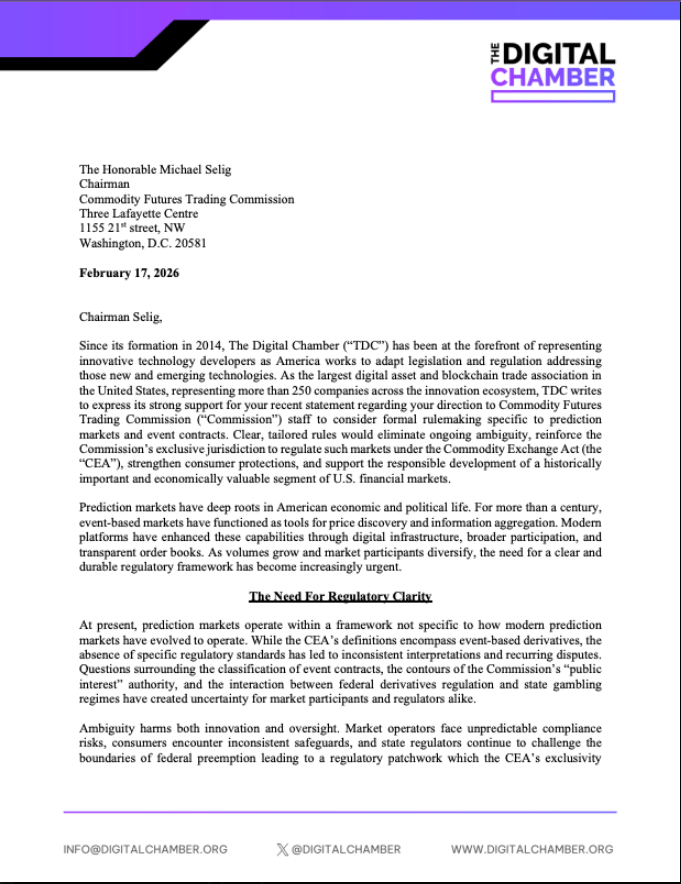
According to the group’s announcement, the first move was a letter praising the Commodity Futures Trading Commission and its chair for arguing that federal oversight should cover many event contracts.

The Prediction Markets Working Group, created by the blockchain advocacy group, The Digital Chamber, called for clearer rules and an end to what it described as enforcement-first regulation.

The group plans to meet with regulators, file policy ideas, publish studies and join court fights through friend-of-the-court briefs to press its view that a single federal regulator should be the lead voice on these crypto markets.

The regulator’s recent public comments were framed as support for that approach. CFTC Chairman Mike Selig has said the agency has overseen similar contracts for many years, and industry backers see that as a foundation for wider federal authority.

Tests On The Ground

Reports note that litigation and enforcement are already testing the theory. A major crypto US platform was hit with state action this week, accused of offering unlicensed wagering.

Kalshi faces a civil case brought by a state gaming regulator seeking to stop certain markets that the regulator calls gambling.

Rival platforms have felt the squeeze too; one has moved to federal court to try to head off state bans. Polymarket sued a state to argue federal oversight takes precedence.

The platforms argue their contracts behave like derivatives and should be treated as such, while state officials keep saying these products look a lot like bets.

As of today, the market cap of cryptocurrencies stood at $2.31 trillion. Chart: TradingView

States Push Back

That tension is clear along state lines. Nevada Gaming Control Board, which enforces strict gambling rules in its jurisdiction, has been among the most aggressive.

Reports say a governor in another state called these markets gambling that harms people, signaling political heat. Utah Governor Spencer Cox criticized federal arguments and framed the issue as one of public safety.

Meanwhile a platform chose to take its fight to the federal courts in a state that has been moving toward enforcement. Massachusetts figures into that legal push.

Image: Flowcarbon

What Comes Next

The next stretch will likely be shaped by filings and court rulings as much as by rulemaking. Industry lawyers are preparing to press federal primacy; state officials are planning to press their gambling statutes.

Legal briefs and amicus filings will try to persuade judges about what these crypto contracts really are. Regulators could also respond with formal rule proposals, and those would change the tone of the debate.

Featured image from The Center for Public Justice, chart from TradingView

İlgili Sorular

QWhat is the main goal of the newly formed Prediction Markets Working Group?

AThe main goal is to guide policy, press regulators, and back industry players through legal fights and public research to advocate for clearer rules and a single federal regulator for crypto prediction markets.

QWhich US regulatory body did the working group praise in its first move, and why?

AThe working group praised the Commodity Futures Trading Commission (CFTC) and its chair for arguing that federal oversight should cover many event contracts, seeing it as a foundation for wider federal authority.

QWhat legal action did the state of Nevada take against crypto prediction markets, according to the article?

AThe Nevada Gaming Control Board, which enforces strict gambling rules, has been among the most aggressive in taking action against these markets, with one major US platform facing a civil case from a state gaming regulator.

QHow are crypto prediction market platforms arguing their products should be classified and regulated?

AThe platforms argue that their contracts behave like derivatives and should be treated as such under federal oversight, rather than being classified as gambling and regulated by state laws.

QWhat is the current market capitalization of cryptocurrencies as mentioned in the article?

AAs of the date of the article, the market capitalization of cryptocurrencies stood at $2.31 trillion.

İlgili Okumalar

War Doesn't Just Drive Up Oil Prices, Why Is Circle's Stock Price Soaring?

A class of companies, like defense contractors and oil giants, typically benefit from global instability. Circle, the issuer of the USDC stablecoin, unexpectedly joined this group as its stock price surged over 150% in five weeks, while the broader crypto market remained down 44% from its peak. The core of Circle's business is holding US Treasuries to back each USDC in circulation. The interest earned on these bonds constitutes about 90% of its quarterly revenue, making the Federal Funds rate its primary driver. The recent price surge was triggered by geopolitical conflict in the Middle East, which drove oil prices up approximately 35%. This raised inflation concerns, leading markets to drastically scale back expectations for Federal Reserve interest rate cuts in 2026. Higher-for-longer interest rates mean Circle's treasury reserves continue to generate elevated yields, translating to more revenue and a rising stock price. This macroeconomic shift caused a short squeeze, as a significant portion of Circl's stock was shorted based on the expectation of falling rates. However, the bullish narrative extends beyond a macro trade. Despite a net loss for FY2025, USDC's supply has reached a new all-time high of $79 billion, and its transaction volume now surpasses that of the larger USDT. This growth is attributed to its use as a payment infrastructure for cross-border transfers, tokenized assets, and AI agent micropayments, especially in regions where traditional banking becomes unreliable during crises. A major structural challenge is Circle's costly revenue-sharing agreement with Coinbase, which took 54 cents of every dollar Circle earned in 2024. The market is currently pricing Circle as both a high-yield play and a critical piece of future financial infrastructure. The central tension remains: its profitability is currently dependent on high interest rates, but its long-term value hinges on successfully transitioning to a business model sustained by transaction fees and payment network services, independent of the Fed's decisions.

marsbit48 dk önce

War Doesn't Just Drive Up Oil Prices, Why Is Circle's Stock Price Soaring?

marsbit48 dk önce

Tether Hires Big Four Auditor, USDT Enters Verifiable Stage for the First Time

Tether, the issuer of USDT, has hired Big Four firm KPMG to conduct a full financial audit of its $127 billion reserves. This marks a significant shift for the controversial stablecoin, moving it into a verifiable financial framework for the first time. Unlike previous attestations, which only confirmed reserves at a point in time, a GAAP-based audit will examine asset origins, internal controls, and financial reliability over time. This development is seen as more impactful than pending legislation, as institutional adoption relies on audited financials rather than regulatory promises. If KPMG issues an unqualified opinion, Tether’s credibility could be fundamentally upgraded, pressuring other stablecoin issuers without Big Four audits to follow suit. The move may accelerate institutional adoption by pensions, corporates, and payment firms, while reshaping the stablecoin landscape. Despite years of regulatory scrutiny and skepticism, Tether has maintained dominance due to its global liquidity and accessibility. An audit could reposition USDT from a contested asset to a verifiable financial instrument, reducing counterparty risk and encouraging broader use in digital infrastructure. The outcome of the audit will be critical: a clean opinion may validate the entire asset class, while a qualified one could introduce new challenges. The industry is watching closely, as this audit could signal a new phase of institutional acceptance for stablecoins.

marsbit2 saat önce

Tether Hires Big Four Auditor, USDT Enters Verifiable Stage for the First Time

marsbit2 saat önce

1 Dollar Return Rate Only 43%, Why Are 87% of Polymarket Users Losing Money?

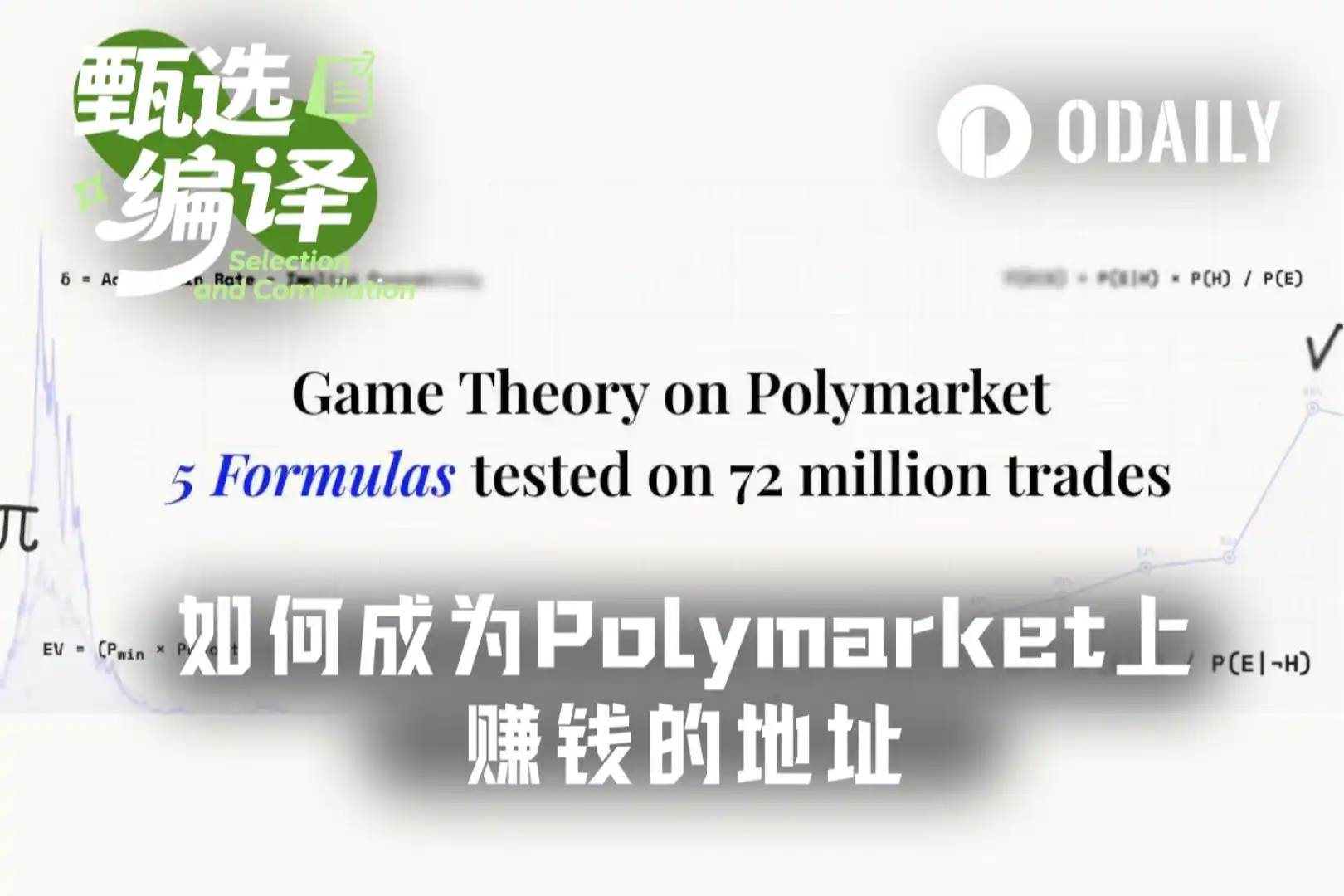
In the prediction market Polymarket, analysis of 72.1 million trades reveals that 87% of wallets lose money, while only 13% consistently profit. The key difference lies in the application of game theory and mathematical strategies, not luck. Five core formulas separate winners from losers: 1. **Expected Value (EV)**: Winners calculate EV to identify undervalued contracts, while most traders rely on intuition. Makers (limit order placers) profit by waiting for positive EV opportunities, while takers (market buyers) lose ~1.12% per trade on average. 2. **Mispricing**: Low-probability contracts (e.g., priced at 1¢) are systematically overpriced, with actual win rates as low as 0.43% (a -57% deviation). High-probability contracts are often undervalued. Takers overpay for "cheap" lottery-like bets, while makers capture this inefficiency. 3. **Kelly Criterion**: Used for optimal position sizing. It maximizes long-term growth but is often applied fractionally (e.g., 1/2 or 1/4 Kelly) to reduce volatility. 4. **Bayesian Updating**: Profitable traders adjust probabilities rationally as new information emerges, unlike emotional overreactions or inertia from others. 5. **Nash Equilibrium**: The market structure evolves with participant behavior. In emotional markets (e.g., sports, entertainment), mispricing creates opportunities for contrarian strategies. As professional market makers enter, spreads tighten, and inefficiencies shrink. The conclusion: Persistent losses stem from emotional trading, overpaying for low-probability bets, and neglecting mathematical discipline. The winning minority uses these formulas to exploit market biases systematically.

Odaily星球日报2 saat önce

1 Dollar Return Rate Only 43%, Why Are 87% of Polymarket Users Losing Money?

Odaily星球日报2 saat önce

İşlemler

Spot
Futures

Popüler Makaleler

PUSH Nasıl Satın Alınır

HTX.com’a hoş geldiniz! Push Protocol (PUSH) satın alma işlemlerini basit ve kullanışlı bir hâle getirdik. Adım adım açıkladığımız rehberimizi takip ederek kripto yolculuğunuza başlayın. 1. Adım: HTX Hesabınızı OluşturunHTX'te ücretsiz bir hesap açmak için e-posta adresinizi veya telefon numaranızı kullanın. Sorunsuzca kaydolun ve tüm özelliklerin kilidini açın. Hesabımı Aç2. Adım: Kripto Satın Al Bölümüne Gidin ve Ödeme Yönteminizi SeçinKredi/Banka Kartı: Visa veya Mastercard'ınızı kullanarak anında Push Protocol (PUSH) satın alın.Bakiye: Sorunsuz bir şekilde işlem yapmak için HTX hesap bakiyenizdeki fonları kullanın.Üçüncü Taraflar: Kullanımı kolaylaştırmak için Google Pay ve Apple Pay gibi popüler ödeme yöntemlerini ekledik.P2P: HTX'teki diğer kullanıcılarla doğrudan işlem yapın.Borsa Dışı (OTC): Yatırımcılar için kişiye özel hizmetler ve rekabetçi döviz kurları sunuyoruz.3. Adım: Push Protocol (PUSH) Varlıklarınızı SaklayınPush Protocol (PUSH) satın aldıktan sonra HTX hesabınızda saklayın. Alternatif olarak, blok zinciri transferi yoluyla başka bir yere gönderebilir veya diğer kripto para birimlerini takas etmek için kullanabilirsiniz.4. Adım: Push Protocol (PUSH) Varlıklarınızla İşlem YapınHTX'in spot piyasasında Push Protocol (PUSH) ile kolayca işlemler yapın.Hesabınıza erişin, işlem çiftinizi seçin, işlemlerinizi gerçekleştirin ve gerçek zamanlı olarak izleyin. Hem yeni başlayanlar hem de deneyimli yatırımcılar için kullanıcı dostu bir deneyim sunuyoruz.

157 Toplam GörüntülenmeYayınlanma 2024.12.13Güncellenme 2025.03.21

PUSH Nasıl Satın Alınır

Tartışmalar

HTX Topluluğuna hoş geldiniz. Burada, en son platform gelişmeleri hakkında bilgi sahibi olabilir ve profesyonel piyasa görüşlerine erişebilirsiniz. Kullanıcıların PUSH (PUSH) fiyatı hakkındaki görüşleri aşağıda sunulmaktadır.

活动图片