Ripple Exec Pushes Central Banks To Back Regulated Stablecoins

bitcoinist2026-01-20 tarihinde yayınlandı2026-01-20 tarihinde güncellendi

Özet

Ripple's UK & Europe policy director, Matthew Osborne, urges central banks to embrace regulated stablecoins as a stabilizing force rather than treat them as a threat. He argues that with proper oversight and access to official infrastructure, stablecoins can complement the existing financial system, particularly in cross-border payments and multi-chain markets. Osborne cites their growing adoption, with market value exceeding $300 billion and transaction volumes surpassing Visa and Mastercard combined. He calls for central banks to extend safety net features, such as allowing issuers to hold reserves in central bank accounts and providing liquidity insurance, to reduce vulnerability to shocks. The choice, he concludes, is between resisting stablecoins and risking uncontrolled growth or integrating them into the regulated financial framework.

Ripple’s UK & Europe policy director Matthew Osborne is urging central banks to stop treating stablecoins as an external threat and instead fold well-regulated issuers into core safeguards, arguing that oversight plus access to official infrastructure can make stablecoins a net stabiliser for payments and settlement.

Writing for the Official Monetary and Financial Institutions Forum on 19 January 2026, Osborne said stablecoins have moved well beyond a niche experiment, citing a market value “in excess of $300bn” and annual transaction volumes that he wrote now surpass Visa and Mastercard combined. He argued momentum could accelerate in the US after the Genius Act, which he said would introduce federal rules and allow banks to issue stablecoins.

The Ripple exec framed the shift as already visible among central banks themselves. He pointed to the European Central Bank’s recent recognition of stablecoins’ benefits for cross-border payments and its view that tomorrow’s financial system will host multiple forms of money. He also cited the Bank of England’s stance that stablecoins could support “faster, cheaper retail and wholesale payments” as part of a “multi-money” system underpinned by central bank money.

Ripple Exec: Bring Stablecoins Into The Safety Net

At the centre of his case is the claim that stablecoins should be treated as an incremental evolution rather than an adversarial replacement. “Regulated stablecoins could play a key role in financial markets alongside other forms of money,” Osborne wrote. “First, stablecoins are more likely to complement the existing financial system than replace it. This is evolution, not revolution.” He then added: “The solution lies in central banks channelling stablecoin momentum, not fighting it.”

Osborne argues central bank money will remain essential as a risk-free settlement asset and safe store of value, but its relative role could shift in digital markets. He pointed to atomic settlement, where legs of a transaction settle simultaneously and conditionally, as reducing the traditional need to use central bank money purely to mitigate settlement risk.

Where stablecoins could be structurally preferred, he wrote, is in cross-border flows and multi-chain markets. “Cross-border payments are one example, given that stablecoins can move value anywhere in the world in seconds,” the Ripple exec said.

“In contrast, central bank money is likely to be less suitable for cross-border payments given access may be geographically limited and adoption of on-chain central bank money is far from universal around the world.” He also argued stablecoins are likely to exist across more blockchain networks than central bank money, making same-chain settlement between tokenized assets and cash more achievable while interoperability remains uneven.

Central banks have repeatedly warned that stablecoins could pull funds from bank deposits, weakening bank credit creation and potentially amplifying stress events. Osborne pushed back, arguing the risk is overstated because markets already accommodate instruments backed by highly liquid assets, money market funds, e-money, and “narrow banks”, without causing sustained deposit runs.

His bigger point is that regulation, while necessary, is insufficient without a backstop. “But regulation alone is not enough,” Osborne wrote. “Stablecoin issuers lack access to the safety net that gives bank deposits their resilience. Without it, even well-managed stablecoins are more vulnerable to shocks – as seen when USDC temporarily lost its peg following exposure to Silicon Valley Bank in 2023.”

He argued central banks should consider extending elements of that safety net, including allowing well-regulated stablecoin issuers to hold part of their backing assets in central bank accounts, offering liquidity insurance against market-wide shocks, and granting more direct payment-system access to reduce tiering risk.

The Ripple exec closed by positioning the choice for central banks as strategic: resist stablecoins and risk the market scaling beyond official influence, or “bring them inside the tent,” shaping development through prudential oversight and infrastructure access as tokenized settlement rails mature.

At press time, XRP traded at $1.9216.
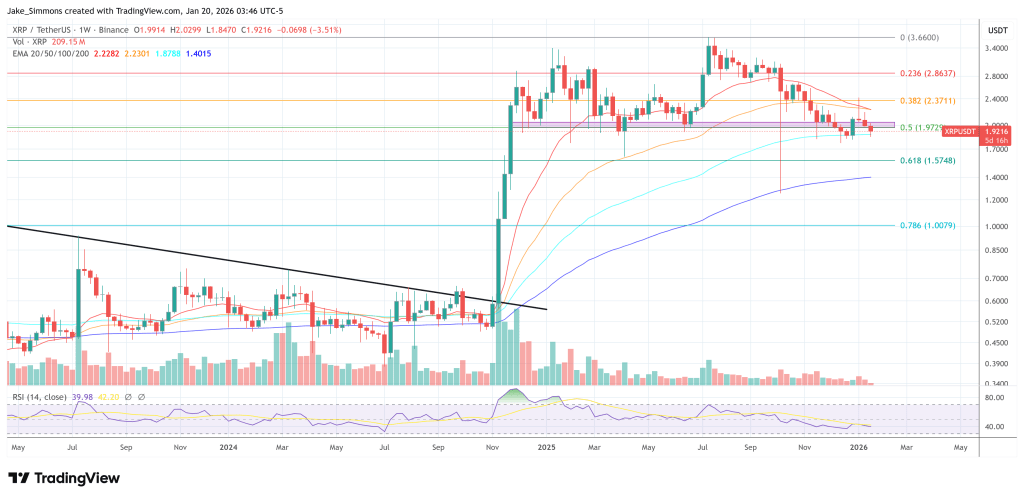
XRP holds above the 100-week EMA, 1-week chart | Source: XRPUSDT on TradingView.com

İlgili Sorular

QWhat is the main argument made by Ripple's Matthew Osborne regarding stablecoins and central banks?

AMatthew Osborne argues that central banks should stop treating stablecoins as a threat and instead integrate well-regulated stablecoin issuers into core financial safeguards, as they can act as a net stabilizer for payments and settlement.

QAccording to the article, what recent US legislation could accelerate stablecoin adoption?

AThe article states that stablecoin momentum could accelerate in the US after the Genius Act, which would introduce federal rules and allow banks to issue stablecoins.

QWhat two specific benefits of stablecoins for cross-border payments does Osborne highlight?

AOsborne highlights that stablecoins can move value anywhere in the world in seconds and are likely to exist across more blockchain networks than central bank money, making them more suitable for cross-border flows.

QWhy does Osborne claim that 'regulation alone is not enough' for stablecoins?

AHe claims regulation is insufficient because stablecoin issuers lack access to the safety net (like central bank accounts and liquidity insurance) that gives bank deposits their resilience, making them vulnerable to shocks even if well-managed.

QWhat strategic choice does Osborne present to central banks at the end of his argument?

AHe presents central banks with the choice to either resist stablecoins and risk the market scaling beyond official influence, or to 'bring them inside the tent' by shaping their development through prudential oversight and infrastructure access.

İlgili Okumalar

Only 60% Real Win Rate: Data Reveals the Truth Behind ICO Predictions on Polymarket

Polymarket's TokenSale markets have processed nearly $250 million in volume, boasting impressive accuracy rates—100% for fundraising amounts and over 90% for fully diluted valuations (FDV). However, an analysis of 231 prediction markets across 29 token sales reveals these figures are misleading. The platform functions more as a sentiment indicator, often acting as a contrarian signal. Key findings show that the true prediction accuracy one week before market close is only 66.7%, meaning the crowd is wrong one-third of the time, with errors consistently skewing toward over-optimism. FDV predictions averaged a 35% overestimation. Analysis of 24-hour post-launch volatility showed an average price swing of ±23%, with 75% of tokens facing sell-offs. Only 62.5% of 24-hour FDV predictions were accurate. The 100% accuracy claim is meaningless because markets close after results are known. High trading volume on Polymarket often serves as a reverse indicator—more optimism typically leads to greater inaccuracy. Tokens with conservative predictions (e.g., Monad, Football.fun) saw smaller declines. Actionable signals: High volume (>$50M) and high optimism (>50% FDV overestimation) are bearish. Low volume (<$5M) and accurate predictions (within 20% of actual FDV) are relatively bullish. In a market where most tokens fall below ICO price, "less bad" is the best outcome. Polymarket’s token sales market is essentially a hype meter—extreme confidence often signals maximum investor pain.

marsbit47 dk önce

Only 60% Real Win Rate: Data Reveals the Truth Behind ICO Predictions on Polymarket

marsbit47 dk önce

Silicon Valley's New Darling Clawdbot: When Local AI Agents Learn to 'Go On-Chain', What Happens?

A new open-source project called Clawdbot (now renamed Moltbot) has gained attention in Silicon Valley. It enables an AI agent to run locally on a user’s computer or server, allowing it to browse the web, click buttons, send messages, and even execute transactions automatically. Unlike cloud-based models like ChatGPT, Clawdbot is self-hosted, open-source, and operates across multiple platforms such as Telegram, WhatsApp, Discord, and Slack. It features persistent memory and can perform tasks via browser automation, command-line operations, and scripts—making it a persistent digital assistant. In the context of Web3, Clawdbot could significantly lower barriers to participation by automating complex and repetitive on-chain operations. Potential use cases include 24/7 monitoring of liquidation thresholds, automated yield reinvestment, cross-chain transactions, and strategy execution via natural language commands. However, the integration of such agents with Web3 also introduces serious risks. Recent incidents include fake token launches under Clawdbot’s name and security vulnerabilities from misconfigured servers. To mitigate risks, users are advised to grant minimal wallet permissions—preferably read-only—use dedicated small-cap wallets with strict limits, and avoid unofficial token promotions. Self-hosting does not guarantee security; improper configuration may expose sensitive data and execution privileges. The agent should serve as an assistant, not a custodian. Any permission beyond the user’s comfort zone requires careful consideration. *This content is for informational purposes only and does not constitute investment advice. The market carries risks; invest with caution.*

marsbit1 saat önce

Silicon Valley's New Darling Clawdbot: When Local AI Agents Learn to 'Go On-Chain', What Happens?

marsbit1 saat önce

İşlemler

Spot
Futures
活动图片