The Stablecoin Wars Just Got A New Contender — And This One Has 500,000 Retail Locations

bitcoinist2026-06-02 tarihinde yayınlandı2026-06-02 tarihinde güncellendi

Özet

MoneyGram, one of the world's largest cross-border payments networks, launched its own branded US dollar stablecoin, MGUSD, on June 2. This marks a strategic shift from relying on third-party stablecoins like USDC to direct control over issuance and reserves. MoneyGram is an 85-year-old mainstream financial institution with 500,000 retail locations and over 50 million annual customers, primarily serving remittance-dependent families globally. Its launch of a native stablecoin, timed with the new US regulatory framework established by the 2026 GENIUS Act, significantly normalizes digital dollar instruments for a broad, non-crypto-native demographic. This move signals the stablecoin economy's convergence with the mainstream global payments industry.

MoneyGram, one of the world’s largest cross-border payments networks, announced on June 2 the launch of MGUSD — a native US dollar stablecoin bearing the company’s own brand and designed to serve as the foundational layer for a growing suite of financial services across its global remittance network, per the company’s official press release.

The move marks a decisive shift in MoneyGram’s stablecoin strategy. Until now the Dallas-based company had built its digital dollar services on third-party infrastructure — primarily Circle’s USDC, deployed through its Stellar Development Foundation partnership to power stablecoin balance features in its consumer app across Colombia and El Salvador. MGUSD changes that equation entirely.

A branded native stablecoin hands MoneyGram direct control over issuance, reserve management, and the yield economics that previously flowed to external issuers.
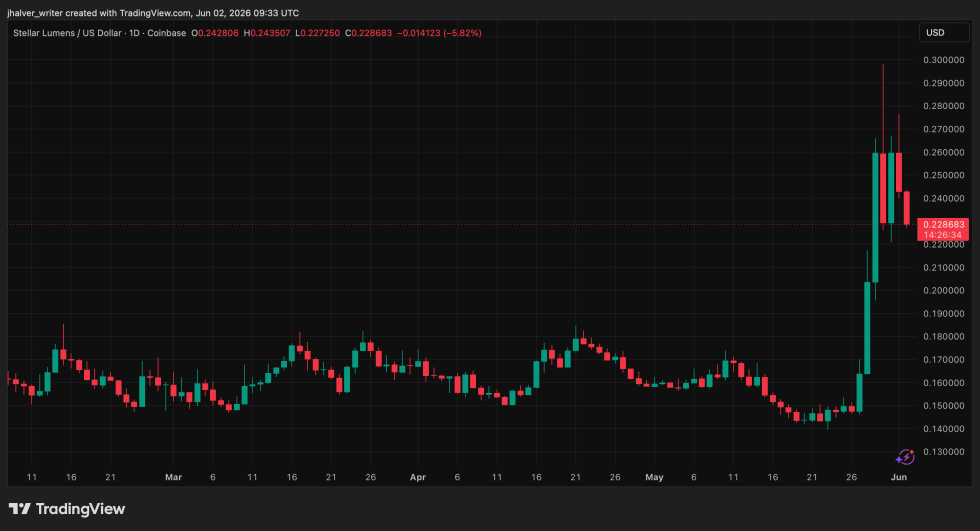
XLM's price trends to the upside on the daily chart. Source: XLMUSD Tradingview

Why This Stablecoin Matters For The Remittance Industry

MoneyGram is not a crypto-native company building a stablecoin for crypto-native users. It is a 85-year-old payments institution operating across more than 200 countries with approximately 500,000 retail locations and over 50 million customers annually — and it just issued its own digital dollar. The distinction is significant. When a company of this scale and regulatory standing launches a native stablecoin, it normalizes the instrument for the exact demographic — remittance-dependent families in Latin America, Africa, and Southeast Asia — that has historically been furthest from crypto adoption.

The timing is deliberate. The GENIUS Act, signed into law earlier in 2026, established the first formal US regulatory framework for stablecoin issuers — a development MoneyGram CEO Anthony Soohoo had publicly described as the guardrails the company needed to scale its digital dollar services confidently. MGUSD is the first major consumer-facing stablecoin launch to arrive squarely within that new regulatory window.

MoneyGram’s infrastructure buildout has been deliberate and sequential — Stellar partnership in 2021, Fireblocks treasury integration in December 2025, Tempo blockchain validator status in May 2026, and now a proprietary stablecoin. Each step has reduced its dependence on external partners and deepened its control over the digital payment stack.

This development marks a pivotal moment for the nascent sector’s convergence with mainstream global finance. A remittance giant issuing its own stablecoin — backed by decades of compliance infrastructure and half a million cash locations worldwide — is the clearest signal yet that the stablecoin economy is no longer a crypto industry story. It is a global payments industry story.

Cover image from Grok, XLM chart from Tradingview

İlgili Sorular

QWhat is MGUSD and which company launched it?

AMGUSD is a native US dollar stablecoin launched by MoneyGram, one of the world's largest cross-border payments networks.

QHow does launching its own stablecoin (MGUSD) change MoneyGram's strategy compared to before?

APreviously, MoneyGram built its digital dollar services on third-party infrastructure like Circle's USDC. Launching its own branded stablecoin, MGUSD, gives MoneyGram direct control over issuance, reserve management, and yield economics, reducing dependence on external partners.

QWhy is MoneyGram's launch of a stablecoin significant for the remittance industry and crypto adoption?

AMoneyGram is an 85-year-old mainstream payments institution with a vast global network. Its launch of a native stablecoin normalizes the instrument for demographics like remittance-dependent families in Latin America, Africa, and Southeast Asia, who have been historically distant from crypto adoption.

QWhat recent US regulatory development is mentioned as enabling MoneyGram's stablecoin launch?

AThe GENIUS Act, signed into law earlier in 2026, established the first formal US regulatory framework for stablecoin issuers. MoneyGram's CEO stated this provided the necessary guardrails to scale its digital dollar services confidently.

QWhat key steps has MoneyGram taken in its infrastructure buildout leading to the MGUSD launch?

AMoneyGram's deliberate steps include: a Stellar partnership in 2021, Fireblocks treasury integration in December 2025, achieving Tempo blockchain validator status in May 2026, and finally launching its proprietary stablecoin, MGUSD.

İlgili Okumalar

Why Not Short Even When Bearish? Munger Did the Math on a 'Losing Trade'

Why Not Short Even When Bearish? Charlie Munger's Calculated "Loss-Making Account" Many traders, drawn to speculative tools like futures contracts, often face repeated failures. As the article notes, unless one is a genius, such instruments should be avoided for long-term profit-seeking. Similarly, the practice of short selling is viewed with caution. The author firmly states a policy of not shorting, even when bearish, preferring to simply wait. The core reason? Successful short selling requires exceptionally difficult conditions to profit. Legendary investors Warren Buffett and Charlie Munger have themselves reflected on painful short-selling experiences. Munger highlights two critical flaws in the mathematical logic of shorting: 1. Asymmetrical Risk/Reward: A long position has a maximum loss of 100% but unlimited upside. A short position caps profit at 100% (if a stock falls to zero) but carries theoretically unlimited loss potential. 2. The "Promoter" Problem: Fraudulent or struggling companies can prolong their decline. As Munger said, "You can run out of money before the promoter runs out of ideas," meaning short sellers may be forced to cover positions at a loss before the company's true fate unfolds. The article cites Stanley Druckenmiller, a famed hedge fund manager. He once shorted 12 companies that all eventually went bankrupt. However, intense market rallies forced him to cover his positions within three weeks, resulting in massive losses—$200 million of his capital plus an additional $600 million. He concluded he likely never made money shorting in his career. His experience perfectly illustrates Munger's points: facing unlimited losses and being wiped out before being proven right. The conclusion is clear: for most investors, complex instruments like short selling and derivatives are not viable paths to stable, long-term gains. Self-reflection is advised before repeatedly wasting time and capital on such speculative strategies.

marsbit6 dk önce

Why Not Short Even When Bearish? Munger Did the Math on a 'Losing Trade'

marsbit6 dk önce

For Hedging, Buy Gold and Oil; For Explosive Growth, Buy AI; Bitcoin, the 'Outdated' Asset, Enters a Bear Market

Bitcoin’s price has recently fallen sharply, hitting a two-month low near $66,000, with Ethereum also dropping to a three-month low. While surface explanations point to ETF outflows, geopolitical tensions, and corporate selling, a deeper issue is emerging: Bitcoin is losing a crucial asset competition. For years, Bitcoin thrived in a low-rate environment where investors sought alternatives amid inflation fears and dissatisfaction with traditional options. Now, the market landscape has shifted, leaving Bitcoin stuck in an "awkward middle ground," facing challenges on three fronts: 1. **As an inflation hedge, gold is winning.** Investors worried about persistent inflation are turning to tangible assets like gold, energy stocks, and commodity producers, which offer more direct pricing power and physical backing. 2. **For growth exposure, AI is winning.** Those seeking high growth now favor AI-related companies with actual revenues and profits, an area where Bitcoin's lack of cash flow puts it at a disadvantage. 3. **Within crypto, infrastructure and stablecoins are winning.** Even investors wanting crypto exposure have alternatives like exchanges, stablecoin issuers, and tokenization firms, whose performance is directly tied to real-world adoption and offers clearer operational leverage. The recent market reaction to inflation warnings highlights this shift. Instead of boosting Bitcoin as "digital gold," such news now drives flows toward traditional inflation-sensitive assets. Therefore, recent events like ETF outflows and corporate selling are seen not as causes, but as symptoms of this new reality. Capital has more compelling options, and investors are becoming more selective. The emerging bear case for Bitcoin is no longer about it being a fraud or failed technology, but rather that **scarcity alone is no longer enough**. It is no longer seen as the best hedge, the best growth asset, or the only crypto play.

marsbit22 dk önce

For Hedging, Buy Gold and Oil; For Explosive Growth, Buy AI; Bitcoin, the 'Outdated' Asset, Enters a Bear Market

marsbit22 dk önce

SaaS Battle Royale: The Survivors Who Win All Share One Common Trait

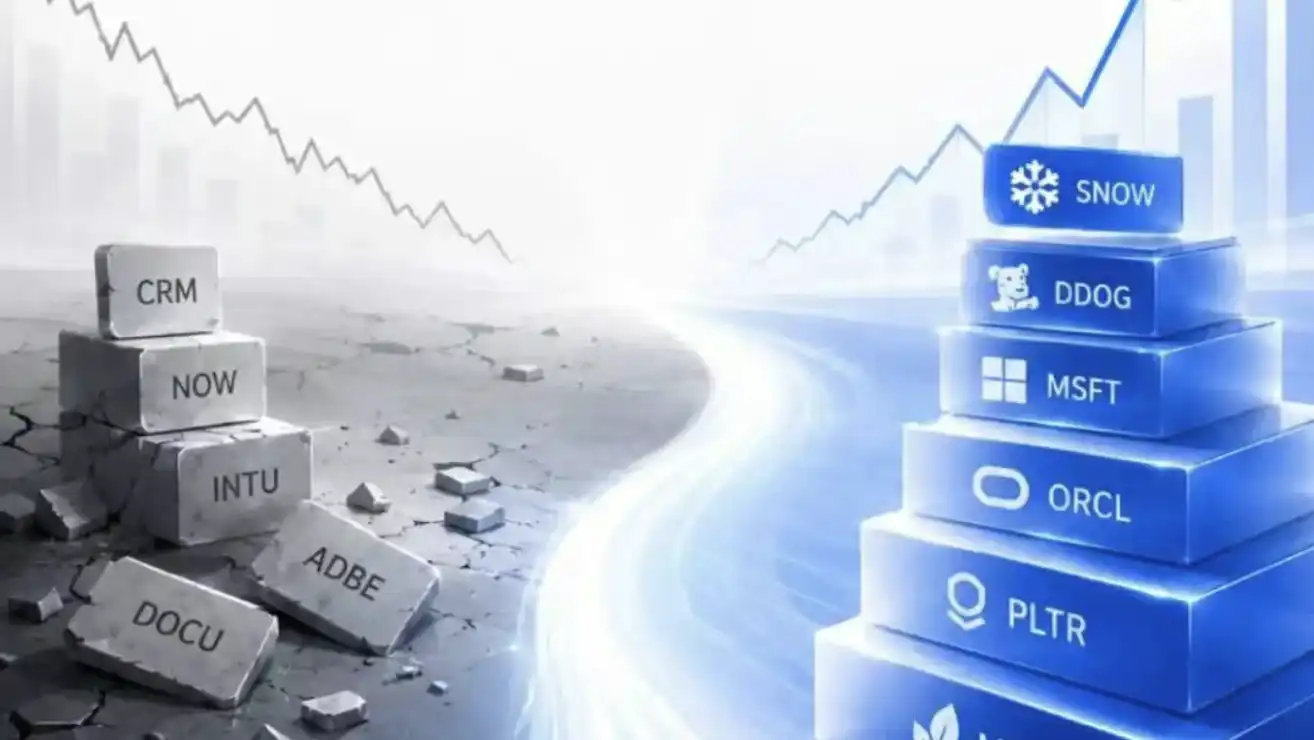
**Summary** The AI revolution has triggered a "SaaS apocalypse," forcing a brutal market shakeout. The key dividing line is the pricing model. Companies like Snowflake and Datadog, which charge based on consumption (e.g., data processed or compute used), are thriving. AI workloads actively *generate* more demand for their services, fueling growth. Datadog's accelerating revenue is a prime example. Microsoft and Palantir, as platform/ecosystem players, also benefit by acting as essential channels for AI deployment. In contrast, traditional SaaS firms built on per-seat or per-task licensing (e.g., Intuit, Adobe) face direct pressure, as AI threatens to automate the very human tasks their software supports. Companies like Salesforce, a per-seat giant, are caught in the middle. While showing strong AI monetization (e.g., its Agentforce platform) and experimenting with consumption-based "Flex Credits," its stock remains under pressure, illustrating that the market rewards *completed* transitions, not just the intent. The recent Microsoft Build conference underscored key trends: AI is evolving from an assistant to an autonomous "agent," and platform providers like Microsoft are consolidating their control. The market's recovery is highly selective, focused on identifying which companies are "fed by AI" versus "eaten by AI." Future focus will be on the diffusion of this recovery to transforming companies and the real-world adoption data of AI agents like Microsoft Copilot.

marsbit39 dk önce

SaaS Battle Royale: The Survivors Who Win All Share One Common Trait

marsbit39 dk önce

İşlemler

Spot
Futures

Popüler Makaleler

ONE Nasıl Satın Alınır

HTX.com’a hoş geldiniz! Harmony (ONE) satın alma işlemlerini basit ve kullanışlı bir hâle getirdik. Adım adım açıkladığımız rehberimizi takip ederek kripto yolculuğunuza başlayın. 1. Adım: HTX Hesabınızı OluşturunHTX'te ücretsiz bir hesap açmak için e-posta adresinizi veya telefon numaranızı kullanın. Sorunsuzca kaydolun ve tüm özelliklerin kilidini açın. Hesabımı Aç2. Adım: Kripto Satın Al Bölümüne Gidin ve Ödeme Yönteminizi SeçinKredi/Banka Kartı: Visa veya Mastercard'ınızı kullanarak anında Harmony (ONE) satın alın.Bakiye: Sorunsuz bir şekilde işlem yapmak için HTX hesap bakiyenizdeki fonları kullanın.Üçüncü Taraflar: Kullanımı kolaylaştırmak için Google Pay ve Apple Pay gibi popüler ödeme yöntemlerini ekledik.P2P: HTX'teki diğer kullanıcılarla doğrudan işlem yapın.Borsa Dışı (OTC): Yatırımcılar için kişiye özel hizmetler ve rekabetçi döviz kurları sunuyoruz.3. Adım: Harmony (ONE) Varlıklarınızı SaklayınHarmony (ONE) satın aldıktan sonra HTX hesabınızda saklayın. Alternatif olarak, blok zinciri transferi yoluyla başka bir yere gönderebilir veya diğer kripto para birimlerini takas etmek için kullanabilirsiniz.4. Adım: Harmony (ONE) Varlıklarınızla İşlem YapınHTX'in spot piyasasında Harmony (ONE) ile kolayca işlemler yapın.Hesabınıza erişin, işlem çiftinizi seçin, işlemlerinizi gerçekleştirin ve gerçek zamanlı olarak izleyin. Hem yeni başlayanlar hem de deneyimli yatırımcılar için kullanıcı dostu bir deneyim sunuyoruz.

297 Toplam GörüntülenmeYayınlanma 2024.12.12Güncellenme 2026.06.02

ONE Nasıl Satın Alınır

Tartışmalar

HTX Topluluğuna hoş geldiniz. Burada, en son platform gelişmeleri hakkında bilgi sahibi olabilir ve profesyonel piyasa görüşlerine erişebilirsiniz. Kullanıcıların ONE (ONE) fiyatı hakkındaki görüşleri aşağıda sunulmaktadır.

活动图片