Post-World Cup, HIP-4 Awaits Its ‘Election Day’

marsbit2026-08-05 tarihinde yayınlandı2026-08-05 tarihinde güncellendi

Özet

Following its significant success driven by World Cup trading, Hyperliquid's HIP-4 prediction market is now looking toward the upcoming US midterm elections as its next major opportunity. Initially viewed as an extension for hedging crypto positions, HIP-4 unexpectedly saw nearly 48% of its total volume come from sports markets, primarily the World Cup. However, activity plummeted over 90% after the tournament, highlighting the platform's heavy reliance on major real-world events. To address this dependency and enable continuous market creation, Hyperliquid launched a permissionless deployment feature for HIP-4 on its testnet on July 31. This new system allows approved third-party deployers to create markets using pre-approved templates, requiring a 500,000 HYPE stake and offering up to 50% of trading fees. The goal is to decentralize the sourcing of timely, high-interest markets. The imminent US midterm elections present a critical test case. While competitors like Polymarket and Kalshi already offer extensive political markets, HIP-4 currently has none. If the permissionless system launches on mainnet in time, deployers could build a comprehensive election trading suite. Missing this window would mean relying on manual validator creation again, forfeiting a chance to prove that external deployers can sustainably supply popular markets. The coming weeks will be crucial for HIP-4's evolution beyond sporadic event-driven spikes.

The biggest success of the Hyperliquid HIP-4 prediction market so far came from World Cup-related trading.

I did not anticipate this outcome initially. When HIP-4 first launched, I suggested the viewpoint that Hyperliquid was not actually aiming to compete head-on with Polymarket or Kalshi. These types of outcome prediction markets seemed more like an extension of its trading ecosystem: providing daily crypto binary contracts to hedge perpetual positions, build option-like exposures, and allow traders to keep all their positions unified within the Hyperliquid platform.

But subsequent developments were unexpected. Hyperliquid successively launched trading markets for the NBA Finals, individual World Cup matches, and the tournament champion. These three categories (with the latter two contributing the vast majority of trading volume) together account for approximately 48% of HIP-4’s total trading volume to date.

After the peak of World Cup trading, the related open interest dropped by over 90%. Objectively speaking, this doesn’t mean HIP-4 has failed; it merely reflects the current lack of event-specific targets with high trading appeal.

The system currently remains in a permissioned mode, where all trading markets require manual creation and listing by validators. Most of the remaining markets on the platform are related to cryptocurrency price movements, with dismal trading volumes that are completely incomparable to the activity driven by sports events.

Now, Hyperliquid wants to break this limitation. On July 31st, the permissionless HIP-4 deployment feature went live on the testnet, paving the way for third-party teams to independently create and operate outcome prediction markets, while also clarifying the conditions required for live operation.
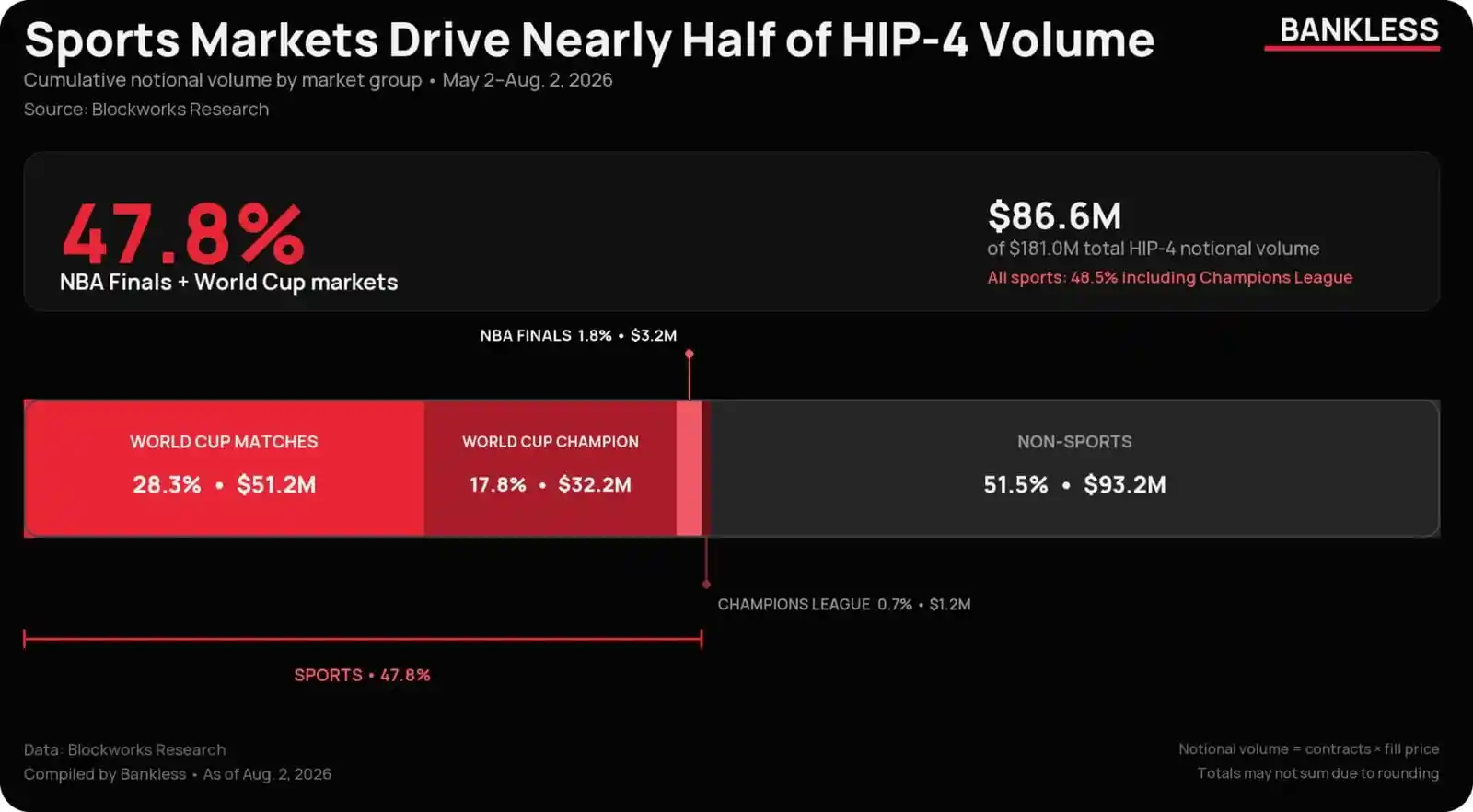
From May–August 2026, 47.8% of HIP-4’s trading volume came from sports markets, with the World Cup contributing the vast majority of sports volume, highlighting the platform’s high dependence on major hot-topic events to attract trading flow.

The Operation Mechanism of HIP-4 in Permissionless Mode

Important note: Permissionless deployment ≠ unrestricted, arbitrary market creation.

According to the initial mainnet proposal: Validators first approve market templates, which are reusable standard frameworks defining market creation rules and settlement methods. Deployers then select an approved template to create a specific trading market, filling in details like the trading topic, possible outcomes, expiry time, and settlement criteria.

One thing is clear: Deployers only need to use a validator-approved template to generate a market; they do not need to apply for separate approval for each individual market.

Consistent with the HIP-3 mechanism, deployers must precisely define market rules and properly execute settlements. In case of significant errors, validators have the right to slash their staked assets.

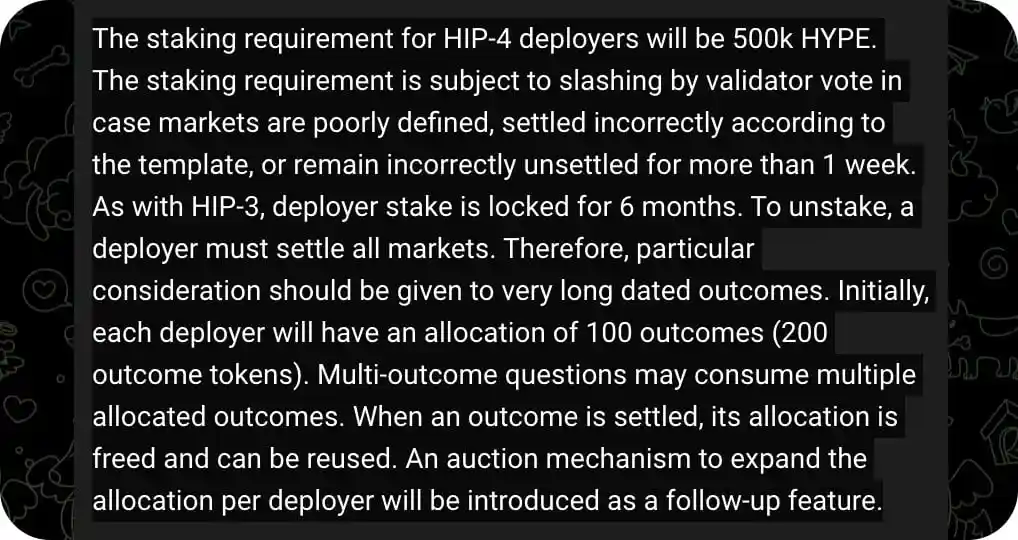
The proposal requires deployers to stake 500,000 HYPE (same standard as HIP-3), with the stake locked for 6 months; a deployer can only withdraw staked assets after all markets under their name have been fully settled. Initially, each deployer has a quota to create a maximum of 100 outcome targets; this quota can be reused after markets are settled. The platform plans to expand additional quotas via auctions later. Deployers can ultimately earn up to 50% of the trading fees generated by their created markets.
After the World Cup Frenzy, Where is the Next Core Opportunity?

The most obvious target: The US midterm elections.

Prediction markets initially gained mainstream visibility through political topics. Kalshi and Polymarket have long-established comprehensive election trading dashboards, covering various markets like control of Congress, individual district races, seat totals, etc., while HIP-4 currently has not listed any related targets.
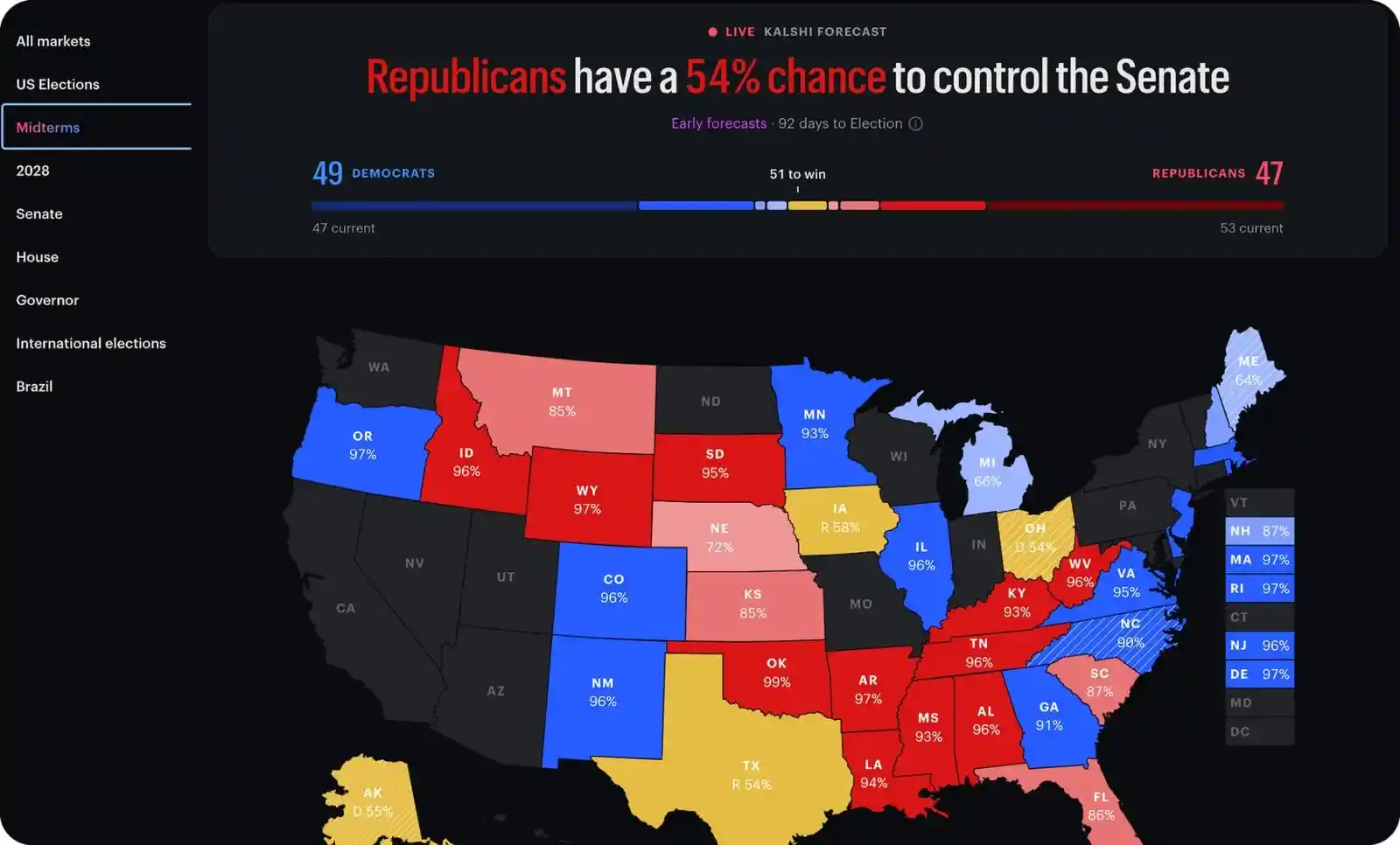
Whether third-party deployers can fill this gap depends on when the permissionless HIP-4 goes live on mainnet. For reference: HIP-3 took 164 days from the launch of the first minimal permissionless testnet version to mainnet launch. However, from releasing the mainnet initial specification and opening the mainnet bug bounty program to the official launch, it was only 18 days.

HIP-4’s current progress lies somewhere between: The mainnet preliminary architecture has been made public, the testnet deployment feature is open, but a mainnet-level bug bounty program has not yet been launched; the overall progress remains in an uncertain phase.

If this system can go live on schedule, deployers could build a comprehensive election trading section around the midterms, rather than sporadically launching individual campaign topic markets—provided validators simultaneously approve trading templates that support election scenarios.

If the permissionless deployment misses the midterm election window, validators can still manually list various midterm election markets. Even so, HIP-4 could still capture trading flow, but it would miss its first major real-world proving opportunity: failing to demonstrate to the market that external third-party deployers can consistently supply the platform with timely, popular trading markets.

The World Cup proved: Hyperliquid users are willing to trade major real-world events. At the same time, the rapid decline in trading volume post-World Cup exposed a pain point: the platform struggles to maintain activity in the absence of blockbuster events.

With high anticipation surrounding this round of midterm elections, it presents an excellent opportunity for HIP-4. The platform can both use this to sustain market heat and advance the launch of permissionless deployment. The coming weeks are crucial to track related progress.


Trend Kriptolar

İlgili Sorular

QWhat was the most successful trading market for Hyperliquid HIP-4, and what event was it associated with?

AThe most successful trading market for Hyperliquid HIP-4 was the one associated with the World Cup, which contributed the vast majority of the sports-related trading volume.

QWhat is the main change introduced to HIP-4 on July 31st, and what is its purpose?

AOn July 31st, a permissionless deployment feature for HIP-4 was launched on the testnet. Its purpose is to allow third-party teams to independently create and operate prediction markets, thereby expanding the platform's market offerings.

QWhat is the next major real-world event mentioned as a key opportunity for HIP-4 to capture trading activity?

AThe next major real-world event mentioned as a key opportunity for HIP-4 is the US midterm elections.

QAccording to the article, what condition must a HIP-4 market creator (deployer) meet before they can withdraw their staked assets?

AA HIP-4 market creator (deployer) can only withdraw their staked assets after all the markets they have created have been fully settled.

QWhat did the drop in trading activity after the World Cup reveal about HIP-4's current limitation?

AThe drop in trading activity after the World Cup revealed that the platform struggles to maintain active trading volume in the absence of major, high-profile events.

İlgili Okumalar

Playing the "Decoupling" Card Again? Domestic Optical Modules Face a Stress Test

The U.S. Federal Communications Commission (FCC) is reportedly drafting a ban on importing new models of Chinese-made optical transceiver modules, with a potential implementation target of 2026. This "decoupling" move comes as Chinese firms, led by industry leaders like Zhongji Innolight and Eoptolink, dominate the global optical module market with over 60% share, and hold an even larger position in the high-speed 800G and 1.6T segments critical for AI data centers. Market reactions were mixed: U.S. optical module stocks initially rose, while Chinese A-shares opened lower but largely recovered by the close. Analysis suggests a complete U.S. decoupling from Chinese modules faces significant hurdles. North American cloud giants (Meta, Google, Microsoft, Amazon) and NVIDIA have massive demand for high-speed modules, estimated at around 40 million units in 2026. U.S. manufacturers' combined monthly production capacity for these modules is less than one-fifth that of a single major Chinese player like Zhongji Innolight, which reported production of 23.76 million units in 2025. Chinese companies are heavily reliant on the U.S. market, with over 90% of revenue for top firms coming from overseas, primarily the U.S. However, they have begun mitigating risks by establishing assembly plants in Southeast Asia and Mexico. Industry observers note the final impact depends on whether any potential U.S. restrictions target specific companies or products based on origin. Past U.S. sanctions on Chinese tech firms have often spurred increased domestic R&D and market diversification. Despite initial stock volatility, shares of major Chinese optical module companies pared losses, indicating market belief in the sector's resilience and the practical difficulties of abruptly replacing Chinese supply.

marsbit40 dk önce

Playing the "Decoupling" Card Again? Domestic Optical Modules Face a Stress Test

marsbit40 dk önce

When the Competition in Chip Manufacturing Equipment Stops Being Just About Who Is More Advanced

The competition in chip manufacturing equipment is no longer solely about who has the most advanced technology. While performance, yield, and cost remain key, U.S. export controls are adding a critical new dimension: long-term supply chain reliability. Major chipmakers like Samsung and SK Hynix, despite having mature supply chains with leading American and European vendors, are reportedly evaluating etching equipment from China's AMEC for their Chinese factories. This move is not primarily about immediate replacement or AMEC's current capabilities. Instead, it's a risk mitigation strategy. Companies are concerned that future U.S. policies could disrupt their access to spare parts, software updates, and maintenance for existing equipment over its decade-long lifespan. For chipmakers investing billions in fabs with long planning cycles, this policy-induced uncertainty is a significant new risk. The U.S., through its controls, is inadvertently eroding the very reliability and certainty that were foundational strengths of its equipment suppliers. This creates a pivotal shift for Chinese semiconductor equipment. Previously seen largely as a "domestic replacement" option when foreign gear was unavailable, they are now being assessed as potential "contingency suppliers" by global players—even before a supply disruption occurs. This provides a crucial entry point for validation in real production lines, which is essential for iterative improvement. Chinese equipment, particularly in areas like etching, has progressed from prototypes to participating in mass production within China, gaining valuable experience. However, this does not signify full global competitiveness. Gaps remain in advanced lithography, metrology, and other key tools. The current evaluations are largely confined to foreign firms' China-based fabs, not their global procurement networks. The core change is in the decision-making framework. Efficiency-driven globalization favored single, optimal suppliers. An era of heightened geopolitical risk is forcing companies to value "replaceability." While technical prowess remains paramount, supply chain certainty is now being factored into a device's competitive equation. Ultimately, U.S. policies have not made Chinese equipment more advanced, but they have given global customers a compelling reason to start testing it. The competition has expanded: it's no longer just about who is more advanced, but also about who can be relied upon to stay.

marsbit41 dk önce

When the Competition in Chip Manufacturing Equipment Stops Being Just About Who Is More Advanced

marsbit41 dk önce

Trading Volume Increased by 2.5x, Why Did Circle's Revenue Only Grow by 7%?

Circle's Q2 performance presents a seemingly contradictory picture: the transaction volume of its stablecoin USDC surged 151% year-over-year to $14.8 trillion, while its "Total Revenue & Reserve Revenue" grew by only 7% to $701 million. This discrepancy highlights the core of Circle's business model. Revenue is primarily driven not by transaction volume, but by the average amount of USDC in circulation and the yield generated from its reserves. Key points: 1. **Revenue Drivers:** Over 90% of revenue comes from "reserve income," which is a function of average USDC circulation (up 25% YoY) and the reserve yield (which fell by 66 basis points). The net effect was a mere ~5% increase in reserve income. 2. **Transaction vs. Revenue:** High transaction volume indicates robust usage of USDC for payments and settlements, but does not translate directly to revenue. It must first convert into a sustained, average circulating balance. 3. **Cost Structure:** After accounting for distribution and other costs, the metric "Revenue Less Direct Costs" (RLDC) grew faster than total revenue, with its margin improving. However, rising operating expenses (up 23% YoY) meant that Adjusted EBITDA growth was limited to 8%. 4. **New Initiatives:** Circle reported progress on new networks like the Circle Payments Network and upcoming products (Arc, Agent Stack), but these are currently measured by adoption metrics (e.g., transaction run-rate, number of services) rather than material revenue contribution this quarter. In summary, the financial results are determined by the interplay of USDC circulation, reserve yields, and cost structures, while high transaction volume signals underlying network strength that has not yet fully flowed through to the income statement.

marsbit58 dk önce

Trading Volume Increased by 2.5x, Why Did Circle's Revenue Only Grow by 7%?

marsbit58 dk önce

Samsung China, Another Step Back

Samsung China Takes Another Step Back Samsung Electronics is further retreating from the Chinese consumer market. Following the exit of its home appliance business in May, its mobile phone division is now reportedly scaling down. Stores with monthly sales below 300,000 RMB are being closed in several cities. Data shows Samsung's smartphone market share in China has plummeted to 0.1% in Q2 2026, a stark contrast to its 22% global leadership. The decline is attributed to intense competition from domestic brands offering better value, higher specs (like faster charging), and superior localization in software and services. Samsung's premium pricing and less adapted One UI system have struggled against rivals like Huawei, Xiaomi, and Honor. This consumer electronics retreat coincides with Samsung's record-breaking semiconductor profits, driven by the AI boom. In Q2 2026, the chip division contributed nearly all operating profit, while the mobile and home appliance unit posted its first-ever operating loss. Internal dynamics, like the chip division charging market prices to the mobile unit, have increased cost pressures. Samsung's strategy now appears to be a focused retreat towards the ultra-premium segment in China, similar to its global push in high-end foldables like the Galaxy Z Fold8. The company is likely to retain only key stores in major cities to serve a niche, high-end clientele. While its deep semiconductor reserves offer a cushion, this shift away from mass-market consumer electronics reduces business diversification. The move is pragmatic but signifies a fundamental transformation; Samsung is ceding mass-market influence and betting heavily on its semiconductor strength and a narrowed premium product focus.

marsbit1 saat önce

Samsung China, Another Step Back

marsbit1 saat önce

İşlemler

Spot

Popüler Makaleler

4 Nasıl Satın Alınır

HTX.com’a hoş geldiniz! 4 (4) satın alma işlemlerini basit ve kullanışlı bir hâle getirdik. Adım adım açıkladığımız rehberimizi takip ederek kripto yolculuğunuza başlayın. 1. Adım: HTX Hesabınızı OluşturunHTX'te ücretsiz bir hesap açmak için e-posta adresinizi veya telefon numaranızı kullanın. Sorunsuzca kaydolun ve tüm özelliklerin kilidini açın. Hesabımı Aç2. Adım: Kripto Satın Al Bölümüne Gidin ve Ödeme Yönteminizi SeçinKredi/Banka Kartı: Visa veya Mastercard'ınızı kullanarak anında 4 (4) satın alın.Bakiye: Sorunsuz bir şekilde işlem yapmak için HTX hesap bakiyenizdeki fonları kullanın.Üçüncü Taraflar: Kullanımı kolaylaştırmak için Google Pay ve Apple Pay gibi popüler ödeme yöntemlerini ekledik.P2P: HTX'teki diğer kullanıcılarla doğrudan işlem yapın.Borsa Dışı (OTC): Yatırımcılar için kişiye özel hizmetler ve rekabetçi döviz kurları sunuyoruz.3. Adım: 4 (4) Varlıklarınızı Saklayın4 (4) satın aldıktan sonra HTX hesabınızda saklayın. Alternatif olarak, blok zinciri transferi yoluyla başka bir yere gönderebilir veya diğer kripto para birimlerini takas etmek için kullanabilirsiniz.4. Adım: 4 (4) Varlıklarınızla İşlem YapınHTX'in spot piyasasında 4 (4) ile kolayca işlemler yapın.Hesabınıza erişin, işlem çiftinizi seçin, işlemlerinizi gerçekleştirin ve gerçek zamanlı olarak izleyin. Hem yeni başlayanlar hem de deneyimli yatırımcılar için kullanıcı dostu bir deneyim sunuyoruz.

504 Toplam GörüntülenmeYayınlanma 2025.10.20Güncellenme 2026.06.02

4 Nasıl Satın Alınır

Tartışmalar

HTX Topluluğuna hoş geldiniz. Burada, en son platform gelişmeleri hakkında bilgi sahibi olabilir ve profesyonel piyasa görüşlerine erişebilirsiniz. Kullanıcıların 4 (4) fiyatı hakkındaki görüşleri aşağıda sunulmaktadır.

活动图片