From Speculation to Risk Management: Predictive Markets Are Filling the Gap in Commercial Insurance

marsbit2026-08-17 tarihinde yayınlandı2026-08-17 tarihinde güncellendi

Özet

From Speculation to Risk Management: Predictive Markets Filling the Commercial Insurance Gap The emergence of AI risk management tools like Blanket is exploring the potential of predictive markets as a genuine insurance tool for businesses. These markets, with their simple contract structure—paying $1 if an event occurs, $0 if not—allow the real-time market price to reflect collective probability assessments. Businesses can use them to hedge against operational risks (e.g., abnormal weather, energy price fluctuations) that are often not covered by traditional business interruption insurance, which typically requires physical damage. A key question is whether these markets are genuinely used for hedging or remain primarily speculative. Analysis of Kalshi markets from August 2025 to August 2026 compared weather contracts (a potential hedge instrument) against sports contracts (largely speculative) and traditional CME grain futures. Three behavioral metrics were examined: 1. **Daily Turnover Rate:** Weather contracts showed the lowest rate (0.210), lower than corn futures (0.266) and significantly lower than sports contracts (0.315), suggesting longer holding periods. 2. **Hold-to-Expiry Ratio:** Weather contracts had a much higher ratio (over 0.5) compared to near-zero ratios for sports contracts, indicating a stronger tendency to hold positions until settlement, consistent with hedging behavior. 3. **Position Buildup Timing:** Weather market positions reached 50% of their...

Written by: G_Gyeomm

Compiled by: AIdidiaoJP, Foresight News

I. A New Type of Insurance Directly Priced by the Market

The recently launched AI risk management tool Blanket is attempting to turn predictive markets into a genuine insurance tool usable by businesses. The logic is straightforward: a business inputs its operational information, the system automatically diagnoses its main risk exposures, and then recommends corresponding Kalshi event contracts to help the business hedge against these risks.

The hedging mechanism itself is not complex. The contract structure of a predictive market is extremely clear — it pays $1 if an event occurs and $0 if it doesn't. The contract's real-time price represents the market's collective judgment on the probability of that event occurring.

It is precisely this simple structure that gives predictive markets the potential to become real hedging tools. Businesses can preemptively purchase contracts for events that could impact their operations, such as abnormal weather, energy price volatility, or tariff policy changes. If these risks materialize, the contract payouts can partially or fully offset the operational losses.

A specific example: an ice cream shop that would lose about $20,000 in revenue if the summer is unusually cool.

The hedging operation is as follows: buy 20,000 temperature contracts at $0.30 each. If the average summer temperature falls below a preset threshold, each contract pays out $1. The total cost is $6,000.

There are only two possible outcomes:

  • Cool Summer: The temperature is below the threshold, revenue is down $20,000, but the contracts pay out $20,000 in total. The net loss is locked at $6,000 — exactly the initial cost of buying the contracts.
  • Hot Summer: The temperature is above the threshold, revenue is unaffected, but the contracts expire worthless, and the $6,000 cost is completely lost.

Regardless of the outcome, the final loss is firmly locked at $6,000. This $6,000 is essentially the insurance premium. And the rate for this premium is not set by an insurance company's actuary or any traditional underwriting institution, but by the market itself — the price quoted in real-time by countless buyers and sellers with real money.

II. Is the Hedging Market Really Functioning?

Predictive markets have already accumulated enough speculative demand. They first gained fame through election predictions, then smoothly expanded into the sports arena, largely solving the volume problem. The industry generally believes the next growth space lies in expanding more practical use cases, with hedging needs repeatedly mentioned as one of the most promising directions.

In principle, its value is indeed significant. The gaps not covered by existing hedging tools are quite broad. Traditional business interruption insurance in commercial insurance typically requires physical damage as a precondition. A ski shop losing revenue because there was hardly any snow all winter — this kind of pure "operational risk" — is almost impossible to find suitable insurance products to cover on the market.

There are mature hedging tools in the futures market, but the barriers are high: requiring an ISDA agreement, opening a specialized futures account, posting margin, and minimum contract size limits. These are not issues for large institutions, but are almost unattainable for ordinary small and medium-sized enterprises. Goldman Sachs can maintain a professional derivatives trading team, but the cafe on the corner obviously cannot.

The problem is, there has always been a clear chasm between theoretical rationality and actual use. Predictive markets have long carried the label of "gambling," and whether they can truly operate as an independent hedging market — rather than just a speculative tool — has never been systematically verified.

The real question that needs answering is: Are predictive markets actually being used for hedging? Does real hedging demand exist? Trading behavior itself can provide clues. We selected three sets of data for comparison.

The first set is CME grain futures — a typical traditional hedging market, primarily used to mitigate losses from price fluctuations in agricultural and livestock products.

The second set is the Kalshi sports market — where hedging demand is extremely limited, and trading is almost entirely driven by speculation.

The third set is the Kalshi weather market — it handles weather risk in a manner similar to CME weather futures, while sharing the exact same event contract structure and trading environment with the Kalshi sports market. This makes it an excellent test sample — to see which side its trading behavior is closer to.

Hedging and speculation typically exhibit different trading characteristics. Hedgers tend to establish positions well before the actual risk window arrives and hold them until expiration; speculators move in and out more frequently, chasing prices, with noticeably higher turnover rates.

If the Kalshi weather market's turnover rate and holding behavior are closer to traditional hedging markets than to the sports market, then hedging demand is real.

Conversely, if it's not much different from the sports market, then actual usage is closer to pure speculation. In that case, tools like Blanket might be responding to a nice industry hypothesis, not a real demand confirmed by data.

The dataset for this analysis covers 1,265 Kalshi markets settled between August 2025 and August 2026. The screening criteria were: cumulative trading volume of at least 500 contracts, and trading lasting at least three days.

III. Data Point 1: Average Daily Turnover Rate

First, look at how frequently positions are traded in each market. Turnover rate is defined as daily trading volume divided by open interest (OI) for that day. We calculated the daily turnover rate for each contract in each market and then took the median for the entire trading cycle.

The results are clear: Kalshi weather contracts have the lowest turnover rate, only 0.210. The traditional hedging product corn futures is 0.266, and Kalshi sports contracts are the highest at 0.315.
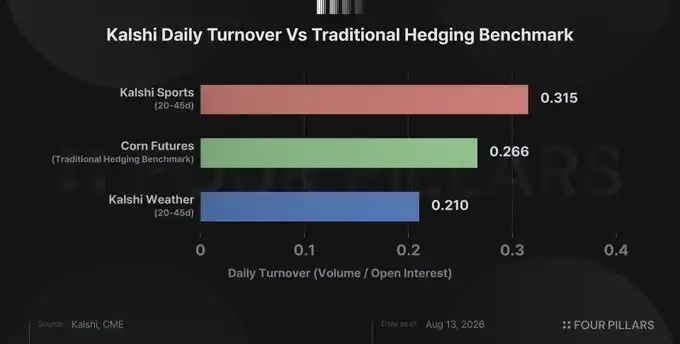
Sports contracts turn over about 1.5 times faster than weather contracts. This indicates a relatively longer holding tendency for weather contracts, initially suggesting the possible existence of real hedging demand.

However, a caveat: Corn futures' turnover rate sits in the middle, and the differences among the three data sets are not particularly stark. Based on turnover rate alone, we cannot fully confirm the existence of hedging demand in the weather market. What this data can definitively tell us so far is only that weather contract turnover is significantly lower than sports contract turnover.

IV. Data Point 2: Hold-to-Expiration Ratio

The second key metric is the hold-to-expiration ratio — measuring how many positions remain untouched in the market at settlement. It is calculated as the final open interest for each contract divided by the cumulative trading volume. A higher value indicates more positions were firmly held until the expiration date.
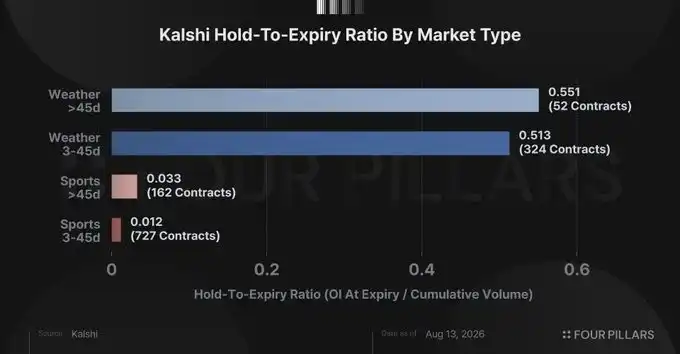
The difference in results is very striking: regardless of trading duration, the hold-to-expiration ratio for weather contracts exceeds 0.5. In contrast, sports contracts are only 0.012 and 0.033 respectively. In the 3 to 45-day trading interval, weather is 42.8 times that of sports; in the over 45-day interval, the gap is still 16.7 times.

This clearly shows: Weather contracts are far more inclined to "buy and hold" than sports contracts. Hedgers hold contracts to receive payouts if the risk materializes, not to chase price differences. Therefore, a high hold-to-expiration ratio strongly supports the judgment that there is real hedging demand in the weather market.

Of course, this cannot be directly interpreted as the entire weather market being used for hedging. This data does not track the identities of individual position buyers and sellers, so it cannot be simply equated with the proportion of original buyers holding to expiration. What can be confirmed at present is that the holding behavior of weather contracts is distinctly different from that of sports contracts.

V. Data Point 3: When Were Positions Established?

The final question is: When were these positions established? We divided the daily open interest for each contract by that contract's peak open interest, converted the time from launch to expiration into a progress bar from 0% to 100%, and then plotted the median curve.

The criterion for judgment is the point at which half of the peak open interest is reached. If half is reached when there is still more time until expiration, it means positions were built earlier — which is more in line with the behavior pattern of hedgers.
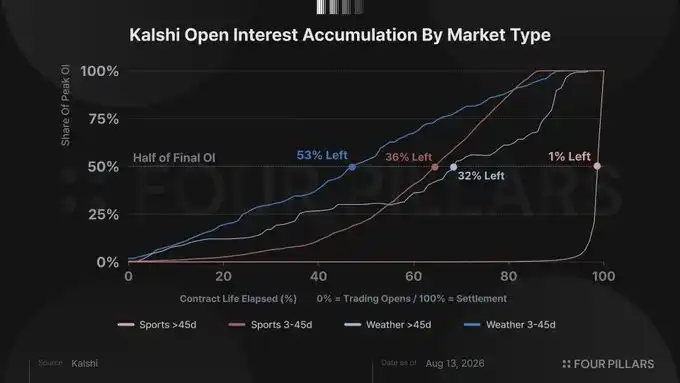
For weather contracts trading for 3 to 45 days, they had already reached half their peak open interest when their lifecycle was at 47%, leaving 53% of the time until expiration. Sports contracts in the same interval didn't reach half until 65%, with only 36% of the time remaining.

For contracts over 45 days, the difference is even more astonishing. Weather contracts reached half when there was still 32% until expiration, while sports contracts had only 1.3% left. Regardless of the interval, weather positions were established much earlier than sports positions.
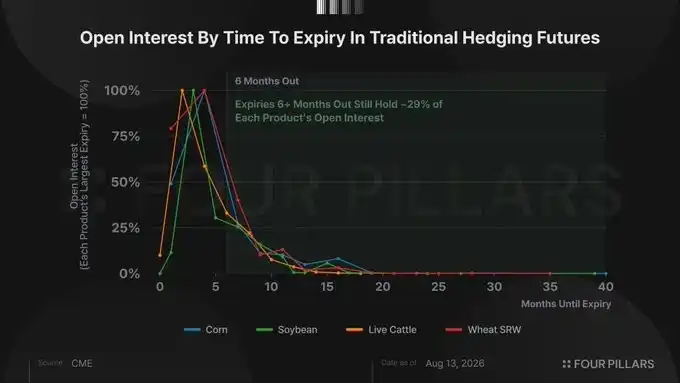
This behavior of "early positioning" is precisely a typical characteristic of traditional hedging markets. As of August 11, 2026, CME grain and livestock futures contracts expiring in six months had already accumulated massive open interest. Corn futures even held 65,127 positions on contracts expiring 16 months later.

This reflects the tendency to act well before the risk actually materializes. And the behavioral pattern of Kalshi weather contracts is clearly closer to traditional hedging markets than to sports markets.

VI. Hedging Relies on Liquidity Built by Speculation

Conclusion first: The Kalshi weather market is neither a purely hedging market nor a purely speculative one like sports. Speculative demand still contributes a significant portion of the liquidity, but on top of that, hedging demand has also emerged relatively clearly.

The three indicators point in the same direction: weather contracts trade less frequently, retain more positions at settlement, and positions are established earlier. No single indicator can confirm trading intent with 100% certainty, but the high consistency of these behaviors collectively supports a judgment — there indeed exists a holding demand in the Kalshi weather market distinct from sports, and a considerable part of it is likely real hedging demand.

More importantly, speculative demand is not so much a weakness of predictive markets as it is a prerequisite for the hedging function to exist. A market with only hedgers and no speculators would struggle to find sufficient counterparties and continuous liquidity.

In predictive markets, speculators are responsible for pricing and providing liquidity, while hedgers transfer the risks they do not wish to bear on this foundation. The risk is no longer directly underwritten by an insurance company but is naturally dispersed among market participants through trading.

Therefore, the next phase of growth for predictive markets is not about "squeezing out" speculation and shifting entirely to hedging. What truly matters is: How much real corporate hedging demand can be layered on top of the liquidity base already built by speculation? This is the core variable that determines whether it can upgrade from an "interesting speculative tool" to a "usable risk management infrastructure."


Trend Kriptolar

İlgili Sorular

QWhat is the main difference between using a prediction market and traditional insurance for business risk management?

AThe main difference is that in prediction markets, the insurance premium (price of the contract) is determined collectively by market participants based on their assessment of the event's probability, whereas in traditional insurance, the premium is calculated by the insurer's actuaries.

QWhat are the three data points used to analyze whether the Kalshi weather market is used for hedging?

AThe three data points are: 1) Average daily turnover rate, 2) Hold-to-expiration ratio, and 3) The timing of when positions are established (measured by the time it takes to reach 50% of peak open interest).

QAccording to the analysis, how does the trading behavior of Kalshi weather contracts compare to its sports contracts?

AThe analysis shows that Kalshi weather contracts have a lower turnover rate, a significantly higher hold-to-expiration ratio, and positions are established much earlier compared to Kalshi sports contracts. This suggests behavior more consistent with hedging.

QWhat is the primary role of speculators in a prediction market that aims to serve hedging purposes?

ASpeculators provide the necessary liquidity and price discovery in the prediction market, which creates a functional trading environment that allows hedgers to enter and exit positions to transfer their risks.

QWhat example is given to illustrate how a business could use a prediction market contract to hedge against operational risk?

AThe example given is an ice cream shop that could hedge against a cool summer. It could buy 20,000 temperature contracts at $0.30 each (total cost $6,000). If the summer is cool and average temperature falls below a threshold, each contract pays $1, offsetting the estimated $20,000 revenue loss, thereby locking the net loss at the initial $6,000 cost. If the summer is hot, the contracts expire worthless, and the shop loses the $6,000 premium but enjoys full revenue.

İlgili Okumalar

Tiger Research: How Far Can the On-Chain Foreign Exchange Settlement Layer Go?

"Tiger Research: How Far Can On-Chain FX Settlement Layers Go?" The article examines KiiChain, a startup aiming to create an on-chain foreign exchange settlement layer, focusing on its potential to address inefficiencies in cross-border payments, especially for emerging markets. The core problem is the slow, costly, and fragmented traditional FX infrastructure, where bank hours, regulations, and thin liquidity for local currencies create delays. KiiChain, founded by OTC veterans, proposes aggregating USD and local currency stablecoin liquidity on one chain to enable 24/7 settlement. The platform consists of four components: 1) The KiiChain App uses an Atomic Quote Network (RFQ-style price discovery with on-chain settlement) to tackle settlement delays, but not underlying liquidity scarcity. 2) The RWA Protocol tokenizes collateral using compliant standards (like ERC-3643), shifting trust from bank relationships to coded rules, though regulatory anchors remain. 3) Kii Oracle uses a decentralized validator network to create consensus pricing from fragmented data, improving transparency but not market depth. 4) KiiChain Pay bundles fiat on/off-ramps and swap services; only the DEX swap bypasses banking bottlenecks, while others still rely on licensed operators. The analysis concludes KiiChain doesn't eliminate intermediaries but creates a unified settlement layer where they can interact without geographic or time constraints. It streamlines the process—three of eight traditional steps are removed—by moving infrastructure on-chain, improving speed and accessibility for digital asset swaps. However, fiat entry/exit points remain subject to off-chain service limitations. Current metrics show over $500M in transaction volume. The future depends on ecosystem growth—attracting liquidity partners and users—to evolve beyond settlement into a broader financial hub. Ultimately, the on-chain structure currently solves settlement friction and time, not liquidity depth. Success will be determined by execution in building partnerships and market presence, not by architectural design alone.

marsbit28 dk önce

Tiger Research: How Far Can the On-Chain Foreign Exchange Settlement Layer Go?

marsbit28 dk önce

İşlemler

Spot

Popüler Makaleler

G Nasıl Satın Alınır

HTX.com’a hoş geldiniz! Gravity (G) satın alma işlemlerini basit ve kullanışlı bir hâle getirdik. Adım adım açıkladığımız rehberimizi takip ederek kripto yolculuğunuza başlayın. 1. Adım: HTX Hesabınızı OluşturunHTX'te ücretsiz bir hesap açmak için e-posta adresinizi veya telefon numaranızı kullanın. Sorunsuzca kaydolun ve tüm özelliklerin kilidini açın. Hesabımı Aç2. Adım: Kripto Satın Al Bölümüne Gidin ve Ödeme Yönteminizi SeçinKredi/Banka Kartı: Visa veya Mastercard'ınızı kullanarak anında Gravity (G) satın alın.Bakiye: Sorunsuz bir şekilde işlem yapmak için HTX hesap bakiyenizdeki fonları kullanın.Üçüncü Taraflar: Kullanımı kolaylaştırmak için Google Pay ve Apple Pay gibi popüler ödeme yöntemlerini ekledik.P2P: HTX'teki diğer kullanıcılarla doğrudan işlem yapın.Borsa Dışı (OTC): Yatırımcılar için kişiye özel hizmetler ve rekabetçi döviz kurları sunuyoruz.3. Adım: Gravity (G) Varlıklarınızı SaklayınGravity (G) satın aldıktan sonra HTX hesabınızda saklayın. Alternatif olarak, blok zinciri transferi yoluyla başka bir yere gönderebilir veya diğer kripto para birimlerini takas etmek için kullanabilirsiniz.4. Adım: Gravity (G) Varlıklarınızla İşlem YapınHTX'in spot piyasasında Gravity (G) ile kolayca işlemler yapın.Hesabınıza erişin, işlem çiftinizi seçin, işlemlerinizi gerçekleştirin ve gerçek zamanlı olarak izleyin. Hem yeni başlayanlar hem de deneyimli yatırımcılar için kullanıcı dostu bir deneyim sunuyoruz.

530 Toplam GörüntülenmeYayınlanma 2024.12.10Güncellenme 2026.06.02

G Nasıl Satın Alınır

@G Nedir

Graphite Ağı, $@G: Geleneksel Finans ve Web3 Arasında Köprü Kurma Graphite Ağı, $@G'ye Giriş Kripto para birimleri ve web3 projeleriyle dolu canlı dünyada, Graphite Ağı yeniliğin bir simgesi olarak ortaya çıkıyor. Yerel token'ı $@G ile bu Katman-1, Yetki Kanıtı (PoA) blok zinciri, geleneksel finans (TradFi) ile hızla gelişen Web3 ekosistemi arasındaki boşluğu kapatmak için tasarlanmıştır. Dijital para birimleri popülerlik kazandıkça, Graphite Ağı güvenlik, uyum ve hız önceliği olan bir blok zinciri platformu sunmayı hedefliyor ve kendisini güven ve hesap verebilirliğin bir kolaylaştırıcısı olarak tanıtıyor. Graphite Ağı, $@G Nedir? Graphite Ağı, yalnızca başka bir blok zinciri projesi değildir; dijital finans alanında merkeziyetsizlik, güvenlik ve kullanıcı hesap verebilirliğinin nasıl algılandığını yeniden tanımlamayı amaçlamaktadır. Proje, bir dizi ayırt edici özellik sunmaktadır: İtibara Dayalı Blok Zinciri: Graphite Ağı, entegre Müşterinizi Tanıyın (KYC) doğrulama ve puanlama mekanizmaları ile güçlendirilmiş bir kullanıcı başına bir hesap politikası uygular. Bu tasarım, kullanıcı gizliliği ile şeffaflık arasında bir denge sağlar; bu, günümüz dijital dünyasında finansal işlemlerin kritik bir yönüdür. Giriş Noktası Düğüm Geliri: Ağ, kullanıcıları giriş noktası düğümleri kurmaya teşvik eder ve operatörlerin ağ işlemlerinden ödüller kazanmasını sağlar. Bu gelir modeli yalnızca kullanıcı katılımını artırmakla kalmaz, aynı zamanda ağ sağlığını ve merkeziyetsizliği de güçlendirir. EVM Uyumluluğu: Ethereum uyumlu sanal makine (VM) ile Graphite Ağı, mevcut Solidity merkeziyetsiz uygulamaların (dApps) ve akıllı sözleşmelerin sorunsuz entegrasyonunu sağlar ve geliştiricilerin kapsamlı değişiklikler yapmadan yeteneklerinden yararlanmalarını davet eder. KYC Entegrasyonu: Uyumun en önemli olduğu bir çağda, çoklu doğrulama katmanları ile entegre KYC çerçevesi, zorunlu katılım olmaksızın finansal işlemler üzerindeki kontrolü artırır ve kullanıcı özerkliği için bir örnek teşkil eder. Graphite Ağı, $@G'nin Yaratıcısı Kimdir? Graphite Ağı, Graphite Vakfı'nın çabalarıyla doğmuştur; bu, Graphite Ağı'nın geliştirilmesi, bakımı ve evrimine adanmış kar amacı gütmeyen bir kuruluştur. Vakfın taahhüdü, projenin güvenli ve sürdürülebilir bir blok zinciri ortamı yaratma vizyonunu vurgular ve gerçek kullanıcı katılımı ile uyum odaklıdır. Graphite Ağı, $@G'nin Yatırımcıları Kimlerdir? Şu anda, Graphite Ağı girişimini destekleyen belirli yatırımcılar hakkında sınırlı bilgi bulunmaktadır. Kurucu kuruluş olan Graphite Vakfı, projenin büyümesini teşvik etmek için bağımsız olarak çalışmakta ve uyumlu ve erişilebilir bir blok zinciri platformu vizyonuna uygun ortaklıklar aramaktadır. Graphite Ağı, $@G Nasıl Çalışır? Graphite Ağı'nın işletimi, yüksek verimlilik ile merkeziyetsizlik arasında etkileyici bir denge kuran benzersiz Yetki Kanıtı konsensüs mekanizmasına dayanır. İşleyişini tanımlayan çeşitli bileşenlere bakalım: Taşıma Düğümleri: Giriş noktası düğümleri olarak hizmet eden bu düğümler, ekosistem için kritik öneme sahiptir. Operatörler, ağdan geçen işlemlerden gelir elde edebilir; bu, bireysel kullanıcıları güçlendirirken ağın merkeziyetsizliğini de artırır. Yetkili Düğümler: Graphite Ağı'nın kalbinde, sağlam KYC doğrulaması ve teknik değerlendirmeleri içeren titiz uyum testlerinden geçen temel doğrulayıcılar bulunmaktadır. Bu güven katmanı, ağ içindeki işlemlerin yüksek bir bütünlük seviyesini korumasını sağlamak için gereklidir. Ticker Sistemi: Graphite Ağı, sarılmış token'ları için @G olarak adlandırılan ayırt edici bir ticker sistemi kullanır. Bu özellik, varlık entegrasyonunda netliği artırarak kullanıcı işlemlerini anlaşılır ve basit hale getirir. Graphite Ağı'nın yenilikçi yaklaşımı, dijital finansın kritik sorunlarını ele almakta önemli bir adım olarak yansıyor ve daha fazla kullanıcının geleneksel finans biçimlerinden merkeziyetsiz uygulamalar dünyasına geçiş yapmasıyla gelecekte kendini olumlu bir şekilde konumlandırıyor. Graphite Ağı, $@G'nin Zaman Çizelgesi Graphite Ağı'nın ilerlemesini ve kilometre taşlarını anlamak için zaman çizelgesindeki önemli olayları gözden geçirmek faydalıdır: 2021: Graphite Vakfı tarafından Graphite Ağı'nın kuruluşu, uyum ve kullanıcı güçlendirmeye odaklanan blok zinciri geliştirme alanında yeni bir bölümün başlangıcını işaret eder. Ana Gelişmeler: Lansmanının ardından, giriş noktası düğüm geliri, itibara dayalı modelin kurulması, entegre KYC doğrulaması ve EVM uyumluluğunun sağlanması, projede önemli ilerlemeleri temsil eder. Son Faaliyetler: Graphite Vakfı'nın sürekli gelişim ve bakım çabaları, ağ özelliklerini artırmaya ve ekosistemin büyümesini teşvik etmeye odaklanarak sürdürülebilirlik ve yenilik için uzun vadeli bir taahhüt göstermektedir. Ek Anahtar Noktalar Temel bileşenlerinin ötesinde, Graphite Ağı, kullanılabilirliğini artıran birkaç araç ve özellik içermektedir: Graphite Cüzdanı: Kullanıcıların Ethereum uyumlu zincirler üzerindeki çeşitli ağ özelliklerine ve uygulamalarına erişimini kolaylaştıran kullanıcı dostu bir Chrome uzantısıdır. Graphite Köprüsü: Bu araç, Graphite varlıklarının farklı ağlar arasında sorunsuz bir şekilde transfer edilmesini sağlar ve entegre ve birlikte çalışabilir bir ekosistem oluşturur. Graphite Explorer: Ekosistem içinde temel bir araç olarak hizmet veren bu özellik, kullanıcıların akıllı sözleşme kaynak kodunu görüntülemesine ve doğrulamasına, işlemleri takip etmesine ve diğer önemli bilgileri gerçek zamanlı olarak keşfetmesine olanak tanır. Graphite Testnet: Proje, geliştiricilere ana ağ dağıtımından önce stabilite ve ölçeklenebilirliği sağlama imkanı sunan sağlam bir test ortamı sağlar. Bu girişim, yalnızca geliştiricileri güçlendirmekle kalmaz, aynı zamanda tüm ağın güvenilirliğini artırır. Sonuç Graphite Ağı, yerel token'ı $@G ile birlikte, geleneksel finans ile en son blok zinciri teknolojisi arasında köprü kurma yolunda önemli bir adımı temsil etmektedir. Güvenlik, uyum ve merkeziyetsizlik odaklı bu yenilikçi platform, Web3 dönemine geçişte liderlik yapmaya hazırdır. Kullanıcı katılımı arttıkça ve daha fazla proje yeteneklerinden yararlandıkça, Graphite Ağı hızla gelişen dijital manzaraya kalıcı katkılarda bulunmaya hazırlanıyor. Sonuç olarak, Graphite Ağı, yenilikçi düşüncenin modern finans ve teknolojinin artan talepleriyle buluştuğunda nelerin başarılabileceğinin bir kanıtıdır. Dünya merkeziyetsiz finansın potansiyelini keşfederken, Graphite Ağı bu alanda dikkate değer bir oyuncu olmaya devam edecektir.

77 Toplam GörüntülenmeYayınlanma 2025.01.06Güncellenme 2025.01.06

@G Nedir

Tartışmalar

HTX Topluluğuna hoş geldiniz. Burada, en son platform gelişmeleri hakkında bilgi sahibi olabilir ve profesyonel piyasa görüşlerine erişebilirsiniz. Kullanıcıların G (G) fiyatı hakkındaki görüşleri aşağıda sunulmaktadır.

活动图片