MY Group Completes Web4.0 First Stock Listing Layout, SEC Officially Discloses Form 8-K Announcement

marsbit2026-05-17 tarihinde yayınlandı2026-05-17 tarihinde güncellendi

Özet

MY Group has completed the listing layout for the "Web4.0 First Share," with the U.S. Securities and Exchange Commission (SEC) formally disclosing a Form 8-K report. According to the filing, the company's board has officially appointed Mr. Zhang Dingwen as Chief Executive Officer (CEO) and Executive Director, marking a significant upgrade in management and the entry into a new phase of its global capital market strategy. The disclosure of Form 8-K, used for reporting major corporate events, coincides with market information indicating the company is advancing several key capital market initiatives. These include a global brand system upgrade, corporate strategic restructuring, and a change of its stock ticker symbol. These moves are viewed by industry experts as signals of accelerated internationalization and enhanced global market presence. Concurrently, MY Group's proposed "Web4.0 Ecosystem" is garnering market attention. The company is integrating core capabilities across social traffic portals, global payment systems, public blockchain infrastructure, digital asset trading, and AI-powered financial systems. Analysts suggest that by closing this ecosystem loop, MY Group has the potential to become a next-generation platform merging Web2 user scale with Web3 asset frameworks and AI financial capabilities. With the management upgrade finalized, the global brand strategy launched, and the stock ticker change pending, MY Group is positioning itself as a focal point in the g...

The Company to Advance Stock Ticker Change, Global Capital Strategy Enters New Stage

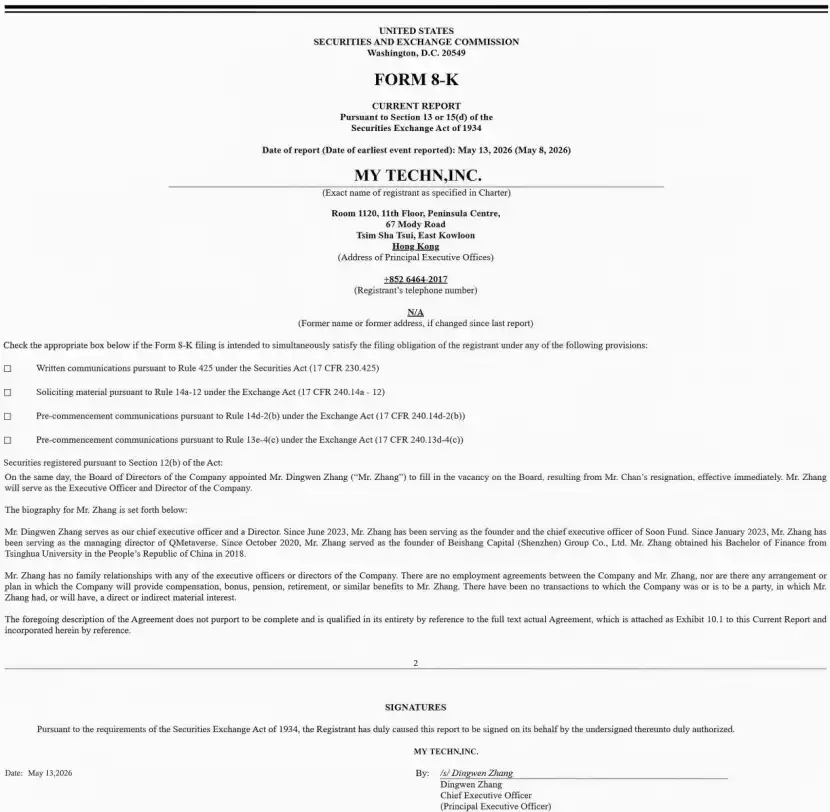
2026513日, The U.S. Securities and Exchange Commission (SEC) has officially disclosed the Form 8-K Current Report submitted by MY Technology Group.

According to the SEC announcement, the board of directors has formally appointed Mr. Zhang Dingwen as the company's Chief Executive Officer (CEO) and Executive Director of the board, with the appointment having taken effect.

The official disclosure of this Form 8-K also signifies that the company's management upgrade and its global capital market strategy have entered a new phase.

Public information indicates that Form 8-K is an immediate disclosure document for significant events of U.S. listed companies, typically used to report important information including management changes, board adjustments, and major capital market matters.

Simultaneously, market sources indicate the company is also currently advancing several key capital market actions, including: global brand system upgrade, corporate strategic structure optimization, stock ticker symbol change, and international capital market positioning upgrade.

Industry insiders believe such actions typically indicate that a listed company is accelerating its international capital market strategy and further enhancing its global market recognition and long-term capitalization capabilities.

Notably, following the disclosure of this Form 8-K, market attention towards the company's subsequent stock ticker change and brand upgrade plans has also increased significantly.

Capital market participants stated: After completing a management upgrade, a listed company simultaneously advancing brand and ticker system optimization is often seen as an important signal of the company entering a new stage.

Public records show that Mr. Zhang Dingwen has long been deeply involved in the fields of technology, digital finance, and international business, possessing extensive experience in corporate strategy and capital markets.

Following the completion of this management upgrade, the company's pace in advancing its international capital market strategy is expected to accelerate further.

As of now, the company has not disclosed its new stock ticker, but related matters are expected to proceed according to SEC regulations and exchange processes.

It is widely believed within the industry that with the official disclosure of this Form 8-K, the company's global capital market layout is continuously deepening, and its subsequent strategic moves are expected to receive further market attention.

"Web4.0 First Stock" Garnering Market Attention

With the ongoing integration of AI, digital payments, Web3, and social ecosystems, the global capital market is searching for the next generation of internet platform companies.

The "Web4.0 Ecosystem" proposed by MY Group is also becoming a key focus in the industry.

Currently, the company has gradually developed core capabilities including: social traffic entry points, global payment systems, public chain infrastructure, digital asset trading ecosystems, and AI-powered financial systems.

Market observers believe: If MY Group can further complete its ecosystem loop, it has the potential to become one of the few new-generation technology platforms in the global capital market that truly integrates "Web2-scale user base + Web3 asset systems + AI financial capabilities."

With the SEC officially disclosing the Form 8-K, management upgrade completed, global brand strategy launched, stock ticker change imminent, and Web4.0 strategy advancing, MY Group may become one of the Web4.0 platform-level companies drawing significant attention in the global technology capital market.

İlgili Sorular

QWhat significant SEC filing was disclosed for MY Tech Group, and what was the key announcement within it?

AThe U.S. Securities and Exchange Commission (SEC) formally disclosed a Form 8-K Current Report for MY Tech Group. The key announcement was the official appointment of Mr. Zhang Dingwen as the company's Chief Executive Officer (CEO) and an executive director of the board, with the appointment already in effect.

QAccording to the article, what other strategic moves is MY Group reportedly advancing alongside the management change?

AAlongside the management change, MY Group is reportedly advancing several key capital market actions, including a global brand system upgrade, corporate strategic structure optimization, a stock ticker symbol change, and an upgrade to its international capital market positioning.

QWhat core capabilities make up MY Group's proposed 'Web4.0 ecosystem'?

AMY Group's proposed 'Web4.0 ecosystem' is built on core capabilities including social traffic portals, a global payment system, public chain infrastructure, a digital asset trading ecosystem, and an AI-powered intelligent financial system.

QWhy is the Form 8-K filing considered significant for a publicly traded company?

AForm 8-K is a significant filing because it is used for the immediate disclosure of major events by U.S. listed companies, typically covering important information such as management changes, board adjustments, and significant capital market matters.

QWhat market potential does the article suggest for MY Group in relation to the Web4.0 concept?

AThe article suggests that if MY Group can further complete its ecosystem, it has the potential to become one of the few next-generation technology platforms in the global capital market that truly integrates 'Web2 user scale, Web3 asset systems, and AI financial capabilities,' positioning it as a key Web4.0 platform-level company for market focus.

İlgili Okumalar

Dumping US Bonds, Buying Japanese Bonds: Wall Street Prepares for 'Capital Repatriation to Japan'

Wall Street is bracing for a potential "great repatriation" of Japanese capital as yields on Japanese Government Bonds (JGBs) soar to multi-decade highs. The 10-year JGB yield recently hit 2.73%, its highest since 1997, while the 30-year yield broke 4% for the first time. This dramatic shift is causing global asset managers to reassess a long-ignored risk: that Japanese investors, who hold roughly $1 trillion in U.S. Treasury debt, could start bringing that money home. For decades, Japan's ultra-low interest rates pushed domestic insurers, pension funds, and banks to seek yield overseas, primarily in U.S. Treasuries. Now, with the Bank of Japan hiking rates and JGB yields climbing, the incentive is reversing. Firms like BlueBay Asset Management are preparing for this shift, believing new Japanese investments will be directed domestically rather than to foreign bonds. Early signs of repatriation are emerging, with record monthly inflows into Japanese sovereign bond funds in March. Some managers, like Ruffer's Matt Smith, hold yen as a hedge, anticipating that market stress could trigger a rapid acceleration of capital returning to Japan. However, analysts caution that a mass exodus hasn't begun yet. Japanese investors were still net buyers of foreign bonds over the past year. Uncertainty remains high as Japan's government fiscal plans could push JGB yields even higher, making investors hesitant to buy immediately. Furthermore, the Bank of Japan's withdrawal as a dominant bond buyer has increased market volatility. Nevertheless, the potential scale of Japanese selling poses a tangible risk to the U.S. Treasury market. As the largest foreign holder of U.S. debt, any sustained shift by Japanese institutions could materially impact supply and demand dynamics, pushing U.S. yields higher. Wall Street's current positioning is a forward-looking bet on this logic becoming increasingly compelling as Japanese yields continue to rise.

marsbit22 dk önce

Dumping US Bonds, Buying Japanese Bonds: Wall Street Prepares for 'Capital Repatriation to Japan'

marsbit22 dk önce

How Did Institutions Adjust Their Crypto Asset Holdings in Q1? Who Increased and Who Exited?

The Q1 2026 13F filings reveal a sharply divided picture of institutional activity in crypto assets. Sovereign wealth funds and bank capital increased exposure, while major endowment funds notably de-risked. The most significant buying came from the Abu Dhabi sovereign wealth fund Mubadala, which expanded its position in the iShares Bitcoin Trust (IBIT). JPMorgan Chase dramatically increased its IBIT exposure by 174%, with other global banks like RBC, Scotiabank, and Barclays also adding to Bitcoin ETF holdings, while using options for asymmetric protection. Conversely, the Harvard Management Company (Harvard University's endowment), once a major academic holder, cut its IBIT position by 43% and fully exited a BlackRock Ethereum ETF. The reallocated capital flowed into traditional assets like TSMC, Microsoft, and gold. Other Ivy League endowments showed varied strategies: Brown and Dartmouth maintained Bitcoin positions, with Dartmouth making a nuanced shift by moving Ethereum exposure to a staking ETF and adding a Solana staking ETF to capture yield. Hedge fund Jane Street significantly reduced Bitcoin ETF holdings, locking in profits, while Wells Fargo increased its Ethereum stake. Overall, institutions are deploying traditional capital market tactics—buying, selling, hedging, and rotating—within crypto via spot ETFs. The Q2 reports will be crucial to determine if Harvard's retreat is an outlier or the start of a broader trend among endowments.

marsbit54 dk önce

How Did Institutions Adjust Their Crypto Asset Holdings in Q1? Who Increased and Who Exited?

marsbit54 dk önce

Blockchain Capital Partner: Most People Have a Narrow Understanding of the On-Chain Economy

Author Spencer Bogart, a partner at Blockchain Capital, argues that most people have a narrow view of the on-chain economy, seeing it primarily as a faster, cheaper version of existing financial systems. While this represents a significant opportunity, he believes it's only a small part of the story. Bogart compares the current state of crypto to the early internet, where email was the obvious "faster mail" application. The truly transformative categories—like search, social media, and cloud computing—were entirely new and unimaginable beforehand. Similarly, the most profound innovations in crypto will not be incremental improvements but entirely new categories enabled by the core properties of public blockchains: atomic execution, shared global state, programmable custody, and composability. He cites the "flash loan" as a prime example of a "new verb"—a financial action structurally impossible before programmable assets and atomic settlement. It allows for uncollateralized, trustless borrowing of any size, provided repayment occurs within the same transaction, enabling novel strategies like arbitrage and collateral swaps. Bogart admits the difficulty in precisely predicting these future innovations, as human imagination tends to extrapolate from the past. He posits that the most exciting applications in ten years will be things that don't exist today and have no precedent—products only possible in a global, composable, always-on environment with programmable assets. While the exploration of this vast design space will involve many failures, the potential for transformative, category-defining breakthroughs is what makes the next decade so promising.

链捕手1 saat önce

Blockchain Capital Partner: Most People Have a Narrow Understanding of the On-Chain Economy

链捕手1 saat önce

İşlemler

Spot
Futures
活动图片