ChronoForge to shut down amid funding collapse and Web3 gaming turmoil

cointelegraph2025-12-10 tarihinde yayınlandı2025-12-10 tarihinde güncellendi

Özet

ChronoForge, a Web3 game studio developing a multiplayer action RPG with onchain asset ownership, is shutting down by December 30 due to severe financial difficulties. The studio cited funding shortfalls, an 80% staff reduction, and poor market sentiment in the Web3 gaming sector. Founders had been financing development personally since July. The closure reflects broader challenges in GameFi, where funding has dwindled and user interest has declined. A 2024 report indicated 93% of Web3 game projects were defunct, with token prices down 95% from all-time highs. Despite these struggles, gaming remained one of the most active sectors in Web3 in October, accounting for nearly 28% of decentralized application activity.

ChronoForge, a Web3 game studio developing a multiplayer action RPG centered on onchain asset ownership, is shutting down after months of operating with a drastically reduced team, a closure that underscores the severe financial pressures facing the Web3 gaming sector during the current market downturn.

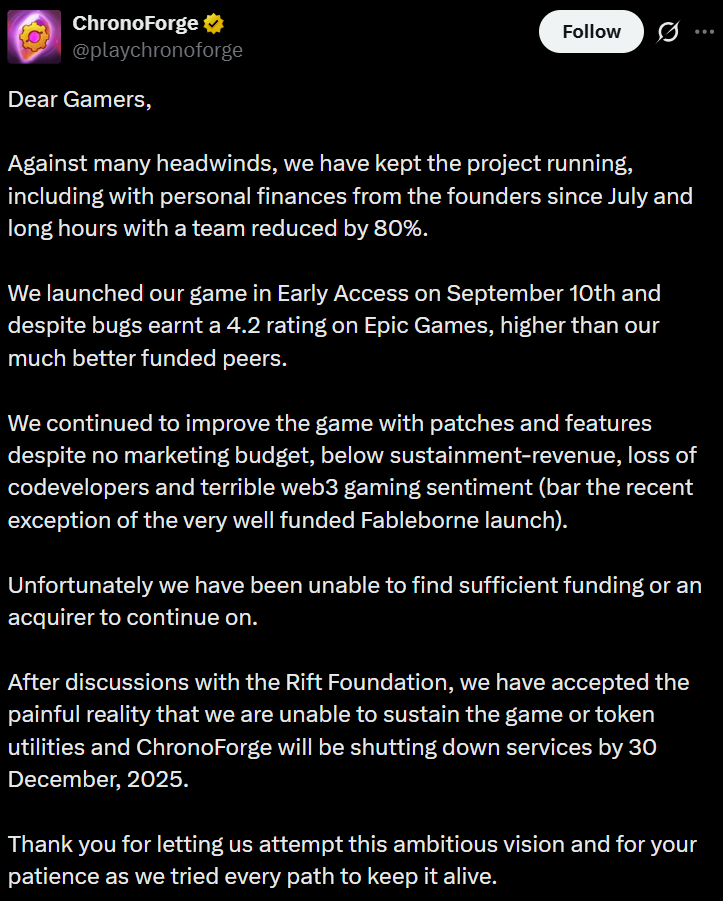
On Wednesday, the studio announced it will cease all services by Dec. 30, citing “many headwinds,” including a funding shortfall that forced the founders to finance development out of pocket since July and reduce staff by 80%.

In a statement posted to social media, the team said it had continued operating under intense financial strain, pushing out patches and new features “despite no marketing budget, below sustainment revenue, loss of codevelopers and terrible Web3 gaming sentiment.”
Source: ChronoForge

Abhishek Pawa, founder of the cryptocurrency consulting company AP Collective, said the closure “reflects how difficult the Web3 gaming market has been this cycle.”

ChronoForge was developed by Minted Loot Studios. Its affiliated entity, Rift Foundation, oversees the game’s token and ecosystem. The foundation raised more than $3 million through the sale of the RIFT token to support development.

The project became active in 2022, when it launched its first NFT collection and began early community-building efforts.

Related: VC Roundup: Big money, few deals as crypto venture funding dries up

GameFi’s broader struggle — and a few bright spots

Web3 gaming, often referred to as GameFi, has faced weak funding and declining user interest through much of 2025.

By late last year, 93% of Web3 game projects were considered defunct, according to a report by ChainPlay, a blockchain gaming platform. At the time, GameFi token prices had dropped 95% from their all-time high.

The trend marked a sharp reversal from the previous crypto bull market, which peaked in 2022 and fueled a surge in demand for GameFi projects.

Venture capital interest in the sector has also waned, given the dismal returns. More than half of the VCs that invested in GameFi as of late 2024 had lost money, according to ChainPlay.

Still, there have been some bright spots. Data from DappRadar shows that GameFi and decentralized finance were the most active sectors in Web3 in October, with gaming accounting for nearly 28% of all decentralized application activity during the month.
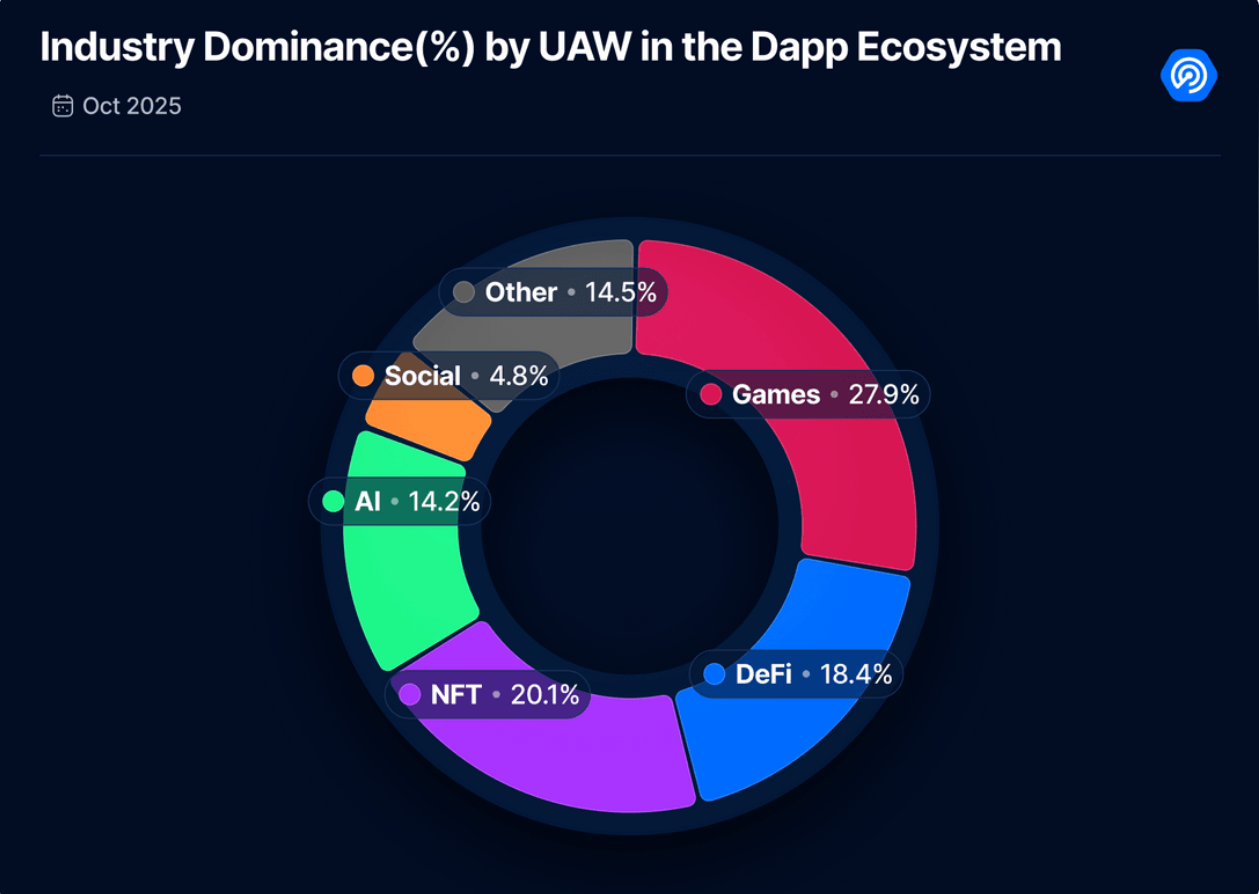
Within Web3, gaming represented the highest number of unique active wallets in October. Source: DappRadar

Related: Investors target ‘fun-first’ crypto games as funding jumps 94% in July

İlgili Okumalar

How Does x402 V2 Enable Autonomous Payments for AI Agents?

The x402 protocol, initially developed by Coinbase, leverages the HTTP 402 status code to embed payment logic directly into web requests. The newly released V2 upgrade introduces significant improvements to address limitations in cross-chain support, scalability, identity authentication, and repeated payments experienced in V1. Key enhancements include: - **Wallet Identity and Reusable Sessions**: Supports wallet-based authentication (e.g., Sign-In-With-X via CAIP-122), allowing reusable sessions after initial payment. This reduces latency and costs for high-frequency use cases like AI agent tasks and LLM inference. - **Unified Payment Interface**: Enables multi-chain payments (e.g., Base, Solana) and compatibility with traditional systems (ACH, SEPA, credit cards) via Facilitators. Dynamic payTo routing allows context-aware pricing and complex market structures. - **Modular Architecture**: A plugin-driven SDK simplifies integration, supporting easy expansion to new chains and payment methods without core changes. Multi-Facilitator support automates optimal payment path selection based on preferences. - **Automatic Discovery**: Services can expose metadata for automatic synchronization, ensuring real-time pricing and availability updates without manual intervention. For end-users, V2 enables seamless, subscription-like access with reduced friction. Developers benefit from flexible, low-maintenance payment integration and dynamic pricing models. AI agents gain autonomy to make economic decisions, such as purchasing API calls or compute resources independently using allocated budgets. x402 V2 evolves from a pay-per-use tool into a versatile economic layer, though challenges like ecosystem adoption, modular risks, and regulatory uncertainty remain.

比推13 dk önce

How Does x402 V2 Enable Autonomous Payments for AI Agents?

比推13 dk önce

Bitcoin (BTC) Price Trend and Investor Sentiment Suggest a Bullish December

Bitcoin (BTC) is showing signs of a potential bullish December, challenging a decade-old bearish seasonal pattern where November losses typically extend into year-end declines. Key factors supporting this shift include reduced leverage, with open interest dropping from $94 billion to $60 billion, and Bitcoin’s price reclaiming its monthly volume-weighted average price (rVWAP), indicating controlled distribution. Liquidity dynamics have also shifted, with deep liquidity clusters moving upward, and around $3 billion in short positions set to liquidate near $96,000. Market structure diverges from historical cycles due to spot ETF inflows, introducing constant structural demand and accelerating price discovery. Analysts note that Bitcoin’s four-year cycle, while not obsolete, is no longer time-aligned, resembling extended accumulation phases like mid-2016 or late-2019. Macro liquidity (M2) growth has plateaued, creating a late-cycle environment where risk assets rally despite underlying economic softening. Supporting indicators, such as CNY/USD and ETH/BTC correlations, along with improving PMI data and gold’s relative strength, suggest continued risk-on momentum rather than cycle fatigue. While buy-sell ratios show urgency, analysts caution this may reflect positioning squeeze rather than sustainable accumulation. Overall, December’s performance may depend more on structural forces—ETF flows, liquidity rotation, and shifting macro correlations—than traditional halving-driven周期 patterns.

cointelegraph_中文29 dk önce

Bitcoin (BTC) Price Trend and Investor Sentiment Suggest a Bullish December

cointelegraph_中文29 dk önce

İşlemler

Spot
Futures
活动图片