TON Revives the Gram Brand, a Name That Disappeared Six Years Ago Returns

marsbit2026-06-10 tarihinde yayınlandı2026-06-10 tarihinde güncellendi

Özet

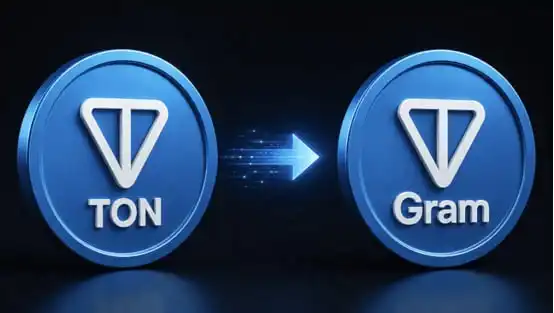
After a community vote with over 81% support, The Open Network (TON) is officially renaming its native token from Toncoin back to Gram (with ticker GRAM), effective June 15. This move reclaims the original name from the project's 2018 inception under Telegram, before regulatory issues forced its halt. The rebrand to Gram is part of the "Make TON Great Again" strategy and is seen as more than a simple logo change. It aims to leverage the historical brand recognition and narrative associated with Telegram’s initial vision of a global blockchain network. Gram evokes the original story of bringing crypto to Telegram's massive user base. This shift comes as TON is experiencing significant growth, driven by Telegram's over 1 billion monthly active users and viral mini-apps like Notcoin. The ecosystem is expanding in wallets, active addresses, and payment use cases. Analysts suggest the name change could strengthen TON's unique identity in a crowded Layer 1 market by deepening its association with Telegram's vast distribution channel. While potentially boosting short-term market attention, the long-term focus remains on Gram's utility within Telegram's evolving ecosystem, particularly for payments, transfers, and mini-app transactions. The ultimate goal is for Gram to become a widely used digital currency within one of the world's largest social platforms.

Author: Winnie, CryptoPulse Labs

On June 9th, the results of the TON Vote community governance were announced. Over 81% of voters supported changing the native token name from Toncoin to Gram, and the token code will also change from TON to GRAM, with the changes scheduled to take effect officially on June 15th.

On the surface, this seems like just a brand upgrade, but for old players who experienced the Telegram token issuance saga, the name "Gram" carries the initial ideals and story of TON.

More importantly, against the backdrop of Telegram's monthly active users exceeding 1 billion, the TON ecosystem re-entering a growth cycle, and the rapid expansion of its on-chain payment and Mini App ecosystem, this renaming may be far more significant than just a logo change.

I. Behind TON's Brand Upgrade: Gram Officially Returns to the Crypto Market

Let's go back to 2018. At that time, Telegram founder Pavel Durov launched the TON (Telegram Open Network) plan, aiming to build a blockchain network covering hundreds of millions of users worldwide.

The project's whitepaper explicitly stated that the name of the network's native currency would be "Gram."
During the fervent ICO era, TON once set a fundraising record of $1.7 billion and was seen as one of the blockchain projects with the greatest potential for mass adoption.

However, in 2020, the U.S. SEC sued Telegram for allegedly conducting an unregistered securities offering. Ultimately, Telegram was forced to halt project development and refund investors.

Many thought TON was over, but the story didn't end there.

Subsequently, the open-source community took over the code and continued development. The project gradually evolved into today's The Open Network. To distinguish it from the original project, the community renamed the token to Toncoin, while keeping the token code as TON.

After several years of development, TON has re-emerged as a mainstream public chain. And now, with the token officially renamed to Gram, this name that had been dormant for years finally returns to the market's view.

An important step in the "Make TON Great Again" plan. Officials stated that this renaming is the fourth step in the "Make TON Great Again (MTGA)" seven-step strategy.

Based on public information, the TON team is driving a comprehensive brand overhaul. This upgrade mainly includes changing Toncoin to Gram, changing the TON code to GRAM, launching a new logo and visual system, synchronizing updates to wallets and ecosystem applications, and gradual adaptation by trading platforms.

It's noteworthy that only the token brand is changing; the blockchain network will maintain the name "The Open Network." In other words, the TON chain remains the TON chain, but the currency on the chain is once again called Gram.

This is similar to the Ethereum network keeping its name while ETH suddenly changes. Therefore, this is not a technical upgrade but a brand strategy adjustment.

In the crypto market, narrative is often more important than technology. For many veteran players, Gram represents TON's original dream. It is the story from 2018 that attempted to bring blockchain to hundreds of millions of global users; it is also a significant symbol of Telegram's challenge to the traditional financial system.

II. From Public Chain Competition to Brand Competition, TON is Seeking Differentiation

If we rewind two years, TON might not have had the conditions to rename, but the situation today is completely different.

Over the past year, Telegram has become one of the fastest-growing Web3 traffic portals globally. Especially after the explosion of hit applications like Notcoin and Hamster Kombat, a large number of users were exposed to on-chain assets for the first time.
The TON ecosystem's user base has rapidly expanded, with continuous growth in wallet numbers, on-chain active addresses, payment scenarios, and developer numbers.

For TON, it is no longer an experimental project; it has begun to become a large-scale ecosystem with a real user base. Against this backdrop, the timing for a brand upgrade has matured. Reviving "Gram" may be about strengthening the Telegram DNA.

In fact, "Toncoin" has always had a problem. Although it is highly aligned with the TON network name, it lacks a sufficiently distinct brand memory point.

Gram is different. This name is deeply tied to Telegram's history. Just mentioning Gram will remind veteran users of a series of keywords: Telegram, Pavel Durov, the $1.7 billion fundraising, the vision for global payments, Web3 super apps, etc. This brand equity is something Toncoin cannot provide.

For TON, re-adopting Gram is equivalent to reactivating brand value that has been dormant for years. This can help TON establish a more unique cognitive label in the fiercely competitive public chain market.

Currently, competition in the Layer1 track is intensifying. Besides Ethereum, new public chains like Solana, Sui, and Aptos are all vying for users and developers.

The technological gap is gradually narrowing, and what can truly create a difference is starting to become brand and traffic.

From this perspective, TON's biggest advantage is not TPS or gas fees, but the Telegram behind it. A global user base exceeding 1 billion is a moat difficult for other public chains to replicate. And the name Gram can further strengthen this association.

In the future, when users mention Gram, they will think not just of a token, but of the entire Telegram ecosystem. This is precisely the effect TON hopes to achieve.

III. From Token Upgrade to Ecosystem Expansion, Can Gram Open Up New Space?

Looking at historical experience, the crypto community often reacts positively to brand upgrades. Whether it's a project name change, token split, or visual upgrade, it can become a focus of short-term capital attention.

The reason is simple: a brand upgrade means a new story. And the market loves stories the most. Gram's return also possesses this attribute.
For a period of time in the future, "Gram's Revival" is likely to become a new communication theme for the TON ecosystem. For the trading market, this narrative has the potential to increase attention and capital inflows.

Of course, a name change alone cannot support prices long-term. What truly determines value remains ecosystem development. The Telegram payment system may be further improved

Compared to short-term price fluctuations, TON's future payment layout is more worthy of attention. From its inception, Gram was positioned as a digital payment currency. Its goal is not merely as an investment asset, but to become a medium of value exchange within the Telegram ecosystem.

Now, with the development of the Telegram Stars system, the expansion of the Mini App ecosystem, and the increase in on-chain payment scenarios, Gram's application space is gradually opening up.

If Telegram further integrates its payment system in the future, Gram may take on an even more central role, which is also one of the long-term logics the market is most concerned about.

Over the past few years, most public chains have been competing for developers. TON seems to have chosen a different path; it attempts to embed blockchain directly into the social platform users are already accustomed to using.

This model is somewhat similar to the development path of WeChat Pay. Users don't need to understand the underlying technology; they just need to complete payments, transfers, tipping, or game operations, with the blockchain hidden in the background.

If this model ultimately proves successful, TON could become the first Web3 network to truly achieve mass adoption by hundreds of millions of users. And Gram would be the core value carrier within this ecosystem.

Therefore, the significance of this renaming may far exceed market imagination. It is not just a brand return, but could be the beginning of TON redefining its own positioning.

Conclusion

For the market, Gram is not just a token name; it represents the dream Telegram once had of building a global digital economic network.

And now, against the backdrop of Telegram's traffic, on-chain payments, the Mini App ecosystem, and the continuous integration of AI applications, this dream may be getting a second chance.

In the coming years, what's truly worth watching may not be that TON changed its name. It is whether Gram can leverage Telegram's vast user network to grow into the crypto industry's first genuinely global internet currency.

İlgili Sorular

QWhat was the result of the TON Vote community governance on June 9th regarding the native token's name?

AThe result of the TON Vote community governance on June 9th showed that over 81% of voters supported changing the native token name from Toncoin to Gram, with the token code changing from TON to GRAM. This change was planned to take effect officially on June 15th.

QWhat is the historical significance of the name 'Gram' for the TON project?

AThe name 'Gram' holds historical significance as it was the original name for the native currency in the 2018 whitepaper of the TON (Telegram Open Network) project launched by Telegram founder Pavel Durov. It represents the initial vision and story of TON, which was later halted due to a lawsuit from the U.S. SEC in 2020, before being revived by the open-source community.

QAccording to the article, what is the 'Make TON Great Again (MTGA)' plan and where does the token rename fit into it?

AThe 'Make TON Great Again (MTGA)' plan is a seven-step strategic initiative by the TON team. The token rename from Toncoin to Gram is the fourth step in this plan, which is part of a broader brand reshuffling effort that also includes a new logo, visual identity, and updates across wallets, ecosystem applications, and trading platforms.

QHow does the article describe the current competitive advantage of TON compared to other Layer1 blockchains?

AThe article states that TON's biggest competitive advantage is not its TPS or gas fees, but its association with Telegram and its user base of over 1 billion monthly active users. This provides a massive, unique traffic moat that other Layer1 blockchains like Solana, Sui, and Aptos cannot easily replicate. The rebranding to 'Gram' is seen as a way to further strengthen this association.

QWhat potential long-term role does the article suggest for Gram within the Telegram ecosystem?

AThe article suggests that Gram has the potential to become a core medium of value exchange within the Telegram ecosystem, similar to how WeChat Pay functions. As Telegram expands its payment systems (like Telegram Stars), Mini App ecosystem, and on-chain payment scenarios, Gram could evolve into the first truly global internet currency for the crypto industry, facilitated by Telegram's vast user network.

İlgili Okumalar

Weekly Data Recap: S&P Pantera Index Launches, Robinhood Chain Volume Climbs to Top 4

Weekly Data Recap: S&P Pantera Index Launches, Robinhood Chain Volume Ranks Fourth This week saw a mixed performance for risk assets amidst internal reshuffling. Bitcoin closed slightly down at $64,444, while Ethereum gained 0.6%. A key development was the launch of the S&P Pantera Digital Assets Index (SPPDA), co-created by S&P Dow Jones Indices and Pantera Capital. This 18-token benchmark index, powered by Artemis's revenue and supply data, filters for protocols with actual revenue and weights constituents by market cap. Notably, Bitcoin and XRP were excluded due to the revenue requirement. Meanwhile, Robinhood Chain, an Arbitrum Orbit L2 launched on July 1st, surged to become the fourth-largest chain by DEX volume with $4.7B weekly trading. However, analysis reveals a gap between its intended purpose and current reality. While marketed for tokenizing real-world assets (RWAs) like stocks, the chain is currently dominated by memecoin trading, accounting for ~75% of DEX volume. Robinhood's own stock tokens represent only 4.2% of the chain's $595M TVL, with 70% locked in third-party protocols like Morpho and Ethena. Uniswap commands a near-monopoly (98%) on the DEX layer. The launchpad pons.family captured most activity, generating fees roughly five times the chain's total gas fees. Robinhood currently earns basic transaction fees, while third-party applications capture significant economic value, illustrating a "fat app, skinny chain" dynamic. Other notable developments include Hyperliquid's open interest hitting a record $11.4B, consistent weekly inflows into Ethereum ETFs (~$104M), and the end of a six-week outflow streak for Bitcoin ETFs. Regulatory news included the LSE announcing a 24/5 trading venue and the SEC scheduling a roundtable on 24-hour stock trading, while the GENIUS Act's implementation was delayed to 2027.

marsbit1 dk önce

Weekly Data Recap: S&P Pantera Index Launches, Robinhood Chain Volume Climbs to Top 4

marsbit1 dk önce

Institutions and On-Chain Capital Are Bullish on CXMT's Continued Surge, Except for South Koreans

Changxin Technology, China's leading memory chip manufacturer, made its debut on the STAR Market, closing up 465.8% with a market cap of 3.28 trillion yuan. Its record-breaking first day included over 140 billion yuan in turnover. Market opinions on its future trajectory diverge. Nomura issued a "buy" rating with a 116 yuan target (implying ~1239.5% upside), citing rapid growth projections, expansion into HBM, and the "crown jewel" status of its DRAM business. Northeast Securities offered a more conservative 10-15x PE valuation range, implying significant but lower upside. While the stock's surge reflects optimism, analysis suggests Changxin's current capacity remains below giants like Samsung and SK Hynix. U.S. equipment export restrictions may limit near-term expansion, and the company is not yet competitive in the high-margin HBM segment crucial for AI. On-chain data from Hyperliquid showed pre-listing positioning was net long by wallets tagged to the U.S., Hong Kong, and mainland China, while Korean-tagged wallets were heavily net short. Other bullish factors noted include a low initial float (6.63%), the ongoing memory "super cycle," and the stock's unique status as a domestic industry leader. Founder Zhu Yiming's plan to distribute 40% of his increased wealth to employees may also slow share sales. Multiple ETF issuers warned that fund net asset values might deviate from displayed reference values on the first day due to the large gap between Changxin's IPO price and its market price.

Odaily星球日报5 dk önce

Institutions and On-Chain Capital Are Bullish on CXMT's Continued Surge, Except for South Koreans

Odaily星球日报5 dk önce

Claude Code Slashes 80% of Prompt Tokens, But Opus 5 Just Adds Them Right Back In

Claude Code, the AI coding assistant from Anthropic, recently announced a massive reduction of over 80% in its system prompt content for models like Opus 5 and Fable 5. The goal was to remove verbose, often conflicting, rules (like strict commenting and documentation requirements) and replace them with a simpler directive: write code that matches the style of the surrounding project. This "pruning" aims to make the model more efficient by reducing internal conflict from overlapping instructions, with no measurable performance drop reported. However, a developer's (@chenchengpro) investigation revealed a twist. While the prompt was drastically cut from 15,225 characters in Opus 4.7 to 4,467 in Opus 4.8, it *increased* by approximately 72% to 7,694 characters in Opus 5. This isn't a contradiction. The "over 80% cut" refers to the overall shift from the old, detailed rulebook-style prompts to a new, streamlined system. The 72% increase for Opus 5 represents new, targeted instructions added to manage the model's enhanced capabilities. Opus 5 is more proactive—it likes to report progress, generate longer outputs, use sub-agents, and expand task scope. The added prompt content (roughly 3,755 characters) primarily provides guidelines for "Delivering work" (controlling task scope, progress reporting) and "Corrections" (limiting excessive self-correction). These new rules are necessary to curb potential over-engineering on simple tasks, ensuring efficiency even as the model becomes more independent. In short, the old, restrictive manual was deleted, but new guidelines were written to harness the model's newfound initiative.

marsbit11 dk önce

Claude Code Slashes 80% of Prompt Tokens, But Opus 5 Just Adds Them Right Back In

marsbit11 dk önce

İşlemler

Spot
活动图片