Uniswap v4 Hook Analysis: Architecture Design, Common Vulnerabilities, and Protection Practices

marsbit2026-06-22 tarihinde yayınlandı2026-06-22 tarihinde güncellendi

Özet

Uniswap v4's Hook mechanism is a major innovation, enabling custom logic injection into liquidity pool lifecycle events like swaps and liquidity provisioning. This transforms the AMM into programmable infrastructure, shifting the security model from protocol-level to pool-level, as each pool's safety now depends on its bound Hook contract. The core architecture revolves around the singleton PoolManager contract, which manages all pools via a flash accounting system. State changes are tracked in transient storage and must be settled by the end of a transaction. Hook contracts are permanently bound to pools via a PoolKey, with their permissions encoded directly into their address via specific low-order bits. This design introduces unique security considerations and challenges for future upgrades. Key vulnerabilities and best practices identified include: - **Access Control Gaps:** Early versions of the BaseHook abstract contract only protect `unlockCallback()`, leaving other lifecycle functions (`beforeSwap`, `afterSwap`, etc.) exposed unless explicitly secured by developers. - **Unrestricted Pool Binding:** The `initialize()` function does not validate if a Hook "consents" to a new pool. Hooks must implement their own whitelisting in `beforeInitialize` to prevent unauthorized pool creation. - **Async/Custom Curve Hooks:** These high-risk Hooks can completely replace Uniswap's swap logic. Their security depends entirely on their own implementation, as they operate outside the...

Since the mainnet launch of Uniswap v4, the Hook mechanism has become one of the most-discussed innovations in DeFi. The memecoin launchpad Flaunch on Base leverages Hooks to achieve fixed presale pricing and automatic listing and liquidation mechanisms; the liquidity protocol Bunni v2 uses Hooks to build programmable liquidity and restaking models; tokens like SATO, uPEG (Unipeg), and Slonks, which revolve around Hook-based gameplay, have also seen tens-of-times price surges in short periods this year.

On the flip side of the Hook ecosystem's prosperity, attacks targeting Hook implementation flaws have also increased significantly. This article will start with the Hook mechanism in Uniswap v4, gradually analyze its core call stack, and help project teams understand potential vulnerabilities.

Uniswap v4 Hook Security

1. Introduction

The most significant architectural change in Uniswap v4 compared to v3 is the introduction of the Hook mechanism: it allows developers to attach custom contracts to lifecycle events of liquidity pools, injecting arbitrary logic at nodes such as swap, add/remove liquidity, and initialization.

Key changes in v4 are as follows:

- Singleton Pattern: All pool states are centrally managed by a single PoolManager contract, no longer deploying separate contracts for each pool.

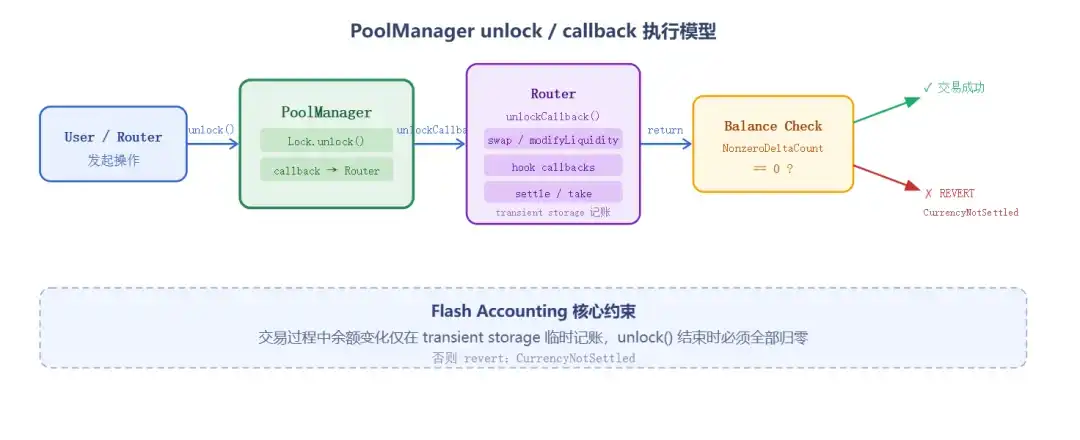
- Flash Accounting: Intermediate balance changes during a transaction are recorded only in transient storage, with final settlement occurring only at the end of the transaction.

- Hook Mechanism: Each pool can be bound to a Hook contract. The PoolManager will call back to this contract at key nodes (beforeInitialize, beforeSwap, afterAddLiquidity, etc.).

- Hook Immutability: Once a pool is initialized, the bound Hook address is permanently fixed (The Hook address bound to a pool cannot be changed, but whether the Hook contract itself is upgradeable depends on its implementation).
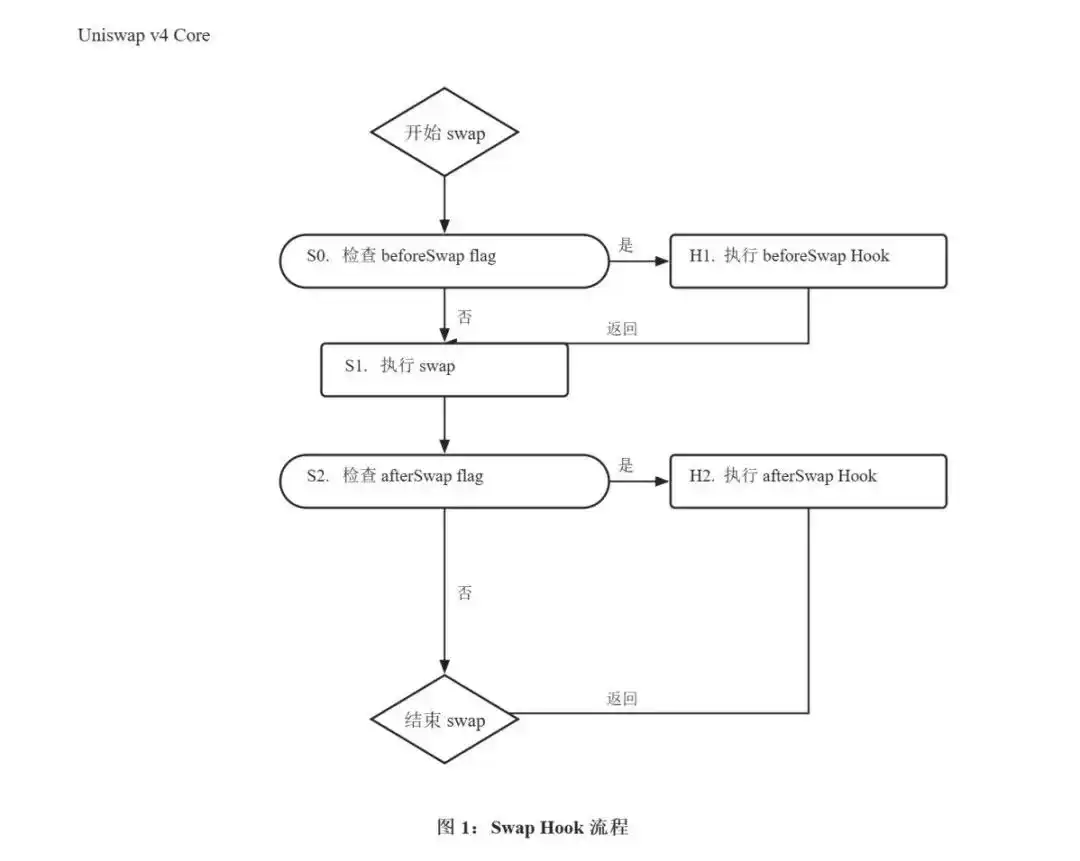
In the v3 era, developers only needed to trust the Uniswap protocol itself; in the v4 era, the security of each pool depends on the Hook it's bound to. Hooks expand AMM from a fixed financial primitive to a programmable financial infrastructure, but the security model has also fragmented from "protocol-level" to "pool-level."

2. Hook Architecture

2.1 PoolManager and the unlock/callback Model

The core contract of v4 is the singleton PoolManager. Any operation that changes a pool's state (swap, add/remove liquidity) must first call PoolManager.unlock() to obtain one-time callback permission, then perform the specific action within unlockCallback(). At the end of the entire process, the PoolManager will verify whether the ledger balances:
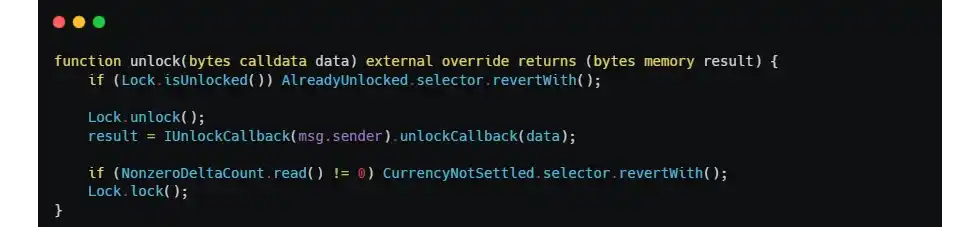
If NonzeroDeltaCount != 0, it directly reverts. This is the core constraint of v4's flash accounting. Any Hook can temporarily unbalance the accounts during execution but must settle itself before the transaction ends; otherwise, the entire transaction rolls back.

Each pool is uniquely identified by a PoolKey structure, which includes a hooks field:

PoolId is calculated as keccak256(PoolKey), so different hook addresses will result in different pools. This also means the PoolManager does not verify whether a Hook address has been used for other pools; the same Hook contract can be bound to multiple pools simultaneously.
2.2 Hook Permission Bits Encoded in the Address

A counterintuitive design in v4 is: Hook permissions are not determined by a variable inside the contract but by the deployment address of the Hook contract.

The PoolManager checks the lower 14 bits of the Hook address to determine if the Hook needs to be called at a certain lifecycle point:

For example, BEFORE_SWAP_FLAG = 1 << 7. If bit 7 of the Hook address is 1, the PoolManager will call the Hook's beforeSwap() before a swap; otherwise, even if the Hook contract implements beforeSwap(), it will never be called by the PoolManager.

This means the Hook must be deployed via CREATE2 + salt to calculate an address where the lower bits exactly match the target permissions. Uniswap officially provides the HookMiner tool for this purpose:
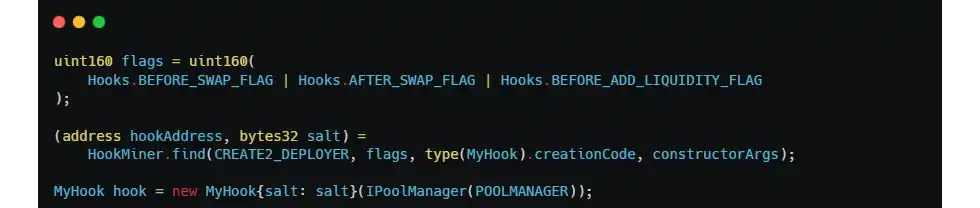
Mismatches between permission bits and function implementation can lead to two types of issues:

(1) A hook function is implemented, but the address does not encode the corresponding permission bit—The PoolManager will never call that function, rendering the logic useless.

(2) The address encodes a permission bit, but the hook does not implement the corresponding function—The PoolManager may revert during the callback (causing DoS) or fail on return value verification, preventing the related operation from executing.

This is also a natural obstacle to Hook upgrades: If a Hook is upgradable via a proxy, the deployment address remains unchanged during upgrades, so post-upgrade, only existing hook function implementations can be modified, not new hook types added. To reserve future extensibility, all possible permission bits must be pre-mined during initial deployment.

2.3 BaseHook and a Commonly Overlooked Access Control Trap

The BaseHook abstract contract provided by earlier versions of the Uniswap v4 periphery allows developers to inherit it for custom Hook implementation. One important role of BaseHook is to provide the onlyPoolManager modifier for the unlockCallback() function:

However—here lies a design trap that is very easy to overlook—early versions of BaseHook only added onlyPoolManager to unlockCallback, providing no protection for other hook callback functions (beforeSwap, afterSwap, beforeAddLiquidity, etc.). Access control for these functions must be explicitly added by the Hook developer.

3. Hook Lifecycle Code Walkthrough

Using an exact-input swap as an example, the following analyzes the complete call stack from when a user initiates a transaction to settlement.

3.1 Pool Initialization and Hook Binding

Anyone can call PoolManager.initialize() to create a new pool:
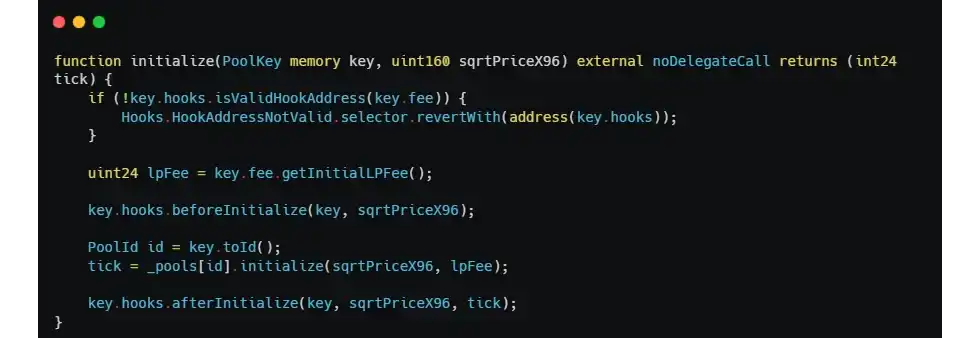
isValidHookAddress only checks the compatibility of the address permission bits with the fee field. It does not verify whether the Hook is already used in other pools, nor does it check if the Hook "wants" to accept this PoolKey. If the Hook design does not include whitelisting or single-pool binding logic in beforeInitialize, anyone can construct a new pool using the same Hook but with an arbitrary token pair, triggering all subsequent callbacks of the Hook.

3.2 beforeSwap and BeforeSwapDelta

The swap process entry is PoolManager.swap(). Before executing the core swap logic, it calls Hooks.beforeSwap():
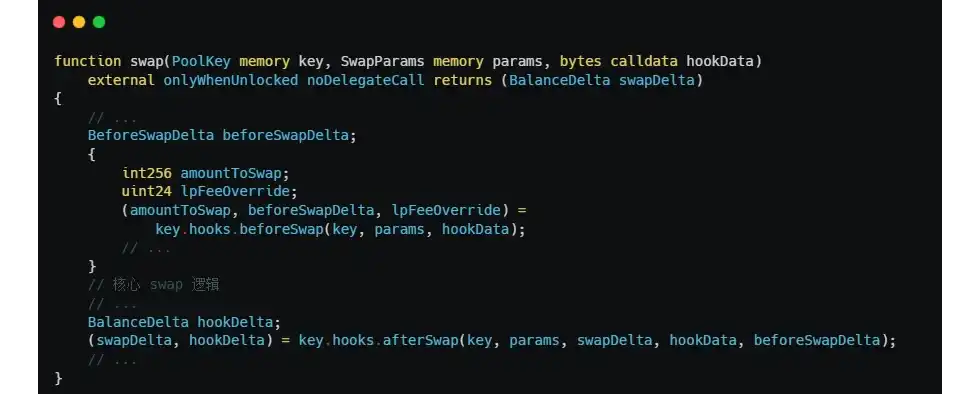
The return value of beforeSwap is a triple (bytes4, BeforeSwapDelta, uint24):

- bytes4: Must equal IHooks.beforeSwap.selector, otherwise PoolManager directly reverts.

- BeforeSwapDelta: The delta adjustments for the specified token and unspecified token that the Hook makes for this swap.

- uint24: Dynamic LP fee override value (only effective when the pool has dynamic fees enabled).

BeforeSwapDelta is an alias for int256, with the high 128 bits being the delta for the specified token (the token the user specified the amount for) and the low 128 bits being the delta for the unspecified token:
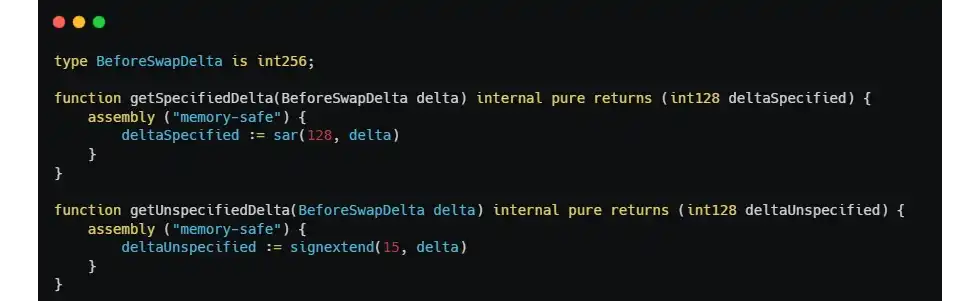
Note that the semantic of BeforeSwapDelta is: the Hook should return a positive value for collecting fees and a negative value for refunding tokens. Developers can easily get the sign wrong. Simultaneously, the correspondence between specified and unspecified depends on params.zeroForOne and the sign of amountSpecified. Slight carelessness in writing can lead to token misplacement.

The PoolManager directly adds the specifiedDelta returned by beforeSwap to the amountToSwap:

This line implies a crucial semantic: the Hook can intercept the swap amount. When hookDeltaSpecified equals -params.amountSpecified, amountToSwap directly becomes zero, meaning the Hook completely takes over this swap—this is the so-called Async Hook or Custom Curve Hook.

Async Hooks are the highest-risk design pattern in v4: they essentially replace Uniswap's swap logic with the Hook's own logic. If the Hook has vulnerabilities or is malicious itself, user funds are no longer constrained by Uniswap's native pricing logic but rely primarily on the correctness of the Hook's own implementation.

3.3 Delta Settlement and NonzeroDeltaCount

The deltas returned by beforeSwap and afterSwap do not immediately trigger transfers but are recorded in the PoolManager's internal ledger:
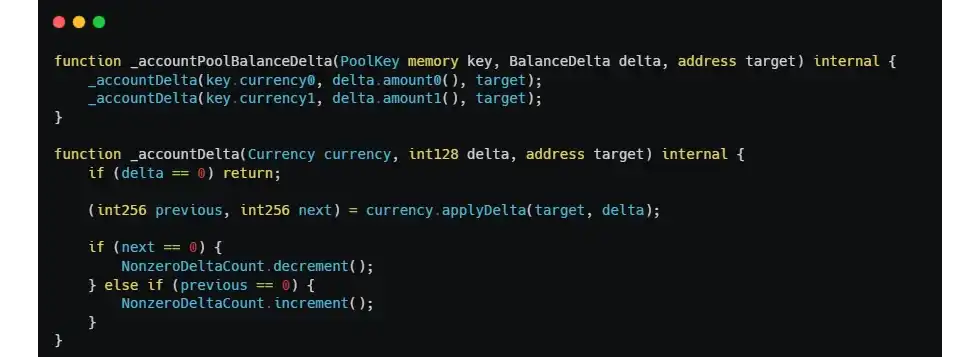
Whenever the cumulative delta for a token changes from zero to non-zero, NonzeroDeltaCount increments; when it returns to zero, it decrements. As mentioned in 2.1, if NonzeroDeltaCount != 0 at the end of unlock(), the entire transaction reverts.

The Hook balances its delta through two actions: settle() (transferring to the PoolManager) and take() (taking from the PoolManager):

The security semantics brought by this mechanism are clear: everyone must eventually balance the accounts. However, it only guarantees "account conservation," not "account correctness." If the Hook returns a maliciously constructed delta in beforeSwap, the PoolManager will faithfully account for this delta. As long as it's eventually settled and balanced, the transaction succeeds—even if this means the Hook can, by forging business states, cause the system to incorrectly believe an attacker has certain asset rights, which the PoolManager cannot recognize as an error at the business level.

A previous security incident involving Cork Protocol was due to a vulnerability in its Hook, and it had been audited by four firms before the attack. In retrospect, we found:

- Three of the four audits did not include the CorkHook contract in their scope.

- The only firm that audited CorkHook identified some code issues and submitted improvement suggestions but did not fully cover access control problems.

- Another auditor explicitly suggested in their report: "an interesting follow-up engagement would be to prove the invariants for the CorkHook functions that are being invoked by different components verified within the scope of this engagement." This suggestion appears highly pertinent in hindsight.

This exposes a new blind spot in audits in the v4 Hook era: the explosion in protocol complexity makes scope definition itself a security decision. The interaction chain between Hooks and other protocol contracts is very long. Auditing the Hook contract alone is insufficient to discover cross-contract combinatorial issues; conversely, auditing peripheral contracts while excluding the Hook from scope misses the largest attack surface in the v4 era.

4. Reflections

Looking at the protocol mechanisms alongside the Cork attack post-mortem, several core points of the v4 Hook security model can be summarized:

(1) If Hook callback functions rely on the calling context provided by PoolManager, they should explicitly restrict calls to only PoolManager. BaseHook does not do this for developers. This is the design trap in v4 that most easily conflicts with general contract auditing experience.

(2) The binding relationship between a Hook and a pool is not restricted by PoolManager. Developers must implement pool whitelisting or single-pool binding in beforeInitialize themselves.

(3) The permission bits of the Hook address must strictly match the function implementation. The calculated address should pre-include all permission bits that might be needed in the future.

(4) Async / Custom Curve Hooks are essentially completely custom swap implementations. They have no Uniswap protocol-level protection and must be audited to the standard of "fully autonomous financial contracts."

(5) "Conservation" in delta accounting does not equal "correctness." NonzeroDeltaCount == 0 only guarantees the final ledger is balanced, not that the ledger's content hasn't been maliciously manipulated.

(6) Token type confusion across markets is a new type of attack surface in the v4 era. When a protocol allows users to create markets, semantic validation of tokens is mandatory and cannot rely solely on interface checks.

Each Hook is an independent trust domain, and the security of each pool is determined by the Hook it's bound to. Therefore, the complexity of Hook security audits is no longer "auditing one piece of code" but "auditing a complete sub-protocol"—this change signifies a methodological upgrade for both project teams and auditors.

View Original Text

Trend Kriptolar

İlgili Sorular

QWhat is the core architectural change introduced in Uniswap v4, and what key security implication does it create?

AThe core architectural change introduced in Uniswap v4 is the Hook mechanism. This allows developers to attach custom logic to key pool lifecycle events like swaps and liquidity changes. The key security implication is a shift from a 'protocol-level' security model in v3, where users trusted the Uniswap protocol itself, to a 'pool-level' security model in v4. The security of each liquidity pool becomes dependent on the security of the specific Hook contract it is bound to.

QHow does Uniswap v4's flash accounting model enforce security, and what is its main constraint?

AUniswap v4's flash accounting model records intermediate balance changes in transient storage during a transaction and only performs final settlement at the transaction's end. It enforces security by requiring the account ledger to be balanced before the transaction concludes. The main constraint is that the `NonzeroDeltaCount` must be zero at the end of a transaction (specifically after `PoolManager.unlock()`); if it is not zero, the entire transaction reverts.

QWhat determines which callback functions (e.g., `beforeSwap`) on a Hook contract are actually invoked by the PoolManager?

AThe invocation of a Hook's callback functions is determined by the last 14 bits (the permission bits) of the Hook contract's deployment address. The PoolManager checks these bits against predefined flags (e.g., `BEFORE_SWAP_FLAG`). If the corresponding bit for a function is set to 1 in the address, the PoolManager will call that function. This permission is fixed at deployment via CREATE2 and cannot be changed later through an upgrade.

QWhat is a significant security oversight in the early version of the BaseHook abstract contract provided by Uniswap v4 periphery?

AA significant security oversight in the early version of the BaseHook abstract contract was that it only protected the `unlockCallback()` function with an `onlyPoolManager` modifier. It did not apply any access control to other critical hook callback functions like `beforeSwap`, `afterSwap`, `beforeAddLiquidity`, etc. This meant developers had to manually and explicitly add access control checks to these functions to prevent unauthorized calls, creating a major security trap if overlooked.

QWhat is an 'Async Hook' or 'Custom Curve Hook' in Uniswap v4, and why is it considered high-risk?

AAn 'Async Hook' or 'Custom Curve Hook' in Uniswap v4 is a Hook design pattern where the Hook's `beforeSwap` function returns a `hookDeltaSpecified` value that cancels out the user's requested swap amount (e.g., `-params.amountSpecified`). This effectively sets the `amountToSwap` to zero, allowing the Hook's own custom logic to completely take over and execute the swap. It is considered high-risk because it replaces Uniswap's native, battle-tested AMM pricing and swap logic. The security of user funds then depends entirely on the correctness and security of the custom Hook implementation, which may have vulnerabilities or be malicious.

İlgili Okumalar

Two Giants' Credit Expansion: Loan Balances of $9.9 Billion vs. $14.6 Billion, Brazil Emerges as the Main Battlefield

Title: Two Giants "Credit" Surge: Loan Balances of 99 Billion vs. 146 Billion USD, Brazil Emerges as Main Battlefield Summary: The article compares the rapid expansion of credit businesses by two major e-commerce and fintech players, Sea (via Monee) and Mercado Libre (via Mercado Pago), in overseas markets like Southeast Asia and Latin America, contrasting with a slowing domestic Chinese credit market. Using Q1 2026 financial data, it highlights their significant growth. Sea's Monee reached a loan balance of $99 billion, up 71% year-over-year (YoY), contributing 17.5% to Sea's total revenue. Mercado Pago's loan balance hit $146 billion, up 87% YoY, contributing 45% to its parent company's revenue. Both maintained stable risk metrics (e.g., Monee's 90+ day NPL at 1.1%) despite rapid scaling. Brazil is identified as a key and accelerating growth market for both. Sea's Brazilian operations saw loan volumes exceed $10 billion, growing 250% YoY, with SPayLater GMV penetration still low (~10%) indicating high potential. Sea also secured a key Brazilian financial credit license (SCFI). Mercado Libre's Brazil segment contributed over half (54%) of total group revenue, with its credit business there generating $11.24 billion in revenue, up 89% YoY and accounting for 12.7% of global revenue. Mercado Pago's credit portfolio, especially credit cards (46% of loans, +105% YoY), is a strategic focus, described as crucial as building logistics was a decade ago. Its net interest margin after loss (NIMAL) remains high at 17.8%. The article concludes that while Brazil presents immense opportunities, the success is largely driven by these integrated "e-commerce + fintech" giants with proprietary transaction data and ecosystems, making it challenging for standalone fintech players to compete effectively.

链捕手12 dk önce

Two Giants' Credit Expansion: Loan Balances of $9.9 Billion vs. $14.6 Billion, Brazil Emerges as the Main Battlefield

链捕手12 dk önce

Research Report Analysis: Is Intel Making a Comeback with Apple? Bernstein's Calculations Show the Right Direction, but the Price Is Already Overvalued

Bernstein analyst Stacy A. Rasgon published a report on June 18 regarding Intel, assessing the potential impact of recent political support for a US-based PC chip design and manufacturing collaboration between Apple and Intel. The report views this as a significant signal for the foundry landscape shift but concludes the initial financial contribution would be minimal. Key conclusions: 1) An Apple deal is seen as a small-scale "proof of concept." Even if Intel wins 40% of Apple's premium notebook chip orders (~5 million units/year), Bernstein estimates it would generate only about $500M in annual revenue and ~$0.03 EPS, negligible against Intel's ~$55B revenue. 2) Political encouragement is not equivalent to enforceable mandates. Winning orders ultimately depends on Intel demonstrating competitive technology (like its 18A node), cost, and reliable supply. 3) The path from validation to large-scale production involves significant challenges, capital investment, and time. Due to these uncertainties, Bernstein maintains a Market-Perform (Hold) rating with a $100 price target, implying potential downside from the ~$121.10 price at the report date. The analysis highlights the tension between near-term validation value—serving as a crucial trust signal for Intel's foundry ambitions and US supply chain resilience—and the long-term opportunity to attract larger cloud and AI chip customers. The investment thesis hinges on successful 18A execution and sustained policy support, not on immediate financial gains from Apple.

marsbit37 dk önce

Research Report Analysis: Is Intel Making a Comeback with Apple? Bernstein's Calculations Show the Right Direction, but the Price Is Already Overvalued

marsbit37 dk önce

27-Year Reign Ends: SK Hynix Market Cap Surpasses Samsung for First Time, an AI-Driven Reshuffle of Korean Chip Power

On June 22, 2026, SK Hynix made history by surpassing Samsung Electronics in market capitalization, ending Samsung's 27-year reign as South Korea's most valuable company. This dramatic reversal is powered by the AI boom and SK Hynix's dominant position in High Bandwidth Memory (HBM), a critical component for AI model training. Once a heavily indebted firm on the brink of bankruptcy, SK Hynix bet early on HBM, which has evolved from a niche product to essential AI infrastructure. It now commands a 59% share of the global HBM market. Its financial performance is staggering, with Q1 2026 net profit soaring nearly fourfold year-over-year to KRW 40.35 trillion, translating to over 2 billion RMB in daily net profit. HBM now drives roughly 40% of its revenue with exceptionally high margins. In contrast, Samsung, with its broad portfolio spanning memory chips, smartphones, and foundry services, has lagged in the HBM race while facing headwinds in other divisions. This shift signifies a deeper restructuring of South Korea's economy, moving from consumer electronics to AI-driven growth. However, the future remains competitive. With major capacity expansions planned industry-wide by 2028 and Samsung aiming to catch up in HBM technology, the new market leader cannot afford complacency. This event marks a pivotal moment in the global semiconductor industry's ongoing power realignment.

marsbit48 dk önce

27-Year Reign Ends: SK Hynix Market Cap Surpasses Samsung for First Time, an AI-Driven Reshuffle of Korean Chip Power

marsbit48 dk önce

İşlemler

Spot
Futures

Popüler Makaleler

ONE Nasıl Satın Alınır

HTX.com’a hoş geldiniz! Harmony (ONE) satın alma işlemlerini basit ve kullanışlı bir hâle getirdik. Adım adım açıkladığımız rehberimizi takip ederek kripto yolculuğunuza başlayın. 1. Adım: HTX Hesabınızı OluşturunHTX'te ücretsiz bir hesap açmak için e-posta adresinizi veya telefon numaranızı kullanın. Sorunsuzca kaydolun ve tüm özelliklerin kilidini açın. Hesabımı Aç2. Adım: Kripto Satın Al Bölümüne Gidin ve Ödeme Yönteminizi SeçinKredi/Banka Kartı: Visa veya Mastercard'ınızı kullanarak anında Harmony (ONE) satın alın.Bakiye: Sorunsuz bir şekilde işlem yapmak için HTX hesap bakiyenizdeki fonları kullanın.Üçüncü Taraflar: Kullanımı kolaylaştırmak için Google Pay ve Apple Pay gibi popüler ödeme yöntemlerini ekledik.P2P: HTX'teki diğer kullanıcılarla doğrudan işlem yapın.Borsa Dışı (OTC): Yatırımcılar için kişiye özel hizmetler ve rekabetçi döviz kurları sunuyoruz.3. Adım: Harmony (ONE) Varlıklarınızı SaklayınHarmony (ONE) satın aldıktan sonra HTX hesabınızda saklayın. Alternatif olarak, blok zinciri transferi yoluyla başka bir yere gönderebilir veya diğer kripto para birimlerini takas etmek için kullanabilirsiniz.4. Adım: Harmony (ONE) Varlıklarınızla İşlem YapınHTX'in spot piyasasında Harmony (ONE) ile kolayca işlemler yapın.Hesabınıza erişin, işlem çiftinizi seçin, işlemlerinizi gerçekleştirin ve gerçek zamanlı olarak izleyin. Hem yeni başlayanlar hem de deneyimli yatırımcılar için kullanıcı dostu bir deneyim sunuyoruz.

393 Toplam GörüntülenmeYayınlanma 2024.12.12Güncellenme 2026.06.02

ONE Nasıl Satın Alınır

Tartışmalar

HTX Topluluğuna hoş geldiniz. Burada, en son platform gelişmeleri hakkında bilgi sahibi olabilir ve profesyonel piyasa görüşlerine erişebilirsiniz. Kullanıcıların ONE (ONE) fiyatı hakkındaki görüşleri aşağıda sunulmaktadır.

活动图片