Zora Launches Solana-Based Attention Markets to Revolutionize Trend Trading

TheNewsCrypto2026-02-18 tarihinde yayınlandı2026-02-18 tarihinde güncellendi

Özet

On February 17, Zora launched "attention markets" on the Solana blockchain, marking a significant shift from its previous Ethereum and Base-based operations. This new product enables users to trade tokens based on internet trends and social media topics, allowing them to buy or sell based on whether they believe a trend will grow or fade. Anyone can create a new market by paying a 1 SOL fee. Initial trading activity was limited, with tokens like bitcoin, cats, and dogs among the first trends. The main token reached a market value of around $70,000. The crypto community had mixed reactions, with some supporting the move to Solana and others questioning the departure from Ethereum. While experts warn of high risk due to low liquidity and potential volatility, supporters see it as an innovative way to measure public interest by blending social media trends with on-chain trading.

On February 17, Zora launched a new product called “attention markets” on the Solana blockchain, and the launch was announced by both Zora and Solana. This move from Zora marked a major shift from NFTs and Ethereum-based tools to Solana, which is known for its faster transactions and lower fees.

What is the attention market?

Attention markets basically allow users to trade based on internet trends. Instead of betting on the financial markets, users can now bet on the topics or memes that they believe will become popular on social media and can buy the token of it. If they think it will fade, then they can sell it. Anyone can create a new market trend by paying a 1 SOL fee. Once they are created, users can trade in the market and close the positions at any time.
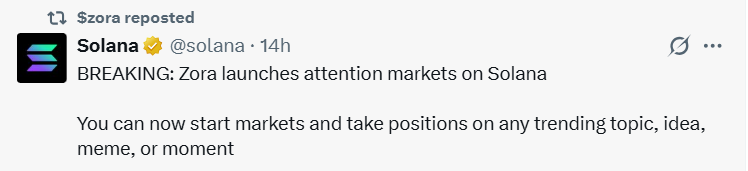
Image Source: https://x.com/solana/status/2023799108545503709

Once after the launch, the initial trading activity has been limited. Some of the feisty trending markets included bitcoin, cats, dogs, and attention markets. The main attention market’s token reached the market value of around $70,000 with a trading volume of $200,000 after the launch. Analysts noted that some of the tokens showed sharp gains, and the liquidity remained limited.

Mixed reactions to this Launch

This launch received mixed comments from the crypto community. Some users have supported Zora’s move to Solana, but others questioned the shift from Ethereum and Base, where Zora originally built its ecosystem. Following this launch, Zora’s native token rose more than 5% and is trading near $0.022.

Right now, Zora is entering the competitive market, and experts describe attention markets as high risk when trading volume is low because the low liquidity can lead to sharp price swings and volatility. However, supporters believe this model could be a new way to measure the public interest. This move from Zora aims to blend the social media interest with in-chain trading.

Highlighted Crypto News:

‌World Liberty Financial (WLFI) Posts 18% Surge: Are Buyers Taking the Driver’s Seat?

TagsSolanaZora

İlgili Sorular

QWhat is the main purpose of Zora's newly launched 'attention markets' on Solana?

AAttention markets allow users to trade based on internet trends, enabling them to buy tokens representing topics or memes they believe will gain popularity on social media or sell them if they think they will fade.

QWhy did Zora's move to launch on Solana attract mixed reactions from the crypto community?

ASome users supported the shift to Solana for its faster transactions and lower fees, while others questioned Zora's departure from Ethereum and Base, where it originally built its ecosystem.

QWhat was the initial trading activity and market performance like for attention markets after launch?

AInitial trading activity was limited. The main attention market's token reached a market value of around $70,000 with a trading volume of $200,000, with some tokens showing sharp gains but liquidity remained low.

QWhat is the risk associated with trading on these attention markets according to experts?

AExperts describe attention markets as high risk when trading volume is low because the low liquidity can lead to sharp price swings and high volatility.

QHow can a user create a new market trend on Zora's attention markets platform?

AAnyone can create a new market trend by paying a fee of 1 SOL.

İlgili Okumalar

Currency and Stock Barometer丨Strategy Invested $204 Million to Purchase 3,015 Bitcoins Last Week; US-Listed Company GD Culture Board Approved Sale of 7,500 Bitcoins Last Week (March 3)

Crypto Market Weekly Roundup: Strategy Invests $204M in Bitcoin, GD Culture to Sell Holdings Last week saw significant activity among crypto treasury companies amid ongoing market volatility. Strategy (formerly MicroStrategy) led Bitcoin acquisitions, purchasing 3,015 BTC for $204.1 million—a 412.8% increase from the previous week—bringing its total holdings to 720,737 BTC. In contrast, NASDAQ-listed GD Culture approved the sale of its entire 7,500 BTC reserve to fund a stock repurchase plan, reflecting the financial pressure some firms face. Meanwhile, Ethereum treasury company FG Nexus sold 7,550 ETH (worth $14.06 million), accumulating an unrealized loss of approximately $82.8 million. ETHZilla rebranded to Forum Markets and pivoted to RWA tokenization, while Bitmine added 50,928 ETH ($98.53 million) to its holdings. Other notable updates include American Bitcoin reporting over 6,000 BTC in reserves and $185.2 million in annual revenue, and Solana treasury firm DeFi Development making a strategic investment in stablecoin protocol Apyx. Global public companies (excluding miners) now hold 981,150 BTC, accounting for 4.9% of the circulating supply. Market analysts suggest a potential consolidation trend among crypto treasury companies in 2026, especially for those trading below net asset value.

marsbit29 dk önce

Currency and Stock Barometer丨Strategy Invested $204 Million to Purchase 3,015 Bitcoins Last Week; US-Listed Company GD Culture Board Approved Sale of 7,500 Bitcoins Last Week (March 3)

marsbit29 dk önce

AI Within the Range of Artillery

"AI in the Range of Cannons" discusses the vulnerability of AI infrastructure in the context of modern warfare, triggered by a real-world incident. On March 1, an Iranian missile struck an Amazon data center in the UAE, causing a fire, power outage, and disruption of about 60 cloud services. This led to a global outage of Claude, a major AI service running on Amazon's cloud. Although officially attributed to surging user demand, the incident is linked to a U.S.-Israel airstrike on Iran that used Claude for intelligence analysis, despite a recent U.S. ban on Anthropic (Claude's developer) for refusing unrestricted military use. The article highlights that this marks the first physical destruction of a commercial data center in war, emphasizing that AI, though virtual, relies on physical infrastructure located in geopolitically unstable regions like the Middle East. Silicon Valley has heavily invested in AI infrastructure in the Gulf due to cheap electricity, wealthy sovereign funds, and data localization laws, with projects from Amazon, Microsoft, and OpenAI. However, security frameworks like the Pax Silica agreement focus on chip controls and political alignment, ignoring physical security risks. The piece raises critical questions: When data centers serve both civilian and military purposes, are they legitimate targets? International law lacks clarity. The incident shifts focus from AI replacing jobs to its fragility—over 1,300 large data centers worldwide are protected only by basic measures like fire systems and generators. As AI becomes national infrastructure, its protection becomes a collective responsibility, beyond individual companies or governments. The title’s metaphor underscores that in an era of conflict, even advanced technology lies within the range of destruction.

marsbit37 dk önce

AI Within the Range of Artillery

marsbit37 dk önce

İşlemler

Spot
Futures
活动图片