Superstate brings stablecoin-settled stock offerings to Ethereum and Solana

cointelegraph2025-12-10 tarihinde yayınlandı2025-12-10 tarihinde güncellendi

Özet

Superstate has launched Direct Issuance Programs (DIPs), enabling SEC-registered public companies to raise capital directly on Ethereum and Solana. Investors can pay in stablecoins and receive tokenized shares instantly at real-time market prices. This onchain model uses Superstate’s SEC-registered transfer-agent infrastructure to update shareholder registries automatically, ensuring compliance with securities laws. The system allows companies to reduce financing costs and reach global investors, while providing instant settlement and regulatory safeguards. Superstate’s initiative builds on its growing onchain infrastructure, which has already attracted firms like SharpLink Gaming and Galaxy Digital. The tokenized real-world asset market has surpassed $24 billion, with Ethereum and Solana leading much of the activity.

Financial technology firm Superstate has rolled out a new way for US Securities and Exchange Commission (SEC)-registered public companies to raise capital directly onchain.

Through its Direct Issuance Programs (DIPs), any issuer registered with the SEC can now offer new shares on Ethereum and Solana, with investors paying in stablecoins and receiving tokenized shares instantly at real‐time market prices, according to a Wednesday announcement from Superstate shared with Cointelegraph.

Jim Hiltner, co-founder and head of business development at Superstate, told Cointelegraph, “The regulatory ability to directly issue registered shares isn’t new. What is new is that issuers can now conduct these offerings onchain, which changes what’s possible operationally and economically.”

The launch of DIPs is part of Superstate’s mission to bring compliant public‐market infrastructure onchain. The model uses Superstate’s SEC‐registered transfer‐agent infrastructure to update shareholder registries automatically as tokenized shares move between verified wallets, ensuring issuances comply with existing securities laws.

“Any SEC‐registered public company is able to run an issuer‐led primary offering onchain using this structure,” said Hiltner. “Our infrastructure is live now. Issuers can begin preparing and filing their programs immediately. The first public company offerings are expected to go live in 2026.”

Related: Spark marks first major rotation from US Treasurys into regulated DeFi

Expanding Superstate’s onchain ambitions

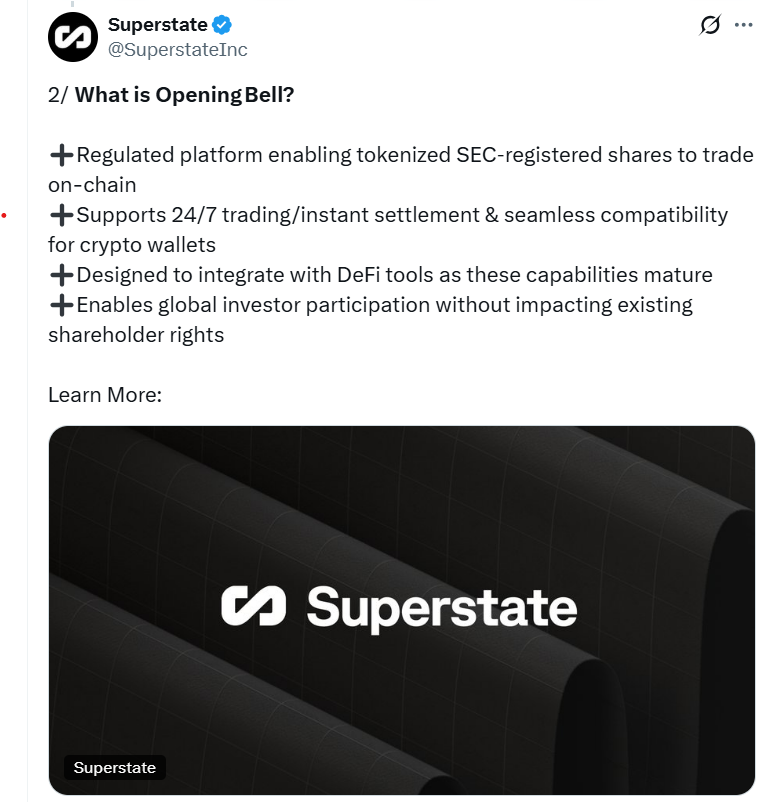
DIPs build on a year of onchain expansion for the fintech startup. In May, Superstate launched Opening Bell, a platform designed to tokenize and enable compliant onchain activity for SEC‐registered equities.
Source: Superstate

In September, SharpLink Gaming, one of the world’s biggest public holders of Ether (ETH), revealed plans to tokenize its common stock through Superstate’s platform. In the same month, Galaxy Digital announced its tokenized public shares on Solana using Superstate’s transfer-agent infrastructure.

The launch of DIPs also lands in a year when other tokenization initiatives are expanding across Ethereum and Solana, such as Franklin Templeton’s move from tokenized money funds to multi‐asset real‐world‐asset (RWA) platforms.

The tokenized real‐world asset market had surged to over $24 billion on public blockchains by Q3, 2025, with Ethereum and Solana accounting for well over half of all RWA activity.

Related: US Treasurys lead tokenization wave as CoinShares predicts 2026 growth

A new channel for issuers and investors

Hiltner said that DIPs allow companies to structure their offerings under standard SEC registrations, receive stablecoin proceeds directly into their wallets, and distribute tokenized shares instantly to verified investors.

Each transaction updates the issuer’s shareholder registry in real time, preserving the integrity of ownership records while enabling instant settlement. According to Hiltner, issuers can achieve lower financing costs through reduced underwriting and distribution fees and broader global reach to eligible investors.

For investors, the system allows retail and institutional participants to purchase newly issued stock directly from companies (sometimes below exchange prices), with shares settling to their wallets immediately.

“This combines regulatory compliance with onchain execution,” said Hiltner. “If an investor meets all requirements, they can participate; if not, the system blocks the transaction.”

Superstate’s model blends established securities law with crypto’s instant settlement rails and aims to bring traditional financial regulation to onchain capital markets infrastructure.

Magazine: Solana vs Ethereum ETFs, Facebook’s influence on Bitwise — Hunter Horsley

İlgili Okumalar

Ethereum Is Becoming the New Global Financial Backend

Ethereum is emerging as a global financial backend, reducing the complexity and cost of building financial services while increasing speed and security. It embeds core financial operations—such as ownership recording, value transfer, and obligation enforcement—into software, executed via a distributed validator set. This shared infrastructure eliminates the need for redundant internal systems, transforming capital-intensive processes into software-driven activities. The platform addresses key economic frictions: triangulation (discovery and agreement), transfer (value movement), and trust (enforcement). By providing a transparent, programmable, and cryptographically secured environment, Ethereum enables real-time settlement, automated compliance, and global interoperability. This reduces operational risks and costs, particularly for new entrants and markets with fragile financial systems. Ethereum’s impact is most significant in emerging economies, where it offers immediate functional improvements, while in developed markets, benefits accumulate gradually as more processes become programmable. It shifts institutional focus from infrastructure maintenance to innovation and product design, promoting leaner, more efficient financial services. As a resilient, open, and verifiable system, Ethereum is positioned to serve as the foundational layer for future financial infrastructure, driven by economic incentives favoring transparency and reliability.

marsbit24 dk önce

Ethereum Is Becoming the New Global Financial Backend

marsbit24 dk önce

The Silver Crisis: When the Paper System Begins to Fail

Silver Crisis: When the Paper System Begins to Fail In December, silver became the most volatile asset in the precious metals market, surging from $40 to over $64 per ounce—a year-to-date increase of nearly 110%, far outpacing gold. While the rally appears fundamentally justified—driven by Fed rate cut expectations, industrial demand from solar/EV/AI sectors, and declining global inventories—it masks deeper structural risks. Unlike gold, which is backed by central bank purchases, silver lacks institutional support and has minimal official reserves. Its market is shallow, with a daily trading volume of only $5 billion (vs. gold’s $150 billion), dominated by paper derivatives like futures and ETFs. This makes it vulnerable to volatility and manipulation. The real driver of the rally is a futures squeeze. The market has entered a persistent “backwardation” (futures prices exceeding spot prices), indicating either extreme bullishness or deliberate market manipulation. Physical delivery demands have surged, with COMEX and Shanghai exchange inventories dropping sharply. The system—where paper claims vastly exceed physical silver—is under stress. JPMorgan, a historically dominant player in silver markets, controls ~43% of COMEX silver inventory and acts as custodian for major silver ETFs. Its influence over physical supply and delivery eligibility adds to market fragility. The silver crisis reflects a broader shift: investors are losing faith in financialized paper assets and moving toward physical holdings. This “physicalization” trend, also seen in gold, signals declining trust in traditional financial intermediaries and a reevaluation of monetary security in a deglobalizing world. As the paper system strains, those holding physical silver—and gold—may hold the ultimate advantage.

深潮32 dk önce

The Silver Crisis: When the Paper System Begins to Fail

深潮32 dk önce

İşlemler

Spot
Futures
活动图片