Quantum Computing "Manhattan Project" Unveiled: Is the Encryption Industry at a Critical Turning Point?

Foresight News2026-06-23 tarihinde yayınlandı2026-06-23 tarihinde güncellendi

Özet

"Quantum Computing 'Manhattan Project' Launched: Is the Crypto Industry at a Critical Juncture?" On June 22, former U.S. President Donald Trump signed two executive orders. The first mandates all federal agencies upgrade their cryptographic systems to new, quantum-resistant standards by 2030. The second orders the Department of Energy to lead the development of a national quantum computer, signaling a shift from laboratory research to a state-enforced national agenda. This creates a hard deadline. A powerful quantum computer could break current encryption. The threat is compounded by "harvest now, decrypt later" attacks, where encrypted data is stored today for future decryption. Federal agencies must appoint migration officers and complete post-quantum cryptography (PQC) upgrades for key establishment by 2030 and digital signatures by 2031. Procurement rules will also be changed, forcing government contractors to comply. The crypto industry faces a direct threat. Bitcoin's ECDSA signatures are theoretically vulnerable. Research indicates millions of Bitcoin with exposed public keys are at risk if quantum computers advance. While projects like Bitcoin Quantum testnets and efforts by Ethereum, Solana, NEAR, and Zcash are exploring quantum-resistant solutions, achieving consensus in decentralized networks remains a major challenge. The centralized U.S. government has started a 5-year countdown. For decentralized crypto networks, the real test is whether they can complete th...


Author: Ma He, Foresight News

On June 22, Trump signed two executive orders in a single day. One requires all U.S. federal agencies to upgrade their cryptographic locks to a new standard by 2030 to resist the threat of quantum computing decryption; the other orders the Department of Energy to lead the construction of a "National Quantum Computer."

Quantum computing has transitioned from a technical discussion in laboratories to a mandatory national schedule.

At the beginning of 2025, tech industry titan Jensen Huang expressed pessimism about quantum computers, stating "a truly practical quantum computer might still be 15 to 30 years away." Yet, merely two months later, his attitude shifted. This year, NVIDIA released the AI-driven Ising model. Huang indicated that this would enable AI to become the control plane and operating system for quantum machines, transforming fragile qubits into scalable, highly reliable systems, and building standardized, industry-grade infrastructure for quantum computing.

Quantum computing, potentially supercharged by AI, may see its development pace accelerate significantly. The faster it progresses, the greater the daily growing threat to current system security.

The 2030 Deadline: A Hard Order for a Nationwide "Lock Change"

Once large-scale quantum computers emerge, the current cryptographic systems will be shattered. More insidiously, there's the strategy of harvest now, decrypt later—adversaries can store your encrypted data today and patiently crack it a decade later when quantum machines mature.

Hence, the U.S. government issued a hard deadline. All federal agencies must complete the migration to Post-Quantum Cryptography (PQC) for key establishment in their high-value assets and high-impact systems by December 31, 2030. Additionally, they must complete the migration for digital signatures to PQC by December 31, 2031.
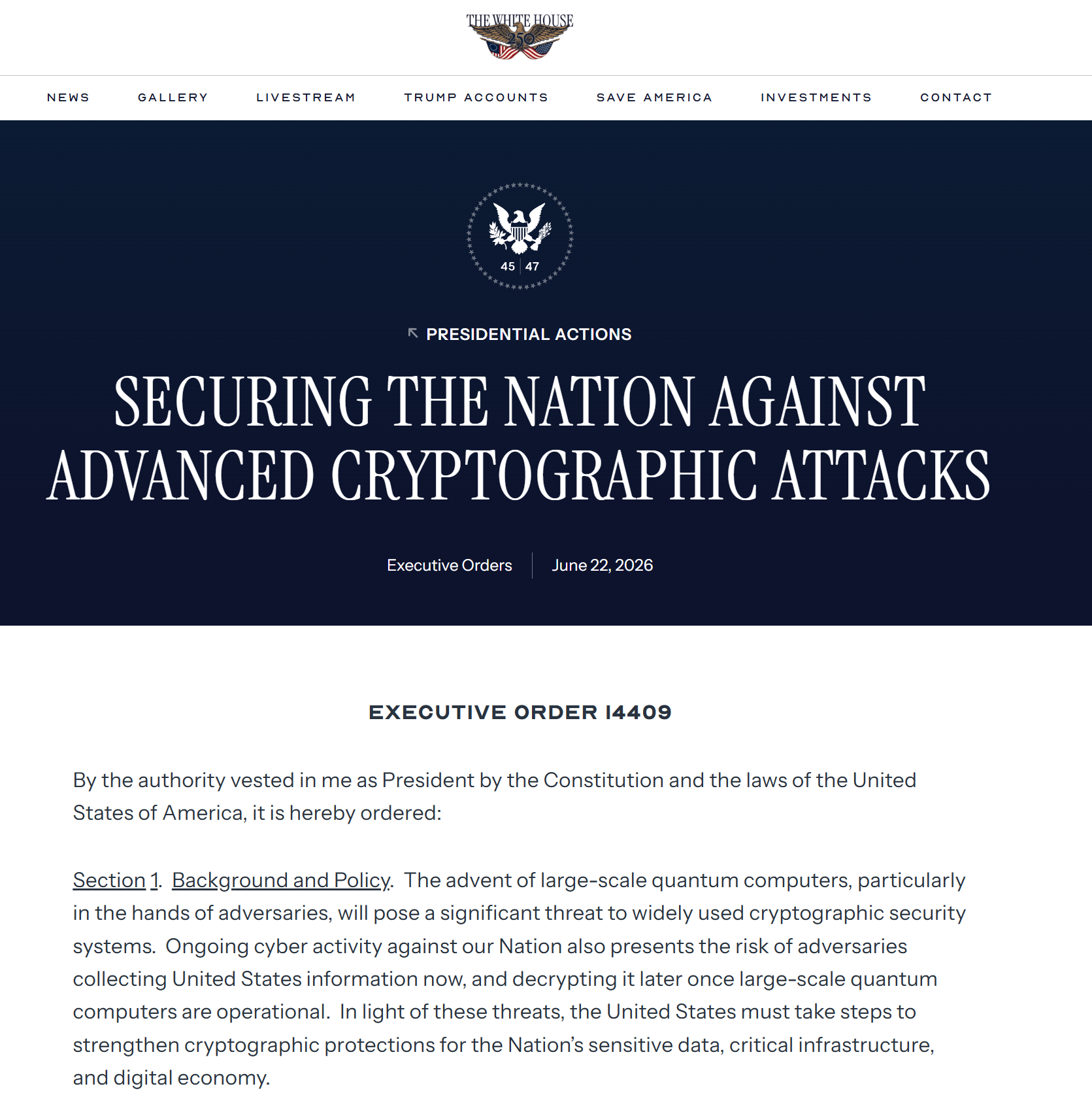

Each agency must appoint a PQC Migration Lead within 30 days, reporting directly to the White House OMB and the National Cyber Director. NIST (National Institute of Standards and Technology) must initiate a PQC migration pilot for its own systems within 180 days and complete it by the end of 2027.

Furthermore, the Federal Acquisition Regulation will be revised within 180 days. All contractors supplying the U.S. government—from Microsoft and Amazon Web Services to various IT service providers—must comply with PQC standards by 2030. The Department of Homeland Security will also assist critical infrastructure like the power grid, banks, hospitals, and communication operators in developing migration plans.

The U.S. government is leveraging administrative power to forcibly drive a massive upgrade of global internet security infrastructure.

The other document signed by Trump on the same day, "Unleashing the Next Frontier in Quantum Innovation," also placed the quantum computing race squarely on the table.
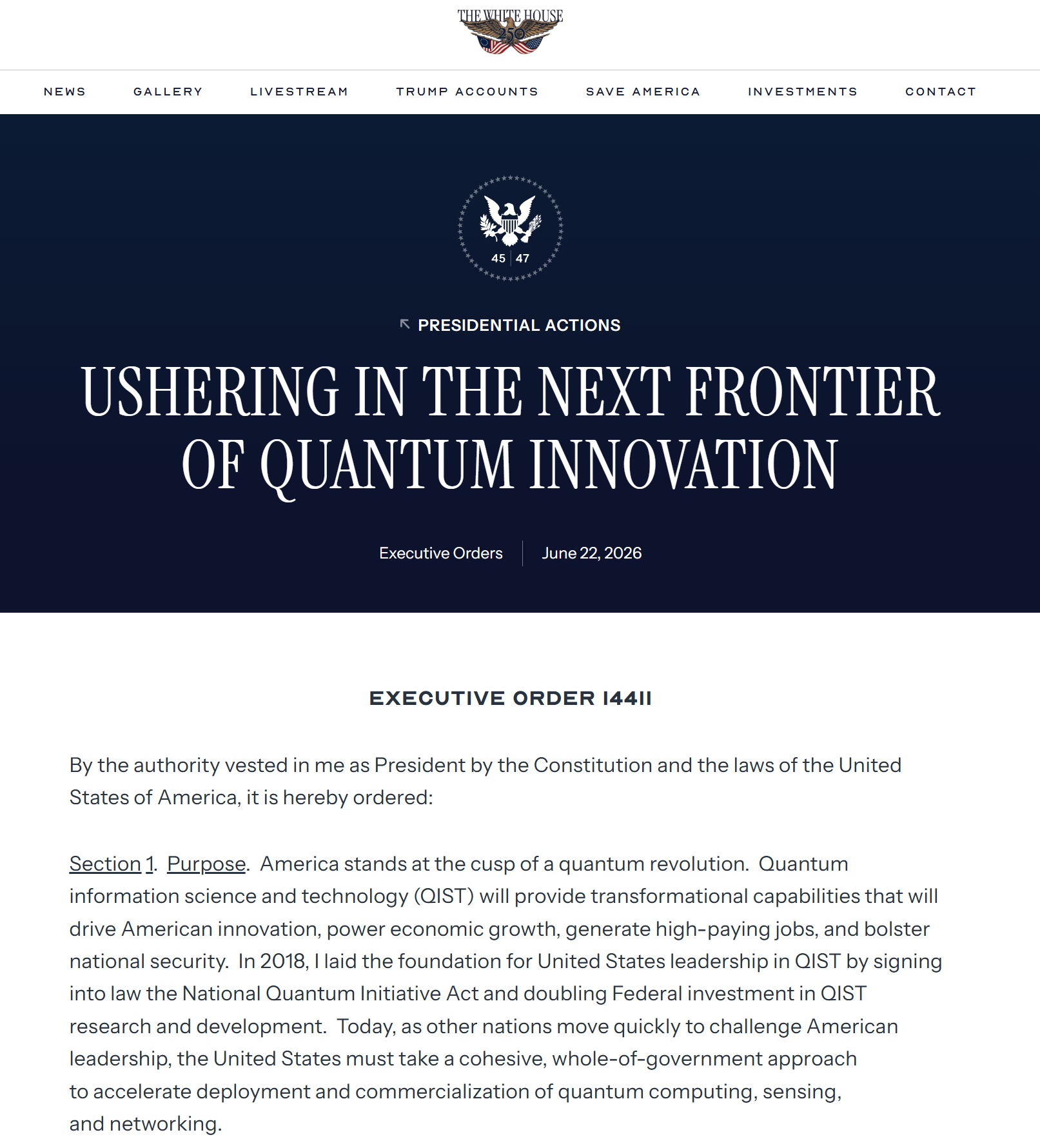

The U.S. government wants a massive machine delivered to the Department of Energy's national laboratories, one that truly solves problems classical supercomputers cannot. The White House requires the Department of Energy to publicly release technical specifications within 90 days and explore public-private partnership models within 180 days.

Perhaps this is the "Manhattan Project" moment for quantum computing. The government provides funding, policies, and orders, guiding through national will to accelerate the evolution of quantum information technology from laboratory prototypes to engineering-grade tools.

While the U.S. races to upgrade its cryptography, the cryptography underpinning the crypto industry is already fraught with peril.

The Crypto Industry Resists Quantum Computing

The foundation of Bitcoin, the ECDSA elliptic curve signature, is theoretically vulnerable to cracking by quantum computers.

According to research data released by BTQ Technologies in October 2025, approximately 6.65 million Bitcoins (worth about $745 billion at the time) have their public keys permanently exposed on the blockchain. This includes 1.9 million Bitcoins in early P2PK addresses and about 4 million Bitcoins in reused addresses.

These BTCs don't need to wait for quantum computers to actively attack transaction broadcasts—the public keys have been lying on the blockchain for over a decade. Once quantum computers mature, they can slowly reverse-engineer the private keys offline.

The Bitcoin base layer protocol has not activated a soft fork in over four years since November 2021. The BIP-360 proposal suggests some mitigation measures, but a complete solution remains distant. Historical precedent is also not optimistic. Bitcoin's SegWit upgrade took three years from proposal in December 2015 to mainstream adoption in December 2018.

In January this year, BTQ Technologies Corp. launched a testnet named Bitcoin Quantum. This testnet is fully open and permissionless, inviting miners, developers, researchers, and users to run nodes, build tools, audit cryptography, and stress-test quantum-resistant transactions before any mainnet migration.

However, achieving consensus among multiple parties for subsequent steps remains a significant challenge.

Coinbase CEO Brian Armstrong rebutted that the quantum computing threat to Bitcoin is severely exaggerated. "This isn't a problem unique to cryptocurrency; it's something the entire world needs to address. We are working directly with core developers to handle the quantum issue."

Beyond Bitcoin, other project protocols are also vigorously advancing their anti-quantum plans.

The Ethereum Foundation has established a dedicated Post-Quantum Security research team and prioritized PQC. Nico, lead of the Ethereum Foundation's privacy project Kohaku, stated that Ethereum can already begin preparing at the account level for the post-quantum era without waiting for a base-layer hard fork upgrade.

Solana has established the Falcon signature standard and announced a three-phase migration roadmap. The NEAR development team plans to add a quantum-resistant secure signature scheme to its testnet by the end of Q2 2026. Zcash expects to achieve protocol-level post-quantum privacy protection through the Tachyon upgrade by the end of 2026.

In this life-or-death race against quantum computing, the highly centralized federal agencies have already pressed the hard switch for a '5-year countdown.' For decentralized networks with concerning governance efficiency that rely on consensus, the real test is not when the quantum crisis arrives, but whether the industry can complete this anti-quantum upgrade before Satoshi Nakamoto's black box is fully deciphered.


İlgili Sorular

QWhat is the significance of the deadlines (2030 and 2031) mentioned in the executive orders for US federal agencies regarding quantum computing?

AThe deadlines set by the executive orders mandate that all US federal agencies must complete the migration of their high-value assets and high-impact systems to Post-Quantum Cryptography (PQC) for key establishment by December 31, 2030, and for digital signatures by December 31, 2031. These deadlines represent a critical and enforceable timeline for upgrading national security infrastructure to resist potential decryption by future quantum computers.

QHow does the article describe the specific threat quantum computing poses to the Bitcoin network?

AThe article describes that Bitcoin's foundational ECDSA (Elliptic Curve Digital Signature Algorithm) is theoretically vulnerable to being broken by quantum computers. Specifically, it highlights that the public keys for approximately 6.65 million Bitcoins are permanently exposed on the blockchain. Once quantum computers become powerful enough, these public keys could be used to derive the corresponding private keys offline, potentially allowing those funds to be stolen without the need to intercept a live transaction.

QWhat is the role of AI, as mentioned in the article, in accelerating the development of quantum computing?

AThe article suggests that AI is poised to significantly accelerate quantum computing development. It cites NVIDIA's release of an AI-driven Ising model, which company CEO Jensen Huang described as turning AI into the control plane and operating system for quantum machines. This integration aims to transform fragile quantum bits into scalable, highly reliable systems, thereby creating standardized, industry-grade infrastructure for quantum computing and speeding up its practical realization.

QAccording to the article, which major blockchain projects are actively working on post-quantum security upgrades, and what are some of their plans?

AThe article mentions several major blockchain projects with active post-quantum security plans: Ethereum has a dedicated research team and considers PQC a priority, noting that account-level preparations can begin without a core protocol upgrade. Solana has adopted the Falcon signature standard and published a three-phase migration roadmap. NEAR plans to add a quantum-resistant signature scheme to its testnet by the end of Q2 2026. Zcash expects to achieve protocol-level post-quantum privacy protection via its Tachyon upgrade by the end of 2026.

QWhat comparison does the article make between the US government's quantum computing initiative and a historical project, and why?

AThe article compares the US government's quantum computing initiative to the 'Manhattan Project.' This comparison is made because the initiative involves a top-down, state-driven effort with significant funding, policy support, and government procurement. The goal is to accelerate the transition of quantum information technology from laboratory prototypes to engineered, practical tools capable of solving problems beyond classical supercomputers, mirroring the concentrated national effort seen in the historical Manhattan Project.

İlgili Okumalar

Deep Insight: Decentralized Inference is Not Hype, but a Key Track for AI to Break Through Centralized Monopoly

Decentralized Reasoning: Beyond the Hype, a Key to Breaking AI's Centralized Monopoly A future scenario where a powerful AI model is banned by a major government illustrates the core value proposition of decentralized AI: resistance to censorship. The core bet of decentralized inference networks is mitigating this risk, with other benefits like cost being secondary. The path is extremely difficult, involving four key challenges: 1. **Running Massive Models:** Distributing a single model across a decentralized GPU swarm requires sophisticated techniques like pipeline and speculative decoding to overcome crippling network latency, aiming for usable speeds (e.g., 30-40 tokens/second). 2. **Proving Model Integrity:** Verifying that a node runs the correct model is critical. Solutions range from cryptographically secure but slow ZKML to faster, economically-secure methods like statistical fingerprints, deterministic re-execution, or live-weight proofs, each involving trade-offs between integrity, latency, and cost. 3. **Ensuring Prompt Privacy:** Simply sharding a model does not protect user inputs from nodes. Robust solutions currently require trusted hardware (TEEs) or advanced cryptography (FHE), which are not yet widely deployed in consumer swarms. 4. **Building a Real Market:** Identifying the ideal customer is tough. Beyond speculative AI agents, the viable market currently consists of startups embedding AI and projects needing batch processing (e.g., synthetic data generation), where decentralized aggregation can be an advantage over low-latency needs. The article analyzes several projects tackling these problems, such as Dolphin Network (live-weight proofs), Inference.net (statistical verification), Morpheus (TEE-based), and Darkbloom (Apple Secure Enclave). It provides a framework: decentralization is a "tax" for latency-sensitive applications (e.g., chat) but a potential supply-side advantage for throughput-oriented tasks (e.g., batch processing). The long-term vision is a closed data loop where decentralized inference generates valuable data (traces, preferences) to feed decentralized training networks, which in turn produce better open-weight models for the inference networks. A due diligence checklist advises focusing on projects that: are truly decentralized at specific layers; have a credible integrity method; offer real cost benefits; ensure genuine privacy; handle node reliability; have paying users; and are built by teams with deep AI expertise. The ultimate goal should be products that appeal beyond the crypto-native audience, using crypto mechanisms invisibly to deliver better cost, performance, or privacy.

Foresight News6 dk önce

Deep Insight: Decentralized Inference is Not Hype, but a Key Track for AI to Break Through Centralized Monopoly

Foresight News6 dk önce

The Final Piece of Franklin Templeton's Crypto Ambition

Franklin Templeton Completes Crypto Ambition with Acquisition of 250 Digital On June 22, Franklin Templeton announced the acquisition of 250 Digital and established Franklin Crypto, a new division focused on actively managed cryptocurrency strategies for institutional investors. The unit is led by Christopher Perkins and Seth Ginns. This acquisition marks a key piece in Franklin Templeton's multi-year crypto strategy, which began in 2018 with a digital assets team. The firm's crypto product suite now spans three layers: tokenized funds like the blockchain-based money market fund BENJI (~$831M AUM); a series of passive ETFs including Bitcoin (EZBC, ~$368M), Ethereum (EZET), XRP (XRPZ, ~$252M), Solana (SOEZ), and a multi-crypto index fund (EZPZ); and the newly added active management strategies from Franklin Crypto. The company has also expanded its crypto ecosystem through investments in projects like Ethena and Crossmint, and collaborations with blockchains such as Aptos and Sui. With approximately $18B in digital asset AUM and a total firm AUM of ~$1.78T, Franklin Templeton is positioning itself as a comprehensive crypto asset manager for pensions and sovereign wealth funds. In contrast, competitor Fidelity Investments has taken a different path, focusing early on building its own custody and trading infrastructure. Fidelity's Bitcoin ETF (FBTC) holds over $11B, significantly larger than Franklin Templeton's equivalent offering. Both giants' moves underscore the deepening trend of traditional finance entering the crypto space.

Foresight News30 dk önce

The Final Piece of Franklin Templeton's Crypto Ambition

Foresight News30 dk önce

İşlemler

Spot
Futures
活动图片