Zcash Founder Says Ironwood Will Verify ZEC Supply On Day One

bitcoinist2026-06-10 tarihinde yayınlandı2026-06-10 tarihinde güncellendi

Özet

Zcash founder Zooko Wilcox states that the proposed Ironwood upgrade will allow users to independently and immediately verify the correctness of ZEC's circulating supply from its first day of activation. This addresses community concerns following a remediated Orchard vulnerability, shifting focus from proving past counterfeiting to enabling trustless, real-time supply verification. Ironwood will deactivate the old, shielded Orchard pool for new transactions, requiring funds to pass through a turnstile accounting mechanism to enter the new pool. This design, according to Wilcox, will "snuff out" any potential excess ZEC above the legitimate 4.5 million ZEC in Orchard, ensuring the total supply aligns with the known 16 million ZEC (eventually 21 million). Users running a full node can thus verify supply soundness without relying on trust in developers or assumptions about past events. While Wilcox personally believes no counterfeiting occurred, Ironwood is designed to function regardless. If excess ZEC attempts to exit the old pool, the turnstile will block it, both protecting the supply and potentially revealing any past exploit. The upgrade aims to provide definitive, trustless assurance about the current supply state.

Zcash founder Zooko Wilcox says the proposed Ironwood upgrade will give users immediate, trustless verification that ZEC’s circulating supply is sound from the first block of activation. His comments address a central concern in the Zcash community following the disclosure of a recently remediated Orchard vulnerability: whether users can verify the supply without relying on developers, auditors, or post-hoc assumptions.

In a post on X and a follow-up discussion on the Zcash Community Forum, Wilcox argued that Ironwood’s purpose is not primarily to prove whether counterfeiting ever occurred inside Orchard. Instead, he framed the upgrade as a way to make the current circulating supply independently verifiable by any user running a full node.

“When Zcash Ironwood activates, you will immediately, on Day 1 of Ironwood, gain trustless verification from your own full node that the actual supply of Zcash is correct,” Wilcox wrote, referring to “16M ZEC now, 21M ZEC eventually.”

Zcash Ironwood To Enable Trustless Supply Checks

The distinction matters because the Orchard pool is shielded. That privacy property is central to Zcash’s design, but it also complicates the question of whether a past soundness bug could have been exploited without leaving the kind of public trace visible in a transparent ledger. Wilcox’s response is to separate two issues that have become conflated in the debate: whether counterfeit coins were ever created, and whether the current supply can be verified as sound after Ironwood.

“This appears to be super confusing to almost everyone, because they are confusing two different things: No counterfeit coins were created. The current supply is sound,” Wilcox wrote. “These are different things! I’m prioritizing the second one.”

Under the Ironwood proposal, the old Orchard pool would effectively be prevented from continuing as an active internal circulation venue. Transactions creating new outputs in the old Orchard pool would be rejected, meaning funds could no longer keep moving privately inside that pool after activation. Instead, funds would have to exit through Zcash’s turnstile accounting mechanism before entering the new Ironwood pool.

That turnstile is the key to the argument. It tracks how much ZEC legitimately entered and exited a pool and blocks attempts to move out more than the amount that entered. According to Wilcox, that means users do not need to wait for every Orchard user to migrate, nor rely on game-theoretic assumptions about how a hypothetical attacker might behave.

“And what I said above — that you will immediately gain that trustless, local verification of the soundness of the Zcash supply — is true regardless of whether or not there are any counterfeit coins in the Orchard pool,” he wrote. “How is this possible!? Because Ironwood will, on Day 1, in the first block that activates Ironwood, snuff out any excess ZEC in the Orchard pool.”

Wilcox specified the relevant threshold as the amount “legitimately part of the supply of ZEC in the Orchard pool,” which he put at 4.5 million ZEC. Any excess ZEC above that would be unable to remain economically useful under the new rules, because it could not continue circulating within the old Orchard pool or escape into another pool beyond the turnstile limit.

“It will snuff out any excess ZEC immediately, trustlessly, and globally,” he added. “It will snuff out any excess ZEC regardless of whether there actually is any excess ZEC. If there isn’t, then all Ironwood does is give you the ability to prove to yourself that there isn’t.”

Wilcox said he personally believes there is no counterfeit ZEC, citing reasons he said he had previously given. But he emphasized that Ironwood is designed to remove the need for trust in his assessment, or in any other individual’s judgment. In his forum post, he laid out two possible worlds: one in which an unlimited amount of counterfeit ZEC was created inside Orchard before the vulnerability was closed, and one in which it was not. In both, he argued, Ironwood should allow users to verify on Day 1 that no more than 16 million ZEC is currently circulating.

The proposal may also produce evidence over time about whether Orchard was ever exploited. If no excess ZEC attempts to leave the old pool as users migrate, that would support the view that no counterfeiting occurred. If excess ZEC does try to leave, the turnstile should reject it, preserving the circulating supply while exposing that counterfeiting had taken place.

At press time, ZEC traded at $
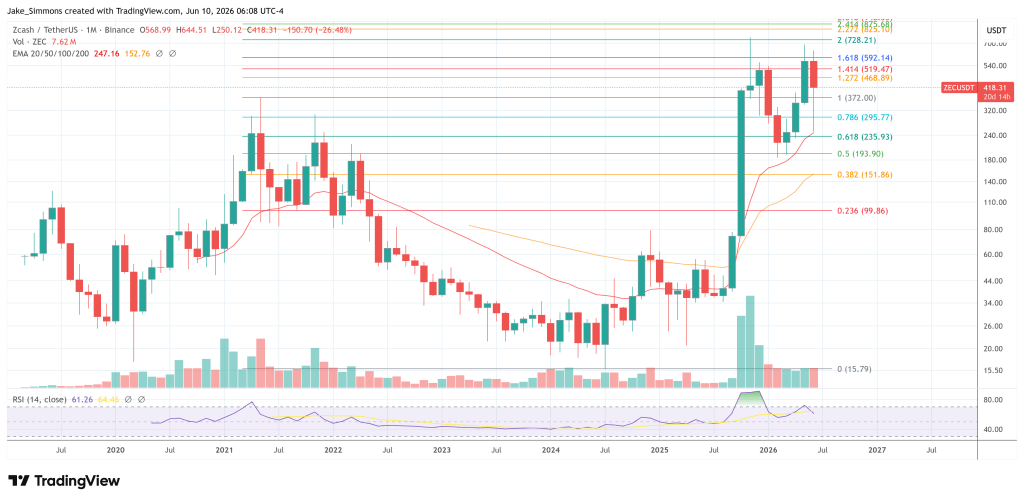
ZEC remains above the prior all-time high, 1-month chart | Source: ZECUSDT on TradingView.com

Trend Kriptolar

İlgili Okumalar

The Verdict in Choi Tae-won's Divorce Case: Revealing the Inheritance Undercurrent Behind SK Hynix's Trillion-Won Empire

SK Group Chairman Chey Tae-won's high-profile divorce case, involving a record 1.38 trillion won settlement, has drawn attention to the succession plans for Korea's second-largest conglomerate, especially its crown jewel, SK hynix. Unlike traditional chaebol scripts centered on the eldest son, Chey's three children from his marriage to former President Roh Tae-woo's daughter, Roh Soh-yeong, are carving distinct, non-traditional paths. Eldest daughter Chey Yun-jung (b. 1989) is seen as the most evident successor. With a scientific and consulting background, she holds executive roles at SK bioscience and SK Inc.'s growth support department, focusing on future strategy and biopharma. Her marriage is to an AI infrastructure entrepreneur, not a traditional business alliance. Second daughter Chey Min-jung (b. 1991) took a unique route, voluntarily serving as a South Korean naval officer, including an anti-piracy deployment. She later worked on policy and strategy for SK hynix in Washington D.C. before co-founding an AI-driven healthcare startup. She married a former U.S. Marine Corps officer, connecting her to U.S. defense and policy circles—networks crucial for a global semiconductor giant. The only son, Chey In-geun (b. 1995), who studied physics like his father, worked briefly at SK E&S before joining McKinsey. Despite fitting the traditional "heir" profile as the eldest son, he remains silent and holds no public position or shares in SK, suggesting the old succession playbook is obsolete. As SK hynix's valuation soars, becoming a geopolitical asset in the AI era, the heirs' legitimacy is no longer automatic. They must prove themselves in fields like AI biotech, global policy, and strategic consulting. Their marriages also reflect new elite networks in tech and defense, not old political alliances. Their inheritance is the complex challenge of navigating a globalized, tech-driven world, not just a corporate throne.

marsbit2 gün önce 09:06

The Verdict in Choi Tae-won's Divorce Case: Revealing the Inheritance Undercurrent Behind SK Hynix's Trillion-Won Empire

marsbit2 gün önce 09:06

From OpenSea to OpenRouter: Is Alex Atallah Repeating His 'Exit at the Peak' Playbook?

From OpenSea to OpenRouter: Is Alex Atallah Repeating His "Exit at the Peak" Playbook? According to the Wall Street Journal, payments giant Stripe is in talks to acquire the AI model aggregation platform OpenRouter in a potential deal valuing the company near $100 billion. This would mark founder Alex Atallah's second creation of a company reaching a $100 billion valuation, following his co-founding of NFT marketplace OpenSea. OpenRouter, founded just over three years ago, has grown rapidly by acting as a unified gateway for developers to access over 400 AI models. It currently has about 10 million users and processes over 200 trillion tokens monthly. While the platform's annualized revenue is around $50 million, its valuation has skyrocketed from $1.3 billion in March 2026. The potential acquisition by Stripe, a company OpenRouter's founder once likened it to, represents a major expansion into AI infrastructure for the payments leader. This move echoes Atallah's previous timing with OpenSea, where he departed before the NFT market's significant downturn. For OpenRouter, selling now may be strategic. Despite its scale, its business model—charging a 5-5.5% fee on AI inference calls—faces pressure from competition, open-source models, and potential price wars among model providers, limiting its profitability narrative for an IPO. A key asset for potential acquirers like Stripe is OpenRouter's vast repository of real-world AI usage data, which offers unique insights into model performance and developer preferences that are difficult to replicate. Whether this potential deal signifies a new valuation benchmark for AI infrastructure or another market peak signal remains to be seen.

链捕手2 gün önce 08:42

From OpenSea to OpenRouter: Is Alex Atallah Repeating His 'Exit at the Peak' Playbook?

链捕手2 gün önce 08:42

İşlemler

Spot

Popüler Makaleler

ZEC Nasıl Satın Alınır

HTX.com’a hoş geldiniz! Zcash (ZEC) satın alma işlemlerini basit ve kullanışlı bir hâle getirdik. Adım adım açıkladığımız rehberimizi takip ederek kripto yolculuğunuza başlayın. 1. Adım: HTX Hesabınızı OluşturunHTX'te ücretsiz bir hesap açmak için e-posta adresinizi veya telefon numaranızı kullanın. Sorunsuzca kaydolun ve tüm özelliklerin kilidini açın. Hesabımı Aç2. Adım: Kripto Satın Al Bölümüne Gidin ve Ödeme Yönteminizi SeçinKredi/Banka Kartı: Visa veya Mastercard'ınızı kullanarak anında Zcash (ZEC) satın alın.Bakiye: Sorunsuz bir şekilde işlem yapmak için HTX hesap bakiyenizdeki fonları kullanın.Üçüncü Taraflar: Kullanımı kolaylaştırmak için Google Pay ve Apple Pay gibi popüler ödeme yöntemlerini ekledik.P2P: HTX'teki diğer kullanıcılarla doğrudan işlem yapın.Borsa Dışı (OTC): Yatırımcılar için kişiye özel hizmetler ve rekabetçi döviz kurları sunuyoruz.3. Adım: Zcash (ZEC) Varlıklarınızı SaklayınZcash (ZEC) satın aldıktan sonra HTX hesabınızda saklayın. Alternatif olarak, blok zinciri transferi yoluyla başka bir yere gönderebilir veya diğer kripto para birimlerini takas etmek için kullanabilirsiniz.4. Adım: Zcash (ZEC) Varlıklarınızla İşlem YapınHTX'in spot piyasasında Zcash (ZEC) ile kolayca işlemler yapın.Hesabınıza erişin, işlem çiftinizi seçin, işlemlerinizi gerçekleştirin ve gerçek zamanlı olarak izleyin. Hem yeni başlayanlar hem de deneyimli yatırımcılar için kullanıcı dostu bir deneyim sunuyoruz.

635 Toplam GörüntülenmeYayınlanma 2024.12.12Güncellenme 2026.06.02

ZEC Nasıl Satın Alınır

Tartışmalar

HTX Topluluğuna hoş geldiniz. Burada, en son platform gelişmeleri hakkında bilgi sahibi olabilir ve profesyonel piyasa görüşlerine erişebilirsiniz. Kullanıcıların ZEC (ZEC) fiyatı hakkındaki görüşleri aşağıda sunulmaktadır.

活动图片