On August 19, U.S. Treasury Secretary Scott Bessent took action.
He increased the single-purchase limit for 10-year, 20-year, and 30-year Treasury bonds from $20 billion to at least $40 billion—directly doubling it. The timing coincided with long-term yields hitting near two-decade highs: the day before, the 30-year yield touched 5.33%, its highest level since 2007.
He named this move "Operation Twist by the Treasury," paying homage to the Fed's famous Operation Twist in the 1960s. He stated that current yields were inconsistent with their "equilibrium" level.
The curve did twist, but only for a day.
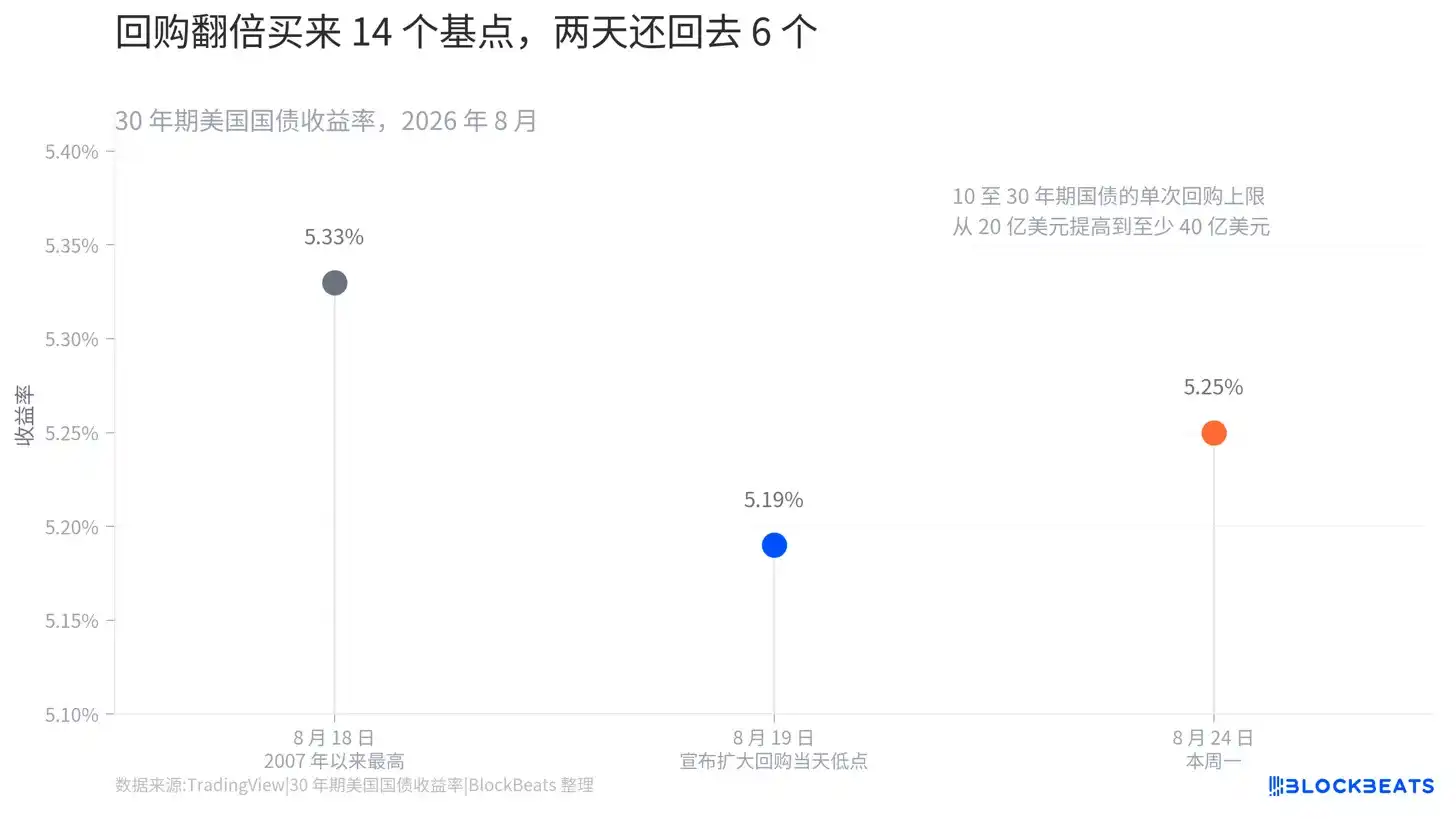
On the day of the announcement, the 30-year yield dropped to 5.19%, a 14-basis-point decline. Then it climbed back steadily, reaching 5.25% by Monday. The 10-year yield closed at 4.73% last Friday, near its highest point since he took office.
What really surged were some other things: Bitcoin approached $80,000, triggering billions of dollars in short liquidations; gold neared a three-month high; XRP rose 51% in a week.
Why Does the Treasury Buying Its Own Debt Lower Interest Rates?
First, let's clarify the mechanical principle involved. It's actually not that complicated.
Treasury yields are the benchmark interest rates for the entire economy. They are not only the government's cost of borrowing but also the reference for pricing housing mortgages, corporate loans, and many other debts. Higher yields simultaneously increase the interest burden for both the government and American households—a particularly glaring issue ahead of midterm elections.
When the Treasury enters the open market to buy back the debt it issued, it effectively adds another buyer. Increased demand pushes bond prices higher; and bond prices and yields move inversely—when prices rise, yields fall.
But there's a crucial precondition: the Treasury is not the Federal Reserve; it cannot create money out of thin air. The funds for buying back bonds must come from either existing cash or borrowing. And borrowing usually means issuing more short-term Treasury bills—so the repurchase is less about "buying back debt" and more about debt replacement: the total amount remains the same, long-term is swapped for short-term.
Wells Fargo analyst Angelo Manolatos estimated that to finance the expanded repurchase plan, the Treasury would need to issue an additional $16 billion in short-term bills per quarter.
This tactic itself isn't new. Since the start of Trump's second term in 2025, the Treasury has funneled all new borrowing needs into bills with maturities of one year or less—pushing up short-term rates while leaving long-term rates untouched. Interestingly, before becoming Treasury Secretary, this was precisely what Bessent criticized his predecessor Janet Yellen for.
Then Why Didn't It Work?
Because none of the forces pushing yields higher were touched by this operation.
Satori Insights founder Matt King put it most plainly: "Every path to durable relief in the long end passes through something this administration doesn't want." He listed three paths: a smaller budget deficit, a decline in the stock market, and reduced AI investment.
All three are blocked.
Debt is at record highs. One measure of U.S. national debt has exceeded $40 trillion this week. Bessent's promised deficit reduction plan faces bleak prospects in Congress—the Republican-controlled Congress has no intention of making net budget cuts this year, and this fiscal year's deficit is projected at $2.1 trillion.
Companies are also competing for funds. AI-driven corporate bond issuance has surged. Alphabet sold bonds with maturities as long as 40 years earlier this month.
Inflation has jumped. Trump's war with Iran has disrupted energy markets, with oil prices rising about 30% since early July. Brent crude is at $93 per barrel.
The Fed itself is unclear. Chair Kevin Warsh's strategy has confused investors, and the new chair's Jackson Hole debut speech hasn't happened yet.
Even more awkwardly, the market doesn't see anything here that needs fixing. Edward Yardeni, who coined the term "bond vigilante," told Bloomberg TV about an hour before Bessent's move: "I think we have gotten back to normal interest rates. Four to five percent is normal." While the Treasury said this intervention was to support liquidity, JPMorgan's rates strategy team wrote in a report last Thursday: "Market functioning has clearly improved this year."
Judgments from institutions like Goldman Sachs and Wells Fargo were more direct: Unless fiscal and inflationary pressures genuinely ease, increasing long-end repurchases will not reverse the uptrend in long-term yields, and the yield curve will continue to steepen.
So Why Is Bitcoin Rising?
Because what the market read wasn't "problem solved," but "they're really worried."
Sygnum Chief Investment Officer Fabian Dori gave a complete explanation: "The Treasury doubling its long-bond repurchases aims to soothe the bond market and provide liquidity at the long end of the curve... This isn't money printing; the mechanism is on the Treasury's balance sheet, not the central bank's, but the signal is important: Managing the U.S. debt cost has become an active policy priority, reigniting the narrative of currency debasement. The fact that gold and silver rose alongside Bitcoin tells a story—capital is rotating into scarce, non-sovereign stores of value."
Criticism from Citadel Securities was even more blunt: This practice of suppressing long-term borrowing costs through repurchases amounts to "financial repression" that could weaken the dollar and exacerbate inflation. Its judgment is that suppressing long-term yields won't eliminate fiscal and inflationary pressures; it will merely transfer those pressures to the foreign exchange market.
The foreign exchange market did move first. Hedge funds increased their bets against the dollar before Bessent announced the plan. The dollar recorded its largest single-day drop in nearly three weeks, and demand for hedging against a dollar decline in the options market rose to its highest since February. On Monday, the dollar index was still hovering near multi-month lows.
Where Exactly Is This Money Coming From?
This became a new variable emerging this week.
CNBC reported on Monday, citing two senior Treasury officials, that the Treasury might use funds from its cash account at the Fed—the Treasury General Account (TGA)—to pay for the repurchases. On August 20, the balance in this account was $935 billion.
The TGA is essentially the U.S. federal government's checking account, used for daily expenses: Social Security checks, federal employee salaries, defense contracts, and interest and principal payments on government debt. It was deliberately thickened earlier this year, partly because the Treasury had to refund importers approximately $166 billion—the Supreme Court ruled earlier this year that a large portion of Trump's import tariffs were illegal.
The benefit of using the TGA is that it avoids issuing new debt; the downside is it directly depletes the nation's cash reserves. In 2015, the Treasury set a rule: the account must hold at least enough for five days of outflows, or no less than $150 billion, as a precaution against being shut out of the bond market.
Upon the news, the 10-year yield fell by as much as 4 basis points to 4.69% on the day.
At Monday's press conference—whose theme was actually sanctions against Iran—Bessent was asked about this. His response was: the Treasury would continue with its regular auction schedule announced in early August, including long-bond auctions; the expanded repurchase hasn't bought a single bond yet, and the 10-year and 20-year repurchases won't start until September 10.
What Else Does He Want to Twist?
Bessent's ambitions for yield curve management extend beyond government bonds.
He factored in the hyperscale tech companies borrowing heavily for AI. He said these investments would ultimately repay with faster, non-inflationary economic growth, but currently, "it is creating a short-term competition for capital." Then he offered a suggestion:
"If I were sitting in the CFO's seat, I would consider issuing more of the so-called 'belly' debt." — meaning the five-year tenor.
The fact that the U.S. Treasury Secretary publicly advises corporate CFOs on what maturity of debt to issue is itself worth a pause.
Another line leads further, to stablecoins. The "Genius Act" passed last year stipulates that U.S.-issued dollar-pegged stablecoins can only be backed by specific assets, including Treasury securities maturing within 93 days. Bessent has cited a prediction: stablecoins could grow into a market nearing $4 trillion and has written, "This could reduce the government's borrowing costs."
Currently, the total market cap of all stablecoins is about $300 billion, while U.S. money market funds approach $8 trillion. But a commentary from the Brookings Institution's Hutchins Center points out the leverage here: Banks typically hold only about 8 cents of Treasury bills per dollar of assets, while a dollar of stablecoin is often backed by close to 80 cents of Treasury bills.
This provides another layer of context for Trump hosting crypto industry executives at the White House last week and urging Congress to pass the "Clarity Act." Both Circle and Coinbase rose over 20% last week.
The Rule He Broke
The Treasury has a decades-long tradition called "regular and predictable"—any changes to debt management methods must undergo thorough discussion internally and with market participants. Bessent himself repeatedly endorsed this principle in a keynote speech last November.
This latest escalation came just two weeks after the quarterly tentative calendar for the program was released.
Wrightson ICAP senior economist Lou Crandall wrote the most accurate assessment of this event in a Monday report: "The decision to increase long-end repurchases may not be aggressive in itself, but the timing and framing of that decision certainly is."
The cost might emerge in the most ironic way: if investors start worrying that auction sizes could change unexpectedly at any time, they will demand a higher premium to buy Treasuries—especially the longest-dated ones.
In other words, the rule broken to suppress long-term yields could itself push long-term yields higher.
Some in the market have already begun discussing whether a "Bessent Put" has emerged, akin to when people believed Alan Greenspan would always step in to support the stock market.
As for Trump, he denied last week that he had instructed Bessent to intervene in the bond market.
He did twist that curve. It's just that what twisted was the dollar, gold, and Bitcoin, not the one he intended to twist.