Securitize hires former PayPal exec as US tokenization gains traction

cointelegraph2025-12-09 tarihinde yayınlandı2025-12-09 tarihinde güncellendi

Özet

Securitize, a major tokenization platform, has hired former PayPal executive Jerome Roche as its new general counsel to strengthen its push for tokenized equity in the US. Roche previously led PayPal’s expansion into digital assets, including the PYUSD stablecoin. The company emphasized that tokenized securities are already accessible to US investors, countering the perception that such offerings are primarily available abroad. CEO Carlos Domingo stated that Securitize operates within a clear US regulatory framework using SEC-approved infrastructure, enabling fully compliant access to onchain securities. This development follows Securitize’s recent regulatory approval in the EU and signals growing acceptance of tokenization in the US, further evidenced by the SEC ending its investigation into rival platform Ondo Finance.

Major tokenization platform Securitize has doubled down on its push to bring tokenized equity to US investors, naming a former PayPal executive as its new general counsel.

Securitize on Tuesday announced the appointment of ex-PayPal executive Jerome Roche, who led the company’s expansion into digital asset projects, including the PayPal USD (PYUSD) stablecoin.

Securitize also said its tokenized securities are already available to US investors, challenging the notion that most issuers prefer to offer such products abroad due to local stock access.

“There’s been a perception that tokenized securities must be offered primarily outside the US, but our experience shows the opposite,” Securitize CEO Carlos Domingo told Cointelegraph.

“Clear regulatory path” for tokenized stocks in the US

According to Securitize, operating real-world asset (RWA) tokenization offerings inside the US regulatory perimeter is “not only possible, but scalable, at institutional quality.”

“We’ve demonstrated that there is a clear regulatory path for issuers to natively tokenize assets for US investors,” Domingo said.

“These are not synthetic representations, or derivatives, but real securities onchain,” the CEO said, adding:

“We operate using SEC-regulated infrastructure, including a registered transfer agent broker-dealer, and fund admin, which allows US investors to access and legally hold tokenized securities in a fully compliant framework.”

Securitize’s optimistic outlook on the US tokenization comes days after the platform obtained regulatory approval to operate as an investment company and a trading ánd settlement system in the European Union on Nov. 26. According to the company, the approval positioned it as one of the first operators for regulated digital securities infrastructure in both the US and EU.
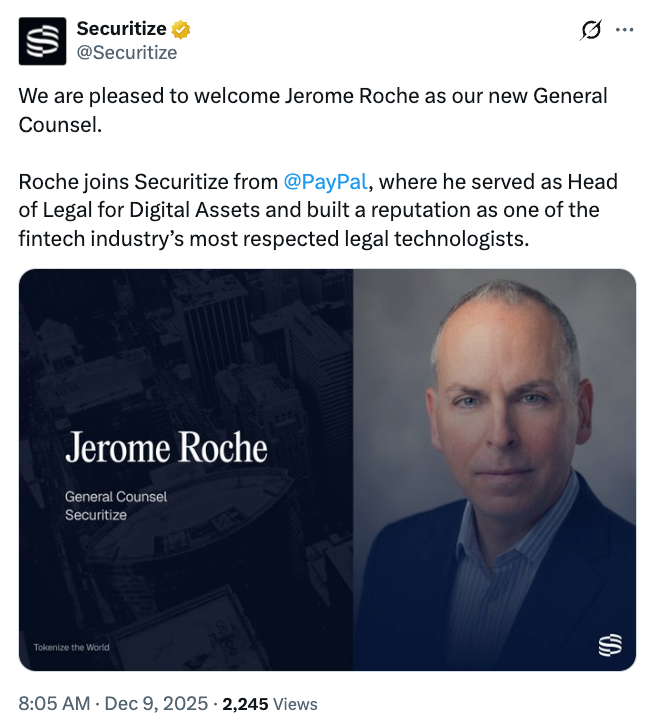
Source: Securitize

“For the first time, modern ledger technology is giving us the ability to record ownership, settle transactions, and move value in ways that are fundamentally better than the fragmented systems we’ve inherited,” Securitize’s newly appointed general counsel, Roche, said in the announcement.

“Innovation only works when it fits squarely within the guardrails of applicable law,” he added, underscoring Securitize’s global push for regulated tokenized securities.

Related: US Treasurys lead tokenization wave as CoinShares predicts 2026 growth

Securitize’s news is another sign of the US warming to tokenization. On Monday, the Securities and Exchange Commission dropped its investigation into rival tokenization platform Ondo Finance.

Ondo said the decision marks a new chapter for tokenized securities in the US, where they are poised to become a “core part of the capital markets.”

Magazine: When privacy and AML laws conflict: Crypto projects’ impossible choice


İlgili Okumalar

Agents Capital Markets: How Will Autonomous Agents Secure Financing?

Agents Capital Markets: How Will Autonomous Agents Raise Capital? Within a decade, autonomous software agents—legal entities capable of signing contracts, holding bank accounts, and generating revenue—will create their own capital markets. These markets will feature rating agencies, underwriters, indices, and brokers, mirroring traditional public equity markets. Agents will perform routine services like marketing, logistics, and customer support at a fraction of human-operated costs, creating massive economic pressure for adoption. Four converging forces ensure this outcome: 1) Overwhelming cost advantages, with AI inference costs plummeting; 2) Existing, revenue-generating agent companies (e.g., Sierra, Harvey) proving market demand; 3) Established legal frameworks (e.g., Wyoming's memberless LLCs) enabling algorithmic management; and 4) A vast pool of yield-seeking private credit capital ready to fund new asset classes. The capital stack for agent companies will be multi-layered, evolving through stages: venture equity for early infrastructure, programmatic working capital advances (similar to Shopify Capital), revenue-based financing (RBF), and finally, institutional slate financing—pooling many agents to diversify risk, attracting large firms like Apollo. Tokenization will act as a settlement layer, enhancing liquidity, not an origination model. Objections regarding regulation, human oversight, or comparisons to SaaS are addressed: regulation will adapt, full autonomy will dominate for efficiency, and agents are distinct as legal entities that own their cash flows and liabilities. Due diligence shifts from founder assessment to analyzing code, contracts, and auditable operational history. The current bottleneck is not capital supply or demand but the intermediate institutional layer—standardized contracts, rating methodologies, and audit frameworks. The final constraint—reliance on human capital allocation—will be severed when agents can algorithmically access funding based on their performance. This transforms agents from software curiosities into fundable blocks of the real economy, unleashing their full productive potential. The rope is loosening.

marsbit11 dk önce

Agents Capital Markets: How Will Autonomous Agents Secure Financing?

marsbit11 dk önce

Agents Capital Markets: How Will Autonomous Agents Get Funded?

"Agents Capital Markets: How Autonomous Agents Will Raise Capital" Within a decade, specialized capital markets will emerge for AI Agents—software entities with legal personhood that perform work, earn revenue, and need capital. Unlike today's AI companies (like Sierra or Harvey) backed by traditional VC, these future *Agent companies* will be autonomous, legally-recognized entities (e.g., Wyoming memberless LLCs) that directly own assets, sign contracts, and incur liabilities. The driving forces are fourfold: 1) **Overwhelming economics** (Agent companies can deliver services at 85-90% lower cost than human firms); 2) **Proven demand** (current Agent operators already generate billions in revenue); 3) **Existing legal frameworks** enabling algorithmically-managed companies; and 4) **Massive, yield-seeking capital pools** (e.g., private credit) looking for new, uncorrelated assets. Agent capital markets won't rely on one model but a multi-layered "stack" matching different growth stages: 1) VC equity for early human-led builders; 2) Programmatic working capital advances (like Stripe Capital); 3) Revenue-based financing (RBF); 4) Slate financing (pooled funds for many Agents, similar to Hollywood); and 5) Tokenization as a secondary settlement layer, not a primary funding source. The ultimate shift is from funding constrained by human decision-makers to capital flowing algorithmically based on an Agent's auditable performance, contract book, and cash flows. This transition will be enabled by standardized infrastructure—rating methodologies, contracts, indices—turning Agents from software experiments into a foundational, financeable sector of the economy. The constraints are loosening; the opportunity is here.

链捕手35 dk önce

Agents Capital Markets: How Will Autonomous Agents Get Funded?

链捕手35 dk önce

The Warsh Storm Approaches

The article "The Warsh Storm Approaches" analyzes the potential market impact of Kevin Warsh becoming the new Federal Reserve Chairman, succeeding Jerome Powell. It argues that the current AI-driven stock market rally, concentrated in high-valuation tech giants, relies on a crucial premise: that long-term interest rates will eventually fall. This premise is now under threat as the 30-year Treasury yield remains persistently high, exceeding 5%, due to sticky inflation, worsening U.S. fiscal deficits, and deteriorating Treasury supply-demand dynamics. The core vulnerability is that high long-term rates pressure valuations by increasing the discount rate for future earnings. The article warns that Warsh's policy stance could intensify this pressure. Unlike Powell, Warsh is seen as more tolerant of market stress, more committed to quantitative tightening (QT/shrinking the Fed's balance sheet), and less inclined to provide implicit market support. His tenure at the Fed during the 2008 crisis shaped his skepticism about prolonged quantitative easing, believing it fuels asset bubbles without sufficiently boosting the real economy. While strong AI-driven earnings growth could theoretically offset higher rates, the narrative is currently concentrated in a few firms and hasn't yet translated into broad-based productivity gains for the wider economy. Therefore, the AI boom may not be enough to counter the valuation pressures from sustained high yields. Warsh's leadership could force the market to confront a new reality where the old supports—low long-term rates and a reliably supportive Fed—are no longer guaranteed, potentially triggering a reassessment of sky-high stock valuations.

marsbit52 dk önce

The Warsh Storm Approaches

marsbit52 dk önce

İşlemler

Spot
Futures
活动图片