Matrixdock FRS Standard: From Gold to Silver, How Is the On-Chain Reserve Asset System Evolving?

marsbit2026-03-19 tarihinde yayınlandı2026-03-19 tarihinde güncellendi

Özet

The article discusses the evolution of on-chain real-world assets (RWA), shifting focus from simple asset tokenization to establishing sustainable and verifiable operational frameworks for long-term on-chain existence. It introduces Matrixdock’s FRS (Fungible Reserve Standard), a mechanism that encodes the economic attributes of reserve assets—like custody and operational costs—directly into the token structure. Unlike traditional mapping approaches, FRS maintains a deterministic relationship between the reserve asset, token supply, and operational costs over time. It adjusts the quantity of underlying assets per token to reflect costs structurally, without charging external fees or extracting profits. The piece highlights the extension from gold—a stable reserve asset—to more volatile and cyclical silver, demonstrating how FRS provides a consistent operational framework regardless of asset type. Matrixdock’s XAGm, a silver-backed token, is presented as a practical implementation of FRS, using LBMA-standard silver bars held in institutional vaults. Finally, the article introduces the concept of a “Reserve Layer”—a structured system of diverse, high-quality assets operating under a unified mechanism to support on-chain finance. The broader implication is that RWA’s future depends not on tokenization alone, but on robust, verifiable, and sustainable on-chain operational frameworks.

In recent times, discussions around RWA (Real World Assets) being brought on-chain have primarily revolved around one question: which assets can be introduced to the blockchain. Whether it's gold, government bonds, or various real-world assets, the core logic centers on "mapping"—converting real assets into on-chain certificates. However, as the market gradually advances, a more specific issue has begun to emerge: can these assets exist on-chain in the long term and operate in a verifiable manner over time?

When assets are no longer short-term holding instruments but need to form long-term structures on-chain, mere "mapping" is no longer sufficient. The clarity of reserve status, how token supply changes, and how custody and operational costs are reflected have become critical factors affecting asset stability.

Against this backdrop, mechanism frameworks built around "how assets operate on-chain" are becoming an important component of RWA infrastructure. Among these, the FRS (Fungible Reserve Standard) developed by Matrixdock is a structural response to this very issue.

FRS: A Mechanism Framework for Encoding the Economic Attributes of Assets

FRS is not a single product issuance model but a mechanism framework that encodes the economic attributes of reserve assets into the token structure. Its focus is not on "how to issue tokens" but on continuously maintaining a deterministic relationship between reserve assets, token supply, and operational costs on-chain.

In the FRS framework:

  • The correspondence between tokens and the underlying reserve assets is explicitly defined at the mechanism level and is verifiable
  • The economic attributes of the assets (including custody and operational costs) are continuously reflected on-chain through systematic mechanisms
  • Costs are structurally reflected on-chain according to established rules, rather than being charged separately as external fees
  • The overall structure does not include management fees or profit extraction, only reflecting the actual costs incurred from asset custody and operations

Specifically, this mechanism adjusts "the amount of asset corresponding to each unit token" so that asset costs are continuously reflected over time, thereby reflecting holding costs without changing the quantity held by users. This design transforms on-chain assets from static "mapping results" into a structured system that operates continuously according to established rules. In this sense, FRS is closer to a standardized operating mechanism for on-chain reserve assets, rather than a single product framework.

From Gold to Silver: The Logic Behind Asset Expansion

In the traditional financial system, gold has long played a central role as a reserve asset, and its value-anchoring properties have made it one of the first precious metals to enter the on-chain structure.

In contrast, silver is influenced by both investment demand and industrial cycles, exhibiting more pronounced volatility and cyclical characteristics. This also means that, in the absence of a unified mechanism, the on-chain representation of such assets often faces higher uncertainty. The stronger the asset volatility, the greater the demand for constraints and verification mechanisms in its on-chain structure.

The role of FRS is to provide a unified structural foundation in this process: regardless of how asset characteristics change, their operational logic on-chain remains consistent. Under this framework, asset expansion is no longer merely an increase in underlying assets but:

  • Introducing reserve assets with different attributes under a unified mechanism
  • Enhancing the diversity of asset portfolios while maintaining structural consistency

Therefore, the evolution from gold to silver is not just an expansion at the asset level but also a continuation at the mechanism level.

XAGm: An Implementation of FRS for Silver Assets

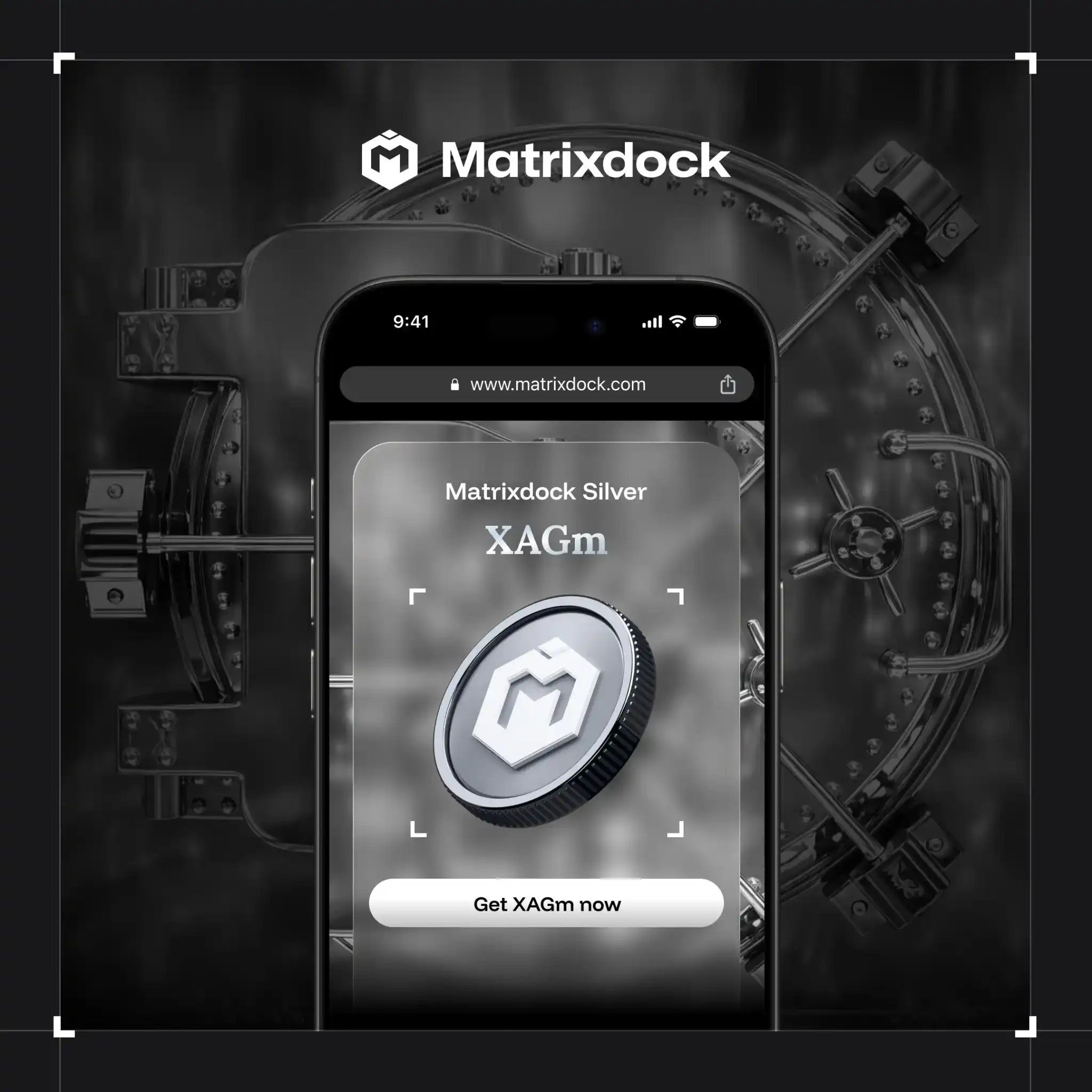
Under the FRS framework, Matrixdock has launched the silver token XAGm, representing a further application of this mechanism to precious metal assets.

From a practical perspective, XAGm operates silver assets within the FRS mechanism, rather than merely mapping physical silver on-chain. Its underlying assets are fully physically allocated silver, using LBMA Good Delivery standard silver bars, and are custodied by institutional-grade vaults. However, within the FRS framework, the key aspect of silver is not just "being put on-chain" but how its economic attributes are continuously encoded into the on-chain structure.

In this mechanism, the operation of silver assets is manifested as:

  • The configuration status of reserve assets has clear boundaries on-chain and can be independently verified through established methods
  • The amount of silver corresponding to each unit token adjusts over time according to established rules, ensuring asset costs are continuously reflected over time
  • The total token supply is adjusted mechanistically to maintain a deterministic relationship with the underlying silver reserves
  • Custody and operational costs for silver are not charged as external fees but are continuously reflected on-chain through preset rules

In this process, silver is not just represented as an on-chain asset; its economic attributes are continuously reflected within the mechanism. Therefore, the significance of XAGm is not only in bringing silver on-chain but also in providing a specific paradigm for how silver assets can be structurally organized and operated under the FRS mechanism.

Reserve Layer: From Asset Collection to Structural System

Under the FRS framework, reserve assets no longer exist as "single assets" but gradually form a structural system with internal logic.

This system (referred to by Matrixdock as the Reserve Layer) can be understood as:

  • Comprising multiple high-quality reserve assets
  • Operating under a unified mechanism
  • Collectively providing value support and a liquidity foundation for on-chain financial activities

Within this structure:

  • Gold serves a relatively stable value-anchoring function
  • Silver introduces cyclicality and trading activity
  • Different assets are organized into a portfolio with consistent operational logic through the FRS mechanism

This shift means that the significance of reserve assets lies not only in "the assets themselves" but also in their structural position and mode of operation.

RWA development is entering a new stage. The act of bringing assets on-chain is no longer the main hurdle; the real challenge lies in: how to ensure these assets can exist on-chain in the long term and operate in a verifiable manner continuously.

FRS, as a mechanism framework built by Matrixdock, provides a path to transform real-world assets into structural units on-chain. As more assets are introduced onto the chain under this framework, a reserve asset system based on "mechanisms" is gradually taking shape.


İlgili Sorular

QWhat is the core focus of the FRS (Fungible Reserve Standard) framework developed by Matrixdock?

AThe core focus of the FRS framework is not on 'how to issue tokens,' but on continuously maintaining a deterministic relationship between reserve assets, token supply, and operational costs on the blockchain in a verifiable manner.

QHow does the FRS mechanism handle the costs associated with holding a reserve-backed asset like XAGm?

AThe FRS mechanism handles costs by systematically adjusting the 'amount of asset corresponding to each unit of token' over time. This reflects custody and operational costs within the token's structure itself, rather than charging them as separate, external fees.

QWhat key challenge in the RWA (Real World Asset) sector does the FRS framework aim to address?

AThe FRS framework aims to address the challenge of how to make real-world assets exist long-term on the blockchain and operate continuously in a verifiable way, moving beyond simple asset 'mapping' to a structured, rules-based system.

QWhat is the significance of expanding from gold to silver within the FRS framework, according to the article?

AThe expansion from gold to silver is significant because it demonstrates the framework's ability to incorporate assets with different attributes (like silver's higher volatility and cyclical nature) under a unified, consistent operational mechanism, thereby increasing portfolio diversity.

QHow does the article define the 'Reserve Layer' that is formed under the FRS framework?

AThe 'Reserve Layer' is defined as a structural system composed of multiple high-quality reserve assets (like gold and silver) that run under a unified mechanism (FRS) to collectively provide value support and a liquidity foundation for on-chain financial activities.

İlgili Okumalar

The Use of Humans: Agentic Wallet and the Next Decade of Wallets

The article "The Use of Humans: Agentic Wallet and the Next Decade of Wallets" discusses the evolution of digital wallets in the age of AI agents. It argues that as software users shift from humans to autonomous agents, traditional wallet security models—relying on human confirmation, signatures, and private key management—become inadequate. The core proposition is that Agentic Wallets must serve two masters: humans, who set rules and retain ultimate control, and agents, which require constrained autonomy to execute transactions efficiently. The wallet thus evolves from a simple asset container into a permission and execution system that allows agents to operate within predefined boundaries (e.g., budget limits, approved assets, whitelisted addresses). The article identifies key challenges: current wallets are designed for human interaction, not agentic speed and scale. It outlines four tiers of agent autonomy—from human-controlled to fully autonomous—and emphasizes "bounded autonomy" as the pragmatic near-term solution. A four-layer architecture is proposed: account isolation, permission rules, execution primitives for agents, and governance tools (logging, alerts, veto mechanisms). Critical enabling technologies include standardized Skills (for链上 operations), policy engines, session keys for limited delegation, and audit trails. Current solutions from players like Coinbase, Safe, Privy, and Polygon are noted, but face gaps in portable identity/reputation, unified policy standards, adversarial security (e.g., prompt injection), and cross-chain functionality. The future direction involves a "Wallet Policy Plane" that sits between agent intent and on-chain execution, performing real-time policy checks, risk scoring, and identity verification—akin to Stripe's payment infrastructure. Ultimately, the wallet's role shifts from a front-end gatekeeper to an embedded control layer enabling secure, scalable agentic economies.

marsbit12 dk önce

The Use of Humans: Agentic Wallet and the Next Decade of Wallets

marsbit12 dk önce

Must-Follow Next Week|Polymarket to Announce Major News Next Monday; Backpack TGE on March 23 (3.23-3.29)

The following is a summary of key events scheduled for the week of March 23-29, 2026. **March 23:** * **Polymarket** is set to announce major news, speculated to be related to a token launch or funding round. * **Backpack** will conduct its Token Generation Event (TGE). * The U.S. SEC may begin processing **Morgan Stanley's Bitcoin ETF** application. * Cboe plans to launch the **BITVX** volatility index, based on iShares Bitcoin Trust (IBIT) options. * **NilChain** will cease operations; NIL token holders must migrate to Ethereum. * **Binance** will list the PAYPUSDT stock perpetual contract. **March 25:** * The U.S. House Financial Services Committee will hold a hearing on **tokenization**. * **Metaplanet** will hold its annual shareholders meeting. **March 26:** * A proposal to distribute ~70 million **USDS** to Sky Agents may be executed. * U.S. weekly initial jobless claims data will be released. **March 27:** * Federal Reserve Vice Chair **Jefferson** is scheduled to speak. * **Bithumb** will delist Neiro (NEIRO). **March 28:** * **Linea** will update its Terms of Service to prepare for the launch of its Yield Boost feature. **Other Events (Date TBD):** * Elon Musk announced that **X Platform** will release a major open-source update to its AI algorithm next week. * **Starknet** will launch the **STRK20** testnet next week, with a mainnet release planned for late April. STRK20 aims to provide token-level privacy for assets on the network.

marsbit35 dk önce

Must-Follow Next Week|Polymarket to Announce Major News Next Monday; Backpack TGE on March 23 (3.23-3.29)

marsbit35 dk önce

İşlemler

Spot
Futures
活动图片