Written by | Beyond the Layout, Author | Painting
One thing DeepSeek has excelled at in the past is making complex things cheap.
The stronger the model, the lower the price. While others burn cash, it drives prices to the floor. After V3 and R1, the industry's impression of it was consistent: a top-tier model doesn't have to be expensive.
But two recent moves have suddenly shifted this narrative.
First, V4 Pro raised its price. Immediately after, the agent framework DeepSeek Harness was launched.
One starts to bring models back into the commercial world, the other simply lays out all that complex stuff beyond the model in front of developers.
Two seemingly unrelated events, when viewed together, instead seem to be answering the same question: What exactly does DeepSeek want to compete for next?
I. DeepSeek Begins to Change Its Strategy
Looking back over the past two years, DeepSeek has actually been answering three questions.
V3 and R1 proved that a Chinese team can build world-class foundation models, and can push inference and training efficiency to a very high level with limited resources.
With the model proven, the next question is whether it's cheap enough. This is where it shook the industry most, continuously driving prices down.
Then, whether these capabilities can be taken by more people. DeepSeek chose open source, extending from model weights to API, to the developer ecosystem.
The logic of DeepSeek in the past was complete: build a strong model, lower the price, open up capabilities, let more people use it.
With V4 Pro, the model continues to upgrade, but the price is no longer pushed down. The price increase alone is not surprising. What's really worth watching is its almost simultaneous appearance with Harness.
DeepSeek may have started calculating a different account.
In the past, it was competing for model call volume; now, it's beginning to compete for *where* the calls happen. These are two completely different battles.
For a model to truly generate value, it must pass through another layer of runtime environment: calling tools, reading files, managing permissions, running tasks. In the past, this layer was encapsulated inside products; users didn't even know it existed.
Harness is the first time DeepSeek has taken this layer out separately.
V4 Pro and Harness are actually two hands. One brings the model itself back to the commercial ledger, the other reaches towards the infrastructure beyond the model.
II. Dismantling the Agent
To understand DeepSeek Harness, the best reference is Apple.
Apple has a very important product philosophy: bear complexity for the user. You don't need to know how the CPU schedules, how memory is managed, how the file system runs. Open a Mac, an iPhone, and just use it.
This logic later entered the Agent world. Claude Code, Codex, WorkBuddy all packaged up the complex capabilities needed for an Agent to run. Tools, Skills, sandbox, permissions, workflows, all there, but the user doesn't need to know. You just say 'help me get this done,' and the product decides the rest for you.
This has been the direction of AI product efforts in recent years. Models become more complex, products become simpler. DeepSeek Harness does the opposite, breaking these things out one by one.
Model, tools, Skills, workflows, UI, all become components that can be individually replaced. Even plugins during runtime can be dynamically loaded, unloaded, and recombined.
What's most noteworthy about Harness is that it redefines the boundary of encapsulation. Apple's logic is: I encapsulate complexity for you into a product. Harness breaks complexity into modules, then hands you the right to modify.
This also explains why it's called Harness, not DeepSeek Code. Code refers to purpose, Harness refers to the runtime environment.
Breaking down an Agent, it's Agent = Model + Harness. The model is responsible for thinking, Harness is responsible for turning thought into action. In the past, this entire set was hidden behind the product.
What DeepSeek did was make this layer of encapsulation itself the object of openness.
III. Enabling Software to Evolve During Runtime
If you only view Harness as an Agent product, it's even a bit abnormal. Why would a model company proactively allow you to use other companies' models?
The answer may lie outside Agent products.
Here we must mention Cordis behind the plugins.
Cordis is the underlying kernel of Harness, specifically managing how plugins are installed, uninstalled, and how they cooperate with each other. It is very restrained, not touching the model, tools, or specific Agent capabilities, only managing this one thing:
Enabling plugins to be dynamically loaded, unloaded, managed, and maintain system stability during the process of change.
Just by doing this, it touches upon two hardcore technical concepts.
One is called temporal composability. After a plugin is uninstalled, can the effects it previously caused be completely undone? The other is spatial composability: if one plugin depends on another, and the latter suddenly disappears or changes, can the former reconnect its dependencies on its own?
It sounds technical, but they're actually answering a big question: Can an Agent change itself while it's running?
Traditional software doesn't do this. Once a program starts, its capabilities are basically set. You can upgrade the version, but you don't suddenly say mid-run, "I'm missing a capability, let me add one now."
Cordis aims to provide this possibility. The Creation Mode in Harness is the most direct demonstration of this concept. The Agent can inspect the environment it's running in, discover what's missing, create it on the spot, hook it back, and continue working.
You can have it make a security audit Agent that only reads code and cannot modify files, or have it make an enterprise research Agent that connects to internal search, uses a fixed model, and is equipped with three proprietary Skills.
Traditional Agents need to be configured first by people. Harness explores another path: people only set the goal, the Agent adjusts its own runtime environment.
This is like a machine that, while running, discovers it's missing a part, and on the spot manufactures one and installs it.
And today it is changing the way software is created.
In the past, people wrote software, and the software executed tasks. In the future, it might be: people propose goals, the Agent generates capabilities, installs them, and then completes the goal.
If this path truly works, the very meaning of the word "Agent" will change. It becomes less like pre-programmed software, and more like a runtime environment that can modify its own capability boundaries at any time.
IV. The Real Battlefield is Beyond the Model
There's a detail here with significant commercial meaning.
Harness does not restrict users to DeepSeek's own models.
The most natural move for a model company making an Agent is to tie it to its own model. OpenAI has GPT, Anthropic has Claude, Google has Gemini. Agents are the last mile for models to reach users; the tighter the binding, the more calls for its own model. Model companies naturally want to fuse model and Agent together.
DeepSeek precisely did not do this. It allows you to customize the model, protocol, Base URL, even connect to other companies' models.
Theoretically, you could completely use a competitor's model inside DeepSeek Harness.
From the perspective of an Agent product, this is strange. But from an infrastructure perspective, it makes sense. What it really wants to control might not be the model, but the layer beneath the model, the runtime environment of the Agent.
This is like an operating system. Windows doesn't make all the software itself, nor does Android. The truly valuable part of an OS is making others willing to develop on it. More developers mean more software, more software means more users, and the platform's weight naturally increases.
This is the logic Harness wants to replicate.
Its real competitors may not be Claude Code and Codex, but rather the runtime for the Agent era. Whoever controls the runtime environment has the chance to dictate how future Agents run.
V. Starting to Calculate the Ecosystem's Account
Reaching this point, another explanation emerges for why V4 Pro raised its price.
In the past, DeepSeek relied on low-priced models to attract more users, more users brought more calls, more calls brought more developers and influence, ultimately nurturing a stronger model.
After Harness appeared, a new ecosystem cycle is taking shape.
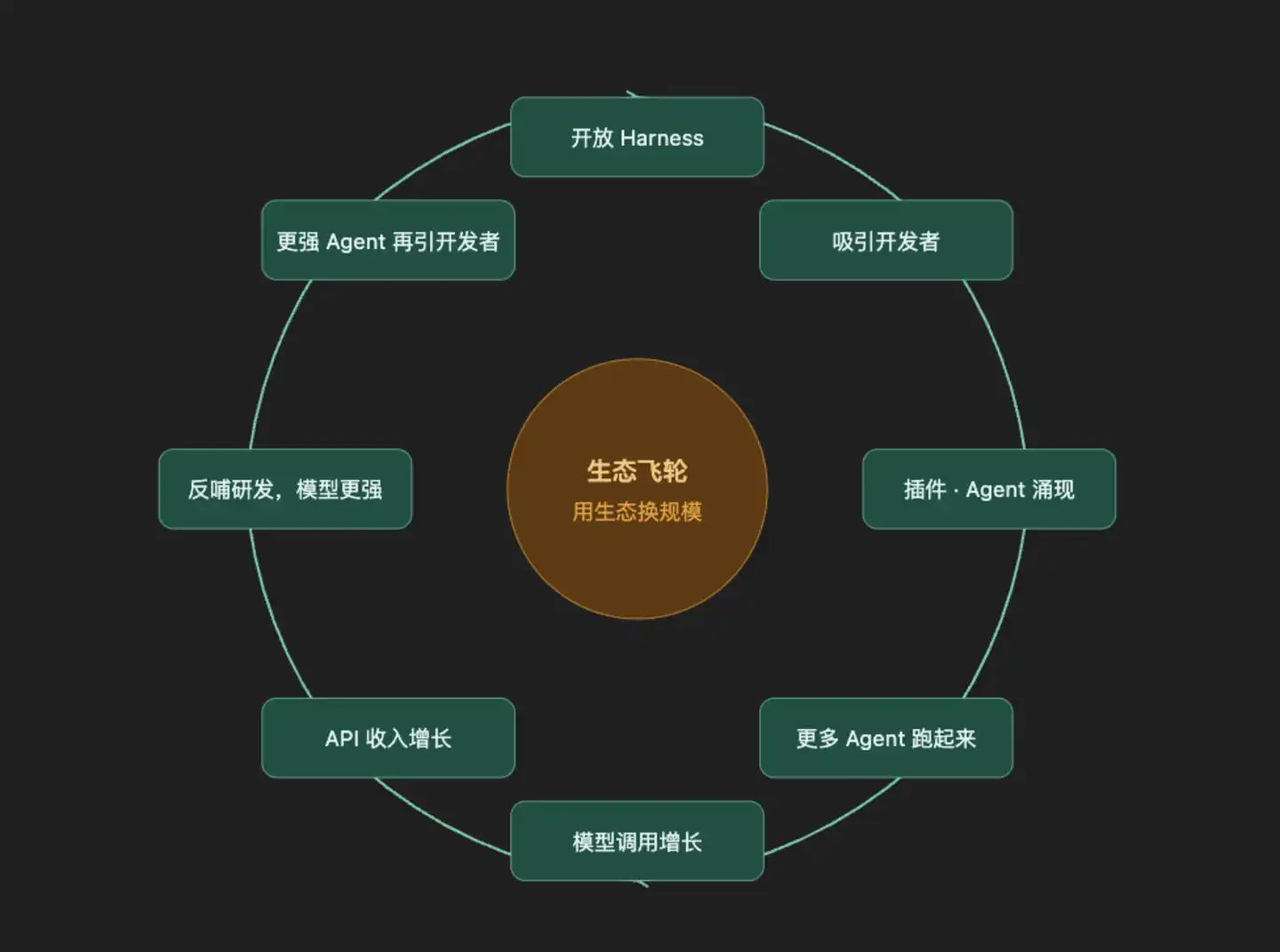
The biggest difference between this model and the past is the changed position of the model; it moves from the endpoint to the engine.
In the past, DeepSeek relied on low prices to get more people to use the model. Now, it's beginning to try to have the entire Agent ecosystem continuously consume the model.
This is also why Harness doesn't need to forcefully lock users into DeepSeek's model.
What it truly wants is for all Agents to run on the runtime it defines; as for which model is used at the bottom, it's less concerned.
As long as the runtime becomes an ecosystem, model calls will naturally occur.
Behind the price increase, the reason lies here. It no longer needs to forever play the role of price slasher; the model is starting to become a machine that can continuously generate cash flow.
VI. Being Unfriendly Might Precisely Be Its Answer
Frankly, when I opened DeepSeek Harness, I didn't know how to use it.
The UI is very engineer-like, the documentation is full of terminology. An ordinary user opening it for the first time would most likely ask: Who exactly is this for?
The issue might be right there. It probably didn't target ordinary users as its first batch of users at all.
But looking at it now, I actually think it's not that important.
The earliest need of a platform is its first batch of builders; consumers come later. Windows, Linux, Android — which one started by relying on developers?
So, judging whether Harness is successful shouldn't even start by looking at downloads.
Look at plugins, look at Agents, look at who is building things on it.
If people start making various Agents around it, even someone uses Harness to build their own Harness, that's when the platform truly begins to grow.
Today, we view an Agent as a product.
If one day, Agents could also be continuously built, modified, combined, and even built upon by Agents themselves?
Then the Agent we understand today might just be its earliest form.
A word from [Beyond the Layout]:
A company's ambition is sometimes hidden in what it releases, sometimes in what it doesn't do for you.
DeepSeek Harness did not make Agent into a finished product.
It placed something unfinished into the hands of developers.
But for a company wanting to be infrastructure, being unfinished sometimes precisely means there's still enough space.
This space, DeepSeek has placed it in the hands of developers and users.