Circle has extended its agreement with Coinbase for USDC and ruled out the possibility of dividend payments

cryptonews.ru2026-08-08 tarihinde yayınlandı2026-08-08 tarihinde güncellendi

Özet

Circle has renewed its partnership with Coinbase for USDC and ruled out paying dividends to shareholders, reaffirming its focus on growth over shareholder returns. The stablecoin issuer announced the extension of its unchanged agreement with Coinbase during its Q2 earnings call. The deal ensures USDC remains deeply integrated across all Coinbase products. CEO Jeremy Allaire highlighted that beyond Coinbase, Circle has over 150 distribution partnerships with economic incentives to promote USDC adoption. On financial returns, CFO Jeremy Fox-Geen stated clearly that the company has no plans to initiate quarterly dividend payments. Instead, Circle prioritizes maintaining a strong balance sheet to invest through market cycles and pursue strategic opportunities. The leadership believes shareholders will gain greater value from the platform's long-term growth potential than from near-term capital returns. This dual strategy underscores Circle's commitment to expanding USDC's reach and utility. The company reported Q2 total revenue and reserve interest income of $701 million, up 7% year-over-year, with USDC circulation at $73.3 billion.

Circle Internet Group is retaining two key components of its capital management strategy: its partnership with Coinbase and a preference to reinvest cash rather than return it to shareholders.

The stablecoin issuer, listed on the New York Stock Exchange (NYSE), reported during its second-quarter earnings call that its agreement with Coinbase has been extended with existing terms unchanged. This agreement ensures deep integration of $USDC across all Coinbase products.

"Our agreement with Coinbase has been extended on its existing terms, ensuring that $USDC remains a central component of all Coinbase products," said Circle CEO Jeremy Allaire.

Circle did not disclose the detailed financial terms of the extended agreement.

Coinbase maintains key role as $USDC distribution expands

Coinbase plays a central role in the development and distribution of $USDC. However, Circle is also looking beyond its closest partner as competition in the dollar-backed stablecoin segment intensifies.

Allaire stated that Circle will continue to pursue "distribution agreements with strategically aligned partners." The company currently has over 150 distribution agreements that provide partners with economic incentives to adopt and promote $USDC.

Circle and Coinbase can also further develop this relationship together. CFO Jeremy Fox-Geen noted that both companies have opportunities to form new partnerships in instances where they believe the other company can significantly boost $USDC adoption.

The extension of the agreement comes amid continued expansion of Circle's core stablecoin business. The company reported aggregate revenue and interest income of $701 million for the second quarter, a 7% increase from the previous year. The circulating supply of $USDC at quarter-end was $73.3 billion.

Circle prioritizes growth over shareholder payouts

Investors expecting regular cash payouts will have to wait. When asked if Circle plans to introduce quarterly dividends, Fox-Geen gave a clear answer: "The short answer is no, we do not."

Instead, Circle aims to maintain a strong balance sheet capable of supporting investment across various market cycles and giving the company flexibility to pursue strategic opportunities.

"We believe the return that our shareholders can achieve by investing in the platform significantly exceeds the return from paying quarterly dividends," said Fox-Geen.

He characterized Circle as a "stock with massive growth potential in a market of the future," not as a company focused on returning capital today.

Both decisions point in one direction. Circle favors distribution and expansion over short-term shareholder payouts, betting that expanding the reach of $USDC will create more value than extracting cash from the business.

end-content
İlgili Sorular

QWhat are the two main components of Circle's capital management strategy as mentioned in the article?

ACircle's capital management strategy maintains two main components: its partnership with Coinbase and its preference to reinvest cash rather than return it to shareholders.

QWhat is the significance of the renewed agreement between Circle and Coinbase for USDC?

AThe renewed agreement between Circle and Coinbase, on the same terms, ensures that USDC remains a central element in all of Coinbase's products, securing deep integration.

QAccording to CFO Jeremy Fox-Ginn, why is Circle not planning to introduce quarterly dividends?

ACircle's CFO stated that the company believes the return shareholders can get from investing in the platform far exceeds the return from paying quarterly dividends. They view Circle as a high-growth stock, not a capital return-focused company, and prioritize a strong balance sheet for investment flexibility.

QHow does Circle plan to expand the distribution of USDC beyond Coinbase?

ACircle plans to continue making distribution agreements with strategic partners. It currently has over 150 such agreements which provide economic incentives for partners to adopt and promote USDC.

QWhat were Circle's Q2 revenue and reserve income, and what was the total USDC circulation at the end of the quarter?

ACircle reported Q2 aggregate revenue and reserve income of $701 million, a 7% increase year-over-year. The total USDC in circulation at the end of the quarter was $73.3 billion.

İlgili Okumalar

Bitcoin's ECX Hard Fork to Introduce Three New Versions Throughout October

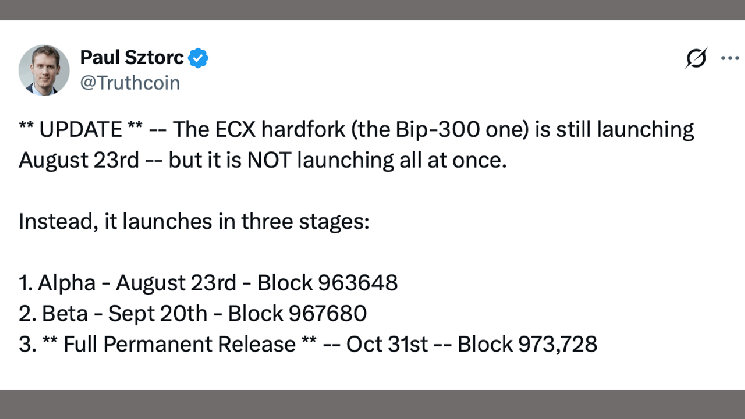
Bitcoin developer Paul Stortz, behind the Drivechain and BIP 300 proposals, has announced a hardfork for a new blockchain called ECX. Scheduled for October 31st (the 18th anniversary of the Bitcoin whitepaper), ECX will copy Bitcoin's full transaction history at a specific block height, crediting nearly all Bitcoin holders with an equal amount of ECX coins without altering the Bitcoin network itself. The launch will be executed in three phases. An "alpha" version is set for August 23rd (block 963,648), followed by a "beta" version on September 20th (block 967,680). The final mainnet launch is planned for October 31st (block 973,728). Coins accumulated during the alpha and beta phases can later be burned or swapped for real ECX. Stortz cites several reasons for the phased rollout: to address potential software bugs (including those possibly found by AI), allow an early market price to form for ECX before mining difficulty stabilizes, and let traders test and speculate. He described it as a "safety net" to manage any major issues and to demonstrate the chain's functionality. A key detail is that replay protection—a mechanism to prevent a transaction from being valid on both the Bitcoin and ECX chains—will remain optional, not automatic. The official ECX wallet software will apply this protection and warn users; Stortz warned that transactions ignoring this warning will be replayed on ECX, effectively tracking a user's spent bitcoins to their new owner unless a deliberate split is made. Stortz has given holders and exchanges 12 weeks from the alpha launch to prepare, during which they must decide on practical matters like running the wallet software to split their BTC and ECX holdings and how exchanges will credit the new asset to clients. The announcement comes as Bitcoin also faces another potential fork related to BIP-110.

cryptonews.ru2 saat önce

Bitcoin's ECX Hard Fork to Introduce Three New Versions Throughout October

cryptonews.ru2 saat önce

İşlemler

Spot
活动图片