Tether To Terminate Offshore Yuan (CNH₮) Operations – Here’s Why

bitcoinist2026-02-22 tarihinde yayınlandı2026-02-22 tarihinde güncellendi

Özet

Tether has announced it will discontinue its offshore Chinese Yuan stablecoin (CNH₮) due to a lack of market demand and operational inefficiency. Effective immediately, new issuance of CNH₮ has been halted. Existing users have one year to redeem their tokens before the stablecoin is permanently phased out. The company stated it will reallocate resources to products with stronger adoption, such as its flagship USDT, which has a market cap of $183.7 billion. In related news, a survey highlighted Nigeria and South Africa as leading markets for stablecoin adoption, with 80% of respondents in these countries holding stablecoins.

Stablecoin operator Tether has announced its decision to discontinue support for its offshore Chinese Yuan token CNH₮. The USDT operator has attributed this development to a lack of market demand, among other points.

Tether To Terminate CNH₮ Redemption In One Year

In a recent blog post, Tether shared a strategic update on its CNH₮, communicating a management decision to withdraw the stablecoin product from its offerings. This decision is based on multiple factors centered around demand and operational efficiency.

A statement from the announcement read:

Community interest and adoption are central to every product decision we make. When evaluating whether to maintain or introduce a Tether token, we assess market demand, operational sustainability, and broader ecosystem conditions that influence long-term usability. Our priority is to allocate resources where they can most effectively enhance security, reliability, and innovation across the digital asset landscape.

Tether explains that the CNH₮ recorded low interest, adoption, and community demand compared to their products, thereby failing to produce an acceptable return on technical and operational efforts.

As of this moment, all new issuance of CNH₮ has been halted. Meanwhile, CNH₮ users will have the next year to process any redemptions before the stablecoin is permanently phased out. The stablecoin operator will issue another reminder ahead of the redemption deadline. Following this development, Tether reiterates its commitment to stablecoin global growth and adoption.

The statement read:

Tether will continue to focus its efforts on stablecoins and infrastructure that demonstrate strong, organic adoption and long-term relevance. This includes advancing core stablecoin liquidity, expanding tokenization infrastructure, and supporting new financial tools that better serve global users and builders.

Tether remains the operator of the world’s largest stablecoin, USDT, which presently boasts a total market cap of $183.7 billion. In January, the stablecoin company launched USAT, designed specifically for American users.

Nigeria Leads Demand For Stablecoins

In other news, a recent survey by BVNK has revealed that Africa’s largest economies are leading the demand for stablecoins. This survey, done in collaboration with Coinbase, YouGov, and Artemis, involved 4658 adults across 15 countries. The results revealed that 80% of Nigerian and South African respondents presently hold stablecoin, while 75% aim to increase holdings as citizens seek a haven from their local fragile currencies.

At press time, the total stablecoin market cap is valued at $310 billion, with high expectations of future market expansion following the approval of the GENIUS Act last July.
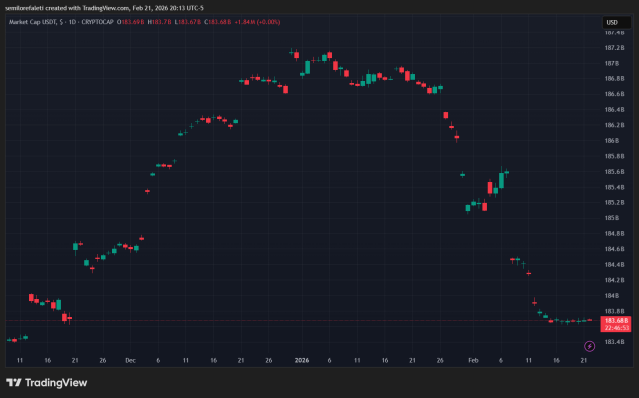
USDT market cap valued at $183.68 billion on the daily chart | Source: USDT chart on Tradingview.com

İlgili Sorular

QWhy is Tether discontinuing its offshore Chinese Yuan token (CNH₮)?

ATether is discontinuing CNH₮ due to a lack of market demand, low community interest and adoption, and the failure to produce an acceptable return on the technical and operational efforts required to maintain it.

QWhat is the timeline for users to redeem their CNH₮ tokens?

ACNH₮ users have one year to process any redemptions before the stablecoin is permanently phased out. Tether will issue another reminder ahead of the redemption deadline.

QWhat is the current market capitalization of Tether's USDT stablecoin?

ATether's USDT stablecoin currently has a total market capitalization of $183.7 billion.

QAccording to the article, which country is leading the demand for stablecoins?

AAccording to a survey by BVNK, Nigeria is leading the demand for stablecoins, with 80% of Nigerian respondents holding stablecoins.

QWhat will Tether focus on following the discontinuation of CNH₮?

ATether will continue to focus on stablecoins and infrastructure that demonstrate strong, organic adoption and long-term relevance, including advancing core stablecoin liquidity, expanding tokenization infrastructure, and supporting new financial tools.

İlgili Okumalar

Written at the UAE-Oman Border: Survival Insights for Crypto Natives After Crossing Through the Fire

Authored by brother bing, co-founder of MegaETH, this article reflects on the relationship between technology and civilization after the author witnessed missile attacks and defense systems at the UAE-Oman border. The author argues that technology acts as an amplifier of a civilization’s inherent trajectory—enhancing productivity and coordination in healthy cycles, while fueling addiction and conflict in periods of decline. Applying this lens to crypto, the author observes that the industry has drifted from its original cypherpunk ideals. Crypto was meant to be a parallel system offering borderless finance, low coordination costs, and individual sovereignty. However, the pursuit of legitimacy and integration with traditional finance (TradFi) has diluted its transformative potential. Many early, structurally meaningful use cases—such as unsecured microloans and cross-border savings—have been sidelined in favor of financialization and speculative gains. The article calls for a return to crypto’s original mission: building infrastructure that enables genuine sovereignty rather than serving as middleware for legacy systems. It urges the community to resist short-term incentives, prioritize meaningful development, and realign with the values of openness, criticism, and independence. The author concludes by emphasizing the importance of individual agency and the courage to build alternative systems despite prevailing uncertainties.

marsbit23 dk önce

Written at the UAE-Oman Border: Survival Insights for Crypto Natives After Crossing Through the Fire

marsbit23 dk önce

İşlemler

Spot
Futures
活动图片