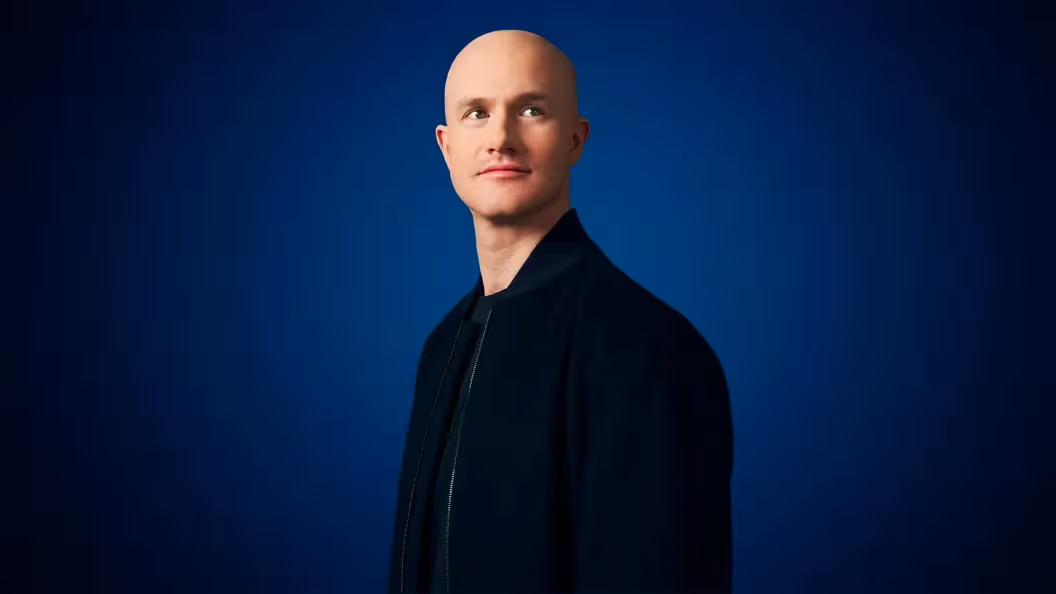
Coinbase Founder Is Now Researching Immortality

Odaily星球日报2026-06-03 tarihinde yayınlandı2026-06-03 tarihinde güncellendi

Özet

Coinbase Founder Invests in the "Fountain of Youth": NewLimit's $435M Funding to Reverse Aging Brian Armstrong, co-founder and CEO of Coinbase, is now targeting a new frontier: human longevity. His biotech startup, NewLimit, has just raised $435 million in a Series C round led by Peter Thiel’s Founders Fund, valuing the company at $3.1 billion. The funding will advance its mission to develop therapies that slow or even reverse cellular aging, with its first drug targeting alcohol-related liver disease set to enter clinical trials next year. Founded in 2021 by Armstrong, former GV partner Blake Byers, and stem cell biologist Jacob Kimmel, NewLimit builds on Nobel Prize-winning research by Shinya Yamanaka, who discovered that adult cells can be reprogrammed to a younger state. NewLimit’s approach focuses on identifying specific gene combinations to reset the "epigenetic age" of cells, aiming first to treat diseases viewed as accelerated aging before broadening its applications. The company joins a growing field of longevity startups backed by tech billionaires, including Sam Altman’s investment in Retro Biosciences and Jeff Bezos’s support for Altos Labs. For these ultra-wealthy backers, conquering aging represents the ultimate investment—extending the one resource even immense wealth cannot buy: time.

Original | Odaily Planet Daily (@OdailyChina)

Author | Azuma (@azuma_eth)
At 3 AM Beijing time on June 3, longevity tech startup NewLimit announced the completion of a $435 million Series C funding round. This round was led by Founders Fund, the fund under Peter Thiel, with continued participation from Abstract Ventures, Kleiner Perkins, NFDG, Eli Lilly Ventures, Valor Equity Partners, among others. New investors including Thrive Capital, Greenoaks, and Quiet Capital also joined this round.

WSJ reported that NewLimit's valuation in this round reached $3.1 billion, more than tripling its valuation from a year ago.
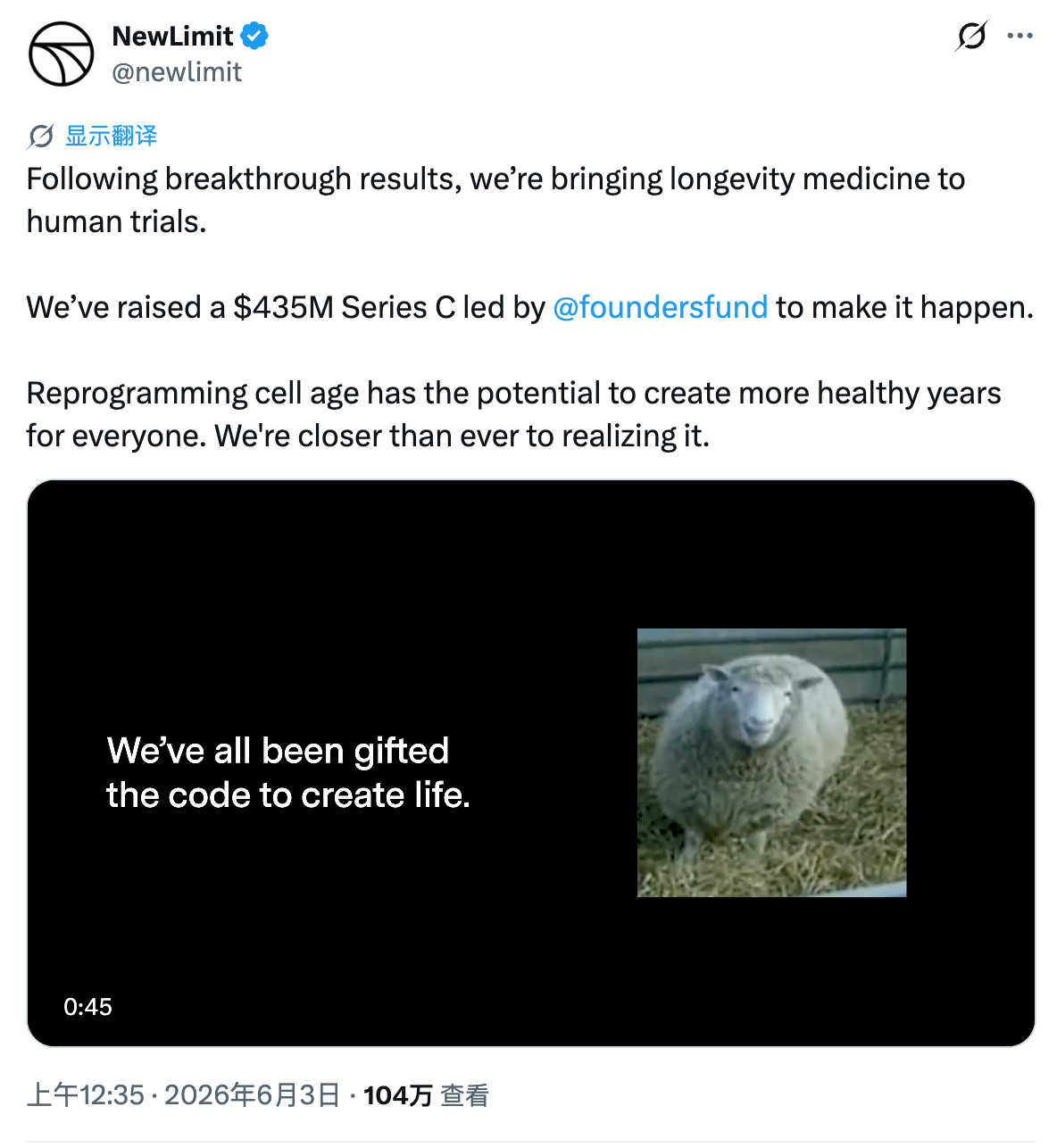
In the funding announcement, NewLimit revealed that following breakthrough research achievements, the company is advancing longevity medicine to the stage of human clinical trials. Its first drug targeting alcohol-associated liver disease is expected to commence clinical trials next year.

NewLimit further emphasized: "By reprogramming cell age, humans have the potential to achieve longer healthspans. Now, humanity is closer than ever to the goal of 'slowing down or even reversing aging.'"

The Founder is an Old Acquaintance

It's worth noting that NewLimit's co-founder is none other than a familiar name – Brian Armstrong, the founder and CEO of Coinbase.

In 2021, Brian Armstrong, alongside former GV partner and bioengineer Blake Byers, and stem cell biologist Jacob Kimmel, jointly invested $110 million to establish NewLimit in the southern part of San Francisco.
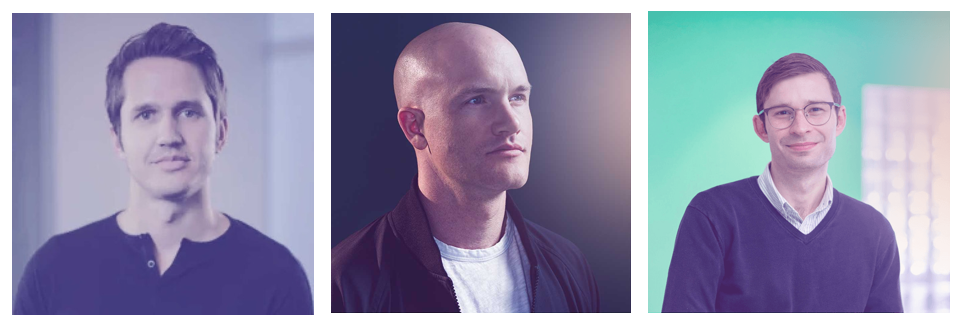
Photo: NewLimit founding team

Prior to this Series C round, NewLimit had completed three rounds of funding, detailed as follows.

  • Completed a $40 million Series A round in May 2023, with investors including Dimension, Founders Fund, and Kleiner Perkins;
  • Completed a $130 million Series B round in May 2025, valuing the company at $810 million, led by Kleiner Perkins with participation from Founders Fund, Khosla Ventures, and Human Capital, among others;
  • Secured an additional $45 million in funding in October 2025, bringing the post-money valuation to $1.62 billion, with investors including Lilly Ventures, Duke University, Section 32, etc.;

According to NewLimit's official introduction, the company is committed to developing drugs that extend people's healthspan – "As we age, our cells' functions gradually decline, making us more susceptible to disease. It was once thought that aging was inevitable, but emerging science suggests the aging process can be reversed at the cellular level. We are developing the first drugs based on these discoveries to restore youthful function to aged cells."

In simpler terms, NewLimit is researching immortality using scientific methods!

Reversing Aging is Not a Fantasy

Over the past few decades, the scientific community has long recognized the connection between aging and cellular functional decline but couldn't find precise methods to make cells 'rejuvenate'. The turning point came in 2006 when Japanese scientist Shinya Yamanaka discovered that activating just a few specific transcription factors could reprogram adult cells into a younger state similar to embryonic stem cells. This discovery was later named "Yamanaka Factors" and earned him the 2012 Nobel Prize in Physiology or Medicine.

Odaily Note: Photo of Shinya Yamanaka speaking in Tokyo

Yamanaka's research first proved something previously thought impossible – that cellular age is not irreversible. The story NewLimit is telling is built precisely upon this discovery.

NewLimit writes on its website: "Our drugs work by reprogramming a cell's epigenome to a more youthful state by activating specific transcription factor genes. We already know this reversal is possible. But for different types of cells, exactly which combination of transcription factors is needed to restore their youthful function remains unknown. The core challenge of our work is finding and discovering these effective gene payloads."

NewLimit's strategy is to first target a specific disease to secure drug approval, then explore broader applications. As mentioned earlier, NewLimit is advancing a drug for alcohol-associated liver disease into clinical trials.

Jacob Kimmel, co-founder and CEO of NewLimit, further explained this: Liver disease can essentially be viewed as a form of 'accelerated aging,' where the aging process everyone experiences manifests faster and more severely.

The Biggest Investors in This Sector Are All Billionaires

NewLimit is not the only tech company currently targeting "immortality."

In 2022, Sam Altman invested $180 million in Retro Biosciences, which is developing drugs to rejuvenate aging cells and revealed last month its valuation had reached $1.8 billion.

Additionally, Altos Labs, reportedly backed by Jeff Bezos's funding, launched in 2022 with $3 billion and has since raised nearly twice that amount cumulatively.

It's not hard to see that from Peter Thiel to Sam Altman, to Jeff Bezos, the biggest investors in this sector are invariably super-wealthy individuals at the pinnacle of the tech and wealth pyramid. Peter Thiel has publicly expressed extreme aversion to death, stating views like: "Death is humanity's greatest enemy, yet we treat it as a natural law..."

The logic behind these tech tycoons' willingness to invest hundreds of millions of dollars isn't hard to understand – when wealth and power reach their peak, time becomes the only enemy, the one luxury that cannot be directly purchased with money.

Having made enough money, "how to live longer" becomes the ultimate quest.

İlgili Sorular

QWho is the founder of NewLimit, and what other company is he known for?

AThe founder of NewLimit is Brian Armstrong, who is also the founder and CEO of Coinbase.

QWhat is the key scientific breakthrough that NewLimit's research is built upon?

ANewLimit's research is built upon the discovery of the 'Yamanaka Factors' by Shinya Yamanaka, which demonstrated that adult cells can be reprogrammed to a younger, embryonic-like state.

QWhat is NewLimit's primary approach to developing its age-reversing drugs?

ANewLimit's primary approach is to discover the specific combinations of transcription factor genes that can reprogram the epigenome of different cell types to a younger state, aiming to restore their youthful function.

QWhat is the significance of liver disease in NewLimit's current clinical trial plans?

AAccording to NewLimit's co-founder Jacob Kimmel, liver disease can be seen as an 'accelerated version of aging,' making it a strategic starting point to develop and test drugs before exploring broader anti-aging applications.

QWhich other prominent tech billionaires are investing in similar longevity research companies?

AOther prominent tech billionaires investing in similar longevity research include Peter Thiel (investing in NewLimit), Sam Altman (investing in Retro Biosciences), and Jeff Bezos (investing in Altos Labs).

İlgili Okumalar

ETH Bull and Bear Views Compilation: Can Ethereum's Value Flow Back to ETH?

Titled "ETH Bull and Bear Views: Can Ethereum's Value Flow Back to ETH?", this article synthesizes the current heated debate around Ethereum's native token, ETH, following Bankless co-founder David Hoffman's decision to sell his entire ETH holdings. The **bullish case**, represented by figures like Tom Lee (BitMine CEO) and Raoul Pal, argues that ETH's core thesis remains intact. They contend Ethereum is the essential, secure, and neutral foundational layer for future finance—encompassing stablecoins, RWA, DeFi, L2s, and Agentic AI. Bulls bet on ETH's long-term revaluation as institutional adoption of on-chain finance grows, with significant buying activity from entities like BitMine and Consensys cited as evidence. Conversely, the **bearish perspective**, led by Hoffman and analysts like Markus Thielen, questions ETH's value capture mechanism. They acknowledge Ethereum's network success but argue that the value created by L2s, DeFi, and applications does not sufficiently accrue to the ETH token itself. Bears point to ETH's prolonged underperformance versus the broader crypto market, lack of traditional cash flows, weakening "ultrasound money" narrative, and apparent institutional retreat (e.g., Harvard Management Company exiting its ETH ETF position) as key concerns. The debate highlights a pivotal shift: ETH is no longer just a community belief asset. The central question is whether ETH can transition from being a "**used infrastructure**" to a "**continuously bought and held core asset**" as more value enters the Ethereum ecosystem. The market is now critically examining the direct link between network growth and ETH's value.

marsbit32 dk önce

ETH Bull and Bear Views Compilation: Can Ethereum's Value Flow Back to ETH?

marsbit32 dk önce

Crypto is dead, Perps are forever

The crypto industry is shifting from a focus on creating native assets (like altcoins and protocol tokens) to becoming a "global asset pipeline." Native cryptocurrencies, except for Bitcoin, are seen as failing in their value storage and utility promises, with demand driven largely by speculation. Attention and liquidity are now moving toward real-world assets (RWAs) like U.S. stocks, bonds, gold, and oil traded on-chain via perpetual contracts (Perps). Stablecoins like USDT and USDC set the precedent, proving blockchain's core strength is efficient global settlement and transfer, not inventing new monetary systems. Meanwhile, assets like Ethereum and many DeFi tokens struggle as their narratives weaken against tangible traditional assets and the rapid real-world progress of AI. Perpetual contracts have emerged as a pivotal innovation. They simplify trading by offering pure price exposure to any asset, bypassing complexities of ownership, custody, and traditional market hours. Projects like Hyperliquid gained traction by combining CEX-like efficiency with on-chain transparency, capitalizing on post-FTX distrust, macroeconomic volatility, and the surge in demand for 24/7 stock trading. In conclusion, while the era of speculative native "crypto assets" may be over, perpetual contracts persist as the industry's most potent financial instrument—transforming all assets into globally accessible, constantly tradable instruments centered on price speculation.

marsbit38 dk önce

Crypto is dead, Perps are forever

marsbit38 dk önce

Tencent, Alibaba, ByteDance in a Battle for the Skill Store

Skill is becoming a key concept in the AI field, essentially serving as a structured "instruction manual" for AI Agents that specifies tool calls, decision logic, and output standards. This allows Agents to execute predefined tasks. As the number of Skills grows, distribution platforms have emerged. Major tech companies are swiftly entering this space. In March, Tencent, Alibaba, and ByteDance launched Skill stores within their respective Agent platforms. Subsequently, players like Zhipu AI, Meituan, and Xiaohongshu joined the fray. This competition for the "Skill store" is fundamentally a battle for the AI-era user entry point; whoever controls distribution controls the users. While ByteDance's Coze has experimented with paid Skills, most platforms offer them for free. The real value lies not in the stores themselves but in using them to attract and retain users within an ecosystem, driving revenue from services like cloud computing, model calls, or advertising. The landscape features three main player types: 1) **Internet giants** (e.g., Alibaba, ByteDance, Tencent, Meituan), leveraging Skills to drive traffic and monetize through their broader ecosystems (cloud services, transactions, ads). 2) **Large model companies** (e.g., Zhipu AI, Moonshot AI), using Skill stores to increase user engagement and monetize model API calls. 3) **Content platforms** (e.g., Xiaohongshu), treating Skills as a new content format to generate traffic and ad revenue. However, transforming Skill stores into a sustainable business faces significant hurdles. Key challenges include: the **difficulty in pricing Skills** due to inconsistent outputs across different models and contexts; **lack of cost transparency** (varying token consumption); **security risks** like Skill poisoning; and the **absence of standardized protocols** for development and evaluation. Unlike standardized mobile apps, Skills are often personalized workflows resistant to uniformity, which hinders the establishment of a reliable review and monetization system akin to the App Store. While there is genuine user demand for paid Skills—particularly in enterprise (e.g., contract review) and certain personal productivity scenarios—current platforms offer developers limited and unpredictable distribution. The future of Skill stores depends on overcoming these standardization, evaluation, and safety challenges to make acquiring a Skill as straightforward as downloading an app. For now, the stores function more as display shelves than robust marketplaces.

marsbit38 dk önce

Tencent, Alibaba, ByteDance in a Battle for the Skill Store

marsbit38 dk önce

The Crypto Scene Is Dead, Perpetual Swaps Are Eternal

The crypto industry is undergoing a fundamental shift. The era defined by minting novel, native digital assets (altcoins) is fading. These assets, lacking real-world cash flows or clear value, are losing relevance as attention and capital flow elsewhere. Two powerful external forces are reshaping the space. First, traditional assets like U.S. stocks, bonds, gold, and oil are being tokenized and traded on-chain. Second, the explosive growth of AI, with its tangible products, has overshadowed crypto's once-dominant "future narrative." This marks a critical pivot: crypto is transitioning from being a "factory for new assets" to becoming a "global conduit for existing assets." Its validated utility is not complex financial reinvention but efficient global settlement, transfer, and trading—the original promise of blockchain. Stablecoins like USDT and USDC exemplify this, offering faster dollar movement rather than replacing it. Consequently, native ecosystems like Ethereum face profound challenges. While still crucial infrastructure, ETH struggles to capture value as users interact with Layer 2s or trade traditional assets without needing to hold it. DeFi's grand narrative of rebuilding finance has narrowed to core needs like cheap transfers and deep liquidity. The true breakout innovation is the perpetual contract (Perp). It brilliantly bypasses the complexities of direct asset ownership (custody, compliance, dividends) by creating pure price exposure. Users can speculate on the price movement of *any* asset—NVIDIA, gold, oil—24/7, globally, and with leverage. This "price casino" model, while risky and ethically fraught, delivers unmatched liquidity and accessibility. Projects like Hyperliquid succeeded not by inventing new mechanics but by perfecting the timing and execution of this model. Key drivers included making on-chain Perps feel like centralized exchanges, post-FTX trust migration towards transparency, and rising demand to trade macro assets and equities round-the-clock. In conclusion, the crypto world's most enduring successes are the dollar (via stablecoins), Bitcoin, and trading. Its new frontier is not creating alternative assets but providing a seamless, perpetual trading layer—a new API—for the world's existing financial system. The age of native altcoins is over; the age of perpetual synthetic exposure has begun.

Odaily星球日报47 dk önce

The Crypto Scene Is Dead, Perpetual Swaps Are Eternal

Odaily星球日报47 dk önce

İşlemler

Spot
Futures
活动图片