Grayscale: The Three Evolutionary Stages of Stock Tokenization and a Rundown of Core Beneficiary Public Blockchains

链捕手2026-07-14 tarihinde yayınlandı2026-07-14 tarihinde güncellendi

Özet

Grayscale research outlines three evolutionary phases for the tokenization of equities, each benefiting different blockchain infrastructures. The first phase is the third-party "wrapper model," where a Special Purpose Vehicle (SPV) holds the underlying stock and tokenized shares represent claims on that entity. This model, accounting for over 70% of the current tokenized stock market cap, allows for DeFi integration and is prevalent on public blockchains like Ethereum, Solana, and BNB Chain. The second phase is the "entitlement model," exemplified by an upcoming pilot from the Depository Trust & Clearing Corporation (DTCC) on the Canton Network. This approach involves placing existing, regulated securities onto a blockchain for transfer within the post-trade infrastructure, without creating a new security. The third and most transformative phase is issuer-led native issuance, where companies directly issue securities on-chain. While offering the greatest long-term potential, this model requires further regulatory clarity and is seen as favoring open-architecture blockchains like Ethereum and Solana, as well as hybrid networks like Avalanche. The report concludes that all three models will likely coexist. The blockchains poised to benefit most from tokenization growth are identified as Ethereum, Solana, BNB Chain, Avalanche, and Canton Network.

Author|Zach Pandl, Head of Research at Grayscale

Translation| WuBlockchain

The global tokenization of stock markets is advancing. Tokenized stocks promise various benefits for users, including 24/7 trading. The next significant development will be the launch of a tokenization pilot by DTCC [1] on the Canton Network [2]. This pilot will enable tokenized stocks and other assets to flow within the regulated financial system via blockchain infrastructure.

We believe the tokenization of equity markets will progress through three stages, each generating value for different types of blockchain infrastructure (see Chart 1).

The first stage is the third-party "wrapper" model [3]. In this model, the issuer holds the underlying stocks through a Special Purpose Vehicle (SPV) [4], and the tokenized stock represents a claim on that SPV. Currently, this model accounts for over 70% of tokenized stocks by market value. Wrapped tokenized stocks do not represent direct ownership of the underlying shares but can be used in DeFi and may be attractive to retail investors. These assets currently trade on networks such as Ethereum, Solana, and BNB Chain.

The second stage is the "entitlement" model [5], exemplified by DTCC's pilot. Instead of creating new versions of securities, DTCC will put existing eligible securities on-chain via its regulated post-trade infrastructure, with the Canton Network serving as the first blockchain network for this pilot.

The third stage is the issuer-led model, where companies issue securities natively on-chain. Last week, Securitize [6] became the first public company to tokenize its common stock upon listing on the New York Stock Exchange. We believe this model holds the greatest long-term potential, although it requires further regulatory clarity. In our view, the issuer-led model will favor open-architecture blockchains like Ethereum and Solana, as well as hybrid networks like Avalanche.

These three tokenization models are likely to coexist for many years.

Key takeaway: Multiple models exist for tokenized stocks. We believe blockchain networks most likely to benefit from tokenization growth include Ethereum, Solana, BNB Chain, Avalanche, and Canton Network.
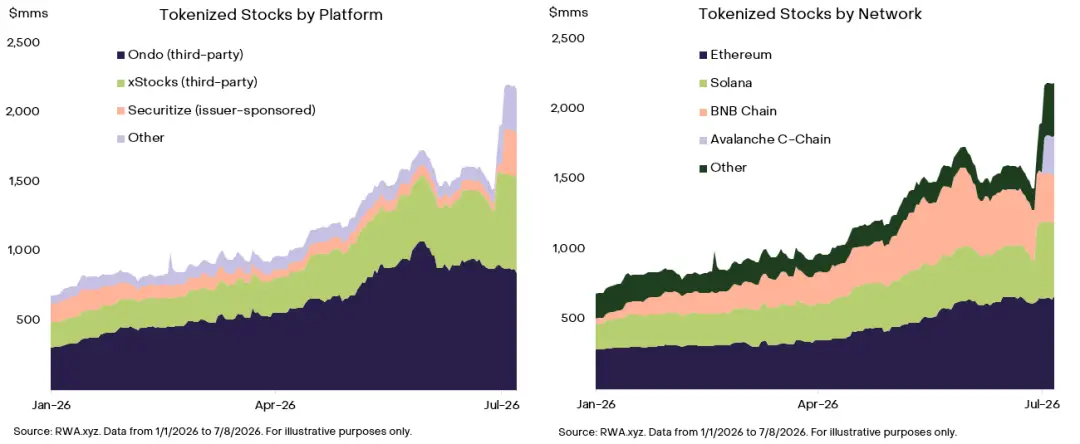
Chart 1: Third-party platforms currently dominate the tokenized stock market, while Ethereum, Solana, and BNB Chain host the majority of on-chain assets.

Notes:

[1] DTCC: The Depository Trust & Clearing Corporation, a core part of the U.S. post-trade securities infrastructure, responsible for clearing, settlement, and custody services for securities transactions.

[2] Canton Network: A blockchain network for institutional financial assets, emphasizing privacy, compliance, and interoperability among financial institutions.

[3] Wrapper model: An approach where a third-party platform holds the underlying stocks through an intermediary structure and issues on-chain tokens representing claims on that structure. Investors hold a claim on the structure, not necessarily direct ownership of the underlying shares.

[4] SPV: Special Purpose Vehicle. In tokenized stocks, it typically refers to an entity set up by the issuer to hold the underlying stock assets, with the tokens representing claims on that entity.

[5] Entitlement model: An approach that does not involve issuing a new security but rather records or maps existing eligible securities onto a blockchain through a regulated post-trade system, enabling them to flow on blockchain infrastructure.

[6] Securitize: A platform for digital securities and real-world asset tokenization. The article mentions its tokenization of its own common stock concurrent with its NYSE listing.

Trend Kriptolar

İlgili Sorular

QAccording to the Grayscale article, what are the three main evolutionary phases of stock tokenization?

AThe three phases are: Phase 1: The third-party 'wrapper' model, where tokens represent a claim on an SPV holding the underlying stocks. Phase 2: The 'entitlement' model, where existing, qualified securities are placed on-chain through regulated post-trade infrastructure (e.g., DTCC's pilot on Canton Network). Phase 3: The issuer-led model, where companies natively issue securities directly on the blockchain.

QWhich blockchain networks are highlighted in the article as the primary beneficiaries in the initial 'wrapper model' phase?

AIn the current 'wrapper model' phase, Ethereum, Solana, and BNB Chain are the primary networks where these tokenized stocks are being traded, accounting for the majority of on-chain assets in this category.

QWhat is the Canton Network, and what role does it play in the evolution of stock tokenization?

ACanton Network is a blockchain network designed for institutional financial assets, emphasizing privacy, compliance, and interoperability between financial institutions. It will serve as the initial blockchain network for the DTCC's tokenization pilot, which represents the Phase 2 'entitlement model' of moving existing securities onto a blockchain within the regulated financial system.

QWhat does the article identify as a key benefit of tokenized stocks?

AA key benefit mentioned is 24/7 trading availability. Tokenized stocks are expected to offer users the ability to trade around the clock.

QWhich company is cited as the first public firm to tokenize its own common stock on a U.S. exchange upon listing, representing the 'issuer-led model'?

ASecuritize is noted as the first public company to tokenize its own common stock upon listing on the New York Stock Exchange. This action is an example of the Phase 3 'issuer-led model' of stock tokenization.

İlgili Okumalar

How to Regulate Single-Stock Leveraged ETFs? On Thursday, the Entire Market Is Watching This Korean Government Meeting

The highest-level economic coordination body in South Korea, the "F4" comprising the Ministry of Economy and Finance, the Financial Services Commission, the Bank of Korea, and the Financial Supervisory Service, will hold an emergency meeting on Thursday to discuss regulatory measures for single-stock leveraged ETFs. These products, launched just six weeks ago, have been widely blamed for exacerbating market volatility. The KOSPI's 8% plunge on Monday triggered the year's seventh trading halt, intensifying scrutiny. Regulators have expressed rare public regret over approving the products. FSS Governor Lee Bok-hyun stated he "regretted not doing everything possible to prevent" their introduction and acknowledged structural problems, citing massive retail investments and legal complications from a rushed rollout. Possible countermeasures under discussion include raising margin requirements, imposing daily price limits, and adjusting leverage caps. However, officials admit these may be temporary fixes. Data confirms the amplified volatility. Since the ETFs' launch, days with KOSPI moves exceeding 3% have nearly doubled. Trading halts have reached record levels, surpassing the 2008 financial crisis peak. The products allow 2x leveraged bets on giants like Samsung Electronics and SK Hynix. Their daily rebalancing to match returns is seen as mechanically fueling market swings. The outcome of Thursday's F4 meeting is highly anticipated, with expectations leaning towards stricter controls on leverage, investor access, or other structural constraints to curb the products' market impact.

marsbit10 dk önce

How to Regulate Single-Stock Leveraged ETFs? On Thursday, the Entire Market Is Watching This Korean Government Meeting

marsbit10 dk önce

AI Overhauled Terence Tao's 30-Year-Old Website, Uncovering Two Bugs Hidden for Over Two Decades in the Process

AI Revamps Terence Tao's 30-Year-Old Website, Unearthing Two 20-Year-Old Bugs in His Code Terence Tao, a renowned mathematician, has enlisted an AI agent to overhaul his personal academic website, which was built in 1997 with a static HTML, manually-maintained "Web 1.0" architecture. In just one day, the agent migrated 560 papers and preprints, 374 travel logs, 68 courses, 19 books, and 29 old math applets to a new system on GitHub Pages. The new site is structured around YAML files as the "single source of truth," with static HTML pages automatically generated from this data—a fundamental shift from maintaining individual documents to managing a centralized database. During the migration, the AI uncovered inconsistencies, outdated entries, and broken links that had accumulated over nearly three decades of manual updates. It also successfully ported a set of small educational Java 1.0 applets to JavaScript. Notably, while reviewing this translation, Tao found only one new bug introduced by the AI. Conversely, the AI identified two subtle bugs in his original Java code that he was previously unaware of. Tao emphasizes the project highlights AI's potential for automating tedious "digital housekeeping"—routine tasks like data migration and website maintenance that are costly and error-prone when done manually. He also revived a 27-year-old stalled project: a special relativity visualizer or "Minkowskian Inkscape." With AI assistance, a working alpha version was built in two hours. While AI still requires human oversight for critical work, Tao argues that for such structured, non-core tasks, "AI + human review" can result in lower error rates and drastically lower correction costs compared to purely manual maintenance over decades.

marsbit10 dk önce

AI Overhauled Terence Tao's 30-Year-Old Website, Uncovering Two Bugs Hidden for Over Two Decades in the Process

marsbit10 dk önce

ZORA Plunges 95%, Coinbase Finally Admits Creator Coins Failed

On July 13th, Coinbase CEO Brian Armstrong publicly declared the failure of Base network's year-long "content coins" strategy. Initially launched in 2025 via the Zora platform and integrated into Coinbase's wallet as a core feature, the model aimed to turn every social media post into a tradeable token. Each post or creator account would generate 1 billion ERC-20 tokens, with creators receiving an initial allocation. The concept briefly propelled Base to become the largest L2 by new token issuance. However, the model proved unsustainable. These tokens, explicitly not granting ownership or revenue shares, primarily functioned as speculative assets dependent on new buyers. While activity surged in mid-2025—with millions of tokens minted and billions in trading volume—it failed to build lasting user engagement or value. High-profile token launches, including one by Base's official account, experienced extreme volatility, often crashing shortly after spikes. The supporting infrastructure token, ZORA, plummeted approximately 95% from its August 2025 peak, losing nearly $520 million in market capitalization. Armstrong acknowledged the misstep, stating "it didn't work" and that Base had shifted focus earlier in the year toward its core competencies of trading and stablecoin payments. This pivot follows internal criticism that the content coin experiment consumed excessive resources, harmed other Base projects, and ultimately resulted in significant financial losses for participating users.

Foresight News26 dk önce

ZORA Plunges 95%, Coinbase Finally Admits Creator Coins Failed

Foresight News26 dk önce

İşlemler

Spot

Popüler Makaleler

CORE Nasıl Satın Alınır

HTX.com’a hoş geldiniz! CORE (CORE) satın alma işlemlerini basit ve kullanışlı bir hâle getirdik. Adım adım açıkladığımız rehberimizi takip ederek kripto yolculuğunuza başlayın. 1. Adım: HTX Hesabınızı OluşturunHTX'te ücretsiz bir hesap açmak için e-posta adresinizi veya telefon numaranızı kullanın. Sorunsuzca kaydolun ve tüm özelliklerin kilidini açın. Hesabımı Aç2. Adım: Kripto Satın Al Bölümüne Gidin ve Ödeme Yönteminizi SeçinKredi/Banka Kartı: Visa veya Mastercard'ınızı kullanarak anında CORE (CORE) satın alın.Bakiye: Sorunsuz bir şekilde işlem yapmak için HTX hesap bakiyenizdeki fonları kullanın.Üçüncü Taraflar: Kullanımı kolaylaştırmak için Google Pay ve Apple Pay gibi popüler ödeme yöntemlerini ekledik.P2P: HTX'teki diğer kullanıcılarla doğrudan işlem yapın.Borsa Dışı (OTC): Yatırımcılar için kişiye özel hizmetler ve rekabetçi döviz kurları sunuyoruz.3. Adım: CORE (CORE) Varlıklarınızı SaklayınCORE (CORE) satın aldıktan sonra HTX hesabınızda saklayın. Alternatif olarak, blok zinciri transferi yoluyla başka bir yere gönderebilir veya diğer kripto para birimlerini takas etmek için kullanabilirsiniz.4. Adım: CORE (CORE) Varlıklarınızla İşlem YapınHTX'in spot piyasasında CORE (CORE) ile kolayca işlemler yapın.Hesabınıza erişin, işlem çiftinizi seçin, işlemlerinizi gerçekleştirin ve gerçek zamanlı olarak izleyin. Hem yeni başlayanlar hem de deneyimli yatırımcılar için kullanıcı dostu bir deneyim sunuyoruz.

316 Toplam GörüntülenmeYayınlanma 2024.12.13Güncellenme 2026.06.02

CORE Nasıl Satın Alınır

Tartışmalar

HTX Topluluğuna hoş geldiniz. Burada, en son platform gelişmeleri hakkında bilgi sahibi olabilir ve profesyonel piyasa görüşlerine erişebilirsiniz. Kullanıcıların CORE (CORE) fiyatı hakkındaki görüşleri aşağıda sunulmaktadır.

活动图片