Hackers use SpaceXAI, Starlink X accounts to pump SCATMAN: Token crashes 98%

ambcrypto2026-07-13 tarihinde yayınlandı2026-07-13 tarihinde güncellendi

Özet

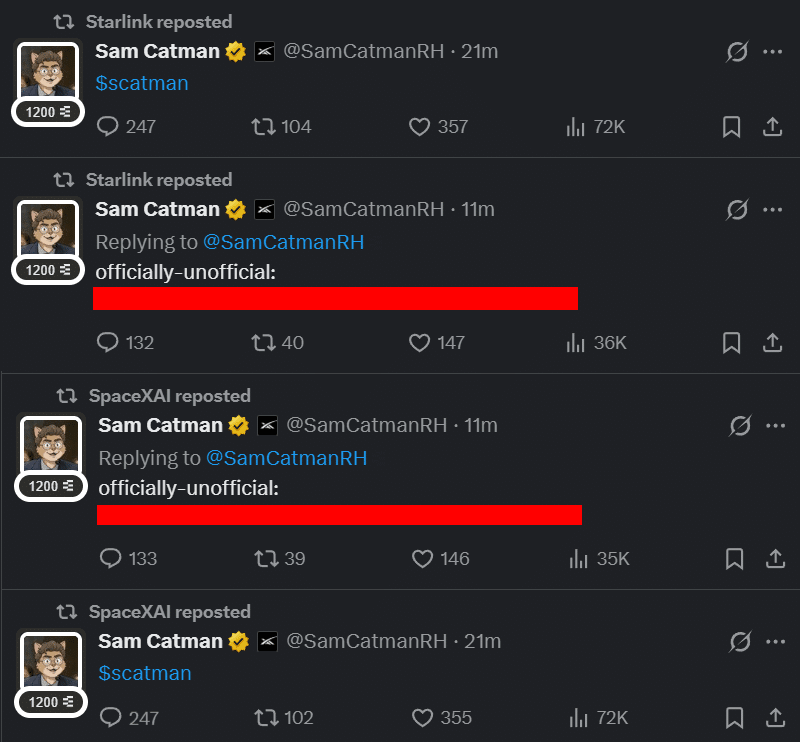
On July 13th, hackers compromised the verified X accounts of SpaceXAI and Starlink to fraudulently promote the SCATMAN memecoin. The tweets, one gaining over 72,000 views quickly, misled users into believing the token was legitimate, generating significant buying pressure. Prior to the campaign, the attacker had minted 10 trillion SCATMAN tokens. After the price briefly approached a $2 million market cap, the attacker dumped their holdings for 73.7 ETH (approximately $135,000), causing liquidity to vanish and the token's value to crash by 98%. This incident highlights how compromised high-profile accounts can exploit online trust to create exit liquidity for crypto scams.

Attackers are increasingly using trusted social media accounts to fraudulently sell tokens to users. This pattern resurfaced on the 13th of July, when hackers compromised verified SpaceXAI and Starlink X accounts to promote the SCATMAN memecoin.

These tweets garnered large amounts of attention, with one post receiving over 72k views in a matter of minutes.

Many people who viewed the tweets believed that the token had an increased level of legitimacy, thus creating additional buying pressure on the token.

Source: X

Meanwhile, the attacker had already minted 10 trillion SCATMAN before the campaign began. The wallets then dumped holdings for 73.7 ETH, worth roughly $135,000. The token briefly approached a $2 million market capitalization before liquidity disappeared, losing 98% of its value.

This incident again showed how compromised high-profile accounts can rapidly transform online trust into exit liquidity for coordinated crypto scams.

Liquidity failed to sustain the rally

İlgili Sorular

QWhat cryptocurrency was fraudulently promoted by hackers using compromised SpaceXAI and Starlink X accounts?

AThe SCATMAN memecoin was fraudulently promoted by the hackers.

QHow much value did the SCATMAN token lose after the scam?

AThe SCATMAN token lost 98% of its value after the scam.

QWhat did the attackers do before starting the promotion campaign on social media?

ABefore the campaign, the attacker had already minted 10 trillion SCATMAN tokens.

QHow much money did the attacker make by selling the tokens during the scam?

AThe attacker made 73.7 ETH, worth roughly $135,000, by selling the tokens.

QAccording to the article, what does this incident demonstrate about compromised high-profile accounts?

AThe incident shows how compromised high-profile accounts can rapidly transform online trust into exit liquidity for coordinated crypto scams.

İlgili Okumalar

Transformer's Ancestral Design Under Fire: Three Papers at COLM Conference Strike a Blow

This article discusses three studies presented at COLM 2026 that challenge fundamental, widely-adopted design choices in Transformer-based language models. The first paper, "Cracks in the Foundation," investigates standard components like QK normalization, GQA, and sliding window attention. Using a controlled set of 26 models (OlmPool), it finds that combinations of these "default" choices can severely degrade long-context performance by up to 47% on the HELMET benchmark. Notably, QK normalization, intended to stabilize training, was found to hurt performance in certain models, and "attention head concentration" (focus on initial tokens) correlated positively with better long-context capabilities. The second paper, "Lost in Backpropagation," analyzes the output projection layer. It reveals a major "gradient bottleneck": because the vocabulary size is much larger than the hidden state dimension, 95-99% of the gradient signal is lost during backpropagation, and the remaining signal is poorly aligned with the true gradient direction, potentially hindering training efficiency. The third paper, "When Fewer Layers Break More Chains," examines layer pruning. While pruning has minimal impact on standard knowledge benchmarks, it catastrophically damages models' ability for complex, multi-step reasoning (test-time scaling). Pruned models fail to improve with more thinking tokens or sampling passes. Fine-tuning struggles to recover this lost reasoning capability. Collectively, these studies demonstrate that several entrenched Transformer design decisions incur significant, previously overlooked costs in areas like long-context processing, gradient flow, and complex reasoning, urging a re-evaluation of architectural defaults.

marsbit11 dk önce

Transformer's Ancestral Design Under Fire: Three Papers at COLM Conference Strike a Blow

marsbit11 dk önce

Altman's Bold Statement: In Six Months, GPT's Context Will Cover Everything About You

OpenAI CEO Sam Altman, in a recent interview, stated that the next generation of ChatGPT, expected within six months, will evolve into an active workplace collaborator. The envisioned model will be able to monitor your screen, record meetings and calls, and integrate with emails, messages, and documents—essentially gaining a complete understanding of your work and life context. The core goal is to combat information overload by proactively identifying missed details, summarizing key points from feedback, and highlighting critical information from vast data streams, rather than merely responding to queries. Altman specifically targets startup CEOs as the primary users, acknowledging their struggle with overwhelming, never-ending tasks. The AI would act as a 24/7 assistant that understands context, helps draft documents, reminds users of client concerns, and fills gaps in strategic plans—all while leaving final decision-making to humans. The announcement sparked a polarized public reaction. Supporters welcome the potential relief from administrative burdens, while critics express significant privacy concerns, fearing extensive data collection. Skeptics also question whether such deep integration into personal and professional life is necessary or safe. Altman emphasizes that user permission and control over data access are fundamental, but the central challenge remains: balancing vastly improved AI utility with the privacy trade-offs required for such deep contextual awareness.

marsbit19 dk önce

Altman's Bold Statement: In Six Months, GPT's Context Will Cover Everything About You

marsbit19 dk önce

İşlemler

Spot
活动图片