Robinhood Chain Public Testnet Officially Launches: An L2 Prepared for Compliance and RWA

marsbit2026-02-11 tarihinde yayınlandı2026-02-11 tarihinde güncellendi

Özet

Robinhood Chain Public Testnet is now live. This Ethereum Layer 2, built on Arbitrum technology, is designed to accelerate on-chain financial services with a focus on tokenizing both real-world and digital assets. The testnet provides developers with core infrastructure to build and validate applications ahead of the mainnet launch. Key available resources include network access, developer documentation, and an Ethereum-compatible dev environment. The chain emphasizes reliability, security, and compliance, supporting 24/7 trading, cross-chain bridging, and self-custody. Future testnet features will include simulated stock tokens and integration with Robinhood Wallet. Developed by Robinhood Digital Assets, the chain aims to serve as a foundation for the future of tokenized assets and decentralized finance.

We are pleased to announce the official launch of the Robinhood Chain Public Testnet.

This is an Ethereum Layer 2 network built on Arbitrum, designed to accelerate the development of on-chain financial services, with a focus on the tokenization of both real-world assets and digital assets. With the testnet now live, developers can begin building on the core infrastructure of Robinhood Chain, exploring its potential and possibilities ahead of the future mainnet launch.

The focus of this phase is to provide developers with the underlying infrastructure, enabling them to start building and validating applications on Robinhood Chain. Currently, multiple infrastructure service providers are in the process of integrating with Robinhood Chain, with more partners expected to join during the early stages of the testnet. We look forward to connecting with more developers, partners, and institutions before the mainnet launch later this year.

Johann Kerbrat, Senior Vice President and General Manager of Robinhood Crypto and International Business, stated: "The Robinhood Chain testnet lays the foundation for an ecosystem for the future of real-world asset tokenization and allows developers to tap into the DeFi liquidity within the Ethereum ecosystem. We look forward to building alongside our infrastructure partners to truly bring financial services on-chain."

Currently Available Features on the Public Testnet

With this launch, participants will have access to the following resources:

  • Network entry points to connect to the Robinhood Chain testnet
  • Official developer documentation (https://docs.robinhood.com/chain)
  • A development environment based on Arbitrum technology, compatible with standard Ethereum development tools
  • Early infrastructure support from ecosystem partners

The goal of the testnet is to support early experimentation, identify potential issues, improve network stability, and provide a solid foundation for developers before the mainnet launch.

Development Focus and Product Positioning

Leveraging Robinhood's years of infrastructure and operational experience, and built on Arbitrum technology, Robinhood Chain was designed from the ground up with reliability, security, and compliance as core considerations. The network supports 24/7 trading, seamless cross-chain bridging, and self-custody, while offering the scalability and customizability needed to build financial-grade decentralized products, including tokenized asset platforms, lending protocols, and perpetual futures exchanges, among others.

In the coming months, teams building on Robinhood Chain will also gain access to the following capabilities and resources:

  • Testnet-only assets (including stock tokens) for integration and functional testing
  • Direct test integration with Robinhood Wallet
  • A highly familiar development environment for Ethereum and Arbitrum ecosystem developers

Steven Goldfeder, Co-Founder and CEO of Offchain Labs, stated: "With Arbitrum's developer-friendly technical architecture, Robinhood Chain has a natural advantage in driving the next phase of tokenization and permissionless financial services. We are thrilled to collaborate with the Robinhood team to collectively build the next stage of the financial system."

Developers and institutional partners can visit https://docs.robinhood.com/chain for more information, documentation, and testnet-related resources.

About Robinhood

Robinhood Chain is provided by Robinhood Digital Assets, LLC ("RHDA"). RHDA is a software service provider and does not offer regulated financial or investment advisory services.

Robinhood Crypto, LLC ("RHC", NMLS ID 1702840) provides cryptocurrency trading services in the United States. Crypto assets held with Robinhood Crypto are not protected by FDIC or SIPC. Robinhood Crypto is licensed by the New York State Department of Financial Services to engage in virtual currency business activities. For more licensing information, please refer to the official disclosures.

Robinhood Europe, UAB ("RHEU", Company Code: 306377915) is authorized and regulated by the Bank of Lithuania (BoL) as a financial brokerage firm and a crypto-asset service provider. RHEU's registered address is: Vilniaus g. 33-201, LT-01402 Vilnius, Lithuania.

Self-custody crypto wallets and related services are provided by Robinhood Non-Custodial, Ltd. ("RHNC", a limited liability company registered in the Cayman Islands) and other third-party service providers. Crypto assets held in Robinhood self-custody wallets are also not protected by FDIC or SIPC, and availability in some regions may be subject to local regulatory approval.

RHDA, RHC, RHEU, and RHNC are all wholly-owned subsidiaries of Robinhood Markets, Inc.

Not all products are available in all jurisdictions.

İlgili Sorular

QWhat is the main purpose of the Robinhood Chain public testnet launch?

AThe main purpose is to provide developers with the core infrastructure to start building and validating applications on Robinhood Chain, accelerating the development of on-chain financial services with a focus on the tokenization of real-world assets (RWA) and digital assets.

QWhich technology is Robinhood Chain built on, and what are its key design considerations?

ARobinhood Chain is built on Arbitrum technology. Its key design considerations are reliability, security, and compliance.

QWhat specific resources are available to participants in the public testnet phase?

AParticipants have access to the network entry point to connect to the testnet, official developer documentation, a development environment compatible with standard Ethereum tools, and early infrastructure support from ecosystem partners.

QWhat future capabilities will developers gain on the testnet in the coming months?

ADevelopers will gain access to testnet-only assets (including stock tokens) for integration and testing, direct test integration with the Robinhood Wallet, and a highly familiar development environment for Ethereum and Arbitrum developers.

QWhich Robinhood entities are involved in providing the Robinhood Chain and related services?

ARobinhood Chain is provided by Robinhood Digital Assets, LLC (RHDA). Related services are provided by Robinhood Crypto, LLC (RHC), Robinhood Europe, UAB (RHEU), and Robinhood Non-Custodial, Ltd. (RHNC), all of which are wholly-owned subsidiaries of Robinhood Markets, Inc.

İlgili Okumalar

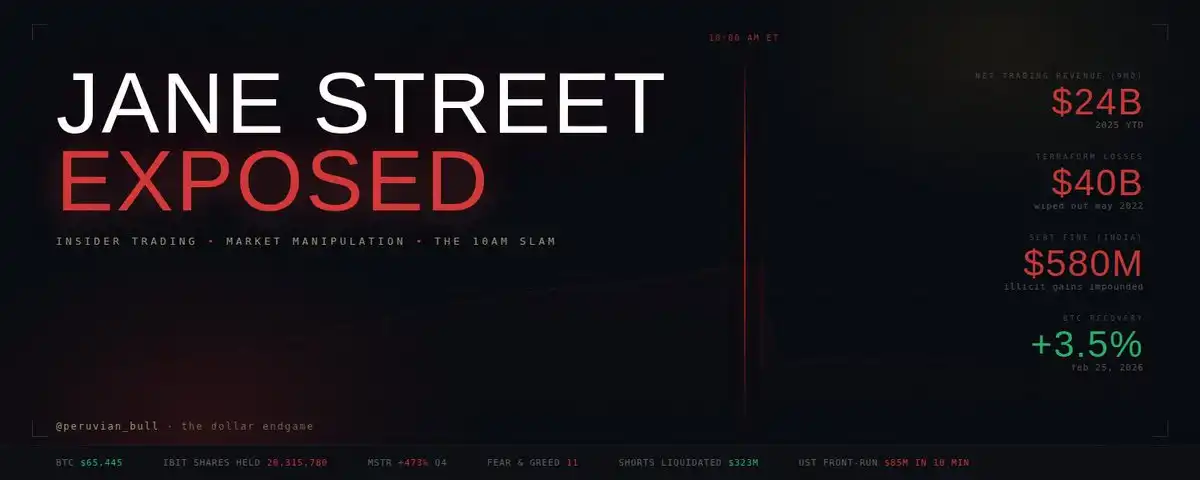
Jane Street's Three Sins: Insider Trading, Index Manipulation, and the Bitcoin 'Morning Massacre'

Jane Street, a highly profitable quantitative trading firm, faces serious allegations across multiple continents. In the U.S., Terraform Labs’ bankruptcy trustee has sued Jane Street, accusing it of insider trading related to the May 2022 collapse of Terra Luna. The suit claims Jane Street withdrew $85 million from a liquidity pool just minutes after Terraform secretly removed $150 million, allegedly using non-public information from a former intern. The action allegedly helped trigger a $40 billion crash. Simultaneously, in India, the Securities and Exchange Board (SEBI) has accused Jane Street of manipulating the Bank Nifty index through a “pump-and-dump” scheme over 18 expiration dates, resulting in alleged illegal profits of ~$580 million. Jane Street has been barred from Indian markets and is appealing. Additionally, Bitcoin traders had observed a pattern of sharp sell-offs at 10 AM ET—dubbed the "10 AM Crashes"—coinciding with U.S. market open, which many attributed to Jane Street’s trading activity. Notably, Jane Street is an authorized participant of BlackRock’s IBIT Bitcoin ETF, holding significant shares. After the Terra lawsuit was filed, the predictable sell-offs stopped, and Bitcoin saw a notable price rebound. The broader implication is the risk of market manipulation by privileged intermediaries within ETF structures—a problem Bitcoin was designed to overcome. If Jane Street halts its alleged manipulative strategies due to legal pressure, a major selling pressure on Bitcoin may be removed.

marsbit52 dk önce

Jane Street's Three Sins: Insider Trading, Index Manipulation, and the Bitcoin 'Morning Massacre'

marsbit52 dk önce

Stock Price Surges Over 35%! Circle's Earnings Report Exceeds Expectations: USDC Circulation Soars 72%

Circle (CRCL) reported strong Q4 and full-year 2025 financial results, with total revenue and reserve income reaching $770 million in Q4, up 77% year-over-year, exceeding expectations. This drove a 35% surge in its stock price. Key highlights include a 72% YoY increase in USDC circulation to $75.3 billion and a 247% rise in on-chain transaction volume to $11.9 trillion in Q4. Reserve income remained the core revenue driver at $733 million, while non-interest income reached $37 million. For the full year, total revenue grew 64% to $2.7 billion. Although the company reported a net loss of $70 million due to a one-time $424 million stock-based compensation expense from its IPO, adjusted EBITDA doubled to $582 million, indicating profitable core operations. Strategic developments include the stable testnet performance of its Arc blockchain, expansion of the Circle Payments Network with 55 financial institutions onboarded, and a key partnership with Polymarket to use native USDC. Regulatory progress includes conditional approval for a national trust bank. Looking ahead, Circle targets a 40% compound annual growth rate for USDC circulation. CEO Jeremy Allaire emphasized AI-driven payment demand, with 99% of agent-based payments currently using USDC. Despite challenges like declining yields and new competitors like USAT, Circle continues to execute its strategy as a growing internet financial infrastructure provider.

marsbit1 saat önce

Stock Price Surges Over 35%! Circle's Earnings Report Exceeds Expectations: USDC Circulation Soars 72%

marsbit1 saat önce

İşlemler

Spot
Futures
活动图片