Bitcoin ETFs Reduce Outflows Amid 7-Day Inflow Streak in 2026

cryptonews.ru2026-08-26 tarihinde yayınlandı2026-08-26 tarihinde güncellendi

Özet

American spot Bitcoin ETFs have extended their streak of net inflows to seven consecutive trading days, attracting $314.37 million on Tuesday. This seven-day series has pushed August's total inflows to $3.03 billion, putting the funds just $390 million short of October 2025's record with four trading sessions remaining. August is likely to become their strongest month of the period. This recovery has more than halved the year-to-date net outflow, reducing it to $2.26 billion. Total net assets have reached $99.05 billion, with cumulative net inflows at $54.36 billion. Meanwhile, Bitcoin traded around $78,880, down 2% in 24 hours after briefly surpassing $80,000 on Tuesday. The Crypto Fear & Greed Index fell from 74 to 65 but remains in the "Greed" zone. Additionally, U.S. spot Ethereum ETFs also extended their inflow streak to seven days, adding $179.8 million on Tuesday for a period total of approximately $1 billion.

U.S. spot Bitcoin ETFs extended their inflow streak to seven consecutive trading days, receiving $314.37 million on Tuesday.

Thanks to this streak, August inflows have reached $3.03 billion. With four trading sessions remaining, the funds are $390 million short of October 2025's figures, according to SoSoValue.

August is likely to become their strongest month for this period. The recovery has more than halved the year-to-date net outflow, reducing it to $2.26 billion.

Total net assets reached $99.05 billion, with cumulative net inflows at $54.36 billion.
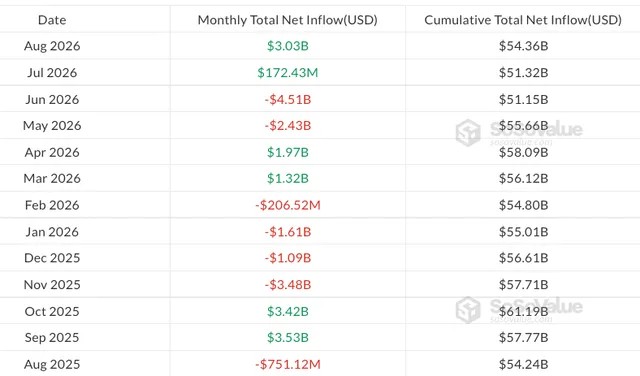
Monthly flows for U.S. spot Bitcoin ETFs since August 2025. Source: SoSoValue

At the time of publication, Bitcoin was trading at $78,880, down 2% over the past 24 hours, according to CoinGecko. On Tuesday, Bitcoin briefly surpassed the $80,000 mark.

Market sentiment deteriorated: the Crypto Fear & Greed Index dropped from 74 the previous day to 65, but remained in the "Greed" zone, according to Alternative.me.

U.S. spot Ethereum ETFs also extended their inflow streak to seven consecutive trading days, receiving $179.8 million on Tuesday. Inflows for this period reached approximately $1 billion, according to SoSoValue.

Related: Bitcoin Retreats from $80,000 Amid Cheaper Gold and Lower U.S. Bond Yields

end-content

İlgili Sorular

QWhat is the current streak of consecutive trading days with inflows for US spot Bitcoin ETFs mentioned in the article?

AUS spot Bitcoin ETFs have extended their inflow streak to seven consecutive trading days.

QAccording to the article, how much did the total net assets of these ETFs reach?

AThe total net assets of the US spot Bitcoin ETFs reached $99.05 billion.

QWhat was Bitcoin's price at the time of publication, and how did it change in the last 24 hours?

AAt the time of publication, Bitcoin was trading at $78,880, having decreased by 2% in the last 24 hours.

QWhat zone does the Crypto Fear & Greed Index remain in, despite a decrease from the previous day?

ADespite a decrease, the Crypto Fear & Greed Index remains in the 'Greed' zone.

QHow did US spot Ethereum ETFs perform in terms of inflows according to the data reported?

AUS spot Ethereum ETFs also extended their inflow streak to seven consecutive trading days, receiving $179.8 million on the reported Tuesday, with inflows for the period reaching approximately $1 billion.

İlgili Okumalar

Japanese Interest Rates Return to 1996 Levels: Can Bitcoin's 'Decoupling Narrative' Withstand the September Rate Hike?

Japan's borrowing costs have hit their highest level since 1996, with 30-year and 10-year government bond yields rising significantly. This marks a major shift for a country long reliant on negative rates. Meanwhile, Bitcoin surged 22% in a week, topping $80,000. The core question is whether crypto's apparent decoupling from traditional market turbulence can withstand potential interest rate hikes by the Bank of Japan (BOJ) in September. For years, the yen carry trade—borrowing cheap yen to invest in higher-yielding assets—has fueled global risk assets. This leverage, estimated at up to $500 billion, relies on near-zero Japanese rates. The BOJ raised its policy rate to 1.0% in June, a 31-year high, with a further hike expected in September. A rapid yen appreciation could quickly wipe out carry trade profits and trigger deleveraging, as seen in August 2024 when Bitcoin and Japanese stocks fell sharply. Currently, however, the yen is weakening, which could temporarily support the carry trade and risk assets. Japan faces a debt dilemma. Its national debt has soared to a record ¥1,346 trillion. Raising rates could stabilize the yen but drastically increase debt servicing costs. The BOJ has signaled a slower pace of policy normalization to ensure market stability. Japan's large-scale selling of US Treasuries to fund currency intervention has also contributed to rising global yields. Bitcoin's recent resilience challenges traditional risk-asset logic. A pessimistic view holds that significant BOJ tightening and a stronger yen would force global deleveraging, pulling Bitcoin down. Higher yields also make interest-bearing assets relatively more attractive than Bitcoin. An optimistic scenario suggests that continued yen weakness could make Bitcoin an appealing hedge for Japanese investors. Japanese institutional interest is growing, with regulatory progress potentially paving the way for spot crypto ETFs by 2027. The key event is the BOJ's September 17-18 meeting. Market focus will be less on the expected rate hike to 1.25% and more on the future policy guidance. A hawkish signal aiming for higher rates could strengthen the yen and unwind carry trades. A dovish stance, constrained by debt concerns, could further weaken the yen, potentially benefiting Bitcoin via a weaker dollar and local demand. The current market prices in a slow evolution of Japan's debt issues. While Bitcoin may be trading on yen weakness and institutional adoption, the 30-year yield near 4% is a significant risk signal. The correlation between the yen's direction and Bitcoin remains crucial and could reverse swiftly if the BOJ alters market expectations in September.

marsbit1 dk önce

Japanese Interest Rates Return to 1996 Levels: Can Bitcoin's 'Decoupling Narrative' Withstand the September Rate Hike?

marsbit1 dk önce

İşlemler

Spot
活动图片