Cardano Brings Pyth Oracles On-Chain In First Pentad Integration

bitcoinist2025-12-12 tarihinde yayınlandı2025-12-12 tarihinde güncellendi

Özet

Cardano has announced its first major integration under the new "Pentad" governance structure, bringing Pyth's Lazer oracle to the blockchain by early 2026. This marks a strategic shift from building in-house oracle solutions to adopting established external infrastructure. Pyth provides ultra-low latency, institutional-grade market data across thousands of price feeds, which is used by hundreds of DeFi applications globally. Charles Hoskinson emphasized that this integration connects Cardano to broader cryptocurrency information networks and is just the first of many planned critical integrations—including bridges, stablecoins, and analytics—aimed at making Cardano a more viable DeFi platform. The move signals a focus on execution and infrastructure readiness as Cardano positions itself for growth in 2026.

Cardano is finally doing the unsexy but absolutely necessary plumbing work: getting serious, external oracle infrastructure wired in, with a governance wrapper that looks a lot more like “adult supervision” than the old ad-hoc ecosystem scramble.

On a Dec. 11 livestream, Charles Hoskinson said the ecosystem’s new “Pentad” structure — the coordination bloc spanning Input Output, the Cardano Foundation, EMURGO, the Midnight Foundation, and Intersect — has approved its first major integration under the “critical integrations” framework: bringing Pyth’s Lazer oracle to Cardano, with deployment targeted for early 2026.

Pyth Deal Kicks Off Cardano’s Critical Integrations Push

“This is the appetizer announcement,” Hoskinson said, framing Pyth as the first of what he expects to be a broader menu: bridges, stablecoins, analytics, custodians — the stuff that turns a chain into a DeFi venue people actually build on, not just a community that argues about roadmaps.

Hoskinson didn’t really sugarcoat why this matters. “Oracles are really the first part of major integrations,” he said, because you need reliable data coming in and you need credible pathways to the rest of the industry. He also admitted the in-house approach hasn’t landed the way it should’ve: Cardano “tried to build an indigenous oracle solution and it hasn’t worked out as well as it should.” So [...] Pyth. That’s the pivot.

Pyth, in its own marketing, has been pushing Lazer as an ultra-low latency product designed for speed-sensitive trading use cases — basically, price updates fast enough that perps and other twitchy DeFi apps don’t feel like they’re operating on last cycle’s data. Hoskinson called Pyth “one of the most advanced Oracle solutions on market,” and emphasized the practical angle: lots of feeds, lots of publishers, and broad distribution across chains.

Intersect’s announcement (the one Hoskinson pulled up mid-stream) from X states: “One of the first concrete outcomes of the Critical Cardano Integrations workstream is now in place! The Steering Committee [...] has approved the first major integration under this framework: bringing Pyth Lazer oracle to Cardano. Pyth provides low-latency, institutional-grade market data across thousands of price feeds spanning crypto, equities, FX, commodities and ETFs, already used by hundreds of DeFi applications across 100+ blockchains to power trading, lending and risk management.”

Hoskinson argued, “[Pyth] effectively attaches Cardano now to the information networks of the entire cryptocurrency space.” He said the team is already exploring whether it can switch parts of the ecosystem — including Djed — over to Pyth, and he wants Cardano dapp teams to seriously evaluate the integration once it’s available.

“Pyth is just the appetizer in the Cardano critical integrations,” he said. “There are many more things to come.”

The broader context is that Cardano’s new “Pentad” has been positioning “critical integrations” as a coordinated, treasury-backed effort to “prime Cardano for 2026,” including a budget proposal tied to ecosystem-wide enablers. If Pyth is the first concrete output, it’s also a signal the Pentad model is going to be judged on execution, not vibes.

Hoskinson, closing out, put it in his usual rally language: “Cardano is not an island anymore [...] the cavalry has come.” The market can do what it wants in the short term. But getting credible oracle rails in place is the kind of boring upgrade that tends to matter later — when teams are deciding where to deploy, and where liquidity is willing to live.

At press time, ADA traded at $0.4253.
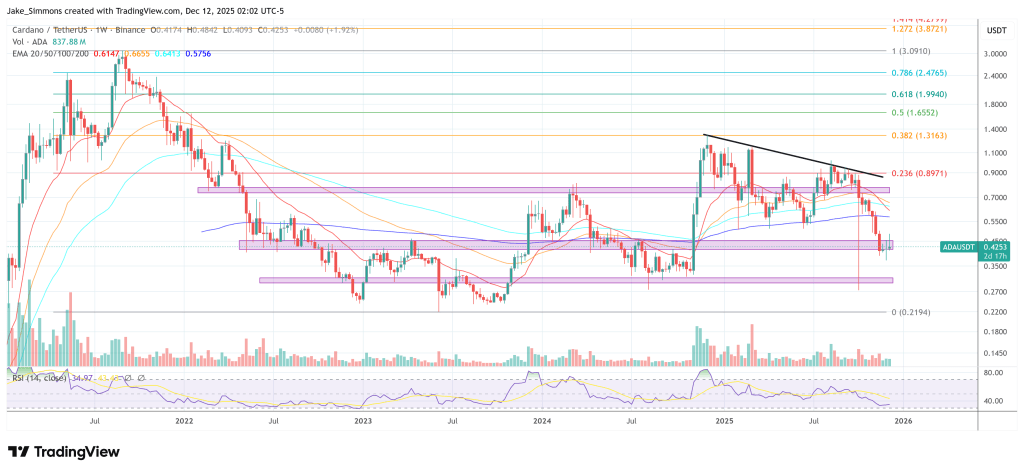
ADA bounces from key support, 1-week chart | Source: ADAUSDT on TradingView.com

İlgili Okumalar

Some Issues Are Better Discussed in Person: Summer of Ethereum 2026 Is Here!

Summer of Ethereum 2026 is returning, focused on bringing crucial discussions about Ethereum's long-term development to in-person meetups across multiple cities. Organized by LXDAO and ETHPanda, the initiative aims to move beyond online discourse and event scheduling by addressing Ethereum's systemic challenges through real-world connections. The core question this year is the value of offline gatherings for the Ethereum community. While online discussions on topics like the roadmap, L2, account abstraction, and governance are abundant, they often lack depth and alignment. The goal is to bring these fragmented, complex issues—such as UX, developer tools, public goods, and local community building—into shared physical spaces to foster deeper understanding, trust, and actionable collaboration. The program will not follow a rigid format but will adapt to each city's context, potentially including talks, panels, workshops, and community gatherings. Key discussion areas include protocol evolution, Ethereum UX/account abstraction, real-world applications, developer tools, and sustainable community governance. The aim is for each event to leave behind clearer problems, stronger personal connections, and tangible follow-up actions. The call is open to developers, researchers, students, community members, local organizers, projects, and media partners. Participation is encouraged whether one brings deep expertise or just genuine curiosity. For Ethereum's ecosystem—built on principles of open networks and long-term collaboration—this "non-negotiable" effort seeks to translate belief into concrete, local cooperation. The ultimate hope is that these meetings will seed lasting partnerships and turn abstract challenges into progress, one city at a time. All event details and schedules will be updated on the Luma Calendar.

marsbit22 dk önce

Some Issues Are Better Discussed in Person: Summer of Ethereum 2026 Is Here!

marsbit22 dk önce

Surging 108% on Debut! The Biggest AI Dark Horse of 2026 is Born, Altman Profits 'Passively' Again

Cerebras, an AI chip company known for its wafer-scale "dinner plate-sized" WSE-3 processor, completed a landmark IPO on the NASDAQ in 2026. Its shares surged 108% on the first day of trading, with the valuation reaching approximately $100 billion at its peak. The offering raised $5.55 billion, marking one of the largest U.S. tech IPOs since Uber in 2019. The company's dramatic turnaround was a key driver, moving from a $482 million loss to a $238 million profit in 2025, with revenue growing 76% to $510 million. Major new contracts, including a multi-year deal with OpenAI potentially worth over $20 billion and a deployment agreement with AWS, boosted investor confidence. Founder Andrew Feldman emphasized to investors the coming explosion in AI inference demand, the viability of non-GPU compute, and the perceived overestimation of NVIDIA's CUDA ecosystem moat. The IPO created substantial returns for early investors like Foundation Capital (76x return) and Benchmark (12x return). OpenAI, through a strategic agreement linked to future compute purchases, secured an estimated $1.8 billion in paper gains, while Sam Altman's personal 2017 investment grew roughly tenfold to around $30 million. Cerebras' success is positioned as the opening act for a wave of massive AI-focused IPOs expected in 2026, including potential listings from SpaceX (targeting a $1.75 trillion valuation), OpenAI ($1 trillion), and Anthropic ($900 billion), collectively representing over $3 trillion in potential market value. The article concludes that these moves signal capital is placing foundational bets on the immense compute infrastructure required for the future development of Artificial Superintelligence (ASI).

marsbit24 dk önce

Surging 108% on Debut! The Biggest AI Dark Horse of 2026 is Born, Altman Profits 'Passively' Again

marsbit24 dk önce

Wall Street Institutional Holdings Exposed: Jane Street Bitcoin ETF Positions Slashed by 71%, JPMorgan Chase Increases Holdings by 174%

Q1 2026 US institutional 13F filings reveal diverse crypto strategies amid a bearish market. Bitcoin fell ~23.8% for the quarter, with spot ETFs seeing net outflows. Key highlights: Jane Street slashed its iShares Bitcoin Trust (IBIT) holdings by 71%, shifting focus to Ethereum ETFs (e.g., doubling iShares Ethereum Trust holdings) and adding stocks like Galaxy Digital and Riot Platforms. Conversely, JPMorgan aggressively increased Bitcoin ETF exposure, boosting IBIT by 174% and other Bitcoin funds by up to 3000%, while initiating a position in a Solana ETF and clearing its XRP ETF. Wells Fargo built Ethereum ETF positions despite sector outflows. BlackRock increased holdings in crypto-correlated stocks like MicroStrategy (MSTR) and Bitmine (BMNR). Its on-chain Bitcoin holdings grew, though its total crypto portfolio value shrank due to price declines. ARK Invest notably increased its stake in Circle (CRCL), emphasizing the stablecoin infrastructure narrative. Institutions displayed three key trends: 1) Growing interest in Ethereum as infrastructure. 2) Divergent Bitcoin strategies (long-term allocation vs. tactical trading). 3) Broader adoption of crypto-related equities. Market sentiment improved in April, with Bitcoin ETF inflows hitting a six-month high as Bitcoin recovered above $80,000. More major institutional filings are pending.

链捕手37 dk önce

Wall Street Institutional Holdings Exposed: Jane Street Bitcoin ETF Positions Slashed by 71%, JPMorgan Chase Increases Holdings by 174%

链捕手37 dk önce

Q1 Wall Street Institutional Holdings Revealed: Jane Street Slashes Bitcoin ETF Position by 71%, JPMorgan Increases Holdings by 174%

Wall Street's Q1 13F filings reveal divergent strategies among major institutions regarding crypto exposure amid a broad market downturn. Bitcoin fell nearly 24% in Q1, with total crypto market cap down 20.4%. Key moves include Jane Street sharply reducing its Bitcoin ETF holdings (cutting IBIT by 71%) while significantly increasing its Ethereum ETF positions and building a new stake in Galaxy Digital. In contrast, JPMorgan Chase aggressively bought the dip, increasing its IBIT holding by 174% and boosting stakes in other Bitcoin ETFs, while initiating a position in a Solana ETF and clearing its XRP ETF. Wells Fargo increased its Ethereum ETF exposure by over 60% despite outflows from the asset class, while nearly exiting its Galaxy Digital position. BlackRock continued buying Bitcoin on-chain (adding ~15,000 BTC) and increased its holdings of crypto-correlated stocks like MicroStrategy and Bitmine, though its overall crypto portfolio value shrank due to price declines. ARK Invest notably increased its bet on Circle, highlighting institutional interest in the stablecoin infrastructure narrative. The filings signal three trends: growing institutional interest in Ethereum for long-term infrastructure plays, strategic differences (not bearishness) driving Bitcoin positioning, and crypto-equities becoming a core, though contested, allocation (e.g., mixed views on Galaxy Digital). The Q1 accumulation by some institutions appears validated in Q2, with Bitcoin rebounding above $80,000 and spot Bitcoin ETFs seeing renewed net inflows.

marsbit38 dk önce

Q1 Wall Street Institutional Holdings Revealed: Jane Street Slashes Bitcoin ETF Position by 71%, JPMorgan Increases Holdings by 174%

marsbit38 dk önce

İşlemler

Spot
Futures

Popüler Makaleler

PYTH Nasıl Satın Alınır

HTX.com’a hoş geldiniz! PYTH (Pyth) (PYTH) satın alma işlemlerini basit ve kullanışlı bir hâle getirdik. Adım adım açıkladığımız rehberimizi takip ederek kripto yolculuğunuza başlayın. 1. Adım: HTX Hesabınızı OluşturunHTX'te ücretsiz bir hesap açmak için e-posta adresinizi veya telefon numaranızı kullanın. Sorunsuzca kaydolun ve tüm özelliklerin kilidini açın. Hesabımı Aç2. Adım: Kripto Satın Al Bölümüne Gidin ve Ödeme Yönteminizi SeçinKredi/Banka Kartı: Visa veya Mastercard'ınızı kullanarak anında PYTH (Pyth) (PYTH) satın alın.Bakiye: Sorunsuz bir şekilde işlem yapmak için HTX hesap bakiyenizdeki fonları kullanın.Üçüncü Taraflar: Kullanımı kolaylaştırmak için Google Pay ve Apple Pay gibi popüler ödeme yöntemlerini ekledik.P2P: HTX'teki diğer kullanıcılarla doğrudan işlem yapın.Borsa Dışı (OTC): Yatırımcılar için kişiye özel hizmetler ve rekabetçi döviz kurları sunuyoruz.3. Adım: PYTH (Pyth) (PYTH) Varlıklarınızı SaklayınPYTH (Pyth) (PYTH) satın aldıktan sonra HTX hesabınızda saklayın. Alternatif olarak, blok zinciri transferi yoluyla başka bir yere gönderebilir veya diğer kripto para birimlerini takas etmek için kullanabilirsiniz.4. Adım: PYTH (Pyth) (PYTH) Varlıklarınızla İşlem YapınHTX'in spot piyasasında PYTH (Pyth) (PYTH) ile kolayca işlemler yapın.Hesabınıza erişin, işlem çiftinizi seçin, işlemlerinizi gerçekleştirin ve gerçek zamanlı olarak izleyin. Hem yeni başlayanlar hem de deneyimli yatırımcılar için kullanıcı dostu bir deneyim sunuyoruz.

167 Toplam GörüntülenmeYayınlanma 2024.12.12Güncellenme 2025.03.21

PYTH Nasıl Satın Alınır

Tartışmalar

HTX Topluluğuna hoş geldiniz. Burada, en son platform gelişmeleri hakkında bilgi sahibi olabilir ve profesyonel piyasa görüşlerine erişebilirsiniz. Kullanıcıların PYTH (PYTH) fiyatı hakkındaki görüşleri aşağıda sunulmaktadır.

活动图片